Chem 2 Exam 2
 Call Kai
 Learn
Learn Practice Test
 Spaced Repetition
 Match
Match Flashcards
 Knowt Play
1/25

There's no tags or description
Looks like no tags are added yet.
Name | Mastery | Learn | Test | Matching | Spaced | Call with Kai | Chat |
|---|
No analytics yet
Send a link to your students to track their progress
26 Terms
Factors that effect reaction rates
T↑, R↑
Catalyst
Collision ↑ (and orientation)
s«l«g
What does a catalyst do? how?
lowers/decrease activation energy
breaks down reaction into steps
Reaction mechanisms: Intermediate
appears first as a product
then as a reactant
not apart of final
Reaction mechanisms: catalyst
first appears as a reactant
then later as a product
Reaction mechanisms: which step = rate law overall?
the slower step
Equilibrium condition
concentration = constant
rate law: rate (forward)= rate (reverse)
equilibrium constant expression
kc = [products]cc / [reactants]cc
kp expression
kp=kc(RT)Δn
Δn = (product cc)-(reactant cc)
T must be in K
Kelvin to Celsius conversion
K=oC+273.15
Find Kc from steps
Koverall =K1K2
which side of reaction will be favored based on Kc
Kc » 1 → favor products
Kc « 1 → favor reactants
Kc = 1 → [P] = [R]
Le Chatelier's Principle: Temperature
Endo- T↑(favor products) T↓(favor reactants)
Exo- T↑(favor reactants) T↓ (favor products)
Le Chatelier's Principle: Pressure
P↑ V↓ → favor side w/ less gas
P↓ V↑ → favor side w/ more gas
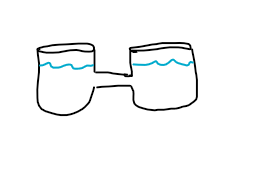
Le Chatelier's Principle: Concentration
Bronsted Lowry acid/base
BL acid - donates H+
BL base - accepts H+
conjugate acid/base pairs
s acid → w. c. base
s base → w. c. acid
w acid → s c. base
w base → s c. acid
amphiprotic or amphoteric species
can act as acid or base (ex: H2O)
Strong acids
HCl
HBr
HI
H2SO4
HNO3
HClO4
HClO3
Decide favored side of reaction (relative strength table)
Strong → weak
Kw constant
Kw = 1.0×10⁻⁷
Calc pH
pH=-log[H3O+] → [H3O+]=10-pH
pOH=-log[OH-] → [OH-]=10-pOH
pH+OH=14.00
[H3o+][OH-]=Kw
wca + wcb = ?
neutral
sca + wcb = ?
acidic
wca +scb = ?
basic
sca + scb = ?
ka > kb → acidic
ka < kb → basic
ka = kb → neutral
what is the quadratic formula?
x= -b =-(-b² -4ac) // 2a