Introduction to Pharmacodynamics and Pharmacokinetics for Pharmacotherapy
 Call Kai
 Learn
Learn Practice Test
 Spaced Repetition
 Match
Match Flashcards
 Knowt Play
1/170

There's no tags or description
Looks like no tags are added yet.
Name | Mastery | Learn | Test | Matching | Spaced | Call with Kai | Chat |
|---|
No analytics yet
Send a link to your students to track their progress
171 Terms
What is pharmacodynamics?
The study of the effects of medications on the human body, including the actions and effects of drugs in relation to their chemical structures.

What is pharmacokinetics?
The study of how drugs are absorbed, distributed, metabolized, and eliminated throughout the body.

What is the role of drug receptors?
They are portions of tissue or cells to which drugs can bind, initiating the chain of events leading to observed effects.
What is the difference between an agonist and an antagonist?
An agonist activates a receptor to produce a response, while an antagonist binds to a receptor but does not activate it, preventing or reversing the action of an agonist.

Define drug efficacy, affinity, and potency.
Efficacy refers to the maximum effect a drug can produce; affinity is the strength of the binding between a drug and its receptor; potency is the amount of drug needed to produce a given effect.
What is receptor-mediated drug activity?
It refers to the actions of drugs that occur through specific interactions with receptors.
What is second-messenger drug activity?
It involves the activation of intracellular signaling pathways that mediate the effects of drugs after they bind to receptors.

What are the ED50, LD50, TD50, and therapeutic index (TI)?
ED50 is the effective dose for 50% of the population; LD50 is the lethal dose for 50% of the population; TD50 is the toxic dose for 50% of the population; TI is the ratio of LD50 to ED50, indicating drug safety.
What is the significance of the blood-brain barrier?
It is a selective barrier that protects the brain from harmful substances while allowing necessary molecules to pass, influencing drug action in the central nervous system.
How do drug clearance, volume of distribution, and half-life relate to patient therapy?
These pharmacokinetic parameters help monitor and adjust drug dosing to ensure effective and safe therapy.
What is the chemical name of a drug?
A precise description of a drug's chemical structure.
What is a generic name of a drug?
The common name derived from the chemical name.
What is a trade/brand name of a drug?
The name used in marketing for a drug.
What does the equation 'Drug + Receptor = Response' signify?
It indicates that the binding of a drug to its receptor leads to a physiological response.

What is the pharmacologic effect of drug receptors?
The effect produced when drug receptors are activated.
What determines the relationship between the dose of a drug and its pharmacologic effect?
The characteristics of drug receptors and their interactions with the drug.
What is the role of structural proteins in drug receptors?
They are located on the cell surface or in the cytoplasm and are involved in mediating the pharmacologic effects of drugs.
What is the study of pharmacology?
The study of the interaction of biologically active substances within living systems.
What does the term 'pharmakos' refer to?
It refers to medicine or drug.
What does 'logos' mean in the context of pharmacology?
It means study.
What are the effects of drugs on the body?
They can lead to changes in physiological parameters such as blood pressure (BP), heart rate (HR), and international normalized ratio (INR).
What type of bonding is characterized as irreversible and uncommon?
Covalent bonding.
What is the primary electrostatic attractor in bonding?
Ionic bonding.
What type of bonding is considered a secondary attractor and is weaker and reversible?
Van der Waals bonding and hydrogen bonding.
What does affinity refer to in drug receptor responses?
The strength of the binding between a drug and its receptor.
What are the two levels of affinity a drug can have?
High affinity and low affinity.
What does quantity refer to in drug receptor responses?
The amount of receptors and drug that reaches the receptor(s).
What is efficacy in the context of drug action?
The ability of a drug to stimulate its receptor in a way that produces a pharmacological response.
How is potency defined in pharmacology?
A measure of the ability of a set dose of an agonist or antagonist to produce its maximum pharmacological effect.
What are agonists in drug receptor interactions?
Substances that activate cell receptors because they resemble naturally occurring hormones, transmitters, or enzymes.
What is a full agonist?
An agonist that acts with maximal effect.
What is a partial agonist?
An agonist that demonstrates a low degree of activation.
What is a pharmacologic antagonist?
A substance that binds without activating its receptor, preventing activation by an agonist.
What is a chemical antagonist?
A substance that counters the effects of another by binding the agonist drug, not the receptor.
What is a competitive antagonist?
An antagonist that competes with an agonist for binding to a receptor and can be overcome by increasing concentrations of the agonist.
What is an irreversible antagonist?
An antagonist that binds to a receptor and stays bound, unable to be displaced by increasing concentrations of agonists.
What are some questions regarding drug effects that arise from their action mechanisms?
1. Why do some drugs produce prolonged effects? 2. Why do responses to some drugs diminish with repeated administration? 3. How do cellular mechanisms amplify external signals? 4. Why do similar drugs show selectivity? 5. Can these mechanisms target new drug development?
What is the first known transmembrane signaling mechanism?
A lipid-soluble chemical signal crosses the plasma membrane and acts on an intracellular receptor.
What happens when a signal binds to the extracellular domain of a transmembrane protein?
It activates an enzymatic activity of its cytoplasmic domain.
What occurs when a signal binds to a transmembrane receptor linked to a protein tyrosine kinase?
The receptor is activated.
What is the role of a signal that binds to an ion channel?
It directly regulates the opening of the ion channel.
How does a signal linked to a G protein affect cell signaling?
It binds to a cell-surface receptor linked to an effector enzyme, activating the enzyme.
What is a second messenger system in drug action?
A signaling mechanism often activated by G-protein coupled receptors, where a signaling molecule activates a third molecule like adenylyl cyclase or guanylyl cyclase.
What are ligand-gated ion channels?
Ion channels that open when an agonist binds to them, allowing ions to flow across the membrane.
What activates voltage-gated ion channels?
An electrical impulse on the cell membrane.
What types of ions are commonly associated with ion channels?
Na+, K+, Ca++, Cl-.
What role do enzymes play in drug action?
They are transmembrane receptors with enzymatic cytosolic domains that typically add or remove phosphate groups from proteins.
What is the function of tyrosine kinase?
To add phosphate groups (PO4) to proteins.
What do antimetabolites do?
They inhibit the conversion of a metabolic pathway or prevent DNA synthesis and cellular division.
How do transporters affect drug action?
They aid or block the normal transport of ions across a cell.
What does selectivity in drug action refer to?
The preference of a drug for acting at certain receptor sites, resulting in fewer adverse effects.
What is the significance of dosage in drug administration?
It is important to prescribe the correct dose to minimize adverse effects and maximize efficacy.
What does a dose-response curve illustrate?
It quantifies a drug's response relative to the amount of drug given, showing the relationship between drug concentration and effect.
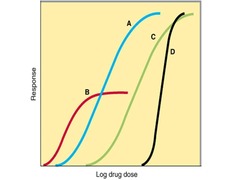
What is ED50?
The median effective dose at which 50% of test subjects respond with a predefined effect.
What is LD50?
The dose at which 50% of a population would die from taking a drug.
What does TD50 represent?
The dose that produces signs of toxicity in 50% of animals tested whose metabolism resembles that of humans.
What is the therapeutic index (TI)?
The ratio of LD50 to ED50, indicating the therapeutic window before toxic or lethal concentrations are achieved.
What is the first rule of drug behavior?
All of a given type of receptor are identical and equally accessible to drugs.
How is the intensity of drug response related to receptor occupancy?
The intensity of response is proportional to the number of receptors occupied.
What is stated in the third rule of drug behavior?
The amount of drug that combines with a receptor is negligible.
What does the fourth rule of drug behavior imply about drug effects?
A drug's intensity and duration of effect are reversible due to weak forces holding the drug to its receptor.
What does the fifth rule of drug behavior indicate about drug effects?
A drug can produce numerous effects if it can respond to more than one set of receptors.
Where can receptors exist according to the sixth rule of drug behavior?
Receptors may exist on the cell membrane or on any of the structures inside the cell.
What criteria must a generic drug meet to be considered a therapeutic equivalent by the FDA?
It must have the same active ingredients, dosage form, route of administration, identical strength and concentration, meet standards of strength, quality, purity, identity, demonstrate bioequivalence, and have similar safety and efficacy.
What are the five basic parameters of pharmacokinetics?
Absorption, Distribution, Metabolism, Excretion, and Half-life.
What is the bioavailability percentage of intravenous (IV) administration?
100% (by definition).
What is the bioavailability percentage range for intramuscular (IM) administration?
75 to ≤ 100%.
How does subcutaneous (SC) administration compare to intramuscular (IM) in terms of absorption?
SC has slower absorption than IM and allows for smaller volumes.
What is the primary characteristic of oral (PO) drug administration regarding bioavailability?
5 to < 100% with first-pass effect being important.
What factors affect drug absorption?
Blood flow, surface area available, solubility of the drug, drug and food interactions, and pH.
How does blood flow influence drug absorption?
Organs with high blood flow, like the small intestine, have greater absorption.
What is the effect of pH on drug absorption in the stomach and intestines?
The stomach (acidic environment) absorbs weak acids, while the intestines (alkaline environment) absorb weak bases.
What is bioavailability (F) in pharmacology?
It is defined as the proportion of a drug that enters the circulation when introduced into the body and is available for activity.
What are the characteristics of enteric-coated modified oral dosage forms?
They delay absorption but do not necessarily prolong action.
What is the purpose of sustained release (SR) dosage forms?
They provide an initial dose followed by a slower, constant release.
What is the difference between controlled dose (CD) and repeat action dosage forms?
CD provides prolonged action with slow continuous release, while repeat action releases an initial dose followed by a second dose later.
Why should oral ciprofloxacin not be taken at the same time as Maalox?
Maalox can interfere with the absorption of ciprofloxacin.
What is the typical oral dose of levothyroxine?
100 mcg QAM.
What is the significance of calcium citrate for patients on a PPI?
Calcium citrate is preferred because it is better absorbed in an acidic environment, which is reduced by PPIs.
What is the onset of action for fentanyl when administered intravenously?
Fentanyl has a rapid onset of action when given IV.
What is the bioavailability of rectal (PR) administration?
30 to < 100%.
What is the bioavailability of transdermal administration?
80 to ≤ 100%, usually with very slow absorption.
What is the bioavailability of inhalation administration?
5 to < 100%, often with very rapid onset.
What are the routes of administration that may have erratic absorption?
Intramuscular (IM) and subcutaneous (SC) routes.
What is the importance of drug and food interactions in drug absorption?
They can significantly affect the metabolism of drugs, leading to increased or decreased INR in the case of warfarin.
What is the process of drug distribution in the body after administration?
The drug is absorbed into the bloodstream, distributed by blood to organs, and carries out its effects.
What factors affect drug distribution?
1. Ability to permeate capillaries 2. Ability to bind to plasma proteins 3. Fat- or water-soluble characteristics 4. Drug dissolution 5. GI tract environment.
What does Volume of Distribution (Vd) measure?
It measures the apparent space in which a dose of drug would have been placed to obtain the measured plasma concentration.
What does a large Volume of Distribution (Vd) imply about drug solubility and duration of action?
It implies low drug plasma concentrations, high lipid solubility (low water solubility), and longer durations of action.
What does a small Volume of Distribution (Vd) imply about drug solubility and duration of action?
It implies high drug plasma concentrations, high water solubility (low lipid solubility), and shorter durations of action.
Why is Volume of Distribution (Vd) important in pharmacotherapy?
It is crucial for determining the loading dose needed to achieve a steady state concentration more quickly.
How does the Blood Brain Barrier affect drug distribution?
Non-ionized molecules not bound to plasma proteins can easily enter the brain if they are lipid soluble.
What happens to drug distribution during meningitis?
Inflammation disrupts the structural modifications of the Blood Brain Barrier, allowing for greater penetration of drugs.
What is drug clearance?
Clearance is the rate or efficiency of drug removal from plasma.
Which organ is principally responsible for drug elimination?
The liver is principally responsible for drug elimination.
What role do the kidneys play in drug elimination?
The kidneys are principally responsible for clearing drugs from the body, along with other organs like the intestines and lungs.
What factors determine drug clearance?
1. Amount of blood flowing to the organ that clears the drug 2. How well that organ is functioning.
What is biotransformation in the context of drug metabolism?
Biotransformation is the conversion of an administered drug into another substance, which can be active or inactive.
What is the First Pass Effect?
The First Pass Effect occurs when the portal blood delivers a drug to the liver, where it is biotransformed before reaching systemic circulation, potentially reducing bioavailability.
What types of reactions occur during Phase I of drug metabolism?
Phase I reactions include oxidation, hydrolysis, and reduction to make the drug more polar and hydrophilic.