Comprehensive Joints: Types, Movements, and Disorders in Human Anatomy
 Call Kai
 Learn
Learn Practice Test
 Spaced Repetition
 Match
Match Flashcards
 Knowt Play
1/114

There's no tags or description
Looks like no tags are added yet.
Name | Mastery | Learn | Test | Matching | Spaced | Call with Kai | Chat |
|---|
No analytics yet
Send a link to your students to track their progress
115 Terms
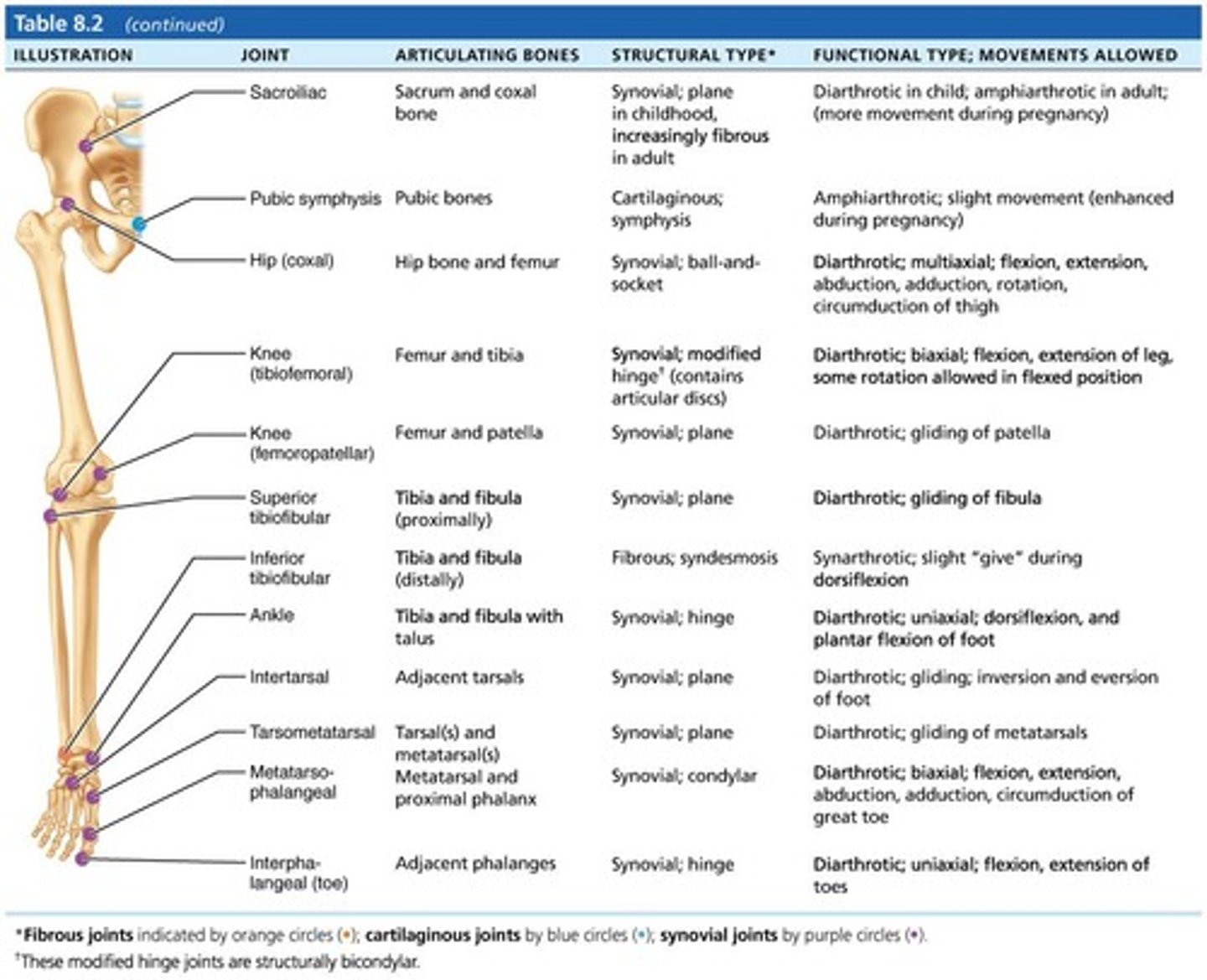
What are joints also known as?
Articulations
What is the primary function of joints?
To give skeleton mobility and hold skeleton together
What are the two main classifications of joints?
Structural and functional classifications
What are the three structural types of joints?
Fibrous, cartilaginous, and synovial
What are the three functional classifications of joints?
Synarthroses (immovable), amphiarthroses (slightly movable), diarthroses (freely movable)
What type of connective tissue joins fibrous joints?
Dense fibrous connective tissue
What are the three types of fibrous joints?
Sutures, syndesmoses, and gomphoses
What are sutures?
Rigid, interlocking joints of the skull that allow for growth during youth
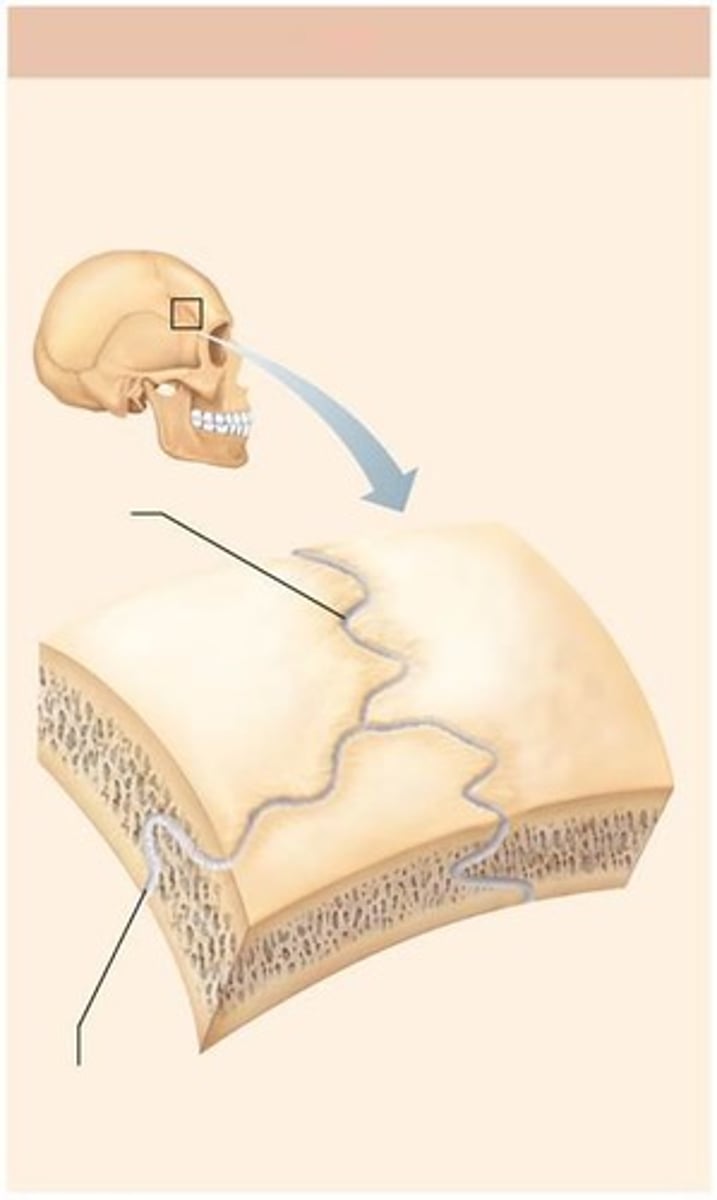
What happens to sutures in middle age?
They ossify and fuse, becoming immovable joints known as synostoses
What connects bones in syndesmoses?
Ligaments, which are bands of fibrous tissue
What is an example of a syndesmosis joint?
The inferior tibiofibular joint
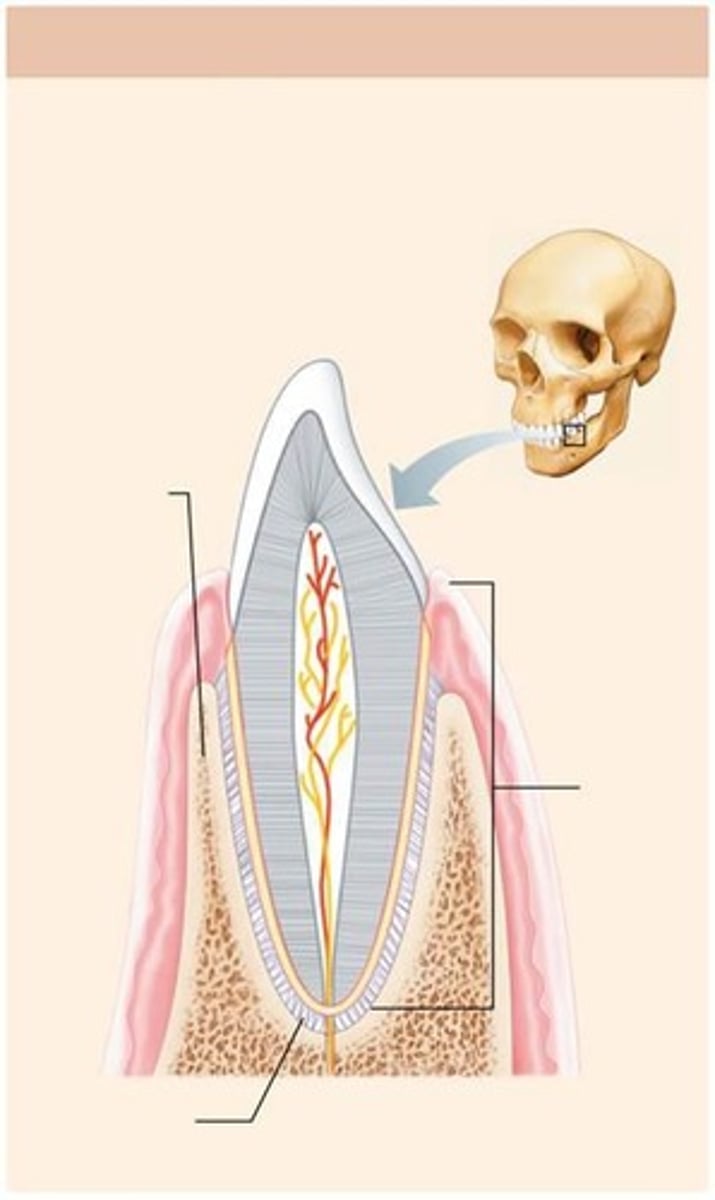
What is a gomphosis?
A peg-in-socket joint, such as the teeth in alveolar sockets
What unites bones in cartilaginous joints?
Cartilage
What are the two types of cartilaginous joints?
Synchondroses and symphyses
What characterizes synchondroses?
A bar or plate of hyaline cartilage unites bones, almost all are immovable
What is an example of a symphysis joint?
Intervertebral joints or the pubic symphysis
What distinguishes synovial joints from other types?
They have a fluid-filled joint cavity and are all freely movable (diarthrotic)
What are the six general features of synovial joints?
Articular cartilage, joint cavity, articular capsule, synovial fluid, reinforcing ligaments, nerves and blood vessels
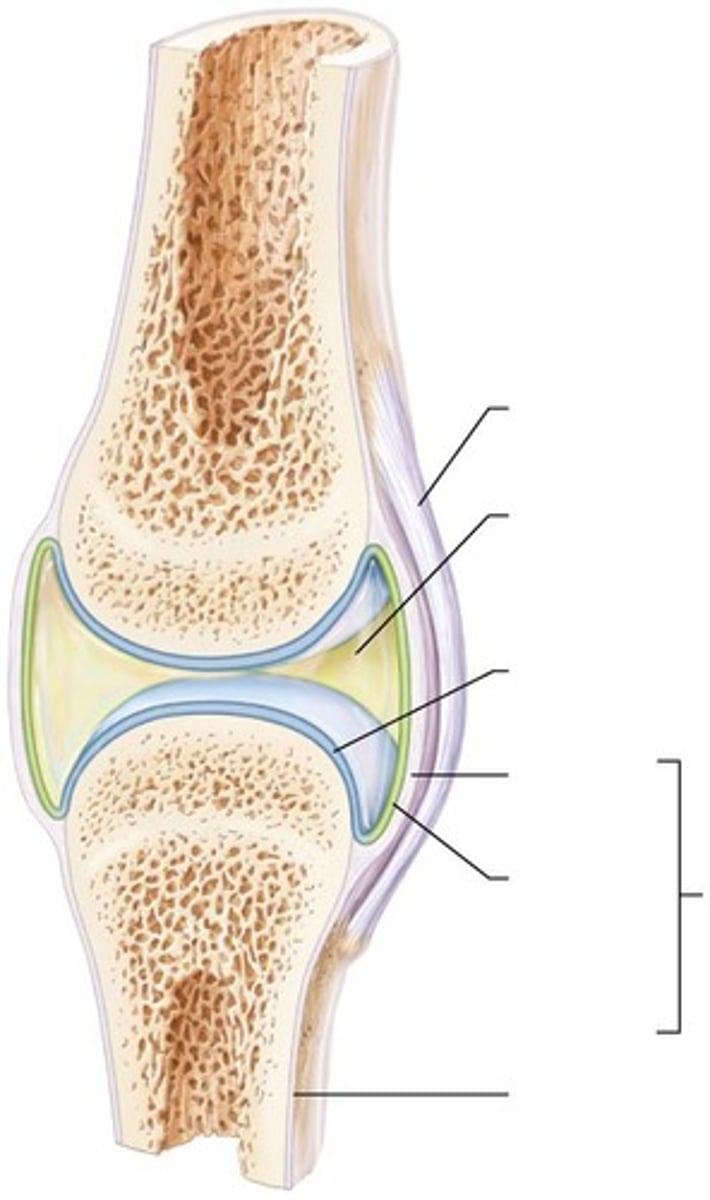
What is the role of synovial fluid?
To lubricate and nourish articular cartilage and remove microbes and debris
What are the three types of reinforcing ligaments in synovial joints?
Capsular, extracapsular, and intracapsular ligaments
What is the function of articular cartilage in synovial joints?
To cover the ends of bones and prevent crushing
What type of joint is characterized by slight movement?
Amphiarthroses
What is the primary characteristic of diarthroses?
They are freely movable joints
What are fatty pads in synovial joints?
Cushioning structures located between the fibrous layer of the capsule and the synovial membrane or bone.
What is the function of articular discs (menisci) in synovial joints?
They separate articular surfaces to improve the fit of bone ends, stabilize the joint, and reduce wear and tear.
What are the three factors that determine the stability of synovial joints?
Shape of articular surface, number and location of ligaments, and muscle tone.
Which factor is most important for reinforcing shoulder and knee joints?
Muscle tone keeps tendons taut as they cross joints.
What is the origin of a muscle?
The attachment point of a muscle to an immovable bone.
What is the insertion of a muscle?
The attachment point of a muscle to a movable bone.
What type of movement occurs in nonaxial synovial joints?
Slipping movements only.
What is an example of a uniaxial synovial joint?
Elbow joint.
What are the three general types of movements allowed by synovial joints?
Gliding, angular movements, and rotation.
What is flexion in terms of angular movements?
Decreases the angle of the joint.
What is extension in terms of angular movements?
Increases the angle of the joint.
What is hyperextension?
Movement beyond the anatomical position.
What is abduction?
Movement along the frontal plane away from the midline.
What is adduction?
Movement along the frontal plane toward the midline.
What is circumduction?
A circular movement involving flexion, abduction, extension, and adduction.
What is the difference between medial and lateral rotation?
Medial rotation turns a bone toward the midline, while lateral rotation turns it away from the midline.
What is supination?
Rotation of the radius and ulna where palms face anteriorly and the bones are parallel.
What is pronation?
Rotation of the radius and ulna where palms face posteriorly and the radius rotates over the ulna.
What is dorsiflexion?
Bending the foot toward the shin.
What is plantar flexion?
Pointing the toes.
What is inversion of the foot?
The sole of the foot faces medially.
What is eversion of the foot?
The sole of the foot faces laterally.
What is protraction?
Movement of the mandible that juts it out.
What is retraction?
Movement of the mandible that pulls it toward the neck.
What is elevation in terms of body movements?
Lifting a body part superiorly, such as shrugging shoulders.
What is depression in terms of body movements?
Lowering a body part, such as opening the jaw.
What is opposition in terms of thumb movement?
Movement of the thumb to touch the tips of other fingers.
What are the six types of synovial joints?
Plane, hinge, pivot, condylar, saddle, and ball-and-socket joints.
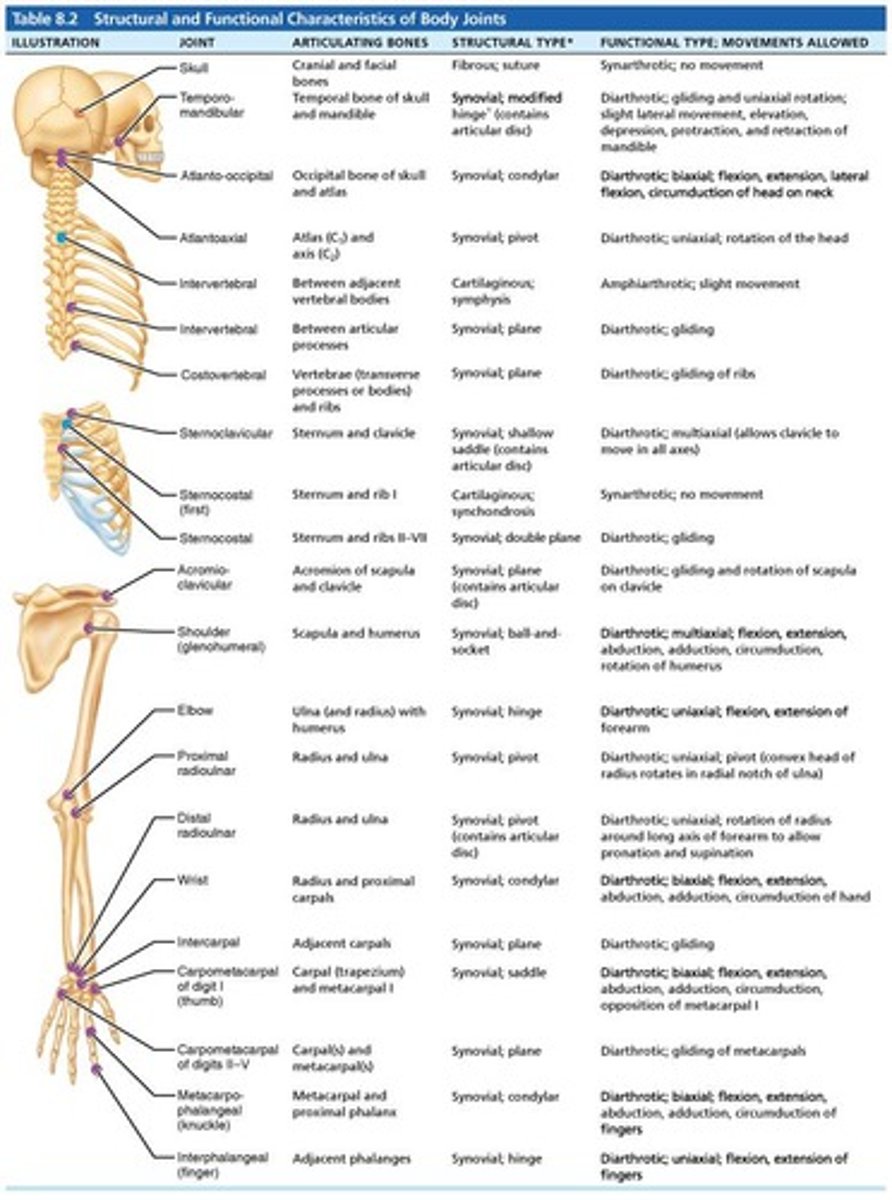
What type of movement is allowed by a plane joint?
Nonaxial movement, allowing gliding.
What type of movement occurs at a hinge joint?
Uniaxial movement, allowing flexion and extension.
What type of movement occurs at a pivot joint?
Uniaxial movement, allowing rotation.
What type of movement occurs at a condylar joint?
Biaxial movement, allowing flexion, extension, adduction, and abduction.
What type of movement occurs at a saddle joint?
Biaxial movement, allowing flexion, extension, adduction, and abduction.
What type of movement occurs at a ball-and-socket joint?
Multiaxial movement, allowing adduction, abduction, flexion, extension, and rotation.
What are synovial joints?
Joints that are diverse in structure and function, characterized by a synovial cavity.
Name the five main types of synovial joints.
Jaw (Temporomandibular Joint), Shoulder, Elbow, Hip, Knee.
What type of joint is the Temporomandibular Joint (TMJ)?
A modified hinge joint.
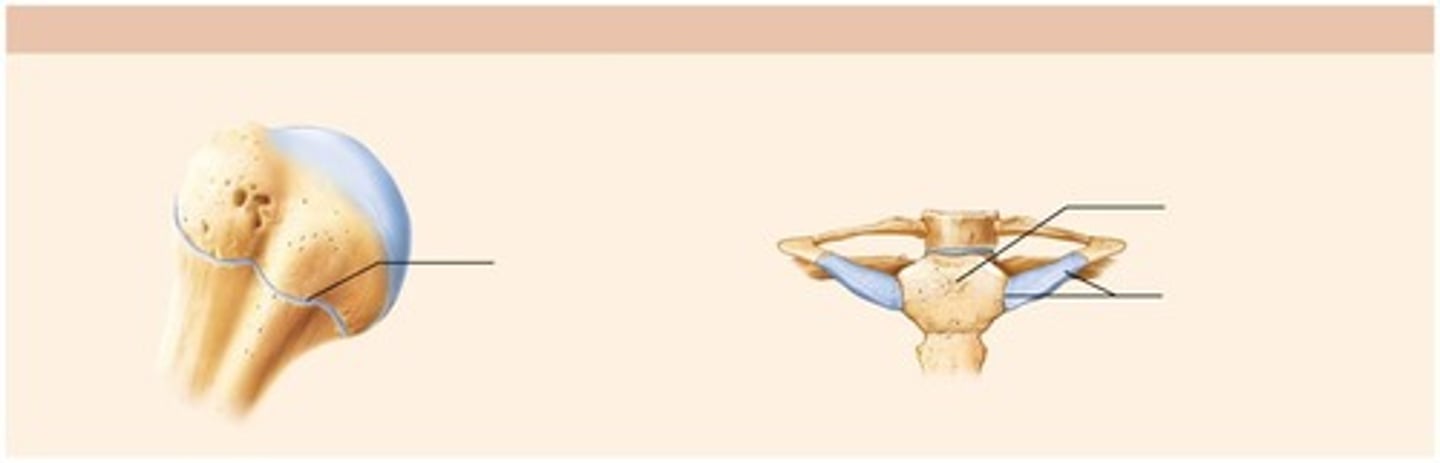
What bones articulate at the TMJ?
The mandibular condyle articulates with the temporal bone.
What are the two types of movement allowed by the TMJ?
Hinge (depression and elevation of the mandible) and gliding (side-to-side movement).
Why is the TMJ easily dislocated?
Due to its shallow socket.
What are common symptoms of TMJ dislocation?
Ear and face pain, tender muscles, popping sounds, and joint stiffness.
What is the primary function of the shoulder joint?
To provide a wide range of motion as the most freely moving joint in the body.
What type of joint is the shoulder joint?
A ball-and-socket joint.
What is the role of the glenoid labrum in the shoulder joint?
It adds depth to the shallow glenoid cavity.
What is the primary stabilizer of the shoulder joint?
The tendons of the rotator cuff muscles.
What is the main function of the elbow joint?
To allow for flexion and extension of the forearm.
What type of joint is the elbow joint?
A hinge joint.
What ligaments restrict side-to-side movement in the elbow joint?
Ulnar collateral ligament and radial collateral ligament.
What type of joint is the hip joint?
A ball-and-socket joint.
What is the function of the acetabular labrum in the hip joint?
To enhance the depth of the socket.
What ligaments reinforce the hip joint?
Iliofemoral ligament, pubofemoral ligament, ischiofemoral ligament, and ligament of head of femur.
What is the significance of the deep socket in the hip joint?
It provides greater stability compared to other joints.
What is a common cause of shoulder dislocations?
The mobility of the shoulder joint, particularly when the arm is rotated laterally and abducted.
What is the role of the articular capsule in synovial joints?
To enclose the joint cavity and provide stability.
What is the function of synovial fluid?
To lubricate the joint and reduce friction.
What is the primary movement allowed by the elbow joint?
Flexion and extension.
What is the anatomical significance of the mandibular fossa?
It is the depression in the temporal bone where the mandibular condyle articulates.
What happens during TMJ dislocation?
The mandible is pushed anteriorly, causing the mouth to remain open.
What is the role of the lateral ligament in the TMJ?
To provide additional support to the joint.
What is the primary structure that allows the shoulder joint to have a wide range of motion?
The shallow glenoid cavity and the loose articular capsule.
What is the role of the rotator cuff in shoulder stability?
To encircle and stabilize the shoulder joint.
What is a common treatment for TMJ disorders?
Using a bite plate and relaxing jaw muscles.
What is the largest and most complex joint in the body?
The knee joint
What three joints are included in the knee joint structure?
Femoropatellar joint, lateral joint, and medial joint
What type of joint is the femoropatellar joint?
A plane joint
What movements does the tibiofemoral joint allow?
Flexion, extension, and some rotation when the knee is partly flexed
What are the two main ligaments that stabilize the knee joint?
Anterior cruciate ligament (ACL) and posterior cruciate ligament (PCL)
What is the function of the anterior cruciate ligament (ACL)?
Prevents forward sliding of the tibia and stops hyperextension of the knee
What is the function of the posterior cruciate ligament (PCL)?
Prevents backward sliding of the tibia and forward sliding of the femur
What is the common name for the combination of injuries to the ACL, tibial collateral ligament, and meniscus?
The 'Unhappy Triad'
What are common knee injuries associated with lateral blows to an extended knee?
Tears in the tibial collateral ligament, medial meniscus, and anterior cruciate ligament
What is bursitis?
Inflammation of the bursa, usually caused by blow or friction
What is tendonitis?
Inflammation of tendon sheaths, typically caused by overuse
What is osteoarthritis?
The most common type of arthritis, characterized by irreversible degeneration of joint cartilage
What are the symptoms of rheumatoid arthritis (RA)?
Joint pain, swelling, anemia, osteoporosis, muscle weakness, and cardiovascular problems
What triggers the inflammation in rheumatoid arthritis?
The immune system attacking its own cells, leading to synovitis
What is gouty arthritis?
A condition caused by the deposition of uric acid crystals in joints, leading to inflammation