Section 2 - Quality Assurance and Quality Control
 Call Kai
 Learn
Learn Practice Test
 Spaced Repetition
 Match
Match Flashcards
 Knowt Play
1/175

There's no tags or description
Looks like no tags are added yet.
Name | Mastery | Learn | Test | Matching | Spaced | Call with Kai | Chat |
|---|
No analytics yet
Send a link to your students to track their progress
176 Terms
Preanalytical activities
refers to everything that affects a patient specimen before it is tested for the analyte
well-written procedures and polices
What can help minimize preanalytical errors?
examples of preanalytical activities
complete physical's order/requisition
patient identification
patient instructions or compliance
collection of specimen
labeling of specimen
processing of specimen
storage of specimen
transportation of specimen
avoid contamination
Analytical activities
refers to every step involved in the actual analysis of lab specimen
accuracy and precision
Using analytical methods with high degree of __________ and ________, as well as maintaining optimal operating conditions of instruments help to minimize analytical errorr
examples of analytical activities
specimen preparation
reagent preparation
instrument maintenance & calibration
quality control & proficiency testing
producing the lab report
Postanalytical activities
refers to those variables that affect patient results in the reporting stage
examples of postanalytical activities
positively identifying the test report with pt sample
reporting pt results in timely manner
using reporting format that can be understood/interpreted by health care providers (complete with reference ranges)
system for alerting health care providers with critically significant results
notifying health care providers when results arrive from outside reference labs
patient notification
proper disposal of lab specimen & other biohazardous lab supplies
disinfection/decontamination of work areas where testing takes place
Proficiency testing
external QC
measurement of unknown samples that are sent from an outside agency at set intervals, as a test of competency of the testing process
- analytical tesing
- 3x/yr w/ 5 challenges per analyte testing
80%
Labs must meet _____% of all PT challenges
**hint: 4/5 challenges passed
deemed status
The agency that provides samples for proficiency testing must have obtained _________ from the federal government (CLIA) in order to offer approved PT programs
CAP, AAB, AAFP, AABB
examples of agencies with deemed status
1st fail
PT Testing fail:
no formal report; repeat test 4 months later
2nd fail
PT Testing fail:
investigation -- written report
3rd fail
PT Testing fail:
investigation & probation
4th fail
PT Testing fail:
no longer allowed to run analyte test in lab
improvement of lab medicine
What is the goal of proficiency testing?
PT Report
a statistical report, which compares the testing lab with peer labs & is prepared by the PT agency
- report includes SDI and CV values
(lab result - peer mean) / peer SD
What is the equation to calculate SDI?
deterioration of accuracy
The PT Report
can be assessed by shifts and changes in the daily QC
caused by: calibration variances, method validation issues etc.
imprecision
The PT Report
demonstrated by an increase in the SD of QC results over time
caused by: differences in pipetting, noise in the electrical system, temp, or number of other factors
< 2
What is the acceptable SDI?
≥ 2
SDI score of _____ deserves some special concern, regardless what the test is
> 1
SDI score of _____ deserves some special attention because method shows a systematic difference from the group
in the future, this bias might lead to unacceptable results
SD x 100 / mean
What is the equation to calculate CV?
true
T or F:
The larger the concentration, the larger the standard deviation
10%
In general, a CV of _____% is acceptable
< 15%
For low level assays, what is an acceptable CV?
identifying sample errors
procedural factors (instrument, reagents, methods)
CV is useful to the lab in what ways? (2)
appropriate education for the task
training for the specific requirements of each test
experience in testing the specific test
What are the requirements for the competency evaluation of laboratory personnel? (3)
Standard Operating Procedure (SOP)
documentation of best practice and work instructions to use to perform a common lab task/test
Purpose: define requirements for each test
at hire
six months after hire
annually thereafter
Competency to perform tests must be demonstrated when? (3)
info included in SOP
specimen requirements
specimen handling & processing requirements
transportation & storage requirements
test methodology
linearity (reportable range info)
reference range info
dilution info
interference/limitations
Delta check
computerized check that is performed to detect changes form earlier individual patient test results
routinely checks patient results and falls when results are outside normal variation
may be reported in percent change/unit increments form the initial test results
misidentified specimens
Delta checks are particularly helpful in detecting:
ICD coding
diagnosis codes
set by WHO
CPT coding
codes assigned to every task and service a medical practitioner may provide to a patient including medical, surgical and diagnostic services
developed, maintained and copyrighted by the AMA & updated regularly
clerical error
What is one of the most common causes of error in lab testing?
diet
lab values are significantly affected by the ingestion of food
ex: glucose, insulin, lipid panels
basal state
the condition of the patient early in the morning
post-prandial state
condition of the patient after food
- usually duration is defined (2hrs, 4hrs, etc)
- not as common due to how hard it is to maintain consistency of meals
diurnal variations
blood constituents have normal fluctuations during a 24hr day
ex: increase of cortisol & testosterone in AM, decrease WBC & iron in AM
test affected by diurnal variation
iron
parathyroid hormone
prolactin
renin/aldosterone
TSH
ACTH
catecholamines
adrenal steroids
gastrin
growth hormone
glucose
exercise
increases many blood chemistries
ex: lactic acid, creatinine, protein, uric acid, CK, LDH
patient position
will cause plasma to tilter in the tissues
- causes a decrease in plasma volume and an increase in formed elements in blood
ambulatory vs sublime
ambulatory
pt is up and walking
sublime
pt is laying down
orthostatic proteinuria
decreased levels when sleeping
increased levels when up & moving
pregnancy
pt has their own established normal ranges
smoking
increases cortisol, WBC and hemoglobin
stress
high stress affects WBC counts, serum iron and increases adrenal hormone values
drugs
alters many physiological functions; numerous are toxic to the liver
can affect colorimetric assays and reagents binding reactions
ex: Diuretics, chemo, steroids
variations due to phlebotomy
prolonged tourniquet use
repeated fist clenching
out of order draw
hemolysis
lipemia/icterus
1 min
Tourniquets should only be left on for no longer than how long?
if left longer, hemoconcentration occurs due to fluid changes
below IV insertion
If you must draw from an arm involved in IV therapy, where do you draw?
fist clenching
should be avoided prior to collection
hemolyzes sample -- increases in lactate, phosphate, and potassium (due to spill out of RBCS)
decreases pH
blood culture, light blue, red/gold, green, purple, gray
What is the order of draw?
**hint: Be a Really Good Phlebotomist
use a discard tube before using light blue
When drawing with a butterfly tube, what should you do?
mild, moderate, gross
Hemolysis is graded based on the visible presence of hemoglobin; what are the levels?

gross hemolysis
Almost every test will be affected by what type of hemolysis?
due to interference with colorimetric testing, and release of intracellular constituents into the serum
true
T or F:
Grossly hemolyzed specimens should always be rejected
potassium
What test is the most affected by hemolysis?
**hint: 98% found intracellular & hemolysis releases it
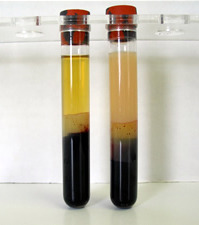
Lipemia
the increased presence of triglycerides in the serum
causes a milky apperance
Icterus
the increased presence of bilirubin in the serum
causes a dark yellow coloration
serum
liquid part of blood that contains NO clotting factors
clot was formed
plasma
liquid part of blood that does contain clotting factors
NO clot was formed
Blue
Green
Purple
tubes where plasma is collected
Red
Tiger Top
Gold
tubes where serum is collected
clot activator; separation gel
Red
Red/Gray SST
Gold
What are the 3 common tubes used for chemistry testing?
Red top
no additive
- glass - no clot activator
- plastic - clot activator
Red/Gray SST top
clot activator and gel serum separator
Gold Top
may or may not have clot activator
has gel serum separator
advantages of gel tubes
less manipulation of specimen
minimize hemolysis over time
less chemical interaction of blood to serum
enhanced recovery of serum
decreased staff time
lower frequency of error with testing
storage time
disadvantages of gel tubes
Tests affected include:
TDM
RBC Enzymes
Lead
Trace Metals
Hormones
Renin
Catecholamines
Serum Separator Tube
What does SST stand for?
Plasma Separation Tube
What does PST stand for?
clot activator & no anticoagulant
Red Top/Tiger Top SST/Gold SST
What is the additive?
blood is allowed to clot prior to centrifugation
Red Top/Tiger Top SST/Gold SST
What is the mode of action?
chemistry
Red Top/Tiger Top SST/Gold SST
What is this tube used for?
Sodium heparin, Lithium heparin, Ammonia heparin
Green Tube / PST
What is the additive?
thrombin and thromboplastin
Green Tube / PST
Mode of Action: What does the anticoagulant (heparin) inhibit?
chemistry
Green Tube / PST
What is this tube used for?
Sodium fluoride and potassium oxalate
Light Gray Tube
What is the additive?
antiglycolytic
Light Gray Tube
prevents RBCs from breaking down and utilizing glucose
Sodium fluoride
5 days
Light Gray Tube
Mode of Action: The antiglycolytic agent (Sodium fluoride) preserves glucose for how many days?
glucoses
Light Gray Tube
What is this tube used for?
requires full draw
Sodium EDTA
Dark Blue / Royal Blue Tube
What is the additive?
forms calcium salts
Dark Blue / Royal Blue Tube
What is the mode of action?
trace element testing and toxicology
Dark Blue / Royal Blue Tube
What is this tube used for?
- acid wash to remove any contaminants from environment
2 hours
amount of time where serum/plasma should be separated by centrifugation
10-15 min
amount of time serum should be left to sit prior to centrifugation
premature centrifugation will permit continued formation of fibrin (leads to clots)
specimen handling and storage
should be tested within 4 hours or stored, refrigerated or frozen
blood should not be exposed to air for extended periods of time
should be protected from light as needed
4 hours
amount of time where serum/plasma needs to be tested or stored
refrigiration
storage of serum/plasma
maintains stability in the plasma and serum specimen
4C
Ammonia, blood gas, fluids for pH, lactate & pyruvate specimens should be stored at what temperature?
bilirubin and liver assays
affected by UV light -- use a dark-colored tube to keep exposure to light minimal
first morning urine
most ideal because of concentrated amounts
also timed collection reduce error from diurnal variations
Formalin
Thymol
Toluene
Urine preservative that reduces bacterial growth
Boric acid
HCl
Urine preservative that maintains the pH of urine and prevent changes in the concentration of urinary analytes
quality control
monitors the analytical aspect of a method, verifying that results from a given method are precise and accurate