AP Biology Chapter 25
0.0(0)
Studied by 1 person Call Kai
 Learn
Learn Practice Test
 Spaced Repetition
 Match
Match Flashcards
 Knowt Play
Card Sorting
1/24

Last updated 9:59 PM on 10/26/22
Name | Mastery | Learn | Test | Matching | Spaced | Call with Kai | Chat |
|---|
No analytics yet
Send a link to your students to track their progress
25 Terms
1
New cards
protocells
droplets with membranes that maintained an internal chemistry different from that of their surroundings, nonliving structures that are believed to have evolved into prokaryotes
2
New cards
Oparin and Haldane
hypothesized early earth atmosphere composed of ammonia, hydrogen, hydrogen sulfide, carbon dioxide, nitrogen, water vapor, and methane; thought at high temperatures organic compounds could form -> when earth cooled compounds could be found in water + lightning/UV radiation -> chemical reaction -> proteins
3
New cards
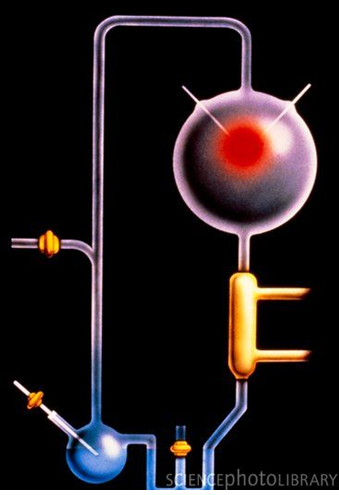
Miller and Urey
tested earlier scientist hypothesis in experiments that simulated conditions on early Earth in a closed system and produced a variety of amino acids.
4
New cards
self-replicating RNA
A current leading hypothesis about the first system of inheritance in the earliest life forms involves_____.
5
New cards
Ribozymes
catalytic RNA molecules that function as enzymes and can splice RNA
6
New cards
Fossil record
a historical sequence of life indicated by fossils found in layers of the Earth's crust
7
New cards
Paleontologists
scientists who study the fossil record.
8
New cards
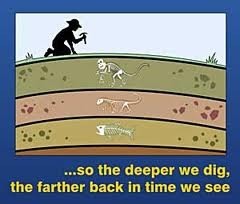
Relative Dating
Method of determining the age of a fossil by comparing its placement with that of fossils in other layers of rock. Oldest fossils are found in deepest strata.
9
New cards
Radiometric Dating
a method of determining the absolute age of an object by comparing the relative percentages of a radioactive (parent) isotope and a stable (daughter) isotope
10
New cards
Half-life
Length of time required for half of the radioactive atoms in a sample to decay
11
New cards
Prokaryotes
a microscopic single-celled organism that has neither a distinct nucleus with a membrane nor other specialized organelles. Include the bacteria and cyanobacteria. Earliest living organisms
12
New cards
Aerobic
Containing oxygen; referring to an organism, environment, or cellular process that requires oxygen.
13
New cards
Anaerobic
Lacking oxygen; referring to an organism, environment, or cellular process that lacks oxygen and may be poisoned by it
14
New cards
Eukaryotes
Unicellular nonbacterial organisms bounded by a cell membrane and contains cytoplasm. cytoplasm contains organelles.appeared about 2.1 billion years ago.
15
New cards
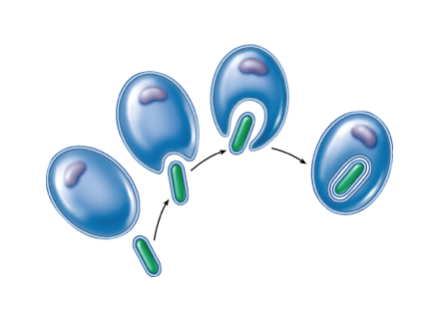
Endosymbiotic hypothesis
Explains the origin of eukaryotes from prokaryotes. The theory that mitochondria and plastids, including chloroplasts, originated as prokaryotic cells engulfed by an ancestral eukaryotic cell. The engulfed cell and its host cell then evolved into a single organism.
16
New cards
Multicellular eukaryotes
organisms with many cells and true nucleus and membrane bound organelles. evolved about 1.2 billion years ago.
17
New cards
Colonization of land
Plants, fungi and animals begin to appear. about 500 million years ago
18
New cards
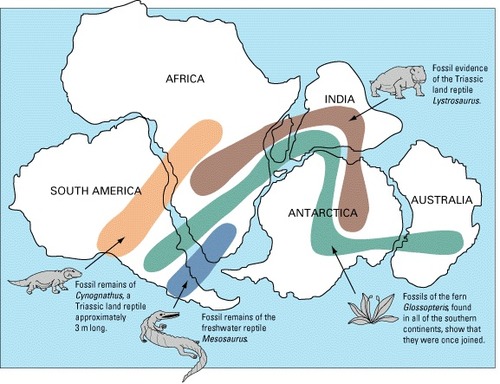
Continental drift
the gradual movement and formation of continents (as described by plate tectonics). Can help explain unique biogeography.
19
New cards
Mass extintions
brief periods of times where a large number of species disappeared. global event from global environmental changes ( dinosaurs)
20
New cards
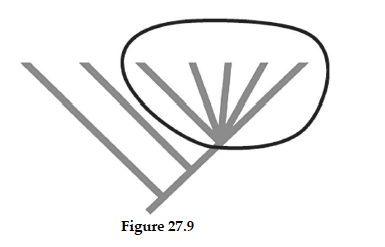
Adaptive radiation
Divergent evolution in which ancestral species evolve into an array of species to fit a number of diverse habitats. Common after mass extinctions.
21
New cards
Evo-devo
Evolutionary developmental biology; a field of biology that compares developmental processes of different multicellular organisms to understand how these processes have evolved and how changes can modify existing organismal features or lead to new ones.
22
New cards
Exaptations
Structures that evolve in one context but become co-opted for another function. Feathers may originally have been beneficial for thermoregulation.
23
New cards
Heterochrony
is an evolutionary change in the rate or timing of developmental events. For example, an organism's shape depends in part on the relative growth rates of different body parts during development. Changes to these rates can alter the adult form substantially. Ex increase for bat finger bones lead to flight. decrease for whale hind leg bones leads to loss of hind legs.
24
New cards
Homeotic genes
Any of the master regulatory genes that control placement and spatial organization of body parts in organisms
25
New cards
Hox genes
a group of related genes that control the body plan of an embryo along the anterior-posterior (head-tail) axis