BSC2011 Exam 1 Flashcards (ALL COMBINED)
 Call Kai
 Learn
Learn Practice Test
 Spaced Repetition
 Match
Match Flashcards
 Knowt Play
1/399

There's no tags or description
Looks like no tags are added yet.
Name | Mastery | Learn | Test | Matching | Spaced | Call with Kai | Chat |
|---|
No analytics yet
Send a link to your students to track their progress
400 Terms
Photosynthesis
Definition: The chemical process by which light energy is used to convert carbon dioxide (CO2) and water (H2O) into carbohydrates like glucose (C6H12O6)
Chemical Rxn: 6 CO2 + 12 H2O + light → C6H12O6 + 6 O2 + 6 H2O
Basically …: Carbon dioxide + water + light energy → sugar + oxygen + water
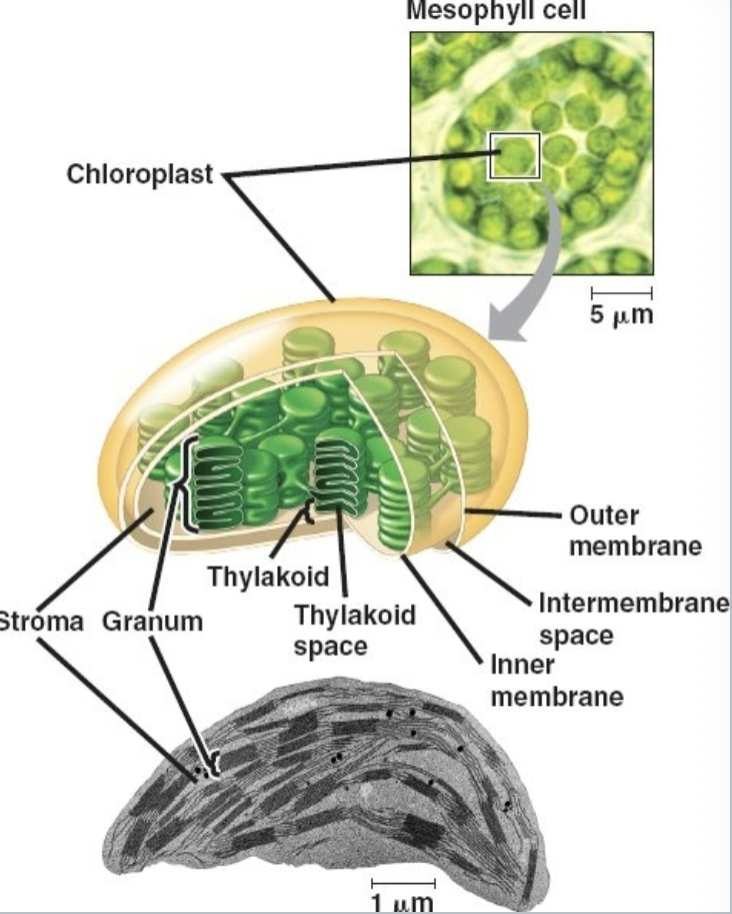
Location: Takes place within the chloroplasts of plant cells
Chloroplasts are … (in terms of photosynthesis)
Organelles that contain the pigment chlorophyll
The tiny factories that the plant uses to produce its own energy through photosynthesis
The 2 stages of Photosynthesis are?
Light Reaction: “Photo” part of photosynthesis
Calvin Cycle: AKA the dark reaction which is the “synthesis” part of photosynthesis
Describe the Light Reaction
Solar energy → chemical energy
Light is absorbed by the chlorophyll
Energy helps split H2O as the electron produced from splitting H2O binds to the electron acceptor NADP+
Products are ATP (provides energy for the Calvin Cycle), NADPH (transfers electrons and H), and O2 (released from the plant)
Describe the Calvin Cycle
CO2 → Organic Carbon
CO2 is absorbed from the air, NAPDH gives up the electron, and ATP provides energy
Products: sugar (C6H12O6), NADP+, ADP+P
Physics of Light and how it impacts Photosynthesis
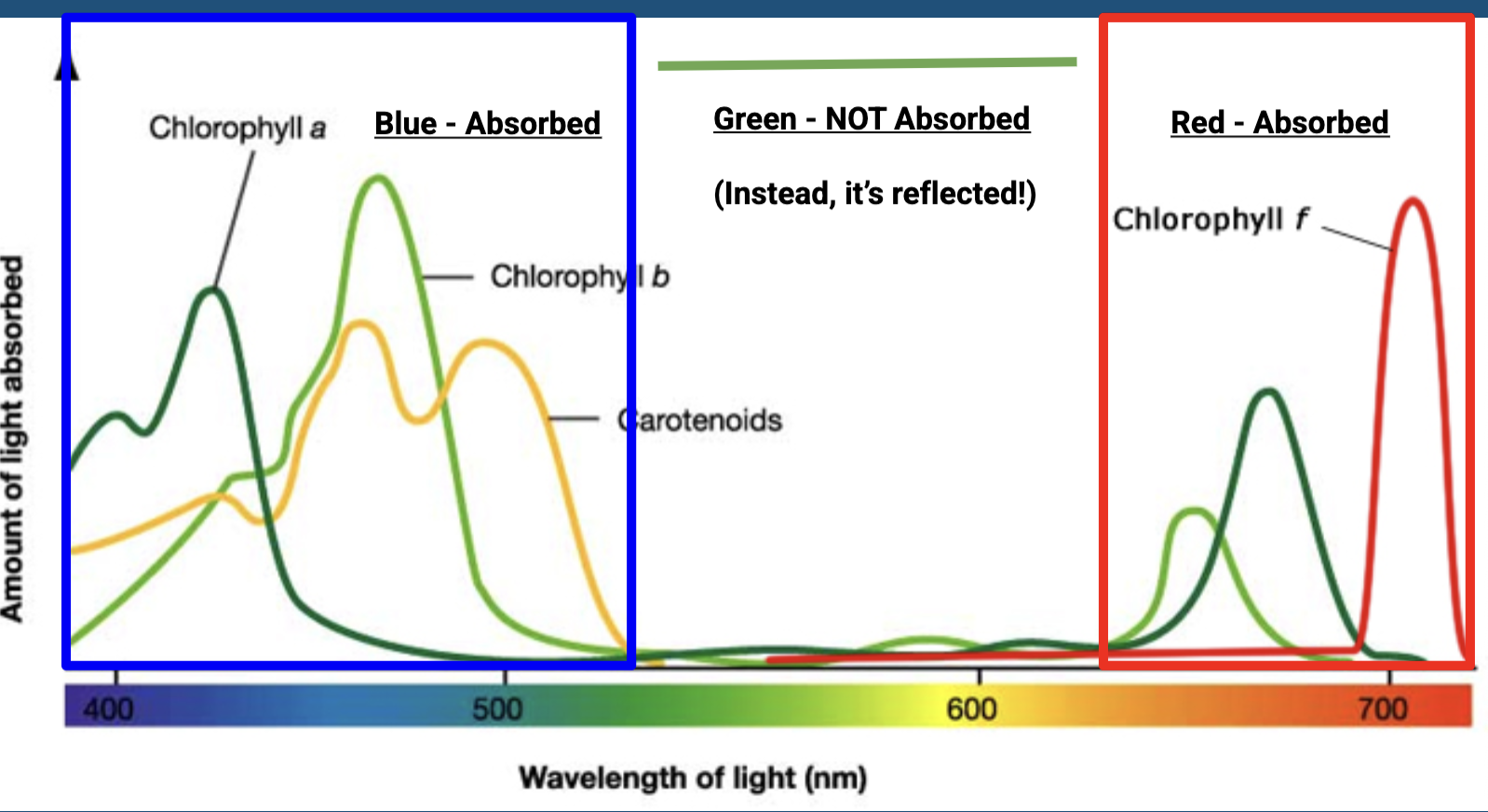
Visible light is only a small part of the electromagnetic spectrum which can be either absorbed, reflected, or transmitted
Wavelength → color, amplitude → intensity
Chloroplasts are green because they reflect green light
Chlorophyll pigments absorb red and blue light but reflect green light
Because our eyes reflected light we see plants as being green
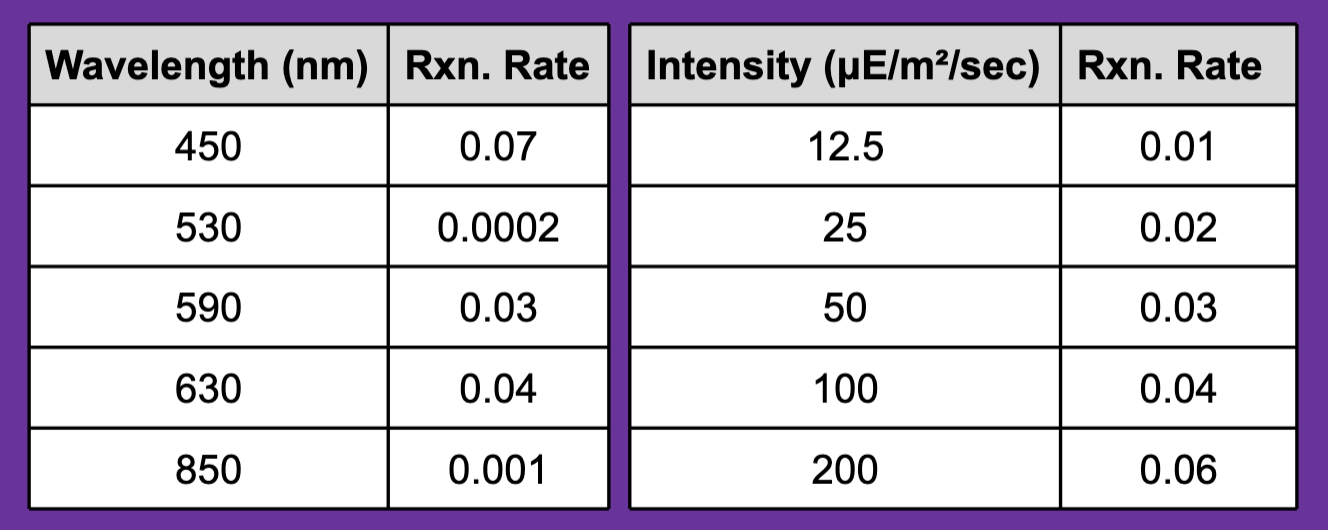
Reaction Rates Data
Here is the graph
Which one is known for having no stomata?
liverwort - they are non-vascular plants that absorb water directly through their entire surface and lack a protective cuticle, making them dependent on moist environments where active regulation of water loss is less critical
Which one is known for having gemma cups that allow it to reproduce asexually?
Liverworts aka hepatophyta
Which one has stomata on their sporophyte for gas exchange?
mosses
Which one has water conducting cells called hydroids?
mosses
Which one's sporophyte grows continuously from its base unlike the other two?
hornwort
Which one has a symbiotic relationship with nitrogen-fixing cyanobacteria?
hornwort
Which clade has a dominant sporophyte phase?
Vascular plants ( tracheophytes)
What are homosporous plants?
Produce one type of spore that develops into a bisexual gametophyte. This is most ferns and bryophytes
What are heterosporous plants?
(e.g., some ferns, seed plants): Produce two types of spores (megaspores and microspores)
What are megaspores?
Haploid plant spore that grows into female gametophytes (egg-producing).
What are microspores?
Male gametophytes (sperm-producing).
Where are microphylls found?
Lycophytes (club mosses, quillworts, and spike mosses).
What are sporangium?
Structure where spores are produced
What is a strobilus?
A cone-like structure formed by clustered sporangia (e.g., in lycophytes) that is the sporophyte generation.
Mega or micro if female or male
What are traits of euphylophytes
Ferns and seed plants that have megaphylls (large, branched leaves). Multiflagellate sperm (except angiosperms). Roots with endogenous branching.
What is endogenous branching?
the process by which branches develop due to internal hormonal and genetic factors rather than external environmental influences like light or mechanical damage.
What is unique about the fern's sporophyte?
is very long-lived and dominates the life cycle.
What is the fern's gametophyte like?
small, photosynthetic, and heart-shaped, producing both sperm and eggs.
Where do fern live?
require water for sperm movement, so they thrive in moist environments.
What is the Leptosporangium in ferns?
Thin-walled sporangium that releases spores.
What is the annulus in ferns?
A ring of specialized cells in the sporangium that contracts when drying out, causing spores to be ejected.
Where are the sporangia of a fern located?
found in sori (clusters) on the undersides of fern leaves.
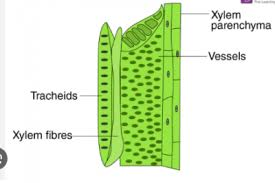
Where are tracheids found?
In the xylem of all vascular plants
Where are vessel elements found?
A vessel element is a highly specialized, tubular cell found in the xylem tissue of most flowering plants (angiosperms).
Stacked end-to-end, they form continuous microscopic "pipes" that transport water and dissolved minerals upward from the roots to the rest of the plant.
What are tracheids?
tube-shaped cells that carry water and minerals up from the roots. found in all of the tracheophytes aka vascular land plants
What are the seive tubes in the phloem?
living cells that transport sugars
What are companion cells in phloem?
Provide ATP required for active transport of organic substances. Assist sieve tubes with metabolism
What is the apoplastic route?
Water moves through cell walls and intercellular spaces.
Does not cross plasma membranes until it reaches the Casparian strip in the root endodermis.
What is the symplastic route?
Water moves through the cytoplasm of cells via plasmodesmata. Controlled movement since it crosses membranes.
Describe the pressure flow model of phloem movement?
Source (e.g., leaves): Sucrose is actively transported into phloem sieve tubes → water enters by osmosis → pressure increases.
Bulk Flow: High pressure at the source pushes the phloem sap to the sink.
Sink (e.g., roots, fruits): Sucrose is unloaded via facilitated diffusion, and water returns to the xylem.
Movement in the phloem requires energy (ATP) at the source but flows passively due to pressure differences.
What is secondary growth?
wood! yo! eyyyy hahaah
Apical Meristem
Embryonic plant tissue in the tips of roots and in the buds of shoots that supplies cells for the plant to grow in length.
Primary Growth
Growth produced by apical meristems, which lengthen stems and roots.
Secondary growth
Increases diameter via lateral meristems (vascular cambium & cork cambium). Produces secondary xylem (wood) and secondary phloem (inner bark).
How does secondary growth increase the diameter?
The vascular cambium produces new layers of secondary xylem and secondary phloem. Cork cambium generates outer protective layers.
Which rings on a tree are the youngest?
outermost rings (think of the fresh bark on the outside)
function of cork cambium
Produces protective, waxy-walled cells that form the outer bark. responsible for secondary growth that replaces the epidermis in roots and stems
Are cycads monoecious or dioecious?
dioecious (separate male and female plants )
Megastrobili (female cones)
Produce ovules and seeds; woody scales protect seeds.
Microstrobili (Male cones)
Produce pollen grains; typically herbaceous.
dioecious
Separate male & female plants (e.g., cycads, Ginkgo).
Monoecious
Male and female reproductive structures on the same plant (e.g., conifers).
Microgametophyte of Seed Plants
Produced in the microstrobili (male cones). Commonly known as pollen. Functions in fertilization.
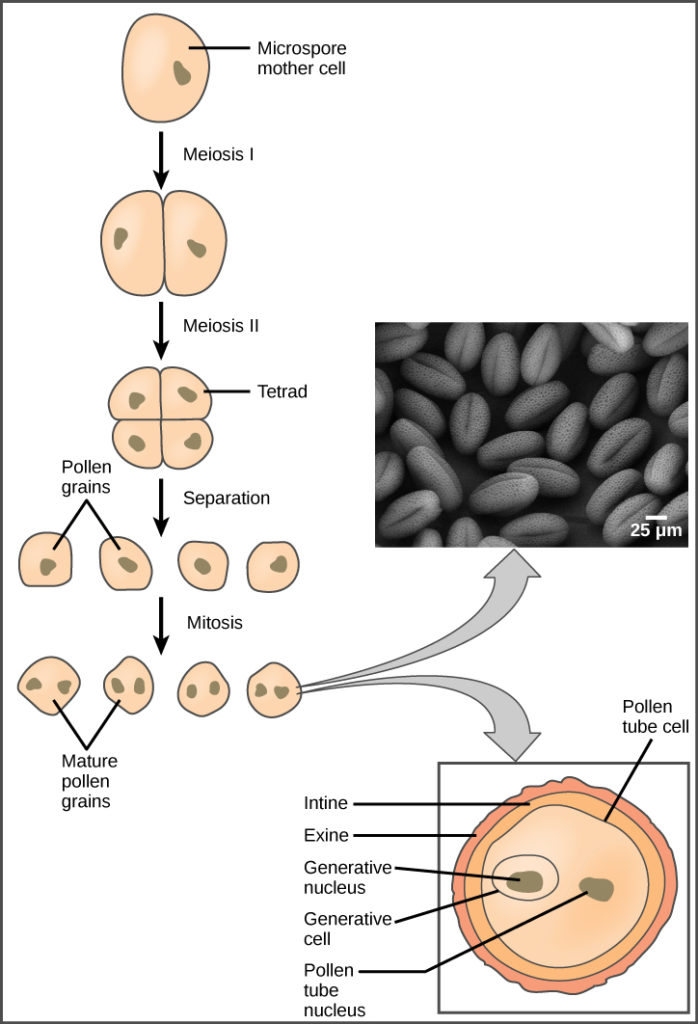
Describe pollen development in angiosperms
Each anther sac is a microsporangium.
Meiosis produces haploid microspores, which form pollen grains.
Pollen grains contain:
Tube cell → Grows into pollen tube.
Generative cell → Divides into two sperm cells.
The nutritive tissue in gymnosperms vs angiosperms is what?
the megagametophyte (haploid, 1n) in gymnosperms vs the endosperm (triploid, 3n) in angiosperms
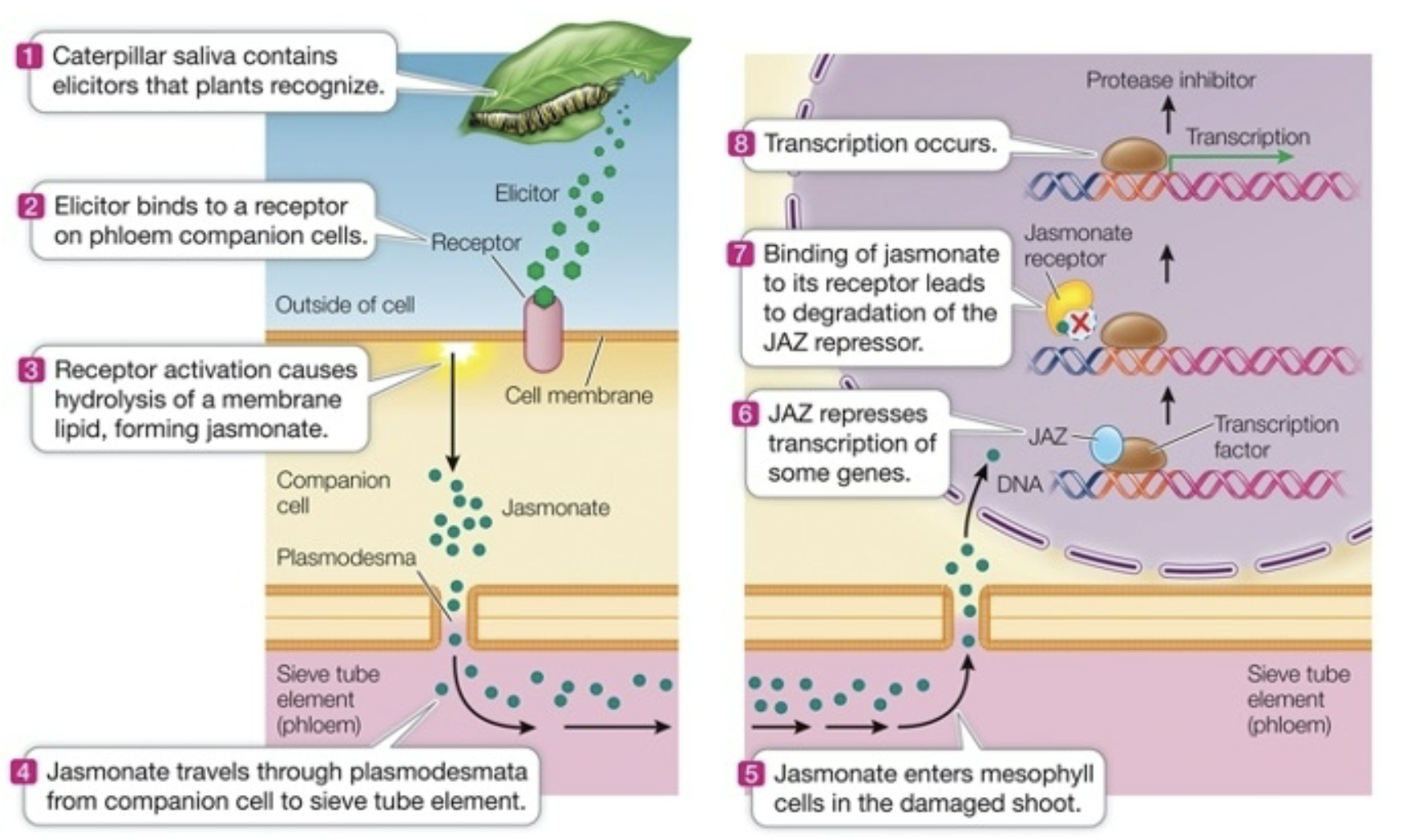
Jasmonate
Jasmonate pathway results in the production of proteins that reduce the growth of insects by inhibiting their digestion.
Jasmonates, once produced, can travel through the phloem to induce protection in undamaged tissues.
Gymnosperm seed layers
2n: Parent sporophyte (seed coat).
1n: Megagametophyte (nutritive tissue).
2n: Embryo (new sporophyte).
Angiosperm seed layers (3 generations)
2n: Parent sporophyte (seed coat).
3n: Endosperm (nutritive tissue).
2n: Embryo (new sporophyte).
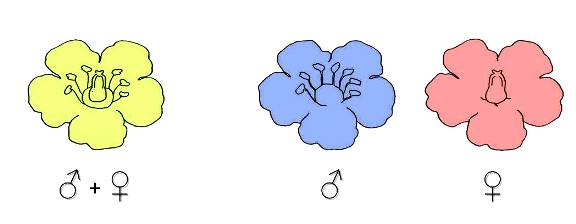
What are perfect flowers?
Have both male (stamens) and female (carpels) parts → Hermaphroditic.
What are imperfect flowers?
Have either male or female structures → Unisexual.
Baker's Law
Colonization by self-compatible organisms is more likely to be successful than colonization by self-incompatible organisms because of the ability for self-compatible organisms to produce offspring without pollination agents. Self-pollinating plants are often successful colonizers.
What is a fruit?
A matured ovary containing seeds.
Protects seeds & aids dispersal.
Can be fleshy (e.g., berries) or dry (e.g., nuts).
Strategies for Surviving in Hot, Water-Limited Environments
Avoidance: Some plants complete their life cycle during rainy seasons and remain dormant otherwise.
Water Storage: Succulent leaves or stems store water.
Modified Stomata: Stomata may be in crypts to reduce water loss.
High Solute Concentration: Lowers water potential, allowing water uptake in dry or salty soils.
Reduced Leaves: Small or absent leaves minimize water loss.
Deep/Shallow Roots: Some plants have deep roots for groundwater access; others have shallow, widespread roots to capture surface moisture.
Protective Surfaces: Waxy, hairy, or spiny structures reduce water loss and heat stress.
Convergent Evolution: Plants in different regions evolve similar adaptations.
What is photorespiration?
Occurs when RuBisCO fixes oxygen instead of CO₂, reducing photosynthetic efficiency. Baddddd we don't like this
What are causes of photorespiration?
High O₂ concentration.
Low CO₂ levels.
High temperature & bright light.
Why is photorespiration a problem?
Wastes energy (ATP, NADPH).
Produces toxic byproducts that must be removed.
Reduces carbohydrate production.
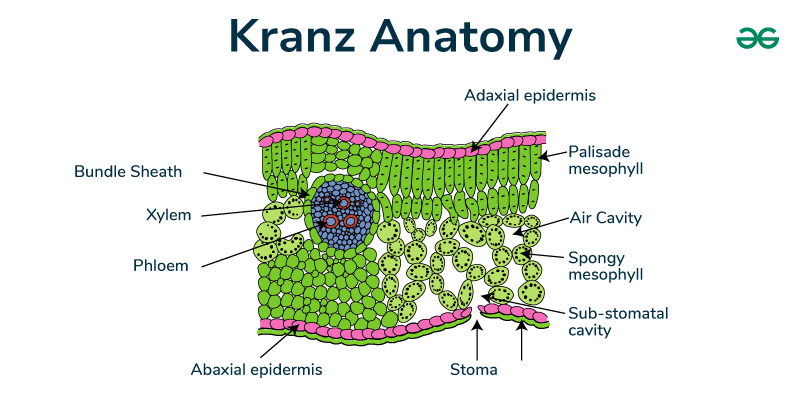
C4 photosynthesis
Process that first converts CO2 into a 4-carbon molcule in the mesophyll cells, converts that product to malate and then shuttles it to the bundle sheath cells, where the malate releases CO2 and rubisco picks it up as if all were normal.
Uses PEP Carboxylase (in mesophyll) to fix the CO2.
Stomata is open during the day.
Moderate water efficiency.
Use Kranz anatomy, where CO₂ is concentrated in bundle sheath cells. ex: corn, sugarcane
CAM Photosynthesis (Crassulacean Acid Metabolism)
CO2 is converted to 4-carbon molecule.
Stomata opens at night and cooler, more humid temperatures.
Carbon fixation takes place at night to reduce rate of water loss during CO2 uptake. Example: desert plants (i.e. cactus, pineapple, succulents).
PEP Carboxylase (at night) Malate (stored in vacuoles at night).
Open at night, closed during the day. Store CO₂ at night and use it during the day, reducing water loss.
Highly water efficient
Where do carniverous plants grow?
High light, high rainfall, nutrient-poor soils (often acidic). They absorb nitrogen and other nutrients from digested insects.
Rhizobium Bacteria & Legumes
Bacteria convert atmospheric nitrogen (N₂) into ammonia (NH₃). Plants provide carbohydrates to bacteria.
Forms root nodules in legumes like beans, peas, and clover.
What does auxin do?
Controls apical dominance, phototropism, and gravitropism.
Stimulates cell elongation (acid growth mechanism).
Promotes root initiation.
What does ethylene do?
Speeds up fruit ripening.
Promotes leaf abscission (shedding).
Induces senescence (aging).
Inhibits stem elongation (affects phototropism).
Enhances its own production (positive feedback loop).
Describe auxin & the phototropic response
Plants bend toward light because auxin accumulates on the shaded side, causing those cells to elongate.
Darwin’s experiments showed that the tip of the plant senses light and sends a signal (auxin) down the stem.
Describe the Acid Growth Mechanism that auxin allows for
Auxin triggers proton pumps, that pump out H+, acidifying the cell wall.
This activates expansins, enzymes that loosen the cell wall.
Loosening allows cells to expand, causing plant bending or elongation.
What is gravitropism?
growth in response to gravity
What is negative gravitropism?
A plant's growth or movement in the direction opposite to Earth's gravitational pull
What is positive gravitropism?
in roots (grow downward). hence going with gravity.
What is phototropism?
growth toward light
What is positive phototropism?
The biological phenomenon where a plant or organism grows or bends directionally toward a light source
What is negative phototropism?
The biological phenomenon where an organism, usually a plant or fungus, grows or bends away from a light source
Apical Dominance & Auxin's Role
This is when the main shoot inhibits side branch growth.
Auxin produced at the tip suppresses lateral bud growth.
Removing the tip (apical bud) allows side branches to grow.
What would happen with an increase of auxin?
More cell elongation, stronger apical dominance, phototropism, root growth
What would happen with an increase of ethylene?
Faster fruit ripening, more leaf drop (abscission), shorter stems
What is phytochrome?
A chemical photo-receptor in plants that is used to detect light
what is the Pr form of phytochrome
(inactive) absorbs red light and converts to Pfr (active).
What is the Pfr form of phytochrome?
(active) absorbs far-red light and converts back to Pr. >700nm
What does phytochrome control?
Seed germination (stimulated by red light).
Shade avoidance (plants elongate in shade).
Flowering timing (based on night length).
Short day plants
(e.g., poinsettias) Flower when nights are long. Even a brief light flash during the night prevents flowering.
Long day plants
Flower when nights are short. Need a minimum daylight duration to flower.
Monocot
An angiosperm that has only one seed leaf. one cotyledon.
Parallel veins.
Multiples of 3 for petals
Dicots
Two cotyledon.
Branched veins.
4 or 5 petals
How have flowers and fruits helped angiosperms diversify?
They are pollinated by animals and have coevolved.
Many pollination mutualisms are vital to both parties. Sometimes, they are highly specific—only one insect species pollinates one plant species.
Flower structure has diversified under the selective pressure of pollinators.
Flowers often provide food for pollinators—nectar and pollen; and have specialized structures or colors to attract them.
What are pollination syndromes?
Many pollination mutualisms are vital to both parties. Sometimes, they are highly specific—only one insect species pollinates one plant species.
Flower structure has diversified under the selective pressure of pollinators.
Flowers often provide food for pollinators—nectar and pollen; and have specialized structures or colors to attract them.
What are bees attracted to? (Pollination syndrome)
Radially or bilaterally symmetrical, colored blue/purple/yellow, broad tube sometimes with nectar guides. Fragrant or not.
What are flies attracted to?
Often pale with musky odor, or colored (and scented) like decaying flesh
What are moths attracted to?
Pale in color, rich fragrance (think jasmine),flowering in the evening
What are butterflies attracted to?
Various colors, often lots of flowers in a flattened platform-like inflorescence, usually not fragrant
What are bats attracted to?
Large fleshy flowers, tons of stamens, night-flowering,pale, very fragrant.
What are birds attracted to?
Bright colors (often red), tubular with copious nectar, no fragrance
What are some wind pollinated species?
Includes grass flowers, oaks, birches, sedges, and some Asteraceae. (sunflower family) species esp. ragweeds.
What are perfect flowers?
They have both megasporangia and microsporangia- male and female in sameflower. AKA "hermaphroditic."
What are imperfect flowers?
They are individual flowers are missing male or female function, so are unisexual.
Plants with imperfect flowers can be
Either monoecious or dioecious