Lecture 9: Descending/Motor Spinal Pathways
 Call Kai
 Learn
Learn Practice Test
 Spaced Repetition
 Match
Match Flashcards
 Knowt Play
1/38

There's no tags or description
Looks like no tags are added yet.
Name | Mastery | Learn | Test | Matching | Spaced | Call with Kai | Chat |
|---|
No analytics yet
Send a link to your students to track their progress
39 Terms
Elicited by cutaneous, nociceptive, or thermoreceptive activity
Monosynaptic reflexes
Because of antagonism between opposing muscles
Polysynaptic reflexes
This is a lower motor neuron (LMN)
No reflexes=LMN disease (no brain needed)
Final common pathway
Alpha motor neuron
Motor cortices in frontal lobe found here:
Primary motor cortex (pre-central gyrus)
Premotor areas ( association areas) – discussed in depth in future lecture
Basal ganglia (sub-cortical) found here
Forebrain
What 5 structures are found in the brainstem?
Acronym: Create Red Veggies Ready Soon
Cerebellum (does not have its own tract, works through vestibular)
Red nucleus (midbrain, deep in thalamus)
Vestibular nuclei (balance)
Reticular formation (reticulospinal tract)
Superior colliculus/tectum (tecto-spinal tract)
What cortex is involved in voluntary movement?
Motor cortex
Primary (pre-central gyrus)
Originate mostly from precentral, primary motor cortex and travel to spinal cord levels WITHOUT intervening synapses.
May synapse directly onto alpha motoneurons OR interneurons which then synapse onto alpha
Typically purposive, manipulative movements (voluntary)
Typically distal musculature and fine movements
Corticospinal - Pyramidal
Originate from brainstem nuclei (but these have input from motor cortex)
Automatic, ‘preconscious’ movements
Typically postural or ‘in-flight’ corrections
Typically proximal * musculature and more gross movements.
Other - Extrapyramidal
Descending motor axons terminate onto these neurons which have direct activation of a specific motor unit and are critical in fine motor control
Alpha motoneurons
Descending motor axons terminate onto these neurons which excite alpha motoneurons, affecting movement indirectly, or can allow for activation of a larger number of motor units or even entire muscles
Interneurons
Organized at the spinal cord level
Can be activated by descending tracts synapsing onto just a few interneurons rather than thousands of individual alpha motoneurons.
Reflexive movement ‘programs’
Axons from the corticospinal tracts (lateral + anterior) originate mostly from this cortex then travel caudally though the forebrain via the corona radiata, then ____a______
Then, in the midbrain via ___b____
In the pons - axons lie posterior to pontine fibers
Travel in medulla as the __c___
____d_____ will cross at the pyramids
Most of the ___e___ will stay ipsilateral
Axons then descend in the spinal cord in the positions indicated by their names (lateral or anterior/ventral)
a. internal capsule
b. crus cerebri
c. pyramids
d. Lateral corticospinal
e. anterior corticospinal tracts
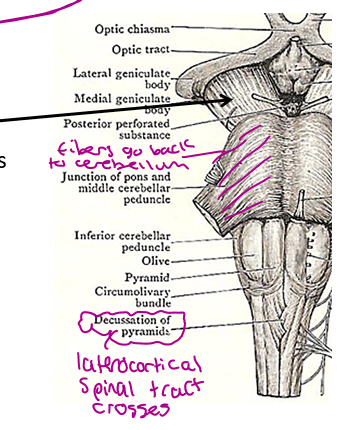
This is the main motor pathway in humans.
Dexterous movements, fractionation (FINE MOTOR CONTROL - finger, hand movement)
90% cross in the MEDULLA
Synapses onto interneurons or alpha motoneurons of DISTAL musculature
Note – NO intervening synapses between motor cortex and termination in spinal cord
Lateral Corticospinal tract (mostly contralateral control)
PROXIMAL tract - upper muscles (neck, shoulder, upper trunk)
Gross motor control
DOES NOT cross in medulla - remains ipsilateral
Descends WITHOUT intervening synapses
Synapses onto ipsilateral interneurons in the spinal cord which will form bilateral synapses with alpha motoneurons
Anterior/ventral Corticospinal Tract (Bilateral control)
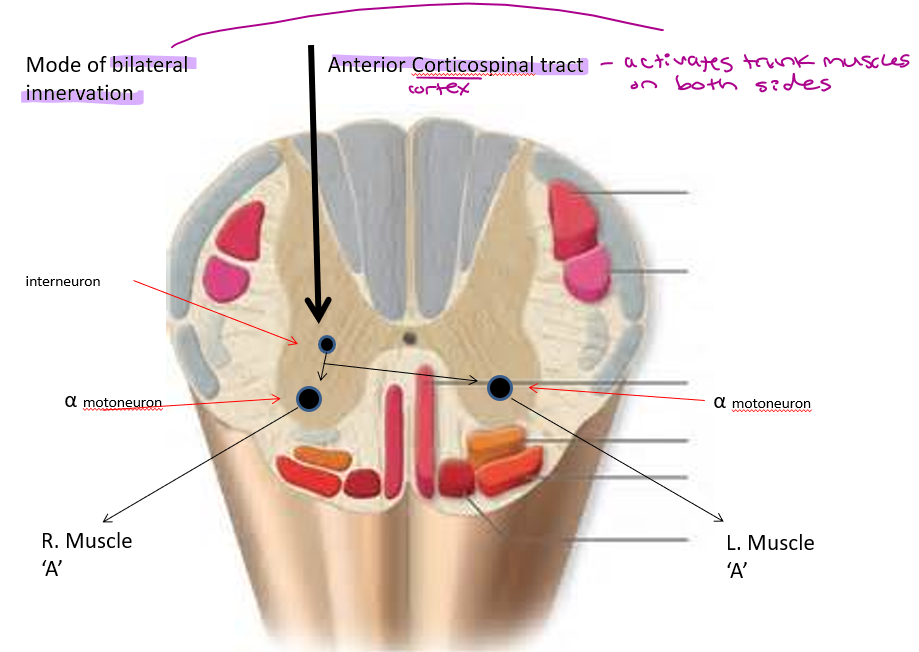
What type of lesion is this?
Contralateral loss of dexterous movements
Gross movements remain
Spasticity and hyperactive reflexes
Lateral corticospinal unilateral lesion
What type of lesion is this?
Bilateral loss of gross movements in neck, shoulder and upper trunk
Anterior corticospinal unilateral lesion
Mostly gross movement, little or no fine muscle control.
One set of tracts terminate onto proximal muscles (postural adjustments)
Another set of tracts terminate onto more distal muscles (gross locomotion)
Extrapyramidal
What are 2 tracts that terminate onto proximal muscles and are extrapyramidal?
Vestibulospinal tracts - ipsilateral
Tectospinal
Includes input from the vestibular system
Balance
Controls all proximal muscles including facilitation of extensor muscles in the upper leg
Vestibulospinal tract
Includes the superior colliculus
Upper trunk and neck
Coordinates head and eye movements
Tectospinal tract
What 2 tracts terminate onto distal muscles (extrapyramidal)?
R.R
Reticulospinal
Rubrospinal
What aspect of the reticulospinal tract facilitates extensor muscles (inhibits flexor)?
What aspect facilitates flexor muscles (inhibits extensor)?
Medial (pons)
Lateral (medulla)
What tract includes the red nucleus (midbrain), upper limbs (gross control), and mostly flexion (no fractionation)?
Rubrospinal tract
This tract is typically inhibitory to ‘lower’ reflexes, whether brainstem or spinal cord
Corticospinal tract
Damage to cortical processes
Decorticate
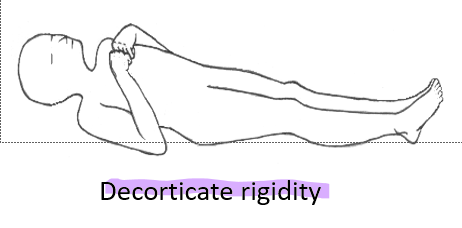
With decorticate, which system is now unopposed/free?
Rubrospinal (flexion)
Disruption of motor pathways at brainstem level- typically pons- below red nucleus
Rigidity due to unopposed gamma activity, unopposed extensor activity (loss of flexor activity from Red nucleus)
Not much hope for function
Decerebrate
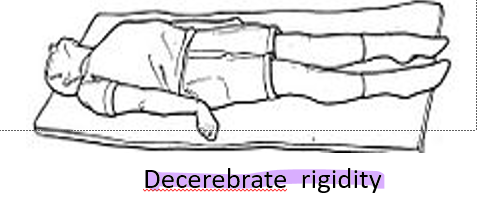
Term for “weakness”
Paresis
Term for “paralysis”
Plegia
Lateral half of the body
Hemi-
Lower part of the body
Para-
Four limb involvement
Tetra- or quadri-
The degree of muscle tension during resting postural states
Muscle tone
Resting state resistance during passive motion
Tone
Force generated by a muscle
Strength
With flaccidity, it is dysfunction of what?
*Think of “L” in flaccidity
LMN
With spasticity, it is dysfunction of what?
UMN
What issue is mainly related to flaccidity?
Hypermobility
Hyperactivity of muscles can include what 4 things?
Clowns Fake Some Creations
Clonus
Fasciculation
Spasm/spasticity
Contracture