Exam 1 - Cellular/Molecular Physio
 Call Kai
 Learn
Learn Practice Test
 Spaced Repetition
 Match
Match Flashcards
 Knowt Play
1/57

Earn XP
Description and Tags
Chapters 1 - 4
Name | Mastery | Learn | Test | Matching | Spaced | Call with Kai | Chat |
|---|
No analytics yet
Send a link to your students to track their progress
58 Terms
3 types of neurons in the body
motor, sensory, interneurons
Cells vary in _____ & ______.
appearance & function
Common features that define life
reproduce, metabolism, grow, evolve, response to stimuli, homeostasis, organization
Despite the diversity, living cells have a similar ____ _____.
basic chemistry
Cell Theory
All plants and animals are made of cells
Cells possess all the attributes of life
Cells arise from division of pre-existing cells
What cells are generally the largest?
Egg cells
What phase of the cell cycle is the longest?
G1 phase
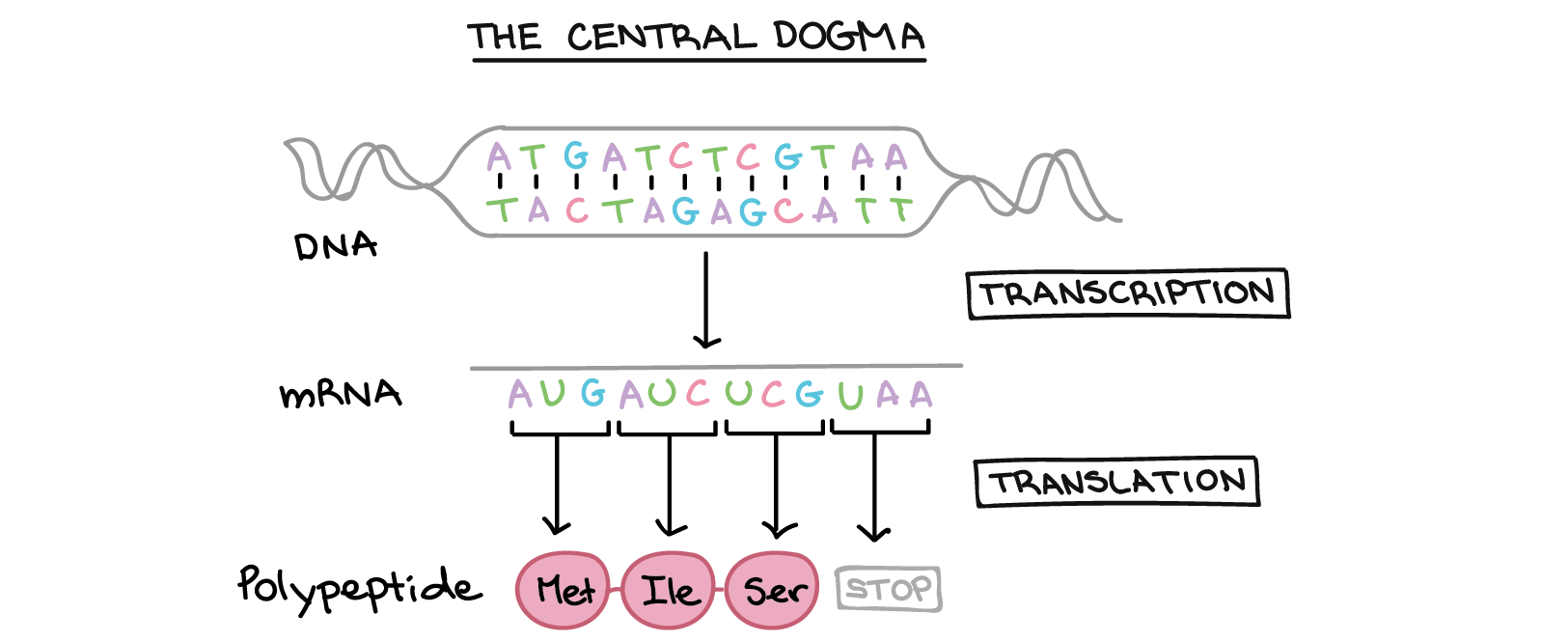
The Central Dogma (of molecular biology)
DNA synthesis (replication) - RNA synthesis (transcription) - Protein synthesis (translation)
Catalytic Activity
Chemical reactions by protein enzymes
Tissues
A group of cells that have similar structure and that function together as a unit
Resolution
The shortest distance between two separate points in a specimen that can still be seen as individual objects
What scientists contributed to the Cell Theory?
Schleiden & Schwann in 1839
How many mitochondria are in a normal body cell?
700
The bacterium ___ is understood more thoroughly than any other living organism
E. coli
Cyanobacteria
Blue green algae
Saccharomyces cerevisiae
Budding yeast
a great single cell eukaryotic model organism
Nucleus
Information store of the cell. Largest organelle in the cell.
Mitochondria can be variable in ___ & ___
shape & size
Endosymbiosis theory of Mitochondria
Mitochondria evolved from aerobic bacteria that were captured and engulfed by an ancient anaerobic achaeal cell.
Supporting evidence for Endosymbiosis theory of Mitochondria
Has its own DNA similar to bacterial DNA
Have ribosomes related to bacterial ribosomes
Cytosol
Fills the empty space in eukaryotic cells between organelles
pH of 7.4
Endomembrane system
Transports lipids and proteins
Cytoskeleton
Microtubule
lots of movement associated
Intermediate filament
keratin
Microfilament
Actin
8-12nm
How do we study cells?
Mutagenesis and screening for new mutant phenotypes
Temperature sensitive mutants
Certain mutation makes the gene product unstable and nonfunctional at elevated temperature; changing temperature can turn the mutation “on” or “off”
Arabidopsis thaliana
Plant model organism
Caenorhabditis elegans
The first multicellular organism to have the complete genome sequenced
microscopic worm
Elements
Cannot be broken down or converted via chemical reaction
Atoms
The smallest particle of an element that still retains its distinctive chemical properties
Molecules are formed by combining two or more atoms via
chemical bonds
A single atom is composed of three subatomic particles
Neutron
Proton
Electron
Chemistry in living organisms
Heavily rely on chemical compounds
Biochemical reactions take place in _____ _____ within relatively narrow range of temperature
aqueous solution
Polymeric molecules
= macromolecules
Living things are primarily dominated by these four elements
Oxygen
Carbon
Hydrogen
Nitrogen
Which element is the most abundant in the human body?
Hydrogen
______ electron determines chemical behaviors of an atom
Valence
Covalent Bond
Sharing of electrons between atoms
Polar bond
Don’t equally share electrons
Non-polar bond
Equally share electrons
Covalent bonds are characterized by particular
Geometries (specific bond angles, bond length and energies)
Bond Strength
Measured by the amount of energy that would be required to break a bond
In the cellular world, we consider ___ bond the strongest
covalent
Polar covalent bonds allow molecules to interact through
electrical forces
Carbon to Carbon bonds
A single bond compounds - alkanes
flexible and rotational
A double bond compounds - alkenes
All atoms are on the same plane
Ionic Bond
A type of electrostatic attraction
Hydrogen Bond
When highly electronegative atoms forms covalent bond with hydrogen, the charge is unequally distributed within the bond, resulting in a polar molecule
Skin pH
5.5 - 6
Functional groups
A group of atoms that have distinct chemical and physical properties that influence the behavior of the molecule that contains each group
COOH
Carboxyl group
OH
hydroxyl group
NH2
amino group
C=O
Carbonyl group
CH3
methyl group
PO4
phosphate group
SH
sulfate group (near nonpolar)
Cells contain four major families of small organic molecules
Sugars - polysaccharides, glycogen, and starch
Fatty acids - fats and membrane lipids
Amino acids - proteins
Nucleotides - nucleic acids
Many small organic molecules may function as a potential subunit for a ____ or as an ______
Macromolecule or as an energy source