Deck 1: Larynx + Lymphatics
 Studied by 3 people
 Call Kai
 Learn
Learn Practice Test
 Spaced Repetition
 Match
Match Flashcards
 Knowt Play
1/71

There's no tags or description
Looks like no tags are added yet.
Name | Mastery | Learn | Test | Matching | Spaced |
|---|
No study sessions yet.
72 Terms
What is the larynx connected to superiorly and inferiorly?
Pharynx - connects to the larynx at the top
Trachea - connects to the larynx at the bottom
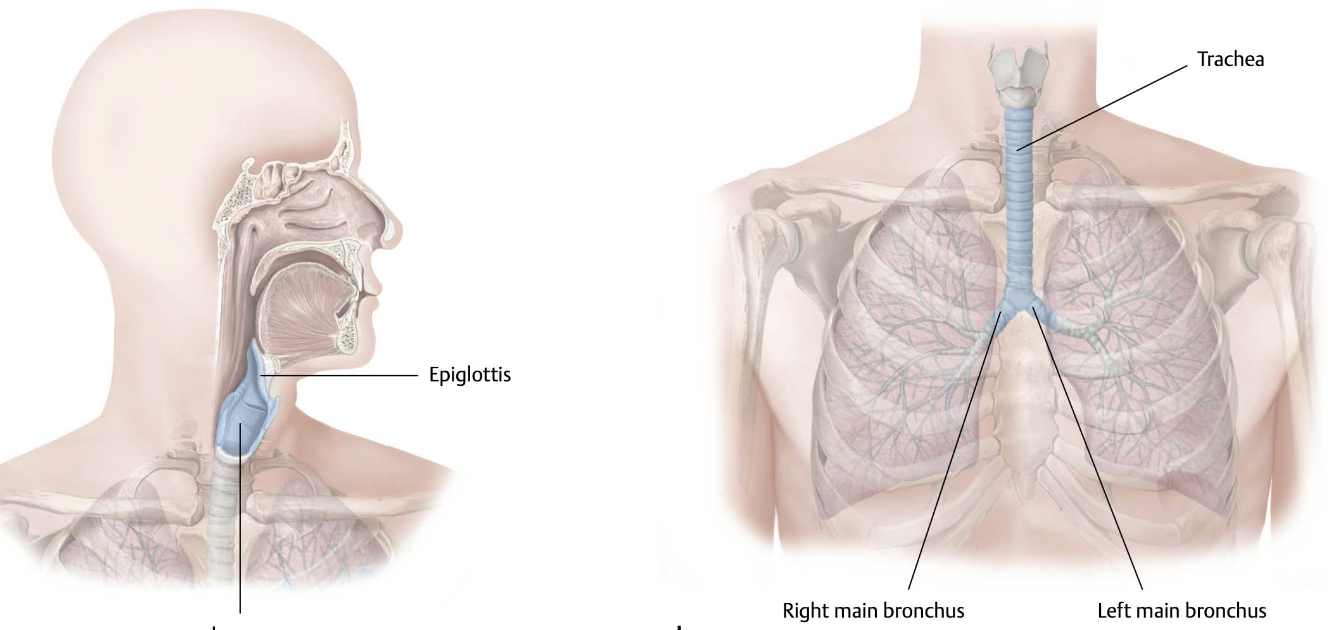
The larynx is part of the ____ airway.
The larynx is part of the upper airway
List the main functions of the larynx.
1) Sound production (specifically “voice”)
2) Route for air and food into the respiratory tract & esophagus
3) Provides an open, unobstructed airway & a way to close it off when needed
When viewed externally, what are the surface features of the Larynx?
1) Thyroid notch
2) Laryngeal prominence (Adam’s apple")
both rise upon swallowing
Where is the larynx located in relation to the cervical vertebrae?
lies anterior to the C3–C6 vertebrae
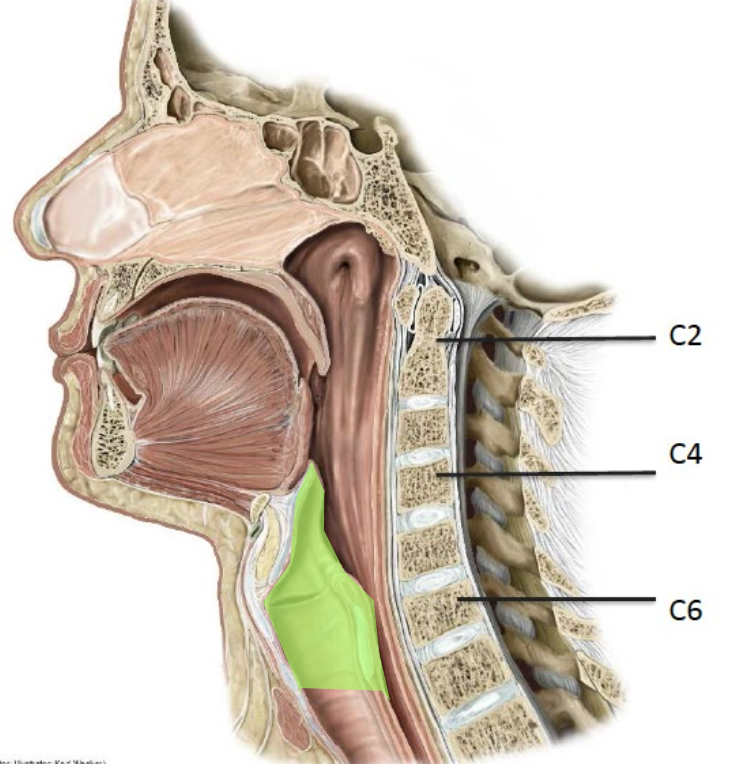
Where does the larynx lie internally?
Anterior to esophagus
Underneath the infrahyoid muscles (top arrow)
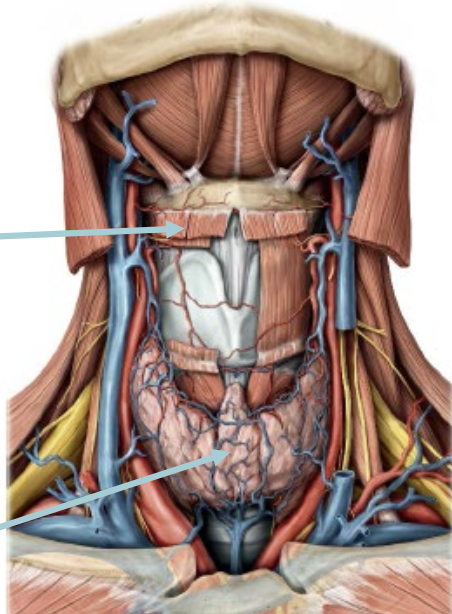
What structure partially covers the lower portion of the larynx?
thyroid gland
Where does the larynx connect superiorly and inferiorly?
Superiorly to the hyoid via the thyrohyoid membrane
Inferiorly to the first tracheal ring via cricotracheal ligament

What forms the basic structure (“skeleton”) of the larynx? List them
9 cartilaginous structures connected by membranes and ligaments
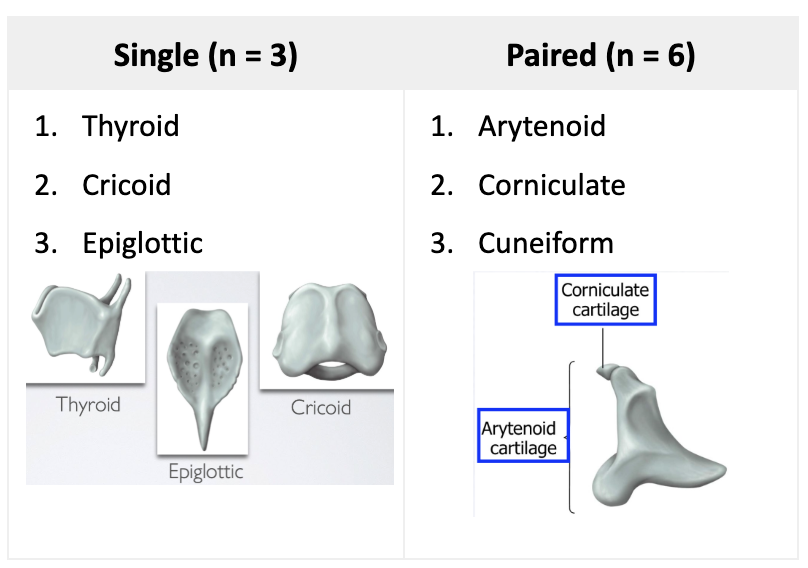
Which of the 9 cartilages is the only one that forms a complete ring?
Cricoid
Identify which cartilage are 11, 13, 14.
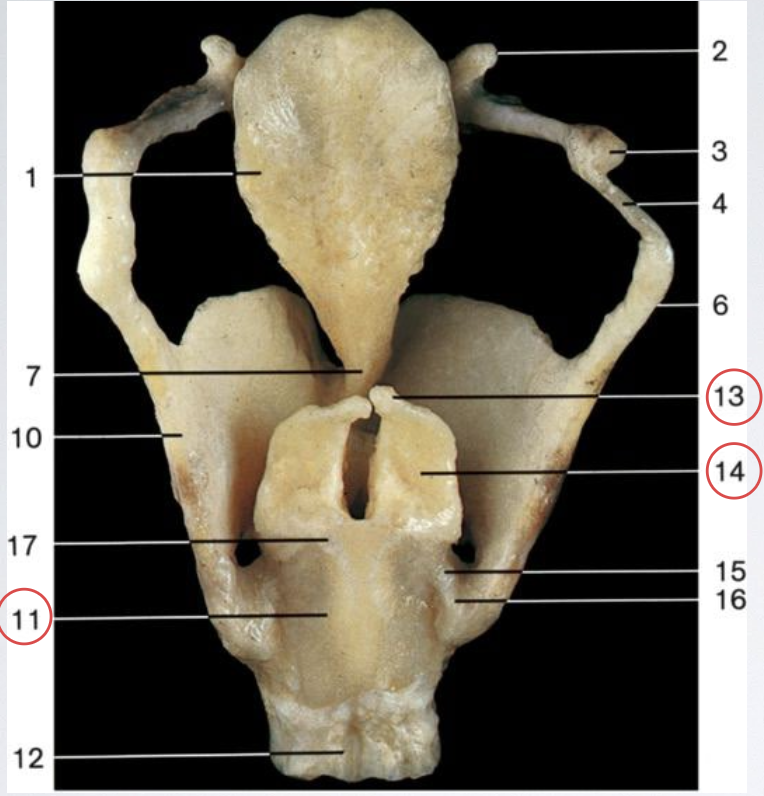
11 Cricoid
13 Corniculate
14 Arytenoid
Outline the 3 stages of Deglutition (swallowing). Mention whether each stage is voluntary or involuntary.
1) Voluntary - bolus pushed from the mouth into oropharynx and tongue ends up against hard palate
2) Involuntary - very rapid, no chewing & no breathing
Larynx is protected by the:
closure of vestibule & epiglottis
posterior movement of the base of the tongue
3) Voluntary - Inferior constrictor of pharynx contracts to push the bolus into the esophagus
What is the role of the epiglottis during deglutition?
acts as the “stop valve”
What does the epiglottis attach to?
Hyoid
Thyroid cartilage
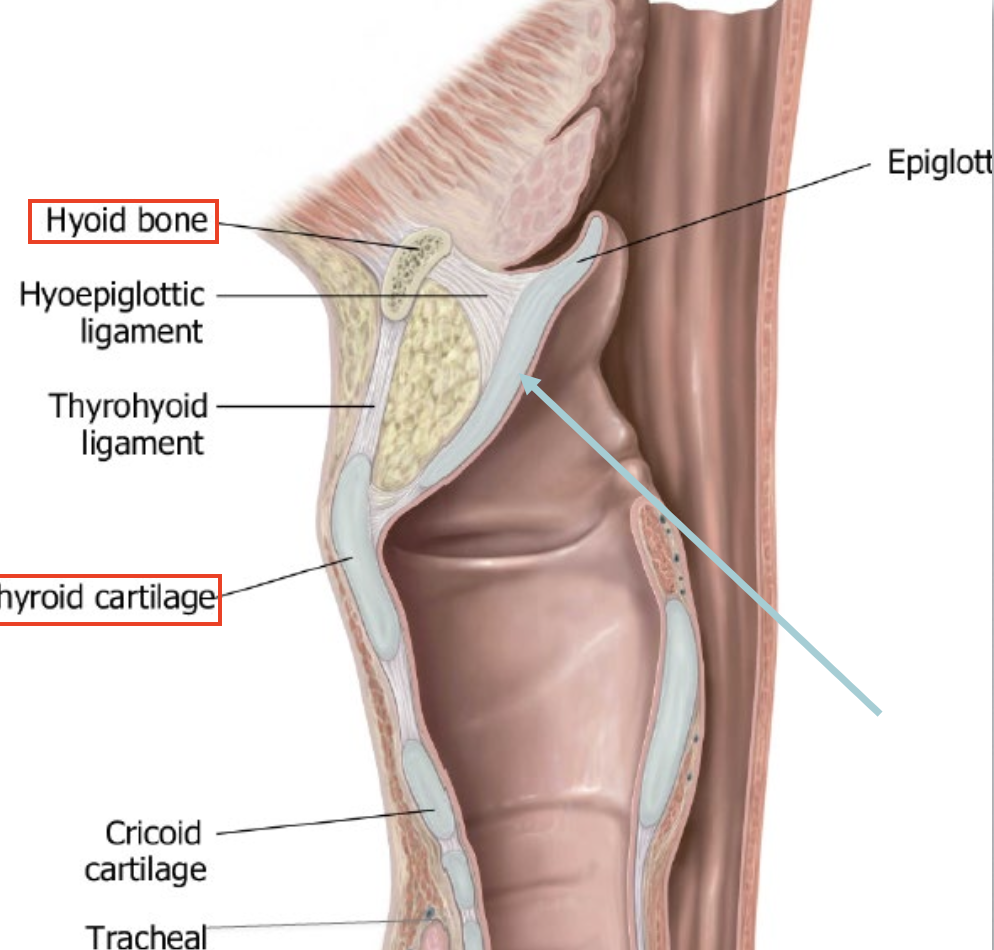
What is the “bend point” of the epiglottis called? What’s the significance of this area?
Aryepiglottic fold
Damage to this structure is dangerous b/c it prevents food and fluid from entering the lungs
What are the valleculae?
2 depressions located on either side of the epiglottis
Fun fact: trigger the gag reflex when stimulated, which is why they are touched to induce vomiting
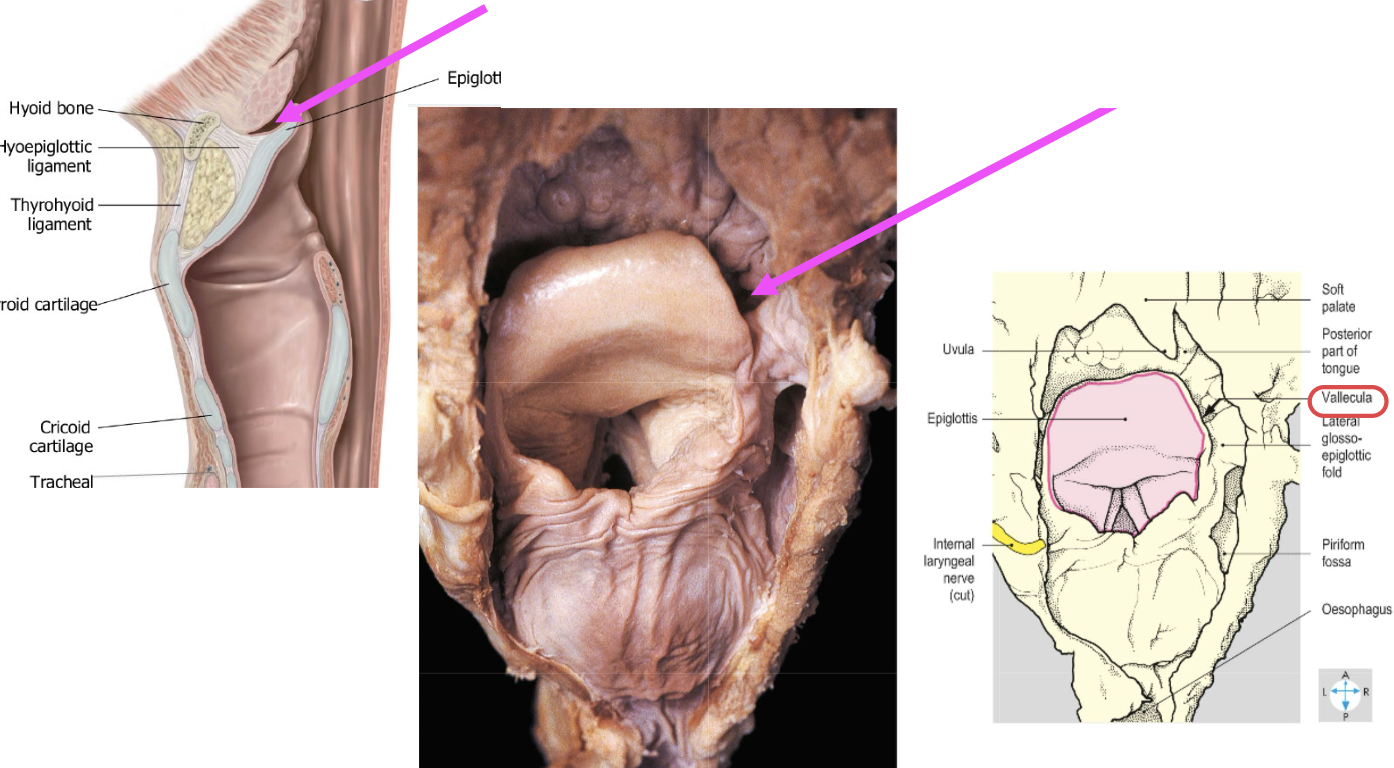
What medical procedure do the valleculae serve as an important landmark of?
Intubation - insert a tube into the trachea to help a person breath
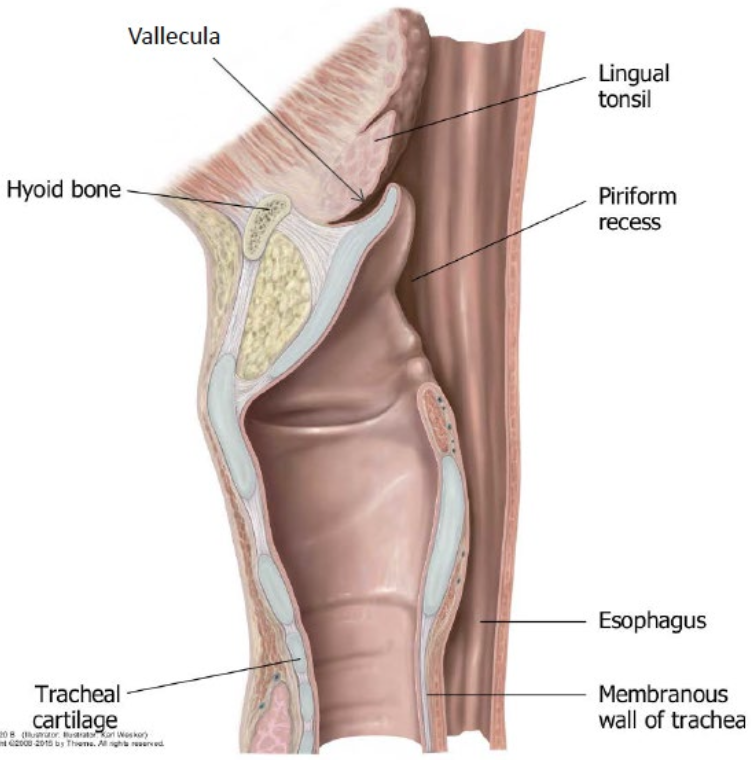
What are the key anatomical structures related to the larynx?
Root of the tongue
Lingual tonsil
Vallecula
Piriform recess
Esophagus
Trachea
What is the role of vocal folds (vocal chords)?

→ produce sound
variations in sound come from changes in the position, tension & length of these folds
paired
What are vestibular folds?
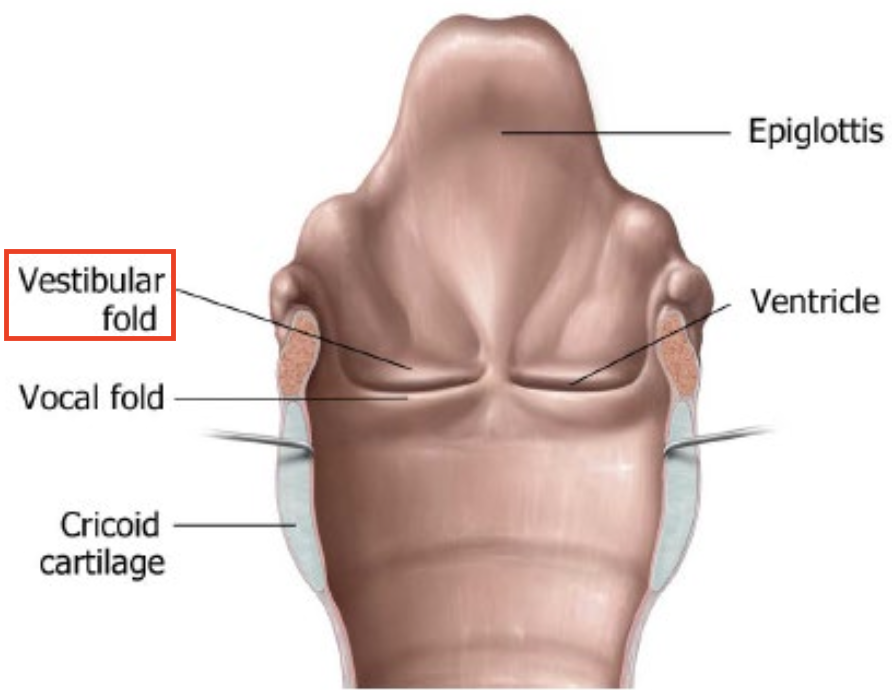
→ is the vestibular ligament that’s covered by mucosa
does NOT produce sound
paired
What is the opening b/w the 2 vocal folds (vocal cords) called?
Rima glottidis
opening to the airway
it’s width changes depending on the vocal fold position

What is the role of the arytenoid cartilage during phonation?
moves and rotates on its base to alter the position of the vocal folds, allowing for abduction (moving apart) & adduction (moving together) of the vocal cords

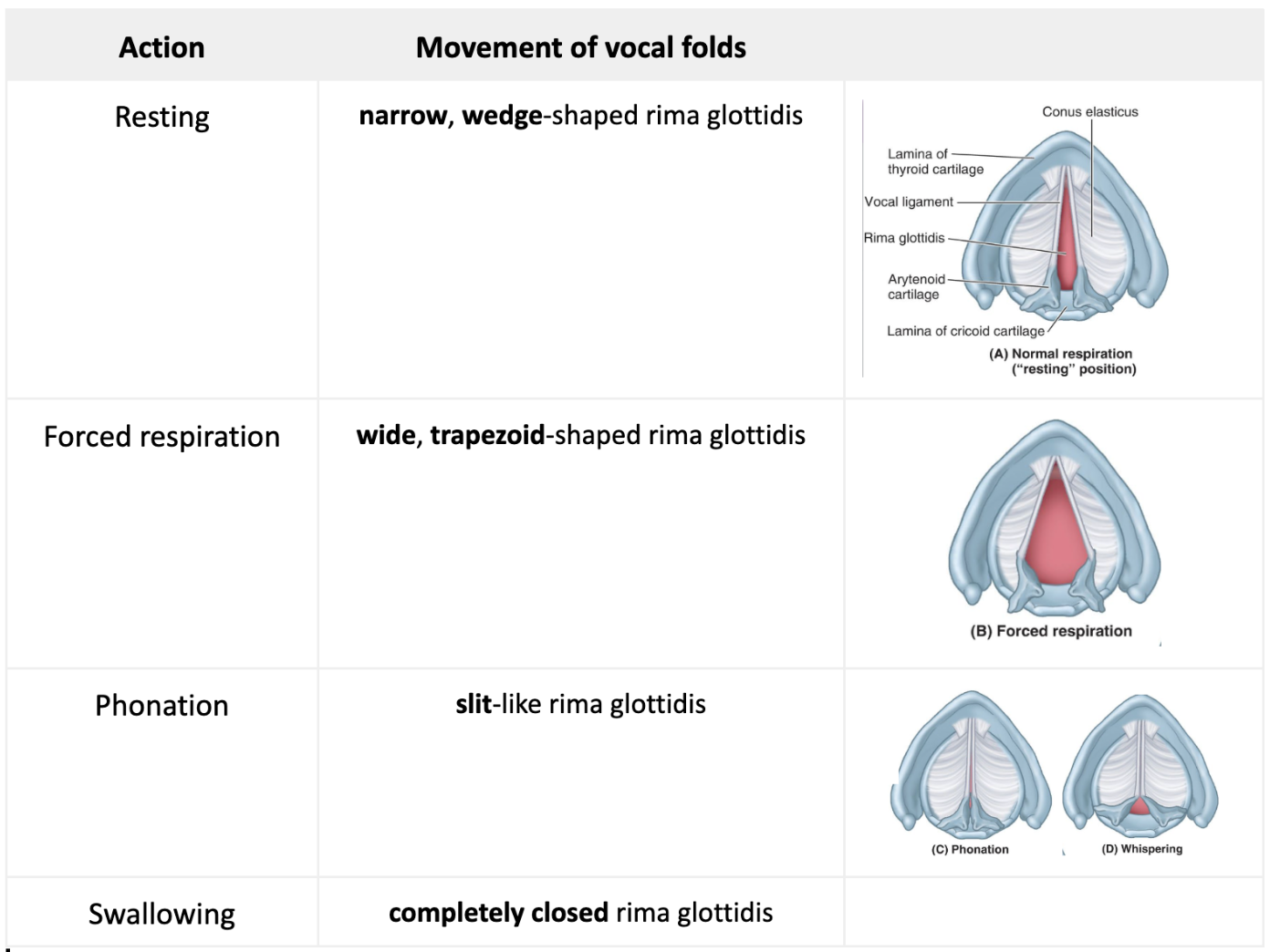
How are the vocal folds/chords positioned during:
resting (normal breathing)
forced respiration
phonation
swallowing
What is the role of the extrinsic muscles in relation to the larynx? What are they?
→ Move the larynx as a whole
Suprahyoid Muscles
Infrahyoid Muscles
What is the role of the intrinsic muscles in relation to the larynx? What are they?
→ Changes the length and tension of vocal folds + size of the rima glottidis
Cricothyroid (b/w cricoid & thyroid cartilage)
Posterior cricoarytenoid (b/w cricoid & arytenoid cartilage)
Vocalis
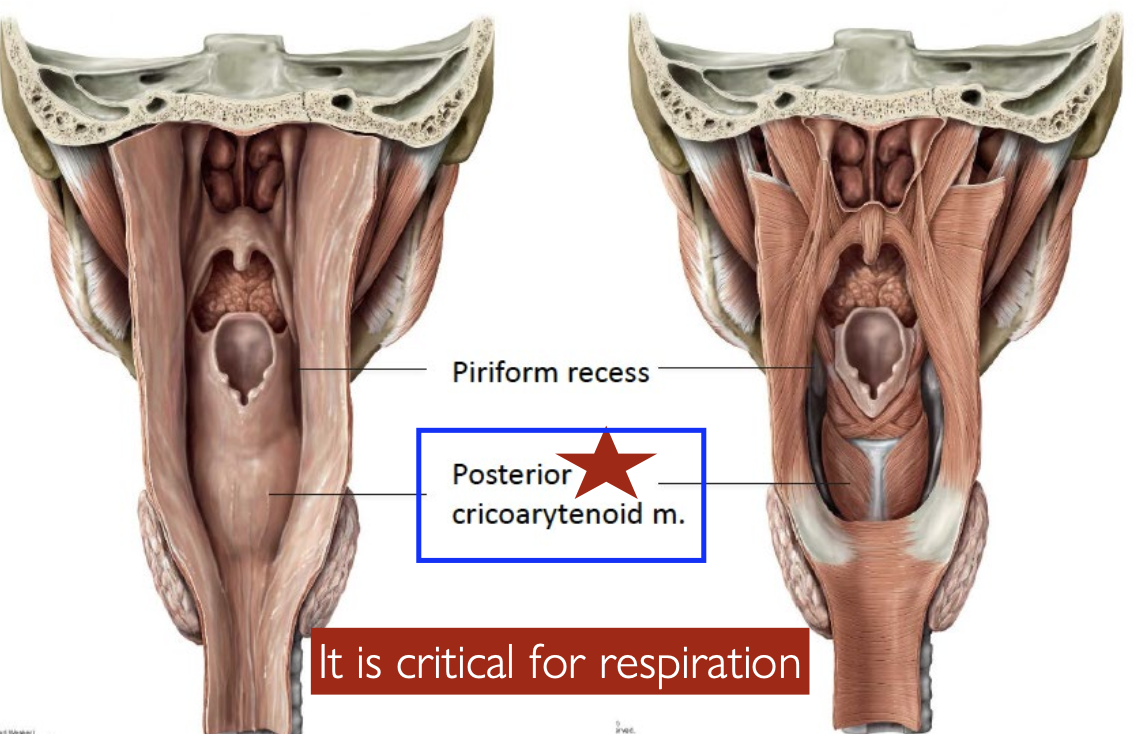
What is the only laryngeal muscle that abducts (opens) the vocal folds and rima glottis?
Posterior cricoarytenoid muscle
critical for respiration
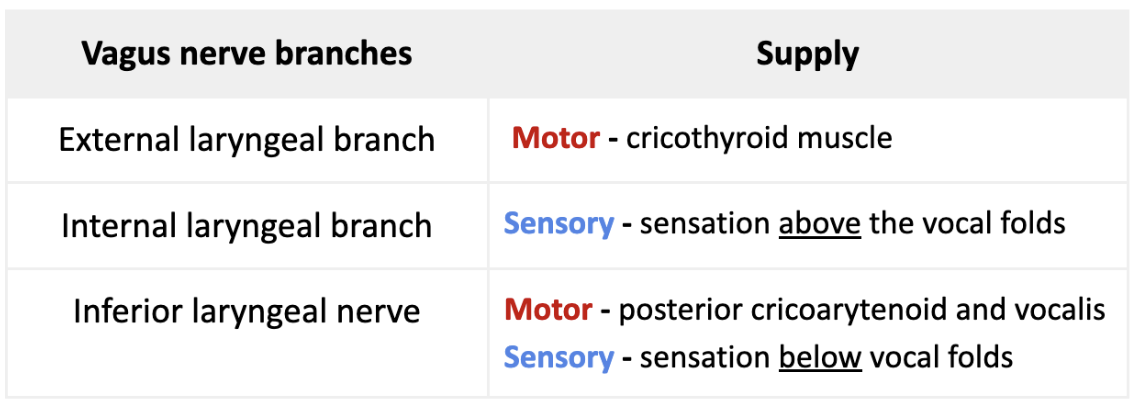
Draw a table showing the branches of the vagus nerve.
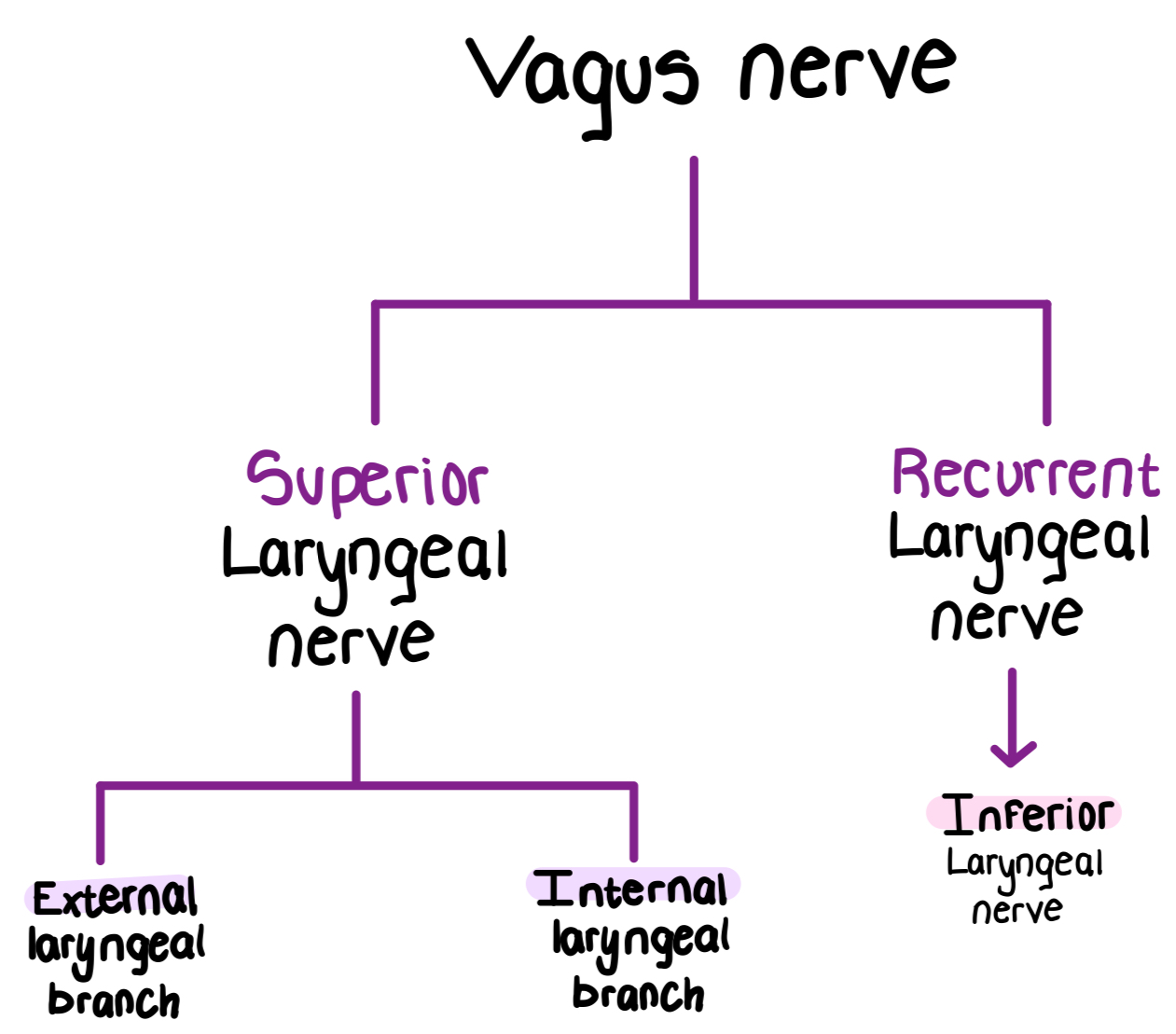
What do the following Vagus nerve branches supply?
External laryngeal branch
Internal laryngeal branch
Inferior laryngeal nerve
What is ALL sensation provided by?
Vagus nerve branches
Which of the 3 intrinsic laryngeal muscles is NOT supplied by the Recurrent larygengeal nerve?
Cricothyroid - supplied by External laryngeal branch
What is the arterial supply and venous drainage of the Larynx?
Arterial supply: superior & inferior thyroid artery
Venous drainage: superior, middle & inferior thyroid veins
larynx blood supply and drainage come from the thyroid

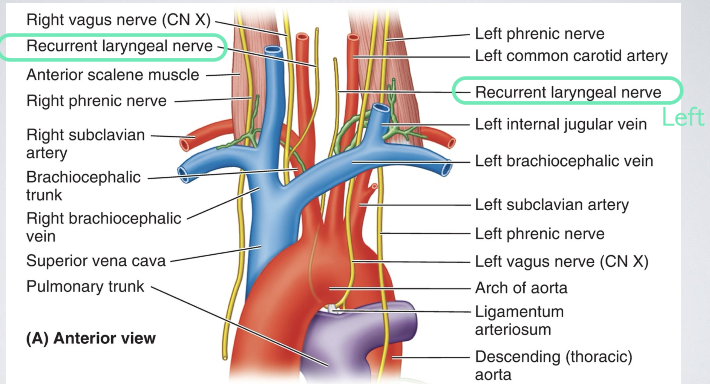
What is the path of the recurrent laryngeal nerve, and why is it easily damaged?
Right and left recurrent laryngeal nerve
Left (longer) - loops under the aortic arch and then ascends → prone to injury
Right - loops under the right subclavian artery
Both ascend back up the tracheoesophageal groove toward the larynx
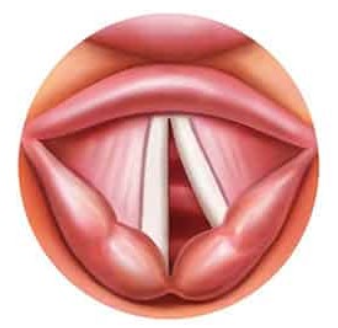
What happens if the recurrent laryngeal nerve is damaged unilaterally?
Normal side: moves normally
Damaged side: Cricoarytenoid can’t abduct on that side → vocal fold won’t open → appears like a “whispering gap” → hoarseness & difficulty breathing
Define glands.
organ that produces and releases substances that perform a specific function in the body
Define Endocrine glands.
→ ductless glands that produce & release hormones directly into the bloodstream
use the bloodstream to monitor the body’s internal environment and to communicate with each other via hormones
List examples of endocrine glands.
Suprarenal (Adrenal) glands
Pancreas
Gonads (ovary/testicle)
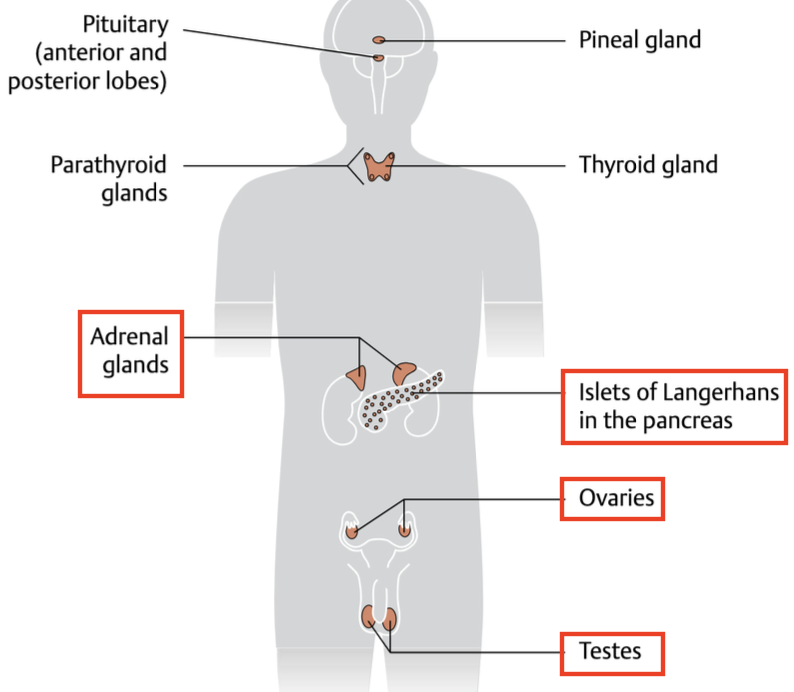
Which organs have hormone production as their primary function?
Adrenal gland
Pancreas (pancreatic islets)
Pineal gland
Pituitary gland
Parathyroid glands
Thyroid gland
Hypothalamus
Which organs have hormone production as their secondary function?
Digestive tract
Kidneys
Gonads
Heart
Thymus
Define Exocrine glands.
→ don’t produce hormones but release their secretions into ducts onto epithelial surface
e.g., Lymph nodes and sweat glands
List the Endocrine glands of the head and neck.
Thyroid
Parathyroid
What is the largest endocrine gland in the body?
Thyroid gland
Describe the characteristics of the Thyroid gland.
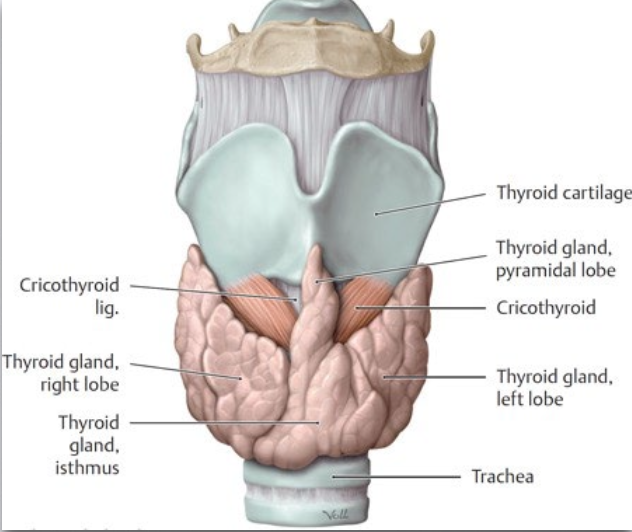
→ secretes hormones affecting metabolic rate and Ca2+ levels in body fluids
singular structure that bridges the midline
largest endocrine gland
found deep to infrahyoid muscles & anterolateral to larynx and trachea
covers 2nd and 3rd tracheal ring
What are the lobes of the Thyroid gland?
2 lobes - left & right
Pyramidal lobe
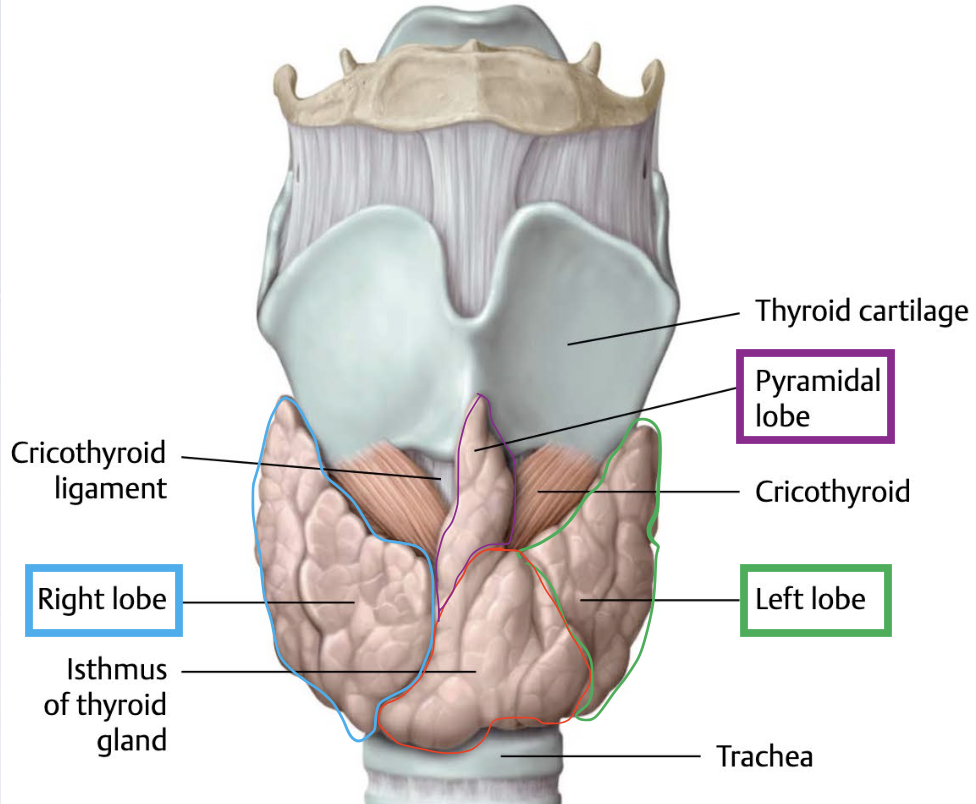
What is the pyramidal lobe?
found superiorly
has a fibrous capsule
highly variable structure - present in ~50% of population
What is the isthmus?
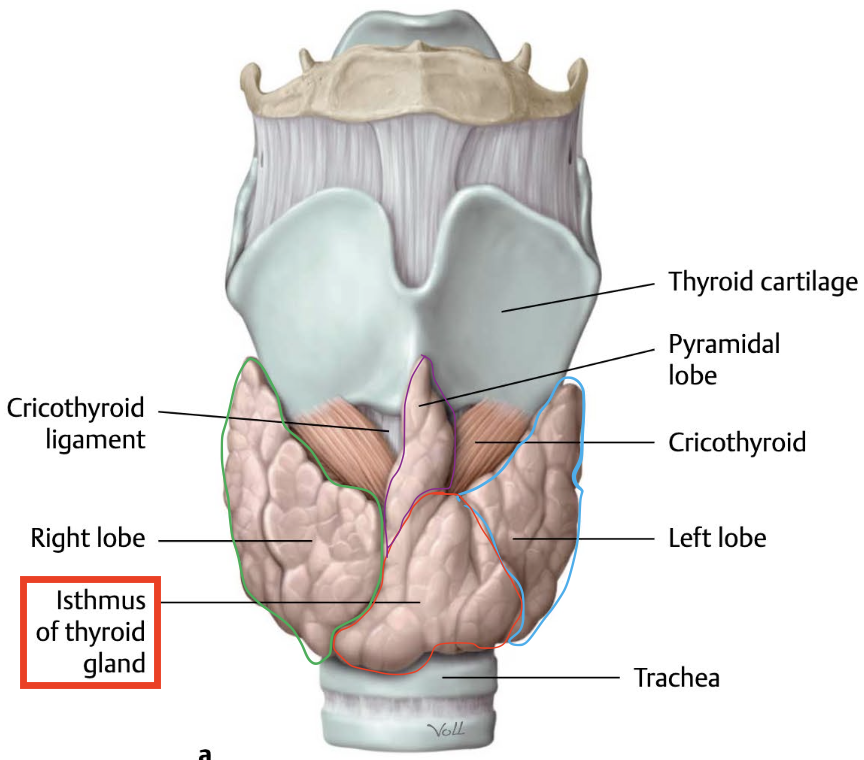
→ connects the left and right lobe
crosses the midline at the 2nd tracheal ring
What is the arterial supply and venous drainage of the Thyroid gland?
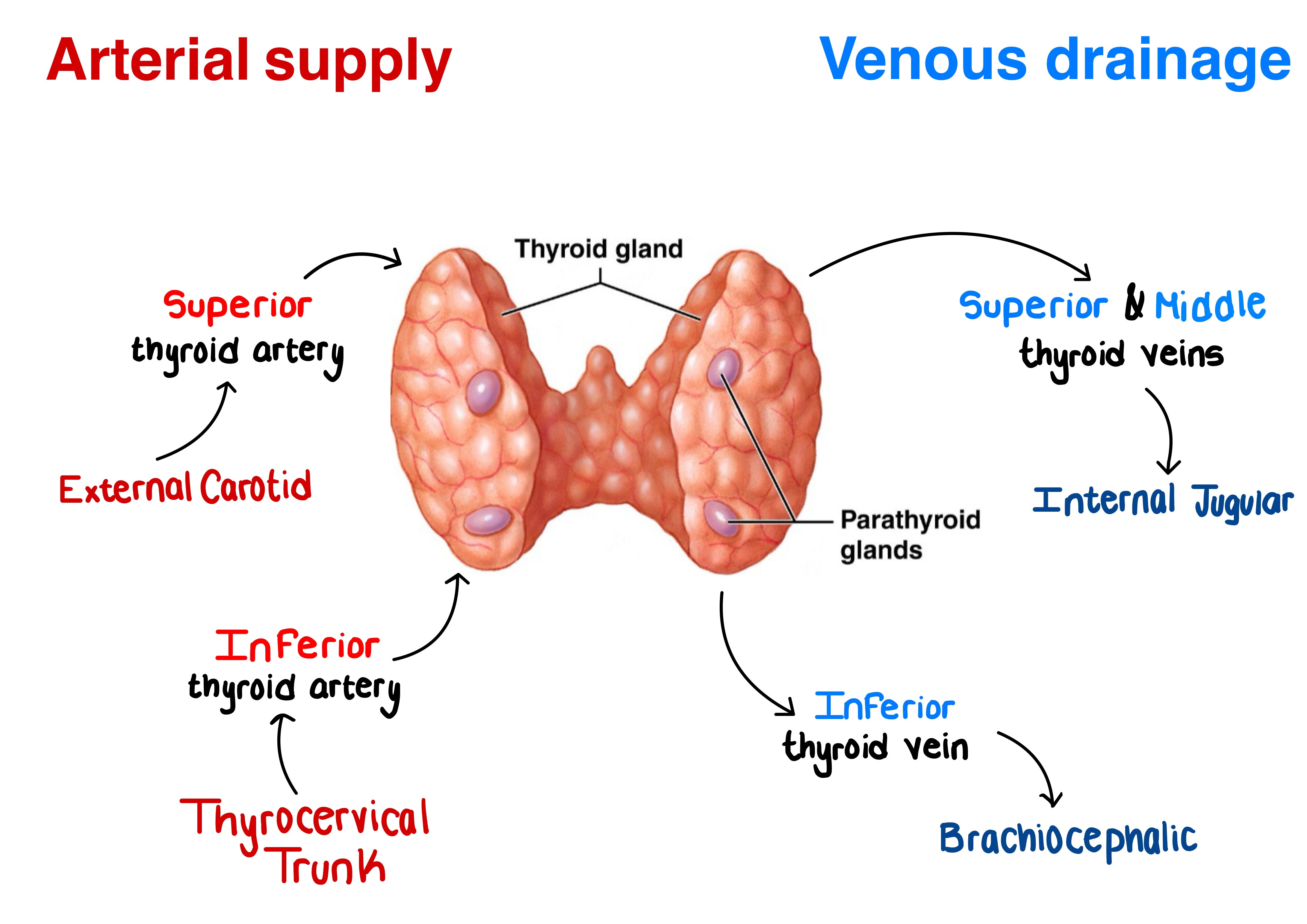
Describe the characteristics of the Parathyroid gland.
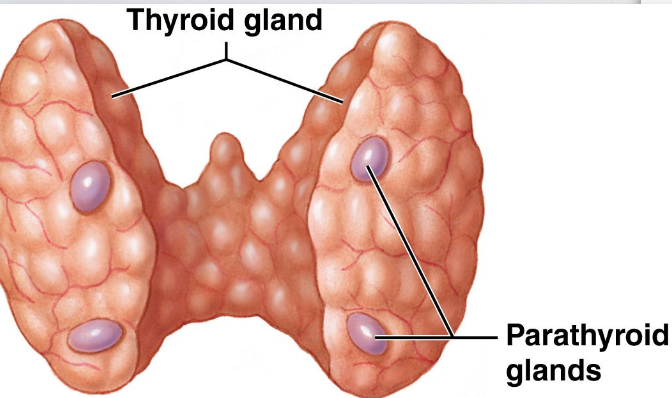
→ secrete PTH which regulates Ca2+ levels in body fluids
4 (2 pairs)
embedded in the posterior surface of the thyroid gland
vary widely in location from neck into the thoracic cavity
What nerve is at risk during surgery involving the neck or thyroid region?
recurrent laryngeal branch of CN X (vagus nerve)
What are salivary glands?
-exocrine glands
-3 salivary glands
Sublingual
Submandibular
Parotid
Salivary glands: What are the Sublingual glands?
→ secretes mucinous saliva (which accounts for ~3-4% of all saliva production) — mainly do lubrication
smallest of the 3
one found under each side of the tongue
make a small series of ducts along buccal side of tongue
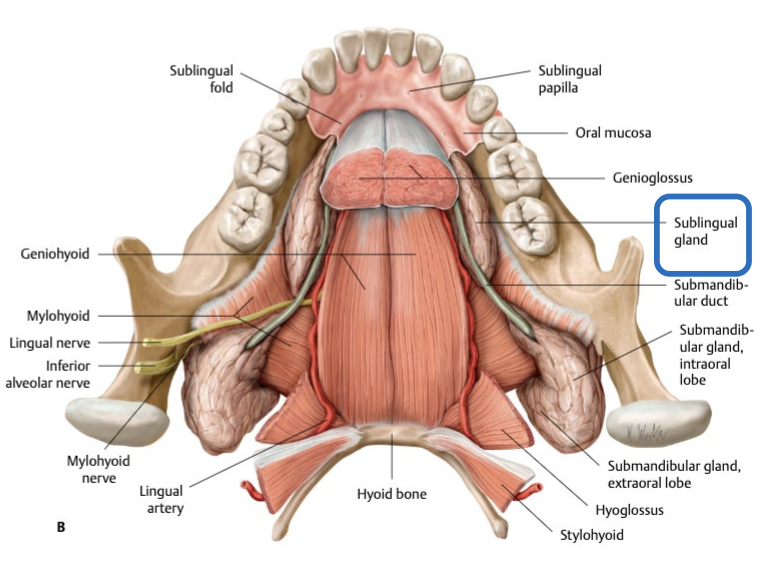
Salivary glands: What are the Submandibular glands?
→ produces serous & mucous secretions
seromucous gland → submandibular duct → sublingual papilla

Salivary glands: What are the Parotid glands?
→ produces serous secretions
serous gland → parotid duct → oral cavity
found outside your mouth (close to ear)

Describe the course of the terminal part of the facial nerve (CN VII) in the parotid gland.
Exits the cranial cavity via the stylomastoid foramen
Enters the parotid gland
Divides within the gland to form the parotid plexus
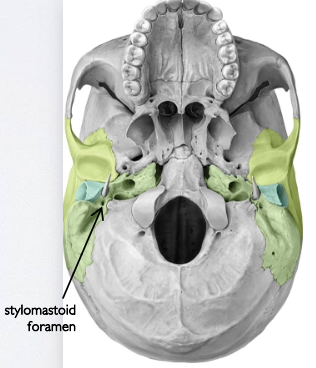
Since the facial nerve (CN VII) enters the parotid gland, does it provide parasympathetic innervation to the parotid gland?
No, it just passes through the parotid gland, NOT supply it
Why can parotid gland swelling affect facial nerve (CN VII) function?
Since CN VII runs inside the parotid gland, when the gland swells (e.g., mumps, sarcoidosis), it can compress CN VII
What is the Lympathic system?
→ System is made of lymphatic vessels, organs, and tissues
Nearly the entire body is drained via a network of lymphatic vessels along which lymph nodes are located
Lymphatic vessels have many valves for one-way drainage
Role: Drains excess ECF & cellular debris to the bloodstream and helps protect against infection
The lymphatic system includes cells, tissues, and organs responsible for 2 functions…
1) Immunity - ability to resist infection and disease
2) Maintaining normal blood volume and ISF composition
Identify the lymphatic structures that can be easily examined during a physical exam.
Tonsils
Lymph nodes
Spleen
Where can tonsils be seen during a physical exam?
can be seen in the posterior oral cavity, located b/w the palatoglossal and palatopharyngeal arches
Which lymph nodes are most easily palpated when enlarged?
Cervical (neck)
Axillary
Inguinal
Popliteal
These are readily palpated b/c they’re close to the skin
Can the spleen be palpated during a physical exam?
Yes it can be palpated in the abdomen, especially if enlarged
What are lymph nodes?
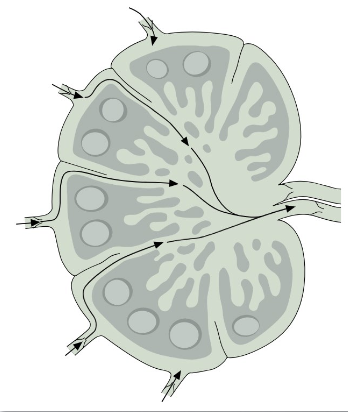
→ Small lymphoid organs surrounded by fibrous CT capsule
looks like a kidney bean
diameter range 1–25 mm (~ 1 inch)
Function: acts like a “filter” removing 99% of pathogens from lymph before fluid returns to bloodstream
Where are large lymph nodes (lymph glands) located?
Neck
Axillae
Groin
How does lymph typically drain in relation to infections?
→ lymph drains to the lymph nodes closest to the structure
when there’s an infection in a region, the nearest lymph nodes are the ones most likely to become affected
Describe the flow of lymph from lymphatic vessels to ducts.
1) Lymph is filtered through lymph nodes
2) Drains into larger lymphatic vessels
3) Vessels converge into lymphatic trunks
4) All trunks ultimately drain into 1 of 2 lymphatic ducts
What are the major lymphatic trunks?
Jugular
Bronchomediastinal
Lumbar
Subclavian
Intestinal
What is the largest lymphatic vessel?
Thoracic duct (that’s why it drains most of the body)
What does the thoracic duct drain? Where does it empty?
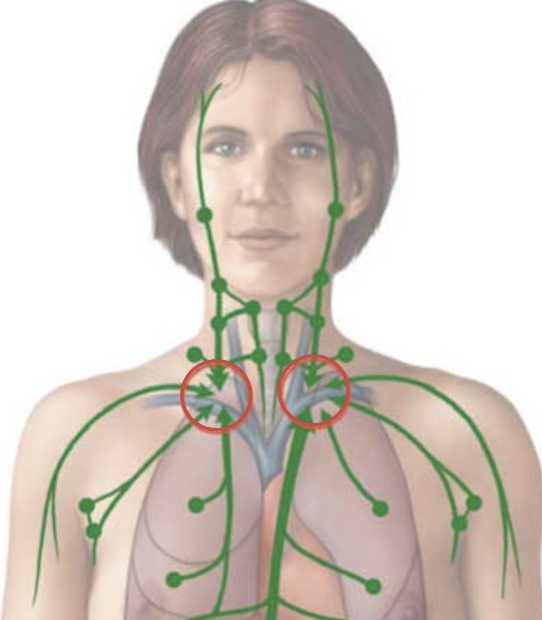
→ drains the entire body below the diaphragm & left side of the body above the diaphragm
empties at the left jugulosubclavian junction (venous angle) in the neck
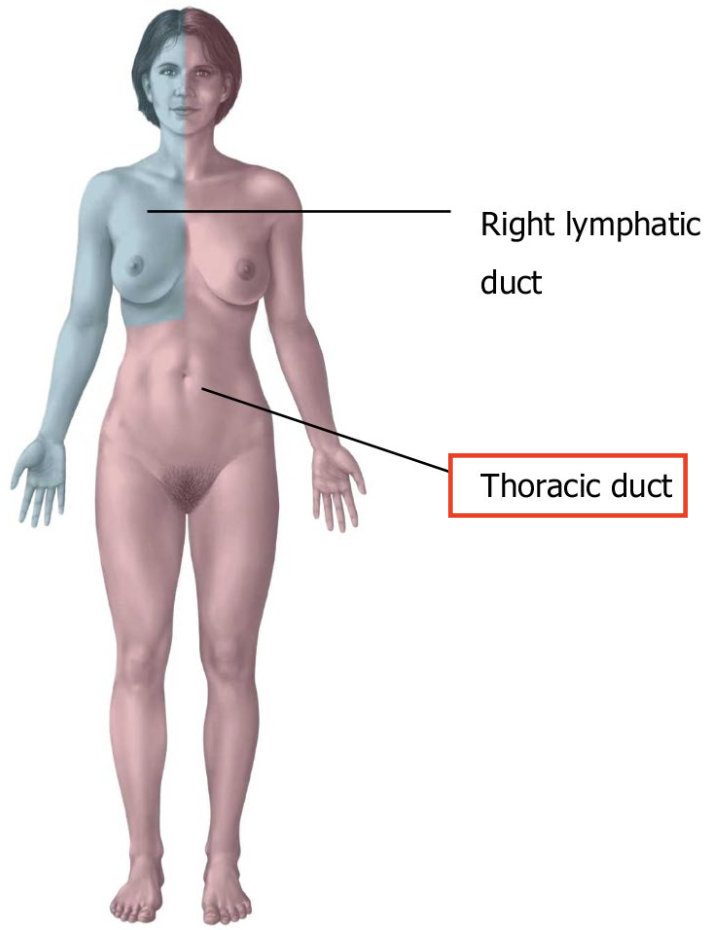
What does the right lymphatic duct drain? Where does this empty?
→ drains lymph from the right side of the head and neck, right upper limb, and right side of the chest
empties into the right subclavian vein, near the junction with the right internal jugular vein

Where are the lymph nodes located?
Occipital
Preauricular (Parotid)
Postauricular
Subclavian
Submandibular
Submental
Anterior and posterior cervical
Deep cervical (not usually palpable)
Supra- and Infra- clavicular
Tonsilar
What is lymphatic staging?
→ testing for the metastasis of tumors along lymphatic pathways
metastasis follows the order of lymphatic drainage
in the head and neck, staging is more complex because lymph nodes are arranged into groupings or “basins”
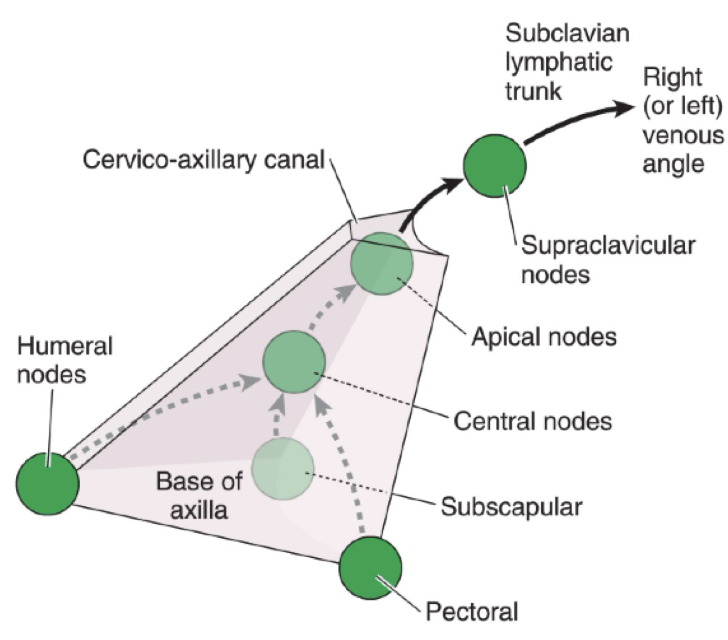
What are lymphatic basins?
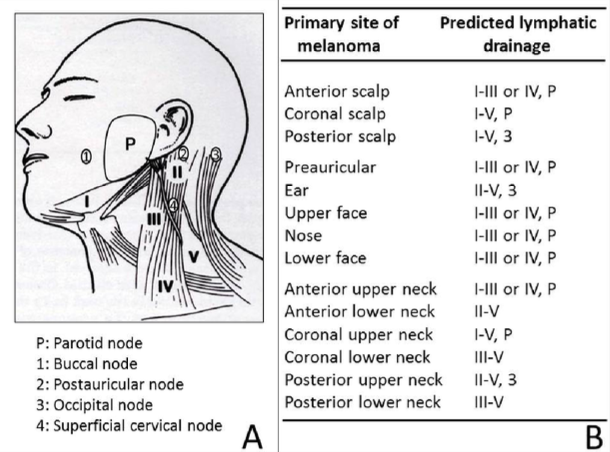
→ represent predictable drainage patterns for lymph in the anterior neck
these patterns prevent the surgeons from cutting up the whole neck to look for cancer spread