Gen Chem 2 Exam 6
 Call Kai
 Learn
Learn Practice Test
 Spaced Repetition
 Match
Match Flashcards
 Knowt Play
1/56

There's no tags or description
Looks like no tags are added yet.
Name | Mastery | Learn | Test | Matching | Spaced | Call with Kai | Chat |
|---|
No analytics yet
Send a link to your students to track their progress
57 Terms
metals
solid at room temperature, lustrous, malleable, conductive of hear and electricity
transition metals
occupy the d and f blocks of the periodic table
Metalloids
have properties of both metals and nonmetals (semiconductors, shiny, brittle solids)
Nonmetals
brittle dull, poor conductors or nonconductors
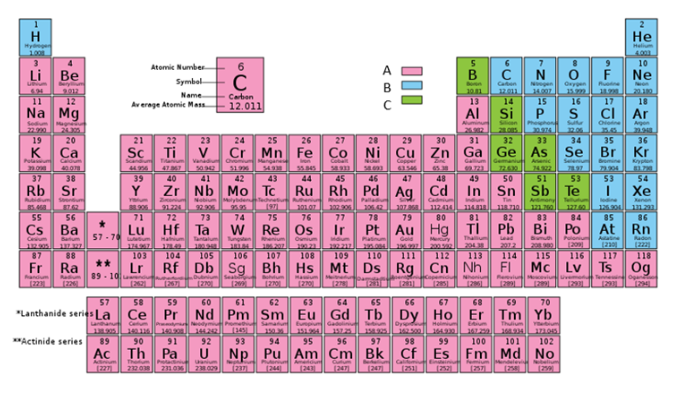
A. metals, B. nonmetals, C. metalloids
Label A, B, and C by element classification
periods
— are rows
groups
— are columns
coordination compound
composed of coordination complex
coordination complex
the product of a Lewis acid-base reaction in which neutral molecules or anions bond to the central metal atom (or ion) by coordinate covalent bonds
ligand
the Lewis base (neutral/negative molecule)
central metal atom
the Lewis acid
coordinate covalent bond
one atom supplies both shared electrons
donor atom
the atom that supplies the shared electrons
complex ion
coordination complex that carries a charge
coordination sphere
the central metal plus its attached ligands (indicated by [] in the chemical formula)
coordination number
the number of donor atoms bonded to the central metal atom
A. OH- B. Fe2+ C. O D. 4
| Lewis base (ligand) | Lewis acid (central metal) | Donor atom | Coordination number |
[Fe(OH)4]2-
| A. ________ | B. ________ | C. ________ | D. ________ |
Alkali, 1, 1+, largest, lowest, fog penetration, batteries
Group 1: — metals: # valence electron, # typical charge, classified as metals (except H), have the — atomic radii and the — ionization energy, common uses: Na is used for — — street lights, Li is used in —
alkaline, 2, 2+, reducing, ionic, fireworks, chalk
Group 2: — Earth Metals: # valence electron, # typical charge, classified as metals, strong — agents, form — compounds, common uses: —, airplanes, —, paint, toothpaste
1, 2+, transition metals, decreases, amalagams
Group 12: # valence electron, # typical charge, classified as — —, similar behavior to group 2 but reactivity trend — as you go down the group, common applications: —
amalagam
alloy of Mercury (Hg) and some other metal, useful for panning for gold and dental fillings
3, 3+, metal, amphoteric, basic, semiconductor, commercial
Group 13: # valence electron, # typical charge, classified as —, forms oxides that can be — or —, B is a —, Al is used in many industrial, transport and — products
4, 4+, metal, allotropes, life
Group 14: # valence electron, # typical charge, classified as —, produces several —, common uses carbon forms organic compounds necessary for all —
allotropes
same element in same physical state with different physical and chemical properties (ex carbon: graphite vs diamonds)
inert pair effect
the formation of a stable ion with an oxidation state 2 lower than expected for the group
5, 5+ to 3-, variety, increases, protein, DNA, batteries
Group 15: # valence electron, # typical charge, has a — of elemental classes, metallic character — as you go down the group, N and P are essential for — and —, also produces alloys used in —
Group 16:
7, 1-, nonmetals, diatomic, increases, halides
Group 17: Halogens: # valence electron, # typical charge, classification —, exist as — molecules, highly reactive, Van der Waals forces — down the group, common uses: binary —
Nobel gases, 8, 0, nonmetals, reactive, electric
Group 18: — —: # valence electron, # typical charge, classification —, least — elements, very low melting points, common uses: glow in characteristic colors when an — current is applied
protons
positively charged molecules in the nucleus
neutrons
neutral charge molecules in the nucleus
electrons
negatively charged molecules surrounding the nucleus
616C, 10
1) Write the notation of the following isotopes using the format: ZXA. 2) State the number of neutrons in each nuclide.
Carbon-16
convert amu to kg, use E=mc², Convert J to eV
to find the nuclear binding energy when given the mass defect: ST1 —-, St2 —-, St3—
atomic number
the number of protons in an atom (Z in ZAX)
mass number
the number of protons and electrons in an atom (A in ZAX)
alpha particle
He nuclei consisting of 2p+ and 2n0
beta particle
an electron
positron
particles with same mass as an electron but with 1 unit of positive charge
proton
nuclei of H atoms
neutron
particles with a mass approximately equal to that of a proton but with no charge
gamma ray
very high energy electromagnetic radiation
alpha decay
the emission of an alpha particle from the nucleus (you get some element plus and alpha particle/He)
beta decay
the conversion of a neutron into a proton and a beta particle (you get some element plus a -1 beta)
gamma emission
when a nuclide is formed in an excited state and then decays to its ground state with the emission of a gamma ray (same element plus gamma)
positron emission
when you get an element and a positron (+1e or +1 beta)
electron capture
when you have an electron that combines with a proton to produce a new element
decay
half-life of a radioisotope is the time required for half of the atoms in the sample to —
dispose, replaced
radioisotope half-lives are useful for knowing how long a substance will be radioactive and when it is safe to —of, it is also useful for determining how long it is available before it must be —
transmutation
the conversion of one nuclide into another
radioactive, manipulated
transmutation can occur naturally through — decay or be — in a laboratory setting
nuclear fission
breaking of a large nucleus into smaller pieces, releasing large amounts of energy
nuclear fusion
the process of converting lighter nuclei to heavier nuclei
non-ionizing radiation
lower-frequency energy waves that cause particles to speed up, producing heat (microwaves, radiowaves)
ionizing radiation
higher frequency energy waves that break bonds and remove electrons, disrupting the function of biomolecules (used to treat cancer)
Raydon-222
radiation that is found naturally in soil and can accumulate in basements
cation, anion, ligand, latin
Rules for naming complexes:
if the coordination compound is ionic, name the — first and the — second
name the — first then the central atom
if more than one ligand is present, a numerical prefix is added to indicate the number of ligands used
when the complex is a cation the oxidation state of the central metal is indicated in its name using roman numerals
when the complex is an anion the name of the central atom is given the suffix -ate and given the oxidation number in its name
if the common English name is clumsy use —