Topic 6 Water Quality
 Call Kai
 Learn
Learn Practice Test
 Spaced Repetition
 Match
Match Flashcards
 Knowt Play
1/52

There's no tags or description
Looks like no tags are added yet.
Name | Mastery | Learn | Test | Matching | Spaced | Call with Kai | Chat |
|---|
No analytics yet
Send a link to your students to track their progress
53 Terms
Water Quality Considerations
Microbial Growth
viruses, bacteria, eukaryotic parasites
other biological material
e.g., from food
feces and urine contamination
chemicals
industrial, agricultural runoff
chemicals excreted in urine
Harmful bacteria
ecoli → pathogenic (transmitted from the fecal to oral route, found in the ruminance of cows)
Cholera (vibrio cholerae) → food borne
Typhoid fever → water-borne; food-borne category
cyanobacteria blooms (prokaryotic) → overgrowth = compromises in water quality
E Coli
Causes severe gastrointestinal illness
Vibrio Cholerae
agent responsible for cholera, disease characterized by acute watery diarrhea and rapid dehydration
Salmonella enterica serovar Typhi
causes typhoid fever and is typically associated with contaminated drinking water
Cyanobacterial Blooms
occur in nutrient-rich waters, produce toxins that may affect both human and ecosystem health
Harmful Viruses
norovirus
polio virus
hepatitis A
Rotavirus
adenovirus
all of these viruses non-enveloped/ naked viruses
Norovirus
common cause of acute gastroenteritis and is highly infectious even at low doses
Poliovirus
transmitted through contaminated water and can lead to poliomyelitis, a disease that can cause paralysis
Hepatitis A
spreads via fecal to oral route and can cause liver inflammation and illness
Rotavirus
major cause of severe diarrhea in young children
Adenovirus
present in water and is associated with a range of illnesses,
including respiratory and gastrointestinal infections
Harmful eukaryotes
Giardia
Cyclospora
Cryptosporidium
Algal Blooms
Giardia
protozoan parasite that can cause gastrointestinal illness following ingestion of contaminated water
Cyclospora
protozoan pathogen associated with waterborne transmission and can lead to prolonged diarrheal disease
Cryptosporidium
highly resistant protozoan parasite that can survive common disinfection processes and cause cryptosporidiosis, which is characterized by severe watery diarrhea
Algal blooms
represent a hazard in water systems, as certain eukaryotic algae may proliferate rapidly under nutrient-rich conditions and contribute to water quality deterioration and toxin production
Main goals of waste water treatment?
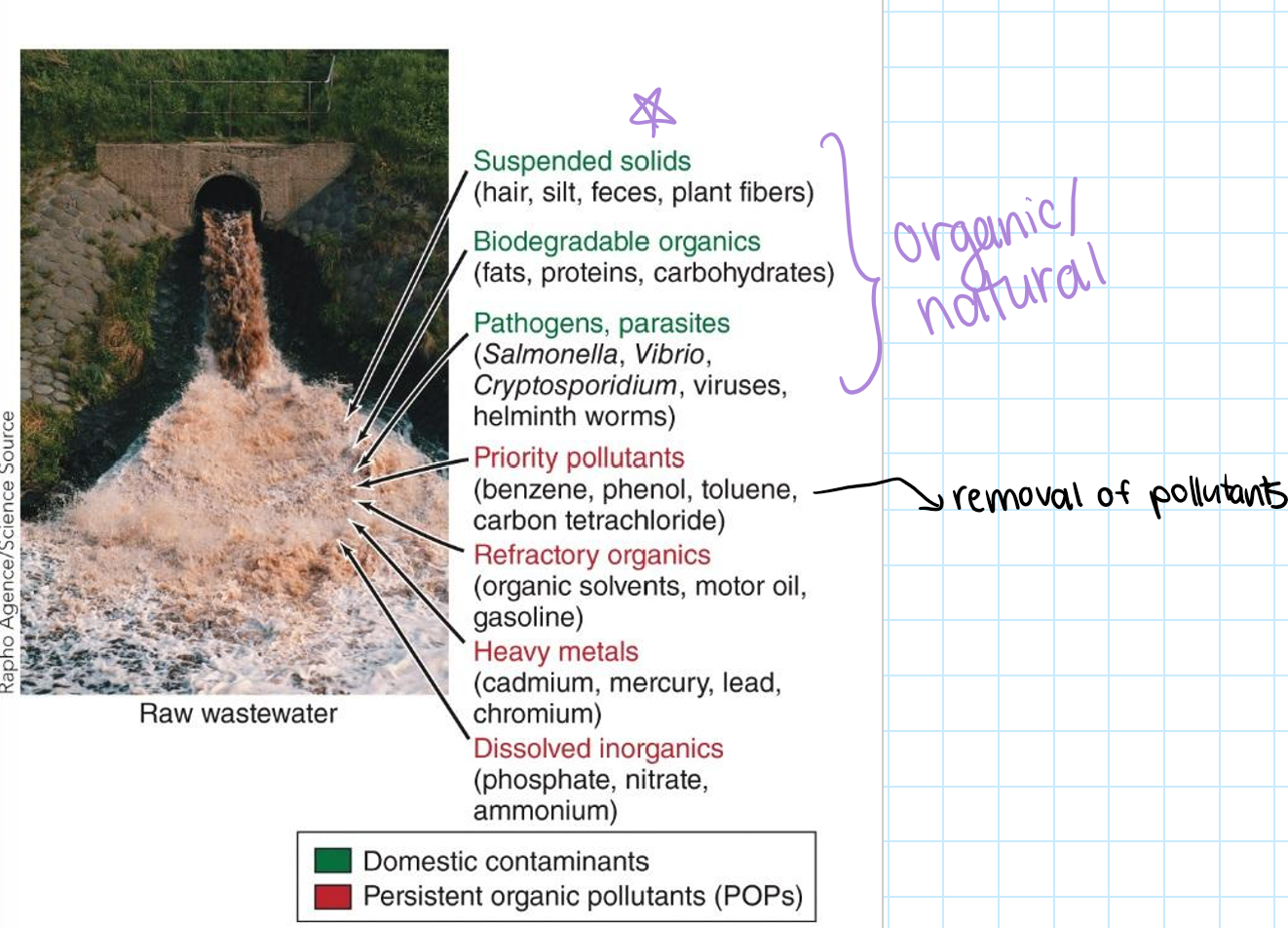
The main goals of wastewater treatment are to:
Lower total organic carbon (TOC) by:
Removing organic compounds
Oxidizing organic material into CO₂
Remove, kill, or inactivate harmful microbes through:
Intrinsic mechanisms: Competitive exclusion by beneficial microbes
Extrinsic mechanisms: Physical, chemical, and biological treatment processes
Reduce inorganic nutrients such as:
Ammonium (NH₄⁺), Nitrate (NO₃⁻), Phosphates (PO₄³⁻)
Recall: Carbon (C), nitrogen (N), and phosphorus (P) are essential nutrients for microbial growth.
Remove persistent organic pollutants (POPs), including:
Pesticides
Pharmaceuticals
Why are carbon (C), nitrogen (N), and phosphorus (P) important in wastewater treatment?
Nitrogen (N) and phosphorus (P) promote rapid phytoplankton growth, which can cause eutrophication.
Some phytoplankton produce toxins that are harmful to humans and wildlife.
When phytoplankton die, they become organic carbon (C).
Organic carbon feeds heterotrophic microbes, which consume O₂ while decomposing it.
This increases biological oxygen demand (BOD) and can deplete oxygen in aquatic environments, harming aquatic life.
What are the four main steps of wastewater treatment?
Pre-treatment
Physically removes large debris (e.g., branches, stones).
Primary treatment
Removes suspended particles by sedimentation and raking.
Removes grease, oils, and floating material by skimming.
Typically takes several hours.
Secondary treatment
Microbes degrade organic matter, reducing biological oxygen demand (BOD).
Lowers intestinal pathogens through:
Competition
Predation
Settling with floc
Common methods:
Trickling filter
Conventional Activated Sludge (CAS) process
Tertiary treatment (optional)
Additional treatment to:
Remove pathogens
Remove nutrients (N and/or P)
Provide other advanced treatment as needed
Visual of steps
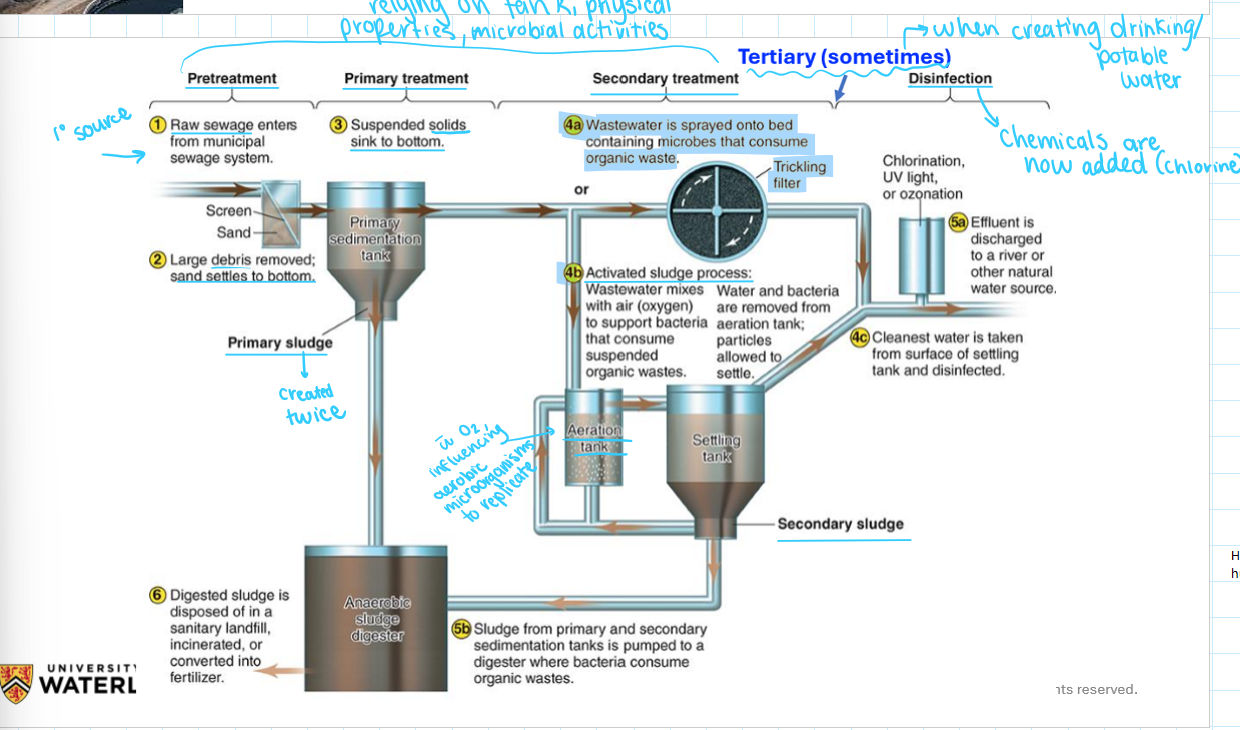
Secondary Treatment Trickle Filter
Wastewater is sprayed over the surface of a trickling filter.
As water moves downward, it provides nutrients for biofilm microbes living on the filter surface.
Oxygen (O₂) may be pumped into larger filter beds to support aerobic microbial activity and prevent oxygen limitation.
Excess organic waste can cause excessive biofilm growth, which may:
Clog the filter
Reduce treatment efficiency
The biofilm community includes:
Bacteria
Fungi
Protists
Larger organisms may graze on the biofilm, contributing to microbial community dynamics.
How does secondary wastewater treatment using an activated sludge reactor work?
Activated sludge reactors rely on flocs, which are clumps of:
Organic material
Biofilm-associated microbes
Flocs contain diverse microbial communities that work together to:
Degrade organic matter in wastewater
Reduce biological oxygen demand (BOD)
Zoogloea is an important bacterium because it:
Helps form and stabilize floc structures
Promotes aggregation and settling of biomass
Improves treatment efficiency
What are the main components of an activated sludge reactor in secondary wastewater treatment?
An activated sludge reactor contains two main tanks:
Aeration tank
Wastewater is held for approximately 5–10 hours (variable).
Oxygen is supplied to support microbial communities that degrade organic matter.
Settling tank
Flocs settle to the bottom.
Allows separation of:
Clarified treated water
Microbial biomass (sludge)
Purpose: Reduce organic matter and lower biological oxygen demand (BOD) through microbial activity.
What is the purpose of an anaerobic sludge digester in wastewater treatment?
Uses anaerobic microbes to break down waste in sludge.
Removes excess microbial biomass produced from the activated sludge reactor.
Takes approximately 2–4 weeks.
Produces less biomass because:
Anaerobic microbes obtain less energy from metabolism.
Less energy is available for microbial growth, so more organic material is converted into end products instead of new cells.
Can operate as:
Mesophilic digesters (moderate temperatures)
Thermophilic digesters (higher temperatures)
Produces methane (CH₄), which can be captured and burned for energy.
Remaining sludge can be:
Dehydrated and burned
Sent to landfill
Processed into biosolids used as fertilizer
What are potential problems that can occur during wastewater treatment?
Changes in environmental conditions (e.g., organic concentration or O₂ levels) can promote the growth of filamentous bacteria.
Excess filamentous bacteria can interfere with normal floc formation.
This produces less dense flocs that:
Do not settle properly in the settling tank
Reduce the efficiency of wastewater treatment.
What is an example of a filamentous bacterium involved in wastewater treatment problems, and what conditions does it favor?
Example: Sphaerotilus natans (G-)
Requires:
Dissolved simple sugars
Organic acids as carbon sources
Can tolerate low oxygen (O₂) conditions.
Low oxygen conditions can allow it to grow excessively, disrupting normal floc formation and reducing settling efficiency.
not pathogenic
How is the reduction of organic carbon in wastewater treatment assessed?
Measured using biological oxygen demand (BOD).
BOD = the amount of O₂ required by microbes to decompose organic matter remaining in water.
A high BOD indicates:
More organic material is present.
More oxygen will be consumed by microbial decomposition.
If high-BOD wastewater is released into lakes or rivers:
Microbes consume dissolved O₂.
Oxygen levels can decrease, harming aquatic organisms.
How is biological oxygen demand (BOD) measured?
water sample (e.g., wastewater) is:
Incubated at 20°C for 5 days
Dissolved O₂ is measured at the start and end
The difference in O₂ levels = BOD
The test is performed in the dark to:
Prevent photosynthesis from producing O₂
Ensure oxygen changes are due only to microbial consumption
One measurement method:
CO₂ produced by microbes is absorbed by NaOH pellets
Pressure changes are measured
Pressure changes are converted into O₂ consumption, which represents BOD.
Why do carbon (C), nitrogen (N), and phosphorus (P) matter in aquatic environments and wastewater treatment?
Nitrogen (N) and phosphorus (P) promote faster phytoplankton growth.
Excess phytoplankton growth can cause:
Eutrophication
Production of toxins that harm humans and wildlife
When phytoplankton die, they provide organic carbon (C).
Organic carbon feeds heterotrophic microbes, which consume O₂ during decomposition.
Increased microbial oxygen consumption raises BOD and can lead to oxygen depletion in aquatic environments.
How is nitrogen removed during wastewater treatment?
Nitrogen removal occurs through nitrification and denitrification:
1. Nitrification (aerobic)
Converts ammonia (NH₃/NH₄⁺) → nitrite (NO₂⁻) → nitrate (NO₃⁻).
Reduces toxic ammonia and nitrite levels that can harm aquatic life.
Requires oxygen (O₂).
2. Denitrification (anaerobic)
Converts nitrate (NO₃⁻) → nitrogen gas (N₂).
Often requires an input of organic carbon as an energy source for microbes.
Treatment design:
Uses multiple reactors:
Aerobic reactor → nitrification
Anaerobic reactor → denitrification
Alternative: Anammox bacteria
Convert ammonium + nitrite → N₂ gas directly.
Ammonium: energy and electron source
Nitrite: electron acceptor for respiration
Are chemolithoautotrophs:
Use inorganic compounds for energy
Do not require organic carbon input.
What is the goal of drinking water treatment, and what types of water are treated?
Goal: Produce water that is safe to use and consume by removing contaminants and harmful microorganisms.
Types of water treated:
Wastewater:
Domestic wastewater (from toilets and sinks)
Industrial wastewater
Storm water (urban runoff)
Source water: Treated to make it safe for human use and consumption.
What are the main water sources for drinking water, and what is the purpose of reservoirs?
Reservoirs: Natural or artificial storage systems that hold water for future use.
Main water sources:
Mountain snowmelt
Streams
Rivers
Ponds
Lakes
What are the three particle removal steps in drinking water treatment, and what happens in each?
Coagulation: Chemical coagulants are added to neutralize charges and aggregate suspended particles.
Flocculation: Gentle mixing encourages particles to combine into larger flocs.
Sedimentation: Flocs settle to the bottom of the tank and are removed.
What are the pathogen removal steps in drinking water treatment, and what happens in each?
Filtration: Water passes through filter beds to remove any remaining particles.
Disinfection: Chemicals, UV light, or ozone are used to kill or inactivate harmful microorganisms, making the water safe to drink.
How did the introduction of chlorine impact public health?
Chlorine was introduced for drinking water disinfection in the early 1900s.
Chlorination greatly reduced waterborne diseases by killing harmful microorganisms.
Its widespread use led to a decline in the crude death rate, improving overall public health.
What are the key concepts of disinfection in drinking water treatment?
Chlorine is the most commonly used chemical disinfectant.
Forms of chlorine used:
Chlorine gas
Sodium hypochlorite
Calcium hypochlorite
Treatment plants must add disinfectants regardless of source water quality to ensure microbial safety.
Non-chemical disinfection: Uses ultraviolet (UV) light to inactivate microorganisms.
Effectiveness varies between disinfectants and target organisms.
Disinfection works best when particle removal is sufficient because microbes can be protected inside particles.
How does chlorination affect bacteria?
Chlorine kills/inactivates bacteria by causing:
Changes in cell membrane permeability → disrupts transport processes and damages cell integrity.
Destruction of enzymes → interferes with essential metabolic functions.
DNA destruction → prevents replication and normal cellular function.
Disruption of lipid peroxidation → damages membrane lipids and weakens cell structure.
What are examples of harmful cyanobacterial toxins found in water, and how do they affect humans?
Anatoxin:
A neurotoxin that affects the nervous system.
Not regulated in treated drinking water in Canada.
Microcystin:
A hepatotoxin that damages the liver.
The only regulated cyanobacterial toxin in treated drinking water in Canada.
Maximum limit: 1.5 μg/L.