Lecture 2: Environmental chemicals
 Call Kai
 Learn
Learn Practice Test
 Spaced Repetition
 Match
Match Flashcards
 Knowt Play
1/37

There's no tags or description
Looks like no tags are added yet.
Name | Mastery | Learn | Test | Matching | Spaced | Call with Kai | Chat |
|---|
No analytics yet
Send a link to your students to track their progress
38 Terms
What is a chemical substance?
A form of matter having constant chemical composition and characteristic properties.
What is matter?
A physical substance in general, which occupies space and possesses rest mass, especially as distinct from energy.
What is mass?
The quantity of matter which a body contains, as measured by its acceleration under a given force or by the force exerted on it by a gravitational field.
What is chemical composition?
The identities and relative numbers of the elements that make up any particular compound.
What is an element?
A substance whose atoms all have the same number of protons — all of a particular element’s atoms have the same atomic number. Elements are chemically the simplest substances and hence cannot be broken down using chemical reactions.
What is atomic number?
The number of protons in the nucleus of an atom, which is characteristic of a chemical element and determines its place in the periodic table.
What is a nucleus?
The centre of an atom. It is made up of nucleons called (protons and neutrons) and is surrounded by the electron cloud.
What is a proton?
A stable subatomic particle occurring in all atomic nuclei, which a positive electric charge equal in magnitude to that of an electron.
What is an electron?
A stable subatomic particle with a negative electric charge, found in all atoms and acting as the primary carrier of electricity in solids.
What is a neutron?
A subatomic particle of about the same mass as a proton but without and electric charge, present in all atomic nuclei except those of ordinary hydrogen.
What is the electron shell or atomic/molecular orbitals?
The outside part of an atom around the atomic nucleus where the electrons are, and is a group of atomic orbitals with the same value of the principal quantum number n.
Electron shells have one or more electron subshells, or sublevels
These sublevels have two or more orbitals with the same angular momentum quantum number
Electron shells make up the electron configuration of an atom
What is the valence shell?
The valence shell is the outermost shell of an atom in its uncombined state, which contains the electrons most likely to account for the nature of any reactions involving the atom and of the bonding interactions it has with other atoms
Why is the atomic mass not an integer?
The mass of an atom of a chemical element is approximately
equivalent to the number of protons and neutrons in the atom (the
mass number) or to the average number allowing for the relative
abundances of different isotopes.
What is an isotope?
Variants of the same element that contain equal numbers of protons but different numbers of neutrons in their nuclei, and hence differ in relative atomic mass but not in chemical properties; in particular, a radioactive form of an element.
Why would an environmental scientist care about atomic mass?
Atomic mass is important because we are using scales to measure chemicals in the environment.
Xenobiotics
Foreign chemicals in an organisms (not normally produced or expected to be present)
Pollutants
Substances that are introduced to the environment and have undesired effects or adversely affect environmental resources.
Contaminants
Unwanted constituents in the environment that render air, water, soil, biota impure and — in sufficient concentration — are harmful.
Poisons
Substances that cause disturbance to organisms when absorbed at a sufficient quantity.
Toxicants
Poisons made or introduced by humans.
Toxins
Poisons made naturally by organisms.
Venoms
Toxins injected via e.g.a bite or sting
Chemical regulation in Australia
Therapeutic Goods Administration
Food Standards Australia New Zealand
Australian Pesticides and Veterinary Medicines Authority
Australian Industrial Chemicals Introduction Scheme
Why does environmental toxicology even exist?
It exists because there is a myriad of synthetic chemicals on the market (and formed as byproducts)
Only approx. 10% of chemicals are thoroughly tested
Only approx. 2% screened for carcinogenic and mutagenic properties
Terms for chemicals
Industrial chemicals
solvents
consumer products
fertilisers
surfactants
plastics
additives
polymers
pigments
intermediates
Natural toxicants
Pharmaceuticals
Pesticides
Biocides
Unintentional by-products
Metals and organometallics
Classification groups
By origin or use:
source
anthropogenic (e.g. industrial, agricultural), natural (e.g. dinoflagellates, bacteria)
occurrence
marine, atmospheric, soil, indoor
purpose
surfactant, pesticide, plasticiser, solvent
By chemistry:
chemical groups
organic, inorganic, heavy metals
base structure
organochlorine, carbamate
physicochemical properties
polar, water soluble, lipophilic, volatile
fate
bio-accumulative, persistent, long-range transport
By toxicology:
toxic end-point:
carcinogen, neurotoxin, EDC
mode of action
acetylcholinesterase inhibitors, cytotoxic, photosystem II inhibitors
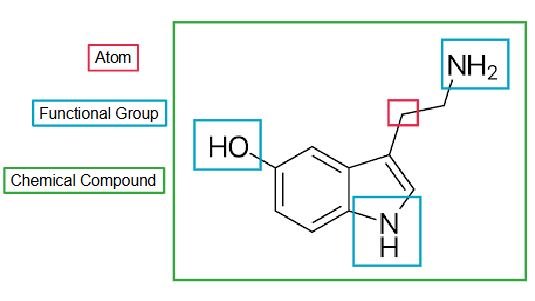
What is a functional group?
A group of atoms that have a predictable chemical behaviour
Many different functional groups in organic chemistry
e.g. alkene has a carbon-carbon double bond
e.g. alyne has a carbon-carbon triple bond
e.g. arene has an aromatic ring
e.g. alkyl halide has a halogen
e.g. alcohol has an OH group (hydroxyl group)
e.g. thiol has an SH group (sulfhydryl)
e.g. ether has an oxygen with an R group on either side
e.g. sulphide has a sulphur atom with an R group on either side
e.g. amine has a nitrogen with three R groups or hydrogens
What does risk assessment (monitoring) and environmental forensics seek to address?
Risk assessment seeks to address the impact/risk of particular chemicals whereas environment forensics concerns which chemical/source has caused the observed effects.
Why classify chemicals?
To inform sampling/monitoring and enable target analysis
Similar chemicals have similar requirements for sampling and can be analysed using similar analytical approaches – related to their physicochemical properties
e.g. no point analysing a liquid if a chemical is volatile (gaseous), it is better to conduct a headspace analysis
‘Organic chemical’
A chemical with a carbon hydrogen backbone.
Physicochemical properties
Govern the behaviour of chemicals in the environment (and can be used to predict their toxicity)
How will a chemical distribute and in what environmental compartment may it become a problem?
How could it enter organisms and does it have
the potential to bioaccumulate?e.g. polarity, solubility, octanol-water partition coefficient (KOW)
How long will a chemical persist, i.e. can regular but low releases cause problems?
Resistance to chemical and biochemical transformation (half-life in soil, air, water, biota)
How readily will a chemical evaporate, i.e. can it disperse by air?
Vapor pressure, Henry’s Law Constant (KOH)
Chemical polarity
Separation of electric charge in a molecule (→ dipole moment, μ)
‘Like dissolves like” as polar chemicals tend to dissolve well in water and nonpolar chemicals tend to dissolve well in oils (lipids)
It is the difference in electronegativity (how much an element attracts e):
Polar = ΔEN 0.5-1.6
Nonpolar = ΔEN <0.5
If ΔEN is very high, electrons can be completely lost to the other atom:
Ionic = ΔEN >2.0 (e.g. Na+Cl- = 2.1)
Solubility (𝑪𝒔𝒂𝒕)
Maximum concentration of a chemical that can be dissolved in a solvent (e.g. water); solubility of chemicals in water or lipids governs their fate in the environment
Can range from “insoluble” (<μg/L) to fully miscible (soluble without limits)
Strongly influenced by temperature
Water soluble chemicals can transport through soil, disperse in rivers, oceans, are often less stable, and less likely to volatilise from water
Lipid soluble chemicals tend to partition to soil/sediments, may accumulate in organisms, are often persistent and have relatively low solubility in water (hydrophobic)
Rule of thumb SW (mg/L; 25 C):
<= 50 (low)
50 - 500 (moderate)
> 500 (high)
Vapor pressure (P0)
Tendency of liquid (or solid) to volatilise; pressure at which a liquid (or solid) is in equilibrium with its vapor (closed system, given temperature)
The higher vapor pressure, the more volatile
Characteristic for each substance and increases with temperature
When vapour pressure = atmospheric pressure → substance boils
Rule of thumb P0 (mPa; 25 ⁰C):
< 1 x 10⁻⁶ (0.000001) (non-volatile)
1 x 10⁻⁴ to 1 x 10⁻⁶ (intermediate state (semi-volatile))
> 1 x 10⁻⁴ (0.0001) (volatile)
Volatile chemicals (VOCs)
Volatilise readily at room temperature; generally have low to moderate water solubility (e.g. paints, solvents (BTEX), fuels) – important indoor air pollutants.
Semivolatile chemicals (SVOCs)
Are often relatively stable and have lower water solubility: have the potential for long-range atmospheric transport (e.g. POPs, pesticides).
Stability
Resistance to chemical and biochemical degradation: the more stable, the longer its residence time, the greater the distance it can travel, and the more it can accumulate over time.
Common transformation processes:
Oxidation (loss of electrons)
Hydrolysis (break of chemical bonds in presence of
water)Microbial degradation and other biotransformation
Photodegradation (photochemical transformation into smaller fragments)
Stability of chemicals also depends on environmental factors (temperature, pH, radiation, oxygen, etc)
Some transformations lead to increased toxicity!
Rule of thumb T1/2 (days; soil):
< 30 = (non-persistent)
30 - 100 (moderately persistent)
100 - 365 (persistent)
> 365 = (very persistent)