JBerg 1-D Displacement & Motion
 Call Kai
 Learn
Learn Practice Test
 Spaced Repetition
 Match
Match Flashcards
 Knowt Play
1/43

Earn XP
Description and Tags
Displacement, velocity, acceleration and the ideas of it, and all that good stuff.
Name | Mastery | Learn | Test | Matching | Spaced | Call with Kai |
|---|
No analytics yet
Send a link to your students to track their progress
44 Terms
What are scalar measurements?
“How much”; mainly deals with just magnitude
What are vector measurements?
“How much”, which is magnitude, but alongside “how much from where something starts to ends”, which includes direction
What is an example of a scalar and vector measurement?
Distance is scalar because it is only just how long or how far, yet displacement is how far or how long from where an object starts to where it ends. Displacement’s direction can be measured negatively or positively too.
How can displacement be represented?
Through arrows visually, or mathematically by subtracting an object’s final position from its initial position. A dot shows the start of a vector, an arrow shows where the vector is pointing, and the resultant displacement is a dotted line at the start of the original vector ray.
What is velocity?
A vector quantified measurement where it’s basically speed (distance/time) but it includes direction. Direction may also be labeled as + or - like displacement. Also similar to displacement, except this is not a term for a type of distance or length.
What is instantaneous velocity?
What an object’s speed and direction at the specific time given. For example, at JUST 8 seconds, interpreting a time-displacement graph may demonstrate that the object’s velocity at that moment is 15 m/s.
What is constant velocity?
When an object never changes direction or speed.
What is a relationship between constant velocity and average velocity?
If constant velocity applies to all data points, then constant velocity will be equivalent to average velocity.
How does one solve for average velocity?
Like solving for slope, you take the difference in displacement (final displace - initial displace) divided by the difference in time. In a word problem, the values may or may not be given to you.
How does one change velocity? What are the ways to change it?
One changes it through acceleration, and ways to change it are to speed up, slow down, or change direction.
How does one solve for acceleration?
It is solved by taking the difference in velocity (final velocity - initial velocity) and dividing that by the change in time. You should assume that acceleration, “a”, is always constant.
What is kinematics?
The study of objects’ movement while disregarding what the object is and what forces are acting upon it (causes + effects of the motion, like air resistance). When there is acceleration, we use kinematic equations.
How come do falling objects resist air resistance? What is that called?
When an object is “free-falling”, it is gravity that is controlling the movement and increasing velocity on the way down by a constant rate of acceleration (-9.81 m/s²).
Why is acceleration due to gravity noted with a negative sign?
(no need to derive where the value 9.81 came from)
Free falling objects fall to the center of the Earth, and the gravitational field wants objects to stay down no matter if an object is thrown up, or dropped. Therefore, it is noted with the value -9.81 m/s²
What happens to velocity as an object is in the air?
The velocity decreases approaching it’s maximum height, and increases on the free fall down. Both situations are due to gravity pushing downwards.
What happens to acceleration and velocity when an object reaches maximum height?
Velocity becomes 0 m/s, yet acceleration remains -9.81 m/s²
What is an object’s acceleration when it’s in the air?
-9.81 m/s²
What is an object’s acceleration right before it strikes the ground?
-9.81 m/s²
How does one solve kinematics when dealing with free falling objects versus horizontal movement?
In kinematic equations for horizontal movement, the change in displacement is based on the x axis. For vertical movement, the change in displacement is based off the y axis. Ignoring air resistance, which can affect the rate of acceleration, acceleration for horizontally moving objects is usually 0 m/s², and -9.81 m/s² for vertical.
What are the kinematic equations?
d = Vi(t) + ½(a)(t)² [time and/or displace. for free falls]
Vf² = Vi² + 2(a)(d) [displace. and/or velocity for free falls]
Vf = Vi + a(t) [time and/or velocity for free falls]
d = ½(Vi + Vf)(t) [displace. and/or time for free falls]
What are the equations for average velocity and acceleration?
Acceleration: DeltaV/DeltaT (velocity/time)
Velocity: DeltaX or V/DeltaT (distance/time)
What is the general diagram for objects being thrown up? Neglect air resistance.
An object is launched with an initial velocity, and decreases in velocity as it ascends to its maximum height (whilst rate of acceleration remains the same). As it ascends, its velocities mirror those as it ascends, but its vector is instead denoted in the (-) downwards direction. Final Velocity = Initial Velocity, but with opposite signs.
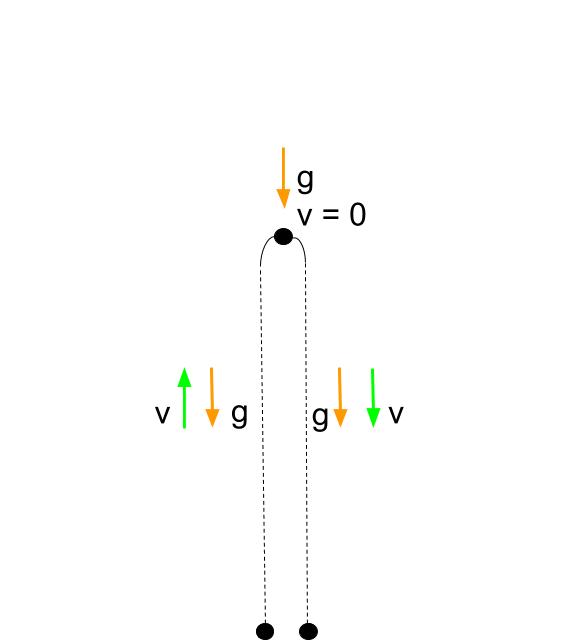
What is the general diagram for objects being dropped? Neglect air resistance.
Beginning of a Vi of 0 m/s, the object’s velocity increases (and acceleration rate remains constant)
What time-position diagram is this?
Standing still, but close to the motion detector
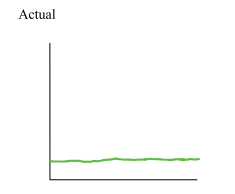
What time-position diagram is this?
Standing still, but far from the motion detector
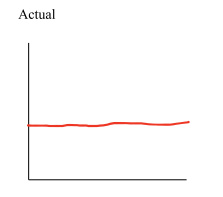
What time-position diagram is this?
Moving away at a slow, constant velocity
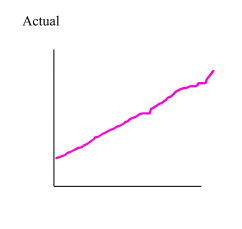
What time-position diagram is this?
Moving away at a fast, constant velocity
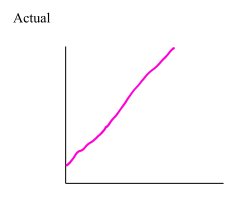
What time-position diagram is this?
Moving towards at a slow, constant velocity
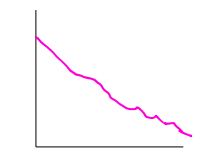
What time-position diagram is this?
Moving toward at a fast, constant velocity
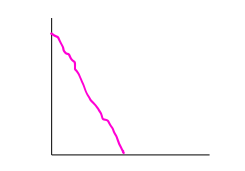
What time-position diagram is this?
Moving away and gradually speeding up
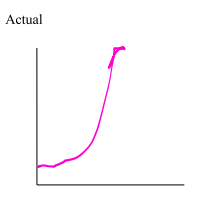
What time-position diagram is this?
Moving away and gradually slowing down
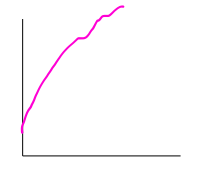
What time-position diagram is this?
Moving towards and speeding up
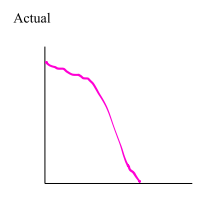
What time-position diagram is this?
Moving towards and slowing down
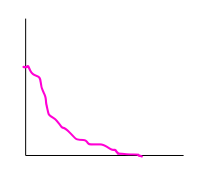
What are the general patterns of time-displacement graphs?
Steeper, constant slopes = Fast constant velocity
Less steeper, constant slopes = Slow constant velocity
Away from x-axis = Movement away from detector
Towards x-axis = Movement towards detector
Any straight horizontal line at any y-value = Standing still a distance away the detector
What velocity-time graph is this?
Standing still close AND far away from the detector
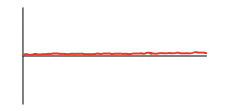
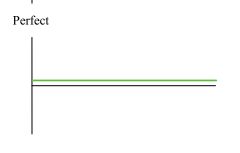
What velocity-time graph is this?
Moving away slow and constant velocity
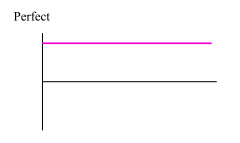
What velocity-time graph is this?
Moving away fast and constant velocity
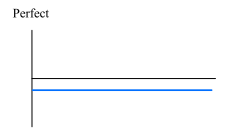
What velocity-time graph is this?
Moving towards slow and constant velocity
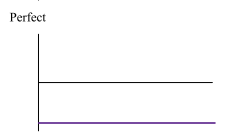
What velocity-time graph is this?
Moving towards fast and constant velocity
What velocity-time graph is this?
Moving away speeding up
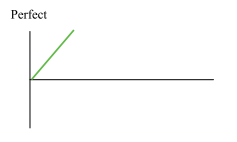
What velocity-time graph is this?
Moving away slowing down
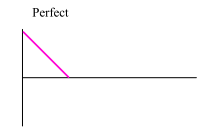
What velocity-time graph is this?
Moving towards speeding up
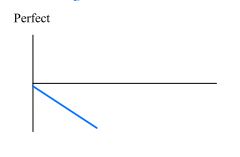
What velocity-time graph is this?
Moving away slowing down
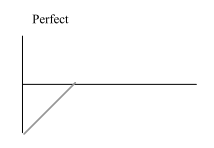
What are the general patterns of velocity-time graphs?
Any sloped line away from x-axis, regardless of direction: Speeding up away/towards detector
Any line sloped towards x-axis, regardless of direction: Slowing down away/towards detector
Any straight line on x-axis: Standing still REGARDLESS of distance from detector
Any straight line slightly below/above x-axis: Slow, constant velocity away/towards detector
Any straight line far above/below x-axis: Fast, constant velocity away/towards detector