Pathophys Quiz 1 - Cell Function
 Call Kai
 Learn
Learn Practice Test
 Spaced Repetition
 Match
Match Flashcards
 Knowt Play
1/70

There's no tags or description
Looks like no tags are added yet.
Name | Mastery | Learn | Test | Matching | Spaced | Call with Kai | Chat |
|---|
No analytics yet
Send a link to your students to track their progress
71 Terms
World Health Organization (1948): Health is a state of complete ____, _____, and _____ well-being and not merely the _____ of disease and infirmity.
physical
mental
social
absence
Aspects of the Disease Process
o _____, pathogenesis, ______ changes, clinical manifestations, _____, clinical course
etiology
morphological
diagnosis
Incidence: the number of new cases arising in a population at _____ during a ______ time
risk
specified
Prevalence: a measure of ______ disease in a population at a given point in time
existing
Secondary prevention: (e.g., Pap smears) detecting disease when still _____ specific to a population at ___
curable
risk
Plasma Membranes: Important for normal physiological fxn.
such as
______ __ _ ___
Activation of a cell
____ + ____ + ______ = Plasma Membranes
fat protein sugar
Lipids: Basic component = lipid bilayer. • Phospholipids; glycolipids; ______. • Responsible for structural integrity of membrane. ◆ provides attachment points for the ______.
cholesterol
cytoskeleton
Hydrophobic end (tail) and hydrophilic end (head) do what?
spontaneous organize itself into a bilayer
Proteins: Control Membrane Functions
• ______ Membrane Proteins- embedded into the lipid bilayer.
• ______ Membrane Proteins - located at one surface, bound to an IMP.
integral
peripheral
Proteins act as
Cell Surface ______: i.e. ______ – help to identify the cell to other cells.
markers
glycoproteins
Role of proteins in Disease is important because of their _____, _____, & ______-receptor fxns in cellular physiology.
enzymatic
transport
recognition
Carbohydrates: The CHO w/in the plasma membrane is in the form of ______.
• Fxns in intracellular recognition. Intracellular recognition is important for tissue ______.
glycoprotein
formation
Cells NEED to communicate with each other for:
• _______ of growth and division
• Overseeing their development & _____ into tissues
• _______ specialized fxns
regulation
organization
coordinating
When there is a _____ in cell-to-cell communication, we see the onset or progression of ____ _____ .
defect
disease processes
Anabolism - _____ Energy
• Catabolism - _____ Energy
Using
releasing
All of the chemical tasks a cell performs to maintain essential function and produce ______ is called ______ ________.
energy
Cellular Metabolism
______ is the metabolic process of using energy to _____ molecules, while ______ is the process of releasing energy by breaking molecules down.
Anabolism; build
Catabolism
The aerobic ATP pathway occurs in the ______ and requires the presence of ______.
mitochondria; O2
The anaerobic ATP pathway occurs in the ______ and occurs in the absence of O2, a state called ______.
cytoplasm; hypoxia
Anaerobic metabolism produces only a small amount of ATP plus a byproduct called ___ ___.
lactic acid
Integral membrane proteins that span the cell membrane and undergo conformational changes to form an open gate for ion movement are called ___ ___.
ion channels
The voltage generated by ions diffusing across the cell membrane is called the ___ ___.
diffusion potential
The point where no net ion movement occurs because diffusion and electrical forces are exactly balanced is called the ______.
equilibrium potential
The resting membrane potential of a cell is approximately ______ mV.
-70
At rest, the inside of the cell is more negative because ______ leak channels are open, allowing ____ of that ion.
potassium (K+)
efflux
______ occurs when Na+ flows into the cell, making the membrane potential less negative.
Depolarization
______ occurs when K+ leaves the cell, returning the membrane potential back toward _____ values.
Repolarization
resting
When the membrane potential becomes more negative than resting (around -90 mV), this is called ______.
hyperpolarization
Voltage-gated Na+ channels open around ______ mV and close again around 0 to +10 mV.
-30
The Na+/K+ ATPase pump moves ______ Na+ ions out of the cell and ______ K+ ions into the cell.
3; 2
The Na+/K+ pump requires ______ to function, making it a form of active transport.
ATP
When the Na+/K+ pump fails, ______ accumulates inside the cell, which is the most common cause of cellular damage.
Na+ (sodium)
Na+/K+ pump failure is most commonly caused by a lack of ATP due to a mitochondrial problem or a deficiency of ______.
oxygen
Restoring ______ can sometimes reverse a failed Na+/K+ pump, which is especially important in ischemic disease.
oxygen
Some arrhythmias are treated by keeping ______ channels open, which keeps the cell hyperpolarized and unable to easily fire another action potential.
voltage-gated K+
A wave of excitation that passes along the surface of excitable cells (neurons, muscle, cardiac tissue) is called an ______.
action potential
The 4 primary cellular functions are movement, ______, metabolic absorption, and secretion.
conductivity
Cells adjust to changes in their external environment and increased work demands through a process called cellular ______.
adaptation
A decrease in cell size is called ______.
atrophy
An increase in cell size is called ______.
hypertrophy
An increase in the number of cells is called ______.
hyperplasia
The replacement of one adult (differentiated) cell type with another is called ______.
metaplasia
Deranged/abnormal growth of a specific tissue is called ______.
dysplasia
Atrophy and hypertrophy are adaptations that change cell ______, while hyperplasia changes cell ______, and metaplasia changes cell ______.
size; number; form
The 5 categories of causes of cell injury are physical agents, radiation injury, chemical injury, biologic agents, and ______.
nutritional imbalances
Examples of chemical injury include drugs, carbon tetrachloride, and toxicity from the heavy metals ______ and ______.
lead; mercury
In a pediatric patient, anemia, constipation, abnormal behavior, and paleness should raise suspicion for ______.
lead poisoning
Mechanism of cell injury #1 involves the formation of highly reactive, unstable molecules with an unpaired electron called ______.
free radicals (ROS)
Free radical injury causes three main types of damage: ______ of lipids, oxidative modification of proteins, and effects on ______.
lipid peroxidation; DNA
Mechanism of cell injury #2 is ______ injury, which deprives the cell of oxygen and interrupts oxidative metabolism/ATP generation.
hypoxic
Cellular swelling in hypoxic injury results from impairment of the energy-dependent ______ pump.
Na+/K+ ATPase
Causes of hypoxia include inadequate O2 in the air, respiratory disease, inability of cells to use O2, edema, and ______.
ischemia
The longer tissue remains hypoxic, the greater the chance of ______ cellular injury.
irreversible
Mechanism of cell injury #3 is impaired ______ homeostasis, caused by ischemia-induced disruption and inappropriate enzyme activation.
calcium
Calcium acts as an important ______ for many cell responses, and is normally kept low in the cytosol by energy-dependent mechanisms.
second messenger
Programmed cell death, essentially cellular suicide that eliminates worn-out or damaged cells, is called ______.
apoptosis
The intrinsic apoptotic pathway is triggered by a problem inside the cell, involves the mitochondria, and activates ______.
caspase-9
The extrinsic apoptotic pathway is triggered by an outside signal binding a death receptor and activates ______.
caspase-8
Gram-negative bacterial ______ can trigger inflammatory signaling that may contribute to activation of the extrinsic apoptotic pathway.
LPS (lipopolysaccharide)
Cell death occurring in an organ/tissue that is still part of a living person, which interferes with cell replacement and regeneration, is called ______.

necrosis
Unlike apoptosis, which is a controlled process, ______ is uncontrolled cell death that interferes with tissue regeneration.
necrosis
Necrosis of a considerable mass of tissue due to ischemia, infection, or both is called ______.
gangrene
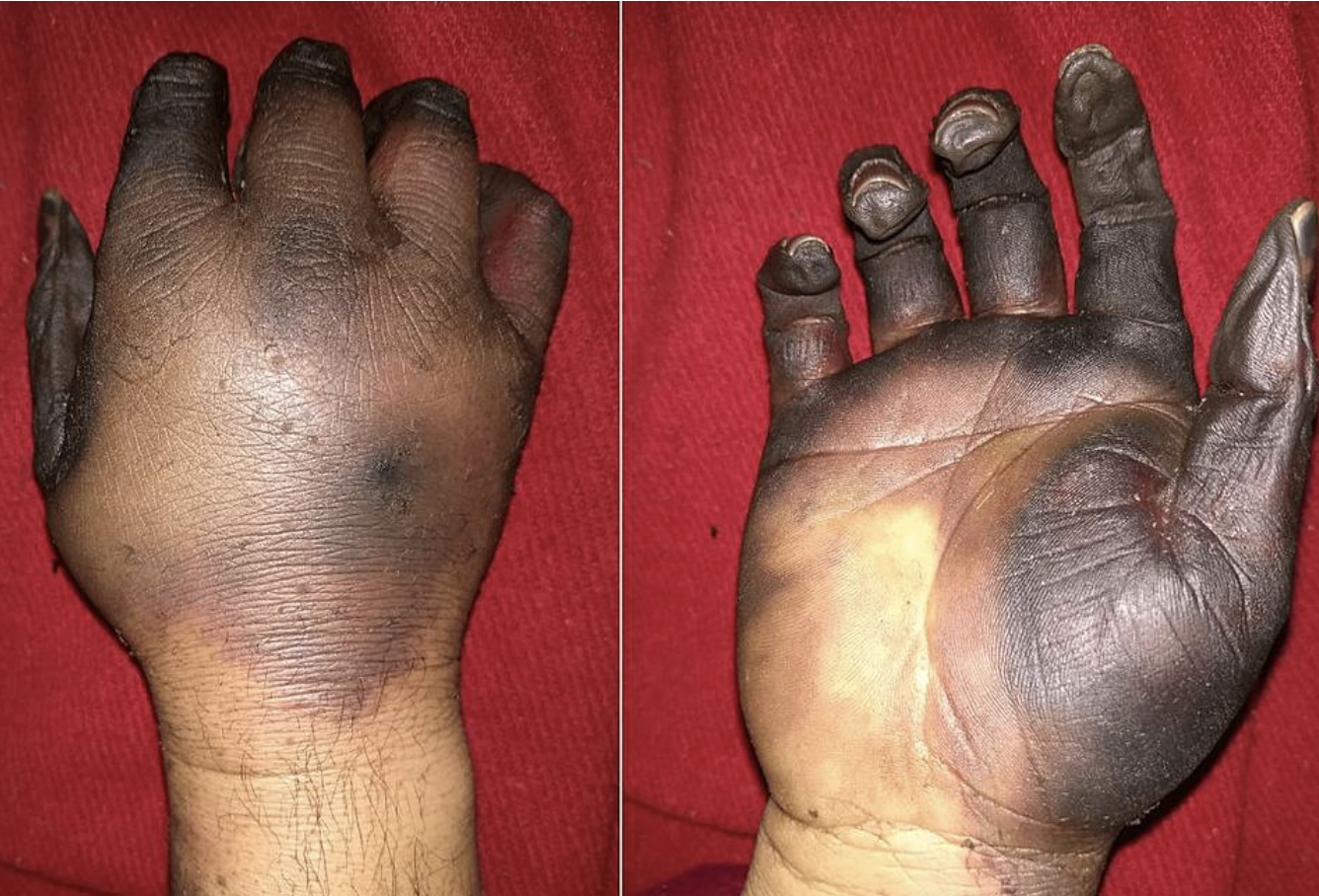
______ gangrene is caused by arterial obstruction in the periphery, resulting in dry, shrunken tissue with a well-defined line of demarcation and slow spread.
Dry
______ gangrene results from superimposed bacterial infection on ischemic tissue due to venous obstruction, causing rapid spread with no defined line of demarcation.

Wet
______ gangrene is caused by Clostridium perfringens and other anaerobic soil bacteria, producing hydrogen sulfide (H2S) and crepitus.

Gas (gas gangrene / clostridial myonecrosis)
In wet and gas gangrene, blebs form, liquefaction occurs, and a foul odor is caused by ______ action.
bacterial
The gas bubble sensation felt under the skin in gas gangrene is called ______.
crepitus
Local signs of gangrene include discoloration, loss of sensation, pain that is initially severe but later absent due to ______, and foul-smelling discharge.
nerve death
Systemic signs of gangrene, especially wet/gas gangrene, include fever, tachycardia, hypotension, shock, and ______ in advanced cases.
multi-organ dysfunction
Of the three types of gangrene, ______ gangrene spreads the slowest, while ______ and ______ gangrene spread rapidly.
dry; wet; gas