4.5 Forces
 Call Kai
 Learn
Learn Practice Test
 Spaced Repetition
 Match
Match Flashcards
 Knowt Play
1/67

Earn XP
Description and Tags
Completed flash card set
Name | Mastery | Learn | Test | Matching | Spaced | Call with Kai |
|---|
No analytics yet
Send a link to your students to track their progress
68 Terms
What are scalar and vector quantities?
Scalar: Quantities that only have magnitude
Vector: Quantities that have magnitude and direction
Describe how a vector quantity can be represented
It can be represented as an arrow
The length represents the magnitude
The direction of the arrow represents the direction of the vector quantity
What is a force and what are the two types and give examples of each?
A push or pull that acts on an object due to the interaction with another object
Contact:
Normal contact force, friction, air resistance (drag), tension (pulling or stretching force)
Non contact
Gravitational force, electrostatic force, magnetic
What type of quantity is force?
Vector
What is weight, what does it depend on and recall the equation
The force acting on an object due to gravity
It depends on the gravitational field strength at the point where the object is
weight = mass x gravitational field strength
N = kg x N/kg
What is the force of gravity around Earth due to?
The gravitational field around Earth
Where does the weight of an object act?
The centre of mass is the single point where the weight of an object will act.
What is the relationship between mass and weight?
They are directly proportional
How to measure weight?
Using a calibrated spring balance (a newtonmeter)
What is meant by resultant force?
A single force that has the same effect as all of the forces acting on an object
How to resolve forces?
(HT only) A single force can be resolved (broken down) into two components acting at right angles to each other. The two component forces together have the same effect as the single force. | 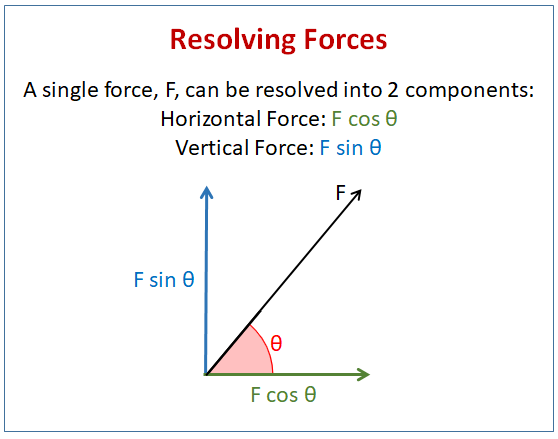 |
How to use free body diagrams to describe qualitatively examples where several forces lead to a resultant force on an object
Free body diagram: isolates an object and illustrates all of the external forces acting on it as vectors, showing their magnitude and direction to work out the resultant force (a single force that has the same effect as all of the forces acting on an object)
When is work done on an object and give the equation
When a force has caused an object to move through a distance
A force does work on an object when the force causes a displacement of an object.
work done = force x displacement (moved along the line of action of the force)
J (or newton-metres) = N x m
One joule of work is done when a force of one newton has caused a displacement of one metre
What does work against the frictional forces on an object cause?
A rise in temperature of the object
Give examples of the forces involved on:
stretching an object
bending an object
compressing an object
Stretching:
two tension forces pulling at each end in opposite directions
Bending:
forces that act in different directions at different points
Compressing:
forces that act towards eachother
Why must more than one force be applied to change the shape of a stationary object?
If you apply only one force, the object would accelerate and move rather than change shape
According to Newton’s First Law, a single unbalanced force would cause acceleration, not deformation
What is the difference between elastic deformation and inelastic deformation caused by stretching forces?
Elastic:
The object returns to its original shape after the forces are removed; the deformation is temporary
Occurs when the object has not been stretched or compressed past its elastic limit
Inelastic:
The object does not return to its original shape after the forces are removed; the deformation is permanent
Occurs when the object has been stretched or compressed past its elastic limit
What is the relationship between the force applied to an object and the extension of the object
The extension of an object is directly proportional to the force applied to it, provided that the limit of proportionality is not exceeded
Give the formula for extension of an object
force = spring constant x extension
f = k * e
N = N/m x m
The relationship also applies to the compression of an object where e would be compression
When a force has stretched or compressed an object, what happens to the energy transferred?
A force that stretched or compresses an object does work on that object.
The energy is transferred and stored as elastic potential energy within the object; provided that the limit of proportionality has not been reached (the object is not inelastically deformed) the work done on the spring and the elastic potential energy stored is equal.
What is the moment and give the equation
Moment is the turning effect of the force; it is how much a force causes something to rotate
moment = force x perpendicular distance from pivot to the line of action from the force
Nm = N x m
If an object is balanced, what is the moment?
The total clockwise moment about a pivot is equal to the total anticlockwise moment of the pivot
What does a moment cause?
An object to rotate
What is a linear and non-linear relationship between force and extension?
Linear: force is directly proportional to extension
Non linear: force is not proportion to extension
Explain how levers transmit the rotational effects of forces
A lever is a rigid bar that rotates about a pivot (or fulcrum).
Levers increase the distance of the force from the pivot, increasing the moment.
When a force is applied to a lever, it creates a moment around the pivot. The moment can be transmitted to another point on the lever to lift or move a load.
This means that a small force applied at a large distance from the pivot can produce a large moment, allowing you to lift a heavier load.
Explain how gears transmit the rotational effects of forces
Gear systems transmit the turning effect of the force from the engine to the wheels.
Smaller gear A is connected to the engine, while larger gear B is connected to the wheels.
The gear system will transmit the turning effect of the force from the engine to the wheels.
The perpendicular distance from the force to the fulcrum correlates to the radius of the gear, so the greater the radius of the gear, the greater the moment produced. Therefore the smaller gear B can double the moment produced by the same force transferred from gear A.
The work done by both gears is the same however, as gear A rotates twice in the same time that gear B rotates once.
What is a fluid?
Liquids and gases
What does the pressure in fluids cause, why? Give the equation for the pressure at the surface of a container holding a fluid
Pressure is the measure of the force applied perpendicular to the surface of an object divide by the area of the surface.
Pressure in fluids causes a force normal (at right angles) to any surface.
This is because the molecules in a fluid are constantly moving around and colliding with the walls of the container (because it is a fluid). These collisions exert a force onto the object.
Therefore, a fluid is constantly exerting a pushing force onto the walls of the container.
Pressure of the fluid can therefore be calculated by calculating the force acting perpendicular (normal) to the surface, and dividing it by the area of the surface
Lots of collisions = lots of pressure
pressure acting on the surface of a container holding a fluid = force normal to the surface/ area of that surface
Pascals = newtons / m²
Give the formula for the pressure due to a column of liquid and the formula for the pressure at the surface of a fluid.
Pressure due to a column of liquid:
pressure = height of column (m) x density of liquid (kg/m³) x gfs (N/kg)
p = pgh
Pressure at surface of liquid:
pressure = force normal to a surface/ area of that surface
Explain why in a liquid pressure at a point increases with the height of the column of liquid above that point and with the density of the liquid.
The pressure comes from the weight of the liquid above.
Increasing the height increases the mass of liquid above, more mass means a greater weight so a higher pressure. It also increases the number of particles.
Greater number of particles and a greater pressure means that molecules collide more frequently and with greater force in all directions.
Greater density means greater mass for that volume
Describe why objects sink and rise in fluids (reference to pressure of fluid)
A partially (or totally) submerged object experiences a greater pressure on the bottom surface than on the top surface as the deeper you go, the higher the pressure.
At a greater, the molecules collide more frequently and with more force; these collisions happen in all directions so the bottom surface experiences a greater upwards force, while the top surface feels a smaller downwards force.
The difference in forces creates a resultant upwards force (called upthrust). If upthrust is greater than weight, an object rises. If upthrust is less than weight, an object sinks.
Describe the factors that influence floating and sinking
For an object to be in equillbrium, its weight must be equal to the force of upthrust.
Upthrust is equal to the weight of fluid that the object has displaced.
Therefore, an object that is denser than the fluid must displace a greater volume of fluid compared to the volume of the object for the weight of the fluid displaced to equal the weight of the object (as density = mass/volume, weight is directly proportional to mass). (and therefore upthrust = weight of object so it is at equilibrium and no longer sinks or rises). Therefore it will sink.
In comparison, an object that is less dense than the fluid will have to displace a smaller volume of the fluid compared to the volume of the object for the weight of the fluid to be equal the weight of the object (and therefore upthrust = weight of object so it is at equilibrium and no longer sinks or rises). Therefore it will float.
Therefore the factors that influence floating and sinking are the:
density of the object (therefore mass and volume)
weight of the object
density of the fluid
As this impacts the two forces that cause the sinking and rising:
weight (acting downwards)
upthrust (acting upwards)
Depends on two forces:
weight (acting downwards)
upthrust (acting upwards)
What creates atmospheric pressure?
Pressure is caused by the weight of air molecules.
Air pressure depends on the number of air particles above a point; all air particles are pulled downwards due to the force of gravity, so if there are more air particles above a point, there are more particles pushing down onto the air due to gravity, causing greater air pressure.
Air molecules colliding with a surface creates atmospheric pressure.
(As pressure is force / area (of surface))
What is the relationship between atmospheric pressure and altitude?
Greater altitude = lower atmospheric pressure
Lower altitude = greater atmospheric pressure
This is because an object’s altitude increases, the number of air molecules above the surface of the object decreases
Describe a simple model of the Earth’s atmosphere and of atmospheric pressure
The atmosphere is a thin layer of air around the Earth
The atmosphere has layers of air molecules stacked on top of eachother
The air at the top of the atmosphere is very thin, as there are fewer molecules,
How to describe an object’s movement?
Distance; scalar quantity, just magnitude
Displacement; vector quantity, direction + magnitude
Displacement is measured in a straight line from the start point to the finish point, and the direction of that straight line
Give values for the speed of:
walking
running
cycling
speed of sound in air
car
train
Aeroplane
Walking: 1.5 m/s
Running: 3 m/s
Cycling: 6 m/s
Speed of sound in air: 330 m/s
Car: 20 m/s
Train: 80 m/s
Aeroplane: 250 m/s
What is velocity?
A vector quantity: speed and direction
If an object is accelerating, how can you calculate its exact speed at a specific point from a distance-time graph?
Drawing a tangent and measuring the gradient
Give the formula for acceleration
acceleration = change in velocity / time taken
m/s² = m/s s
Give the acceleration of any object falling freely under gravity
About 9.8 m/s²
Explain terminal velocity
Terminal velocity: maximum constant speed an object reaches when falling through a fluid and can no longer accelerate
When an object is falling through a fluid, it will initially accelerate due to the force of gravity being greater than air resistance.
However as speed increases, air resistance grows.
When air resistance is equal to weight, the object stops accelerating and continues to fall at a constant speed (terminal velocity)
What is Newton’s first law?
If the resultant force acting on an object is 0 and:
the object is stationary, the object remains stationary
the object is moving, the object continues to move at the same speed and direction (continues to move at the same velocity)
So the velocity of an object will only change if a resultant force is acting on an object.
What is inertia?
The tendency of objects to continue in their state of rest or state of uniform motion
(Links to newton’s first law)
What is newton’s second law
The acceleration of an object is proportional to the resultant force acting on the object, and inversely proportional to the mass of the object
resultant force = mass x acceleration
or: acceleration = resultant force / mass
N, kg, m/s²
What is inertial mass?
Inertial mass is the measure of how much an object resists a change in its velocity when a force is applied
Inertial mass is defined as force / acceleration
What is newton’s third law?
When two objects interact, the forces they exert on each other are equal and opposite
force = mass x acceleration
acceleration = force / mass
For example, the earth and moon exert equal and opposite forces on each other, however the effect on the moon (acceleration) is much greater, as it has a much smaller mass.
What is the stopping distance of a vehicle?
The sum of the thinking distance and braking distance
Thinking distance: distance the vehicle travels during the driver’s reaction time
Braking distance: distance it travels under the braking force
What is the thinking distance and braking distance?
Thinking distance: distance the vehicle travels during the driver’s reaction time
Braking distance: distance it travels under the braking force
What is the range of typical reaction times for a person?
0.2 - 0.9 seconds
What can a driver’s reaction time be affected by?
tiredness
drugs
alcohol
distractions
What can the braking distance of a vehicle be affected by?
poor condition of vehicle (vehicle’s brakes or tires)
adverse road conditions (wet or icy)
adverse weather conditions
(speed of vehicle)
Explain methods used to measure human reaction times and recall typical results
Ruler drop test:
A partner holds a ruler vertically with the 0 cm mark at your open fingers.
Without warning, they drop the ruler.
You catch it as quickly as possible.
The distance the ruler falls before you catch it is recorded.
What is the relationship between speed of a vehicle and the braking force needed to stop the vehicle a certain distance?
Greater the speed, the greater the braking force needed
Explain the dangers caused by large decelerations
When a force is applied to the brakes of a vehicle, work done by the friction force between the brakes and the wheel reduces the kinetic energy of the vehicle
Due to friction, the kinetic energy of the vehicle is converted to heat
The greater the deceleration, the greater the braking force, which means the greater the temperature rise of the brakes/tires
This can cause the brakes to overheat (which may cause the brake surface to become smoother) which reduces friction
This may cause the vehicle to lose control
Also:
Passengers experience an extremely large force as
force = mass x deceleration
this can cause extreme injuries
Give the equation for momentum
Momentum = mass x velocity
kg m/s = kg x m/s
Momentum is described as the quantity of motion
What is the law about momentum?
Conservation of momentum:
In a closed system, the total momentum before an event is equal to the total momentum after the event. (Momentum can be transferred)
What happens to the momentum of an object when a force acts on that object?
A change in momentum occurs
What happens when there is a rapid change in momentum?
A very large force is placed onto the subject which has changed momentum; this force is so great that it can be fatal.
This is because:
force = mass x acceleration
force = mass x change in velocity / change in time
= change in momentum / time
so force is equal to change in momentum over time
force = rate of change of momentum
Give safety features that protect against rapid changes in momentum and explain why they work
air bags
seatbelts
gymnasium crash mats
cycle helmets
cushioned surfaces for playgrounds
They reduce the force on the person by increasing the amount of time over which the change in momentum occurs.
Eg. they all stretch or compress in ways that increase the amount of time over which the person’s momentum (acceleration) changes
Why is momentum in a system constant?
Momentum is constant in a system because the internal forces only redistribute momentum among objects - they can’t create or destroy internal momentum.
Momentum can only be changed if there is an external force impacting it.
When hitting the golf ball the golfer swings the golf club to keep it in contact with the golf ball for as long as possible.
The force acting on the golf ball is constant during this time.
Explain the effect that the time of contact between the golf club and the golf ball has on the distance the golf ball travels (4 marks)
-longer the time of contact the greater the change of
momentum
-since the mass of the golf ball is constant
-the velocity of the golf ball must increase
-increasing the distance the golf ball travels
this is because of impulse
impulse is the total change in momentum
impulse = force x time
if the force on an object increases, or the amount of time that a force is applied onto an object increases, the total momentum of the object increases
Describe how to draw vector diagrams and how to find resultant forces
Vectors not at an angle:
To add vectors, draw them to scale
Arrange them so that the arrow tail of one vector is the arrow head of another
Draw vector that goes from the tail head of the first vector to the arrow head of the last one
This is the resultant vector
The angle of a vector is always measured from the horizontal in an anticlockwise direction
Vectors at an angle to eachother:
Make a parallelogram by drawing the parallel lines at the same angles
Connect and measure from the point to the other point
How to write the direction of a resultant vector
Measure the angle from the horizontal
Eg: 20 degrees from the horizontal
What is the rule for finding resultant forces in vector diagrams?
Tip to tail!
Describe the relationship between resultant force and change in momentum
For a constant mass, resultant force is equal to rate of change of momentum
as resultant force = mass x acceleration
rate of change in momentum = mass x acceleration
( momentum = mass x velocity
and change in momentum = mass x change in velocity)
so resultant force is equal to rate of change of momentum (when mass is constant)
State the two risks of a large deceleration
Brakes will overheat
The driver will lose control of the car
Explain how airbags reduce the risk to the driver
Increases the time taken for the driver to come to a stop
The change of momentum is the same but over a greater time
So the rate of change of momentum decreases
So the force on driver is reduced