Lec 5: Nerves that Move the Eye CN III, CN IV & CN VI
 Studied by 0 people
 Call Kai
 Learn
Learn Practice Test
 Spaced Repetition
 Match
Match Flashcards
 Knowt Play
1/47

There's no tags or description
Looks like no tags are added yet.
Name | Mastery | Learn | Test | Matching | Spaced |
|---|
No study sessions yet.
48 Terms
lateral rectus action?
abducts eye
medial rectus action?
adducts eye
superior rectus action?
elevates eye
inferior rectus action?
depresses eye
inferior oblique action?
elevation, abduction and extorsion
superior oblique action?
depression, abduction & intorsion
what is visual pathway:
Retina – Optic Nerve – Optic Chiasm – Optic Tract – LGN – Optic Radiations – Primary Visual Cortex – Parietal/Temporal
what is pupillary light reflex path":
Retina – Optic Nerve – Optic Chiasm – Optic tract – Superior Colliculus (pretectal
nucleus) – Bilateral Edinger-Westphal Nucleus – CN III, Parasym – Sphincter Pupillae muscle
what is under focusing for close vision?
Pupillary Constriction – parasympathetic (Edinger-Westphal Nucleus)
Accommodation for Near Vision – parasympathetic (Edinger-Westphal Nucleus)
convergence of eyes
what is Pupillary Constriction?
parasympathetic (Edinger-Westphal Nucleus)
By contracting the Sphincter Pupillae muscles
what is Accommodation for Near Vision?
parasympathetic (Edinger-Westphal Nucleus)
By contracting the Ciliary muscles
what is convergence of eyes?
Activates both Medial Rectus muscles
__ receives signals directly from the retina
__ controls the following (mostly) reflexive actions
Head alignment
Pupillary Diameter
Accommodation for Near Vision
Superior Colliculus
what is horner syndrome?
damage to the pathway of sympathetic signals to the eye
• Ptosis, miosis & Anhidrosis
Connects to the Oculomotor Nucleus (and E-W nucleus) in the Midbrain
Edinger-Westphal Nucleus
Parasympathetic Nucleus for Pupillary Constriction & Accommodation
Trochlear and Abducens Nuclei are in the Pons
Oculomotor Nerve
Oculomotor Nerve sends motor signals to the:
Sends motor signals to the:
Medial rectus, Inferior rectus, Superior rectus & Inferior Oblique
Ciliary Muscles – Parasym. Accommodation
Sphincter Pupillae Muscle – Parasym. Constrict Pupil
Levator Palpebrae Superioris
what is levator palpebrae superioris?
• Palpebra = Eyelid; Superioris = Upper
• Raises upper eyelid
Levator Palpebrae Superioris Nucleus
Superior Rectus Nucleus
Medial Rectus, Inferior Rectus, and Inferior Oblique Nuclei
Oculomotor Nuclei of the Midbrain
what is levator palpebrae superioris nucleus
• sends fibers to both eyes
• facilitating bilateral eye opening
what is superior rectus nucleus?
sends information to the contralateral side
what is Medial Rectus, Inferior Rectus, and Inferior Oblique Nuclei”
project only to the ipsilateral side
Therefore, a patient with a rare unilateral oculomotor nucleus injury could present with symptoms that include:
• Ipsilateral medial rectus, inferior rectus & Inferior oblique paresis
• Contralateral superior rectus paresis
• bilateral ptosis
what is occulomotor
Superior Colliculus is the visual reflex center of the brainstem
See the Optic Nerve Lecture
Receives information directly from the retina
Also receives auditory and somatosensory signals
to rapidly guide coordinated and/or reflexive movements in the eye
Also Autonomic intraocular actions
E.g., Pupillary Light Reflex
Eye is turned “down and out.”
Due to the unopposed action of CN VI and CN IV
External Strabismus - Laterally Deviated eye
Eye positioned in partial abduction and depression with intorsion
Produces Diplopia – double vision
Ptosis
Dilated pupil
or one that responds poorly to light
Cranial nerve III Palsy
Cranial nerve III Palsy: As the nerve continues its journey to the extraocular muscles, it travels alongside the
posterior communicating artery
is the most common cause of a nontraumatic isolated CN III palsy
aneurysm of the posterior communicating artery
A dilated pupil associated with a CN III palsy is always assumed to be due to an
aneurysm until proven otherwise
From its origin, CN IV innervates the superior oblique muscle on the contralateral side of the head
Nucleus in the contralateral midbrain
The only CN that emerges from the posterior side of the brainstem
Thinnest cranial nerve
Has the longest intracranial course before it exits the skull
Most susceptible to injury, trauma, and increased intracranial pressure
Trochlear Nerve
Superior Oblique Actions:
Intorsion, ADduction and Depression of the eye
CN IV has extensive connections with the __
critical for orientation of the eyes associated with head tilt
vestibular system
When the head is tilted to the right shoulder:
• the right eye intorts slightly
• the left eye extorts slightly
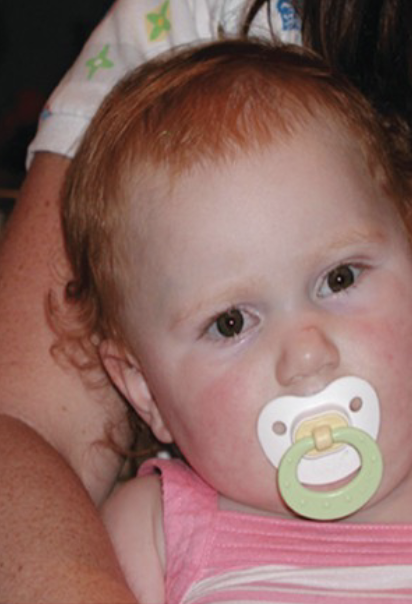
CN IV palsy affects the superior oblique muscle:
• slight extorsion of the eye
• Hyper-deviation or elevation of the eye.
• Each of these actions is due the unopposed actions of the other extraocular muscles
Diplopia
Lateral Neck flexion (Head tilt)
to bring the good eye in line with the elevated eye
Many patients present with a subtle __ to compensate for the slight extorsion
head tilt away from the side of the muscle palsy
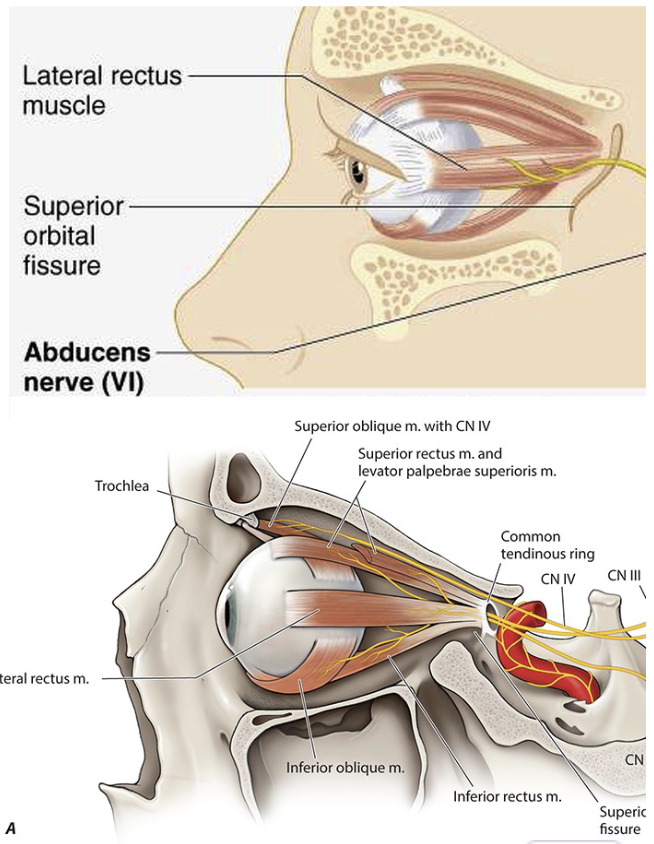
supplies the Lateral Rectus
Abducts the eye
emerges near the midline at the pontomedullary junction
Fold between pons and medulla
Nucleus in the Pons
Abducens Nerve
Injury to the Abducens Nucleus is usually accompanied by
facial nucleus
Abducens Nerve Injury Presentation:
Ipsilateral Internal Strabismus
medial deviation due to unopposed action primarily of the medial rectus
Diplopia
what is gaze?
coordinated movement of both eyes (and the neck) that directs visual stimuli onto the fovea of both retinas
what is horizontal gaze?
involves synchronous activation of the lateral rectus muscle of one eye and the medial rectus muscle of the other
Horizontal gaze is controlled by CN VI and its associated paramedian pontine reticular formation (PPRF)
what is saccade?
rapid movement of both eyes, simultaneously in the same direction to a new point of fixation
what is horizontal saccade?
rapid horizontal movement of both eyes in the same direction
• Can be voluntary or reflexive
Horizontal gaze is controlled by the
CN VI Nucleus
2 types of neurons in the Abducens Nucleus:
motor neurons
internuclear neurons
what are motor neurons
axons of these neurons create the abducens nerve
what is internuclear neurons
• axons of these neurons decussate and ascend contralaterally through the Medial Longitudinal Fasciculus (MLF)
• Synapse with neurons in the Oculomotor Nucleus (specifically those that control the medial rectus)
Activation of the abducens nucleus simultaneously directs __ to deviate both eyes toward the abducting side
ipsilateral abduction and contralateral adduction
Thus the __ drives ipsilateral horizontal gaze
CN VI nucleus
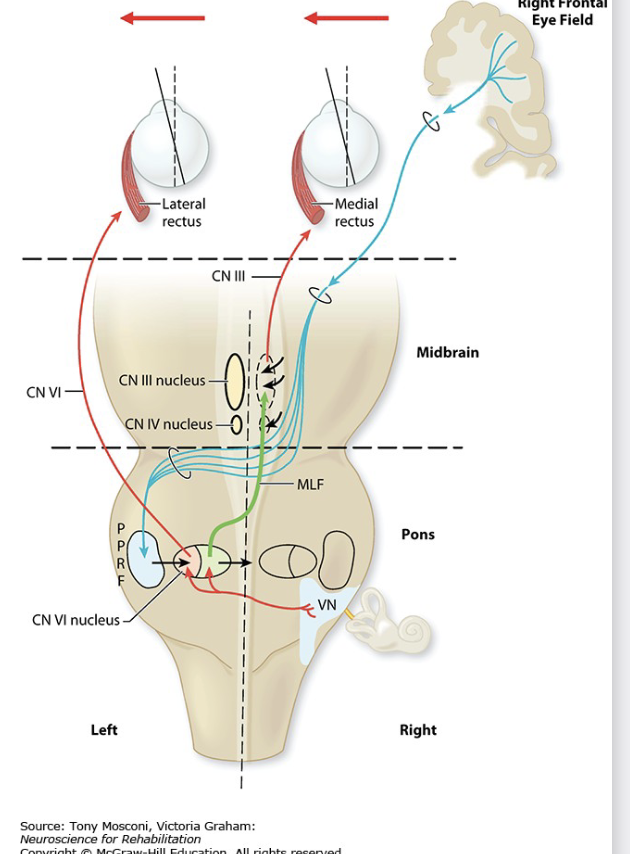
The signal originates in the frontal eye fields of the Right frontal lobe
To the Right Superior Colliculus
After leaving the SC the signal decussates to the contralateral side of the Pons
To the Left Pontine Reticular Formation
To the Left Abducens Nucleus
To the Lateral Rectus muscle
To the Oculomotor Nucleus for the Medial Rectus
Voluntary Horizontal Saccade