9/14 - Porcine, Fish, and Marine Mammal Parasites
 Call Kai
 Learn
Learn Practice Test
 Spaced Repetition
 Match
Match Flashcards
 Knowt Play
1/17

There's no tags or description
Looks like no tags are added yet.
Name | Mastery | Learn | Test | Matching | Spaced | Call with Kai | Chat |
|---|
No analytics yet
Send a link to your students to track their progress
18 Terms
I. suis
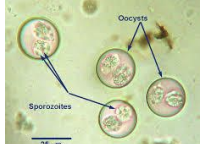
What coccidial species infects pigs, is not zoonotic, is directly transmitted by ingestin sporulated oocysts, and infects neonates? It produces white-yellow watery diarrhea and reduced growth. Diagnosis is by seeing an oocyst with two sporozoites on fecal float. Treatment is with sulfonamides and amprolium.
Eimeria
What coccidial genus infects pigs and is not zoonotic, and is directly transmitted by ingestion of sporulated oocysts? Signs include infection of older pigs, mild infections, and frothy-mucoid watery diarrhea. Diagnosis is by seeing an oocyst with four sporozoites on fecal flotation. Treatment is with sulphonamides and amprolium.

B. coli
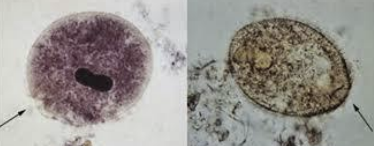
What species causes balantidiasis and is zoonotic, transmitted by ingestion of cysts, and producing watery-mucoid diarrhea or intestinal hemorrhage in humans? In pigs, it causes mild-severe enteritis and diarrhea, and diagnosis is with fecal floatation or direct smear. Treatment is with metronidazole and tetracycline.
A. suum
What species of roundworms infects pigs, is zoonotic, is transmitted by ingestion of infective eggs with L3, and causes VLM, respiratory signs, and fever in humans? Signs in pigs include reduced feed efficiency, emaciation, inflammation in the liver, and in the lungs. Diagnosis is with centrifugation flotation and necropsy. Treatment is with BZs, ivermectin, and pyrantel.
T. spiralis
Which species causes porcine trichinosis, and is zoonotic? It is transmitted by ingestion of L1 larvae in muscle and causes diarrhea, abdominal pain, vomiting, fever, headache, periorbital edema, and death. Signs in pigs are absent. Diagnosis is by larvae on biopsy and there is no treatment. Control infection by avoiding feeding raw meat to pigs, docking tails, and freezing/cooking meat.

T. suis
What species is the porcine whipworm and is zoonotic? It is transmitted by ingestion of infective L1 eggs, and causes GI signs. In pigs it causes stunting, bloody diarrhea, and poor growth. Diagnosis is by centrifugation flotation and treatment is with fenbendazole, hyrgromycin, and ivermectin.

O. dentatum
What species is the porcine nodular worm, and is not zoonotic? It is transmitted by ingestion of infective larvae, and signs in pigs include ill thrift, enteritis, and diarrhea. Diagnosis is with fecal floatation and necropsy. Treatment is with fenbendazole, ivermectin, LEV, and pyrantel tartrate.

S. ransomi
What species is the porcine threadworm and is transmitted by skin penetration or transmammary? Signs include asymptomatic infections, diarrhea, anemia, emaciation, and death in heavy infections. Infections induce strong immunity, so older pigs do not usually have clinical signs. Diagnosis is with fecal float, Baermann flotation, necropsy, and mucosal scraping of the SI. Treatment is with benzimidazoles, ivermectin, and doramectin.

T. solium
What species is the porcine tapeworm and is zoonotic, and is transmitted by ingestion of infective eggs shed by parasites in humans to pigs? In humans, signs include tissue cysts and neurocysticercosis. Signs in pigs include absence of clinical signs or cysticerci in skeletal/cardiac muscle. Diagnosis is with observation of cysticerci at necropsy, and there is no treatment. Control is by preventing pig ingestion of human feces or cooking/freezing pork.

H. suis
What species is porcine lice, and is not zoonotic? It is transmitted by close contact and signs include pruritus, self-trauma, anemia, and it is a vector of swinepox. Diagnosis is by observation on the skin. Treatment is with pyrethrins, pyrethroids, and MLs.

Suis
What variant of S. scabiei is known as porcine mites and is zoonotic? It is transmitted by direct contact, causing pruritus and a red papular rash in humans. In pigs it causes severe pruritus, allergic hypersensitivity, and hyperkeratotic mange. Diagnosis is with skin scrape and treatment is with injectable ivermectin or doramectin and hot lime sulfur dip.

I. multifillis
What species is a freshwater ciliate parasite that is not zoonotic and is transmitted by tomites? Signs include white spots on the skin, fins, or gills, lethargy, and high morality. Diagnosis is by skin/gill biopsy wet mount. Treatment is with formalin, increasing salinity, copper, and malachite green. C. irritans causes similar signs in saltwater fish. Treatment is with formalin, decreasing salinity, and copper.

D. latum
What tapeworm species is zoonotic, and infects fish? Transmission is indirect and mainly involves dogs and seals, through the coracidium and procercoid stages. The plerocercoid is the larval stage and encysts in the muscle and viscera of fish. Humans get it by ingesting undercooked fish and human signs include mild abdominal pain, vomiting diarrhea, weight loss, and fatigue. Signs in fish include inflammation, adhesions, loss of buoyancy, and sterility. Diagnosis is with necropsy or histopathology. There is no treatment. Prevention is using a dry tank and treating with chlorine or lime to kill eggs and IH.
Anchorworm
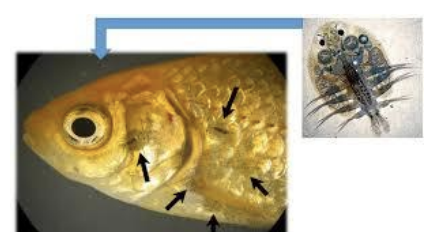
What external fish parasite is in the genus Lernaea, and infects freshwater fish like koi and goldfish? It is not zoonotic and the life cycle is direct. Signs include the adult female burrowed into the skin, red ulcerated lesions, death, and respiratory issues involving the gills. Diagnosis is by observation of the attached parasite. Treatment is with salt or other treatments like organophosphates and potassium permanganate.

Argulus
What genus contains fish lice, which are found in freshwater and saltwater fish, and is not zoonotic? The life cycle is direct. Signs include flashing, jumping, and erratic swimming, plus erythema, inflammation, ulcerations, and observation of the lice. Diagnosis is with clinical signs and observation, and treatment is with physical removal or organophosphates.
T. gondii
What species infects pinnipedia/seals and cetacea, and is zoonotic? Signs include subclinical infection, severe encephalitis, and fatal meningoencephalitis. Diagnosis is with serology, clinical signs, or PCR. There is no treatment due to cyst formation.
S. neurona
What species infects marine mammals and seals, and is not zoonotic? Signs include asymptomatic infection and muscle wasting, and treatment is with prolonged ponazuril.
Anisakis
What genus which infects marine mammals is a non-pathogenic nematoede in the stomach of marine mammals? It is zoonotic, and transmission involves ingesting eggs (cetaceans/pinnipeds), larvae/IH (crustaceans), L3 (fish), or PH (cephalopod mollusks). Signs include granulomas at the attachment site, blood loss, ulceration, and leading to perforation/peritonitis. Diagnosis is with fecal float for the DH stage, and treatment is with dichlorvos, fenbendazole, MBZ, and ivermectin.