AICE Marine – Unit 3 Characteristics of Seawater, Solubility in Water, Density and Pressure
 Call Kai
 Learn
Learn Practice Test
 Spaced Repetition
 Match
Match Flashcards
 Knowt Play
1/58

There's no tags or description
Looks like no tags are added yet.
Name | Mastery | Learn | Test | Matching | Spaced | Call with Kai | Chat |
|---|
No analytics yet
Send a link to your students to track their progress
59 Terms
Solute
a solid that dissolves in a solvent
Solution
a mixture of a solute dissolved in a solvent
solvent
a substance which is able to dissolve another substance
Solubility
the ability of a solute to dissolve within solvent
Dissolution
the process of being dissolved
What’s in seawater?
dissolved “salts”, dissolved gases, organic molecules, suspended sediment, mainly chloride(CI-) and sodium Na+
Salinity
concentration of dissolved salts in seawater
How is salinity expressed?
ppt
principle of constant proportions
the salinity of seawater varies in different areas of the ocean, but proportions of the major salts in seawater stay about the same everywhere
Decreases salinity
precipitation, runoff, melting of sea ice
Increases salinity
Evaporation, sea ice formation
How is sea ice formed?
from sea water during polar winters
Iceberg
pieces of glacier that broke off
where to glaciers from and what causes them?
on land, from the accumulation and compaction of snow
How does high salinity affect density?
density-higher salinity= higher density
How does high salinity affect freezing temperatures?
Freezing Temperature-Higher salinity=lower temperature freeze
How does high salinity affect electrical conductivity?
Electrical conductivity-Higher salinity= high e.c
how does high salinity affect viscosity?
viscosity-higher salinity=higher viscosity
how does high salinity affect osmotic pressure?
osmotic pressure- higher salinity=higher osmotic pressure
ph scale
an important abiotic factor for the survival of marine organisms
what ion to acids add to the solution? what ion do alkaline substances/basic add to the solution?
H+, OH-
what is the pH of the ocean?
8.2
what substance buffers the ocean?
calcium carbonate(CaCO3)
three main methods of measuring pH are
litmus indicator, universal indicator, pH probes
litmus indicator
a solution commonly used as papers where has been soaked in the solution, determines if acid or base
universal indicator
a solution commonly used as papers where it has been soaked in the solution, determines the range of strengths for acids and bases
pH probe
probes measure the H+ concentration within a solution to provide a numerical readout, much more precise than any other method
Do gases dissolve better in cold or hot water?
cold
do gases dissolve better in high or low pressure?
high
what gases are in the ocean?
nitrogen, oxygen, and carbon dioxide
what gas from the ocean is the most soluble?
CO2
are gases able to dissolve better in lower or higher salinity areas?
lower
during photosynthesis what happens to the O2 and CO2 levels?
O2 increases, CO2 decreases
during respirations what happens to CO2 and O2 levels?
O2 decreases, CO2 increases
what happens at the surface layer?
photosynthesis by plants at the ocean surface(photic zone) causes high levels of O2 and low levels of CO2
what happens in the oxygen minimum layer?
As depth increases, levels of oxygen decrease until it reaches this level
why is there less decomposition in deep water?
not enough oxygen for decomposing bacteria to perform aerobic respiration
why do deep-ocean organisms use less oxygen?
lack of food causes them to need less energy and repsire less
what happens to the solubility of oxygen as temperature decreases?
it increases
what happened to oxygen solubility as pressure increases?
it increases
density formula
mass/volume
different clines?
pycnocline(density, thermocline(temperature), and halocline(salinity)
is colder water denser then warm water?
yes
what is the ocean stratified by?
density
Surface zone(mixed layer)
contains the least-dense water. Temperature and salinity are mixed by waves and currents. Contact with atmosphere and has sunlight.
Pynocline
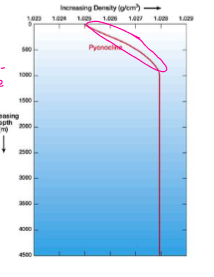
density increases dramatically with depth here. Acts as a barrier to mixing between surface zone and deep zone
deep zone
little change in density throughout this layer
what layer takes up 80% of the ocean water?
deep zone

thermocline
as temperature increases, density increases

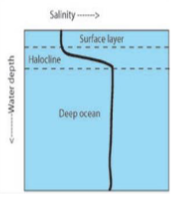
halocline
as salinity increases, density increases


pycnocline
the rapid change of density with depth
why are gradients formed by mixing due to
strong winds and wave action, currents and upwelling pushing water of different densities together
how is density expressed
g/cm3
what factors affect the density of water?
temperature, salinity, pressure
does freshwater freeze at a lower temperature then seawater?
no
average salinity of the ocean
35 ppt
where in the world do we see thermoclines?
temperate and tropical oceans because warm water and cold deep water don’t mix because of different densities
turbulence
chaotic swirling motion of water where the flow isn’t smooth
dissolved oxygen
oxygen mixed into ocean water that fish and other organisms need to breathe