Biochem Exam 1
 Call Kai
 Learn
Learn Practice Test
 Spaced Repetition
 Match
Match Flashcards
 Knowt Play
1/209

There's no tags or description
Looks like no tags are added yet.
Name | Mastery | Learn | Test | Matching | Spaced | Call with Kai | Chat |
|---|
No analytics yet
Send a link to your students to track their progress
210 Terms
What makes up a biological macromolecule?
Monomers
What are the 4 most abundant elements in the human body?
Carbon, oxygen, hydrogen, nitrogen
Define a reaction pathway
A distinct set of metabolic reactions
What are the polymers of amino acids?
proteins
Define covalent bonds
Bonds formed by atoms that share electrons
How many covalent bonds can carbon form?
4
How many covalent bonds can nitrogen form?
3
How many covalent bonds can oxygen form?
2
How many covalent bonds can hydrogen form?
1
What is the pH of an amino acid?
7

Circle the functional groups in this compound? What is the name of the compound?
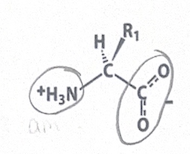
Amino acid
Draw the hydrogen bonding network in a solution of methanol in water. Mark the H-bond donor and the H-bond acceptor
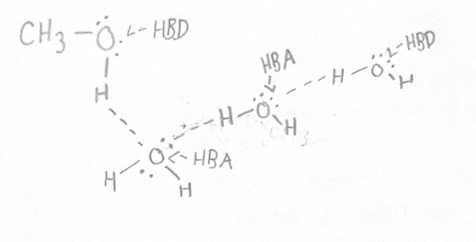
Circle the H-Bond donors in this molecule

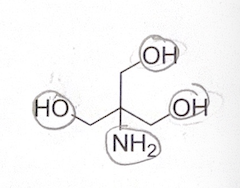
Circle the H-bond acceptors in this structure


What ΔEN value range shows that a polar bond is present?
0.5-1.9
Why is water always polar?
It has a permanent dipole
How many hydrogen bonds can 1 water molecule form with another water molecule?
4
Define dispersion forces
due to temporary polarity in the molecules because of unequal electron distribution
Define dipole-dipole attractions
due to permanent polarity in the molecules due to their structure
Define hydrogen bonding
very strong dipole–dipole attraction; H is attached to an electronegative atom (N, O, F)
Define ion-dipole interactions
between ions and water molecules in aqueous solution
What allows electrolytes to dissolve in water?
ion-dipole interactions
What is the bond energy of a charge-charge interaction?
13-17kJ/mol
What is the bond energy of a hydrogen bond interaction?
2-21kJ/mol
What is the bond energy of a van der waals interaction?
0.4-0.8kJ/mol
The strength of noncovalent interactions _____ with ______ in distance
drops ; increase
What are induced dipoles
temporary polarity created due to pi-pi stacking interactions
What impact does extreme pH have on protein structure?
Disrupts hydrogen bonds leading to loss of structure
Explain why ionic compounds are able to be dissolved in water
They have a high dielectric constant of water screens which decreases the electrostatic force between the oppositely charged ions
What is a hydrogen bond acceptor? (HBA)
O or N with a lone pair
What is a hydrogen bond donor? (HBD)
O or N covalently bonded to H
Which distance value between an HBD and HBA signifies a strong hydrogen bond?
2.8
What are the 4 types of macromolecules?
Proteins, lipids, polysaccharides, nucleic acids
How much of the human body is composed of water?
70%
What are the 4 most abundant elements in all living systems
Oxygen, carbon, hydrogen, nitrogen
Which element is involved in both the transfer of energy and the structure of nucleic acids?
Phosphorus
What are the 2 main components that make up the phospholipid bilayer?
Glycoproteins and cholesterol
Define organelles
specialized structures inside a cell that perform specific jobs to keep the cell alive and healthy
Define the central dogma
genetic information flows in one direction from DNA to RNA to a protein
What are the 5 main concepts of biochemistry?
Biochemistry is an observational and experimental science
The molecules and pathways in life are common amongst organisms
Biochemistry is an interdisciplinary science
Life obeys the laws of physics
Life obeys the laws of chemistry
What happens to energy in an exergonic reaction?
It is released
What happens to energy in an endergonic reaction
It is absorbed
Define the zeroth law of thermodynamics
when two objects are separately in thermodynamic equilibrium with a third object, they are in equilibrium with each other
Define the 1st law of thermodynamics
energy can be converted from one form to another but cannot be created or destroyed
Define the 2nd law of thermodynamics
the entropy of an isolated system will tend to increase to a maximum value
Define the 3rd law of thermodynamics
the entropy of a perfect crystal at absolute zero, 0 K, is zero
Define homeostasis
self-regulating process where an organism maintains a stable, balanced, internal environment while adjusting to external conditions
What are the 2 ways biomolecules interact?
Shape and charge complementarity
Define oxidation-reduction reactions
basis of many biochemical reactions and pathways involving the transfer of electrons
What is the monomer and bond name involved in a protein?
Monomer - amino acid
Bond - peptide bond
What is the monomer and bond name involved in a polysaccharide?
Monomer - monosaccharide
Bond - glycosidic bond
What is the monomer and bond name involved in a nucleic acid?
Monomer - nucleotide
Bond - phosphodiester bond
What type of reaction occurs to join monomers into biopolymers and what compound is released?
Condensation reaction, water is released
Define amphipathic molecules
the foundation for biological membranes with both hydrophobic and hydrophilic groups
What are 2 examples of amphipathic molecules?
Phospholipids and cholesterol
Draw the following functional groups:
Methyl
Ethyl
Aldehyde
Ketone
Carboxyl
Alcohol
Phenyl
Ether
Ester
Amine
Amide
Imidazole
Phosphate
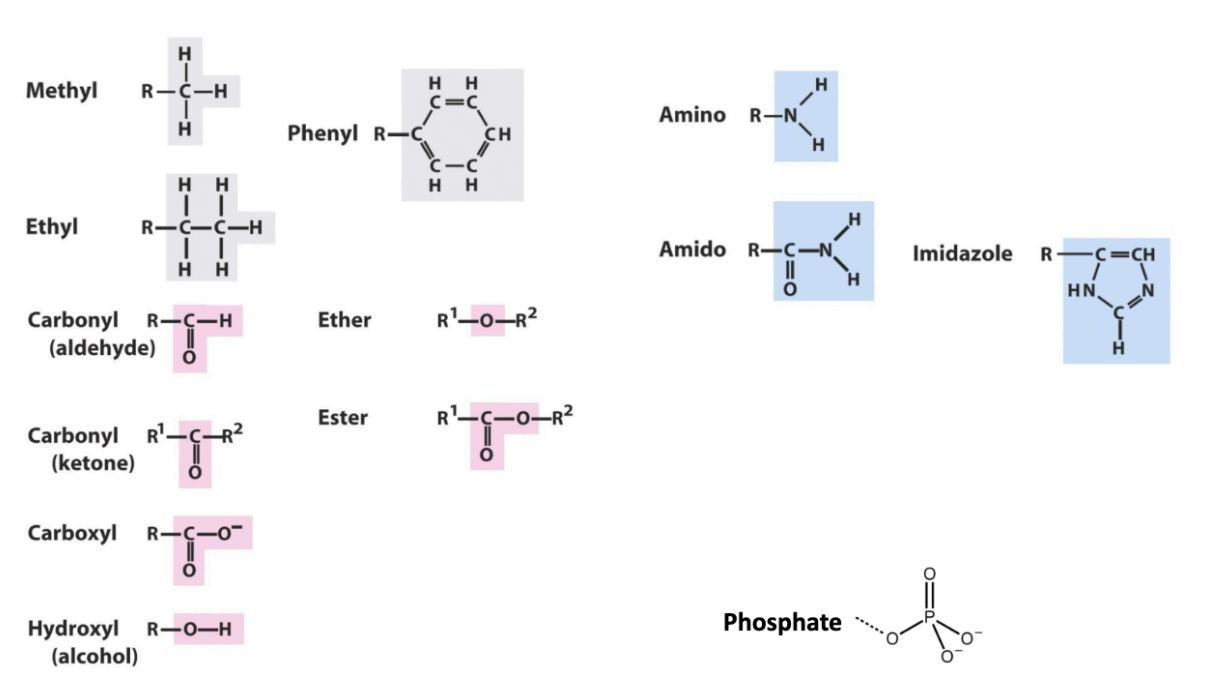
.
What is the function of the nucleus?
membrane-bound structure in a eukaryotic cell that contains DNA wrapped around proteins
What is the function of the nuclear envelope?
surrounds the nucleus
What is the function of the nucleolus?
in the nucleus. Transcribes ribosomal RNAs and assembles processed ribosomes
What is the function of the cytoplasm?
holds organelles in place, gives the cell its shape, and acts as the site for vital chemical reactions
What is the function of the cytoskeleton?
structural framework of the cells and tracks internal movement
What is the function of ribosomes?
consists of RNA and proteins and use mRNA to make proteins
What is the function of the smooth endoplasmic reticulum?
makes lipids and stores calcium ions
What is the function of the rough endoplasmic reticulum?
covered in ribosomes; synthesizes, folds, modifies, and transports proteins
What is the function of the mitochondria?
makes and supplies the cell with ATP via oxidative phosphorylation
What is the function of lysosomes?
contain digestive enzymes and remove damaged organelles and pathogens
What is the function of the golgi apparatus?
Modifies, sorts, and packages secretory proteins and lipids for storage or transport
What is the function of peroxisomes?
carries out cellular reactions involving the transfer of hydrogen from a substrate to O2
Name 4 common examples of a lipid
Cholesterol
Palmitic acid
Phosphatidyl serine
Triacylglycerol
Name 5 common examples of a carbohydrate
Cellulose
Glucose
Sucrose
Fructose
Starch
Name 6 common examples of a protein
Insulin
Thrombin
Trypsin
Myoglobin
Urease
Antibodies
Name 4 common examples of nucleic acids
DNA
RNA
Genes
Polynucleotides
Is urea a macromolecule?
No
How many HBA’s are in this molecule? Mark the HBA’s

3, the 3 O’s
Write a reaction showing a bronsted-lowry acid
HCl + NH3 → Cl- + NH4+
Write a reaction showing a bronsted-lowry base
NH3 + H2O → NH4+ + OH-
Define aliphatic group
Carbon atoms in chains rather than a ring
Draw a chiral molecule and mark the chiral center

A weak acid HA is 2% ionized in a 0.25 M solution.
Calculate the Ka of this acid;
Calculate the pH of this solution.
1.02 × 10^-4
2.30
The pH of acetic acid varies with its concentration. Ka of acetic acid is Ka = 1.74 x 10⁻⁵
Calculate the pH of a acetic acid solution with 0.035 M acetic acid
3.11
Calculate the pH of a solution prepared by dissolving 0.560 g of KOH in 250 mL of water.
12.60
What is the pH of a 0.15M HCl solution
0.82
Calculate the pH of a buffer that contains 0.15 M acetic acid (CH3COOH) and 0.25 M sodium acetate (CH3COONa). Ka = 1.74 x 10⁻⁵ for acetic acid
4.98
What is the pH of the buffer made by mixing 150mL 1.50 M acetic acid with 100mL 0.35 M sodium acetate? Ka = 1.74 x 10⁻⁵
3.95
A 100 mL sample of a 0.10 M acetate buffer, pH 4.40, is treated with 1.0 mL of a 1.00 M NaOH solution. What is the pH of the final solution? Ka = 1.74 × 10^-5
4.59
What volume of 1.0 M NaOH should be added to 150 mL of 0.25 M lactic acid solution to make a buffer with pH 4.20? Lactic acid, Ka = 1.38 x 10⁻⁴
25.7mL
What does a buffering capacity of a buffer depend on
Concentration
High buffering capacity = _____ concentration
high
Write the step-wise ionization for H3PO4 .
H₃PO₄ ⇌ H⁺ + H₂PO₄⁻
H₂PO₄⁻ ⇌ H⁺ + HPO₄²⁻
HPO₄²⁻ ⇌ H⁺ + PO₄³⁻
What is the pH equation?
pH = -log[H+]
What is the pOH equation?
pOH = -log[OH-]
What is the relationship between pH and pOH?
pH + pOH = 14
What are Bronsted-Lowry acids?
H+ donors
What are Bronsted-Lowry bases?
H+ acceptors
What happens when strong acids and bases are added to water?
They dissociate completely
What does LogY = X translate to?
10^X = Y
What determines the strength of an acid?
The percentage of acid molecules that ionize when dissolved in water
What does a higher percent ionization mean?
A stronger acid
What does Ka measure?
acid strength
What does a larger Ka mean?
stronger acid