FSIAPIA: Processing of Latent Image
 Call Kai
 Learn
Learn Practice Test
 Spaced Repetition
 Match
Match Flashcards
 Knowt Play
1/91

There's no tags or description
Looks like no tags are added yet.
Name | Mastery | Learn | Test | Matching | Spaced | Call with Kai | Chat |
|---|
No analytics yet
Send a link to your students to track their progress
92 Terms
Gurney-Mott Theory
Only accepted theory about latent image formation
Latent image
The invisible change induced in the film after exposure and before processing; potential image, invisible image
Manifest image
Exist on film after exposure and after processing, visible image
Sensitivity center
Physical imperfection in the lattice of the emulsion layer that occurs during the film manufacturing process (inherent to the film)
Sensitivity speck
Electron trap
Sensitivity center
Latent image center or the focal point
Silver sulfite
A chemical contaminant responsible for the physical imperfection of the silver halide crystal
Point defect
Sensitivity speck/center
Types of imperfection
Point defect
Occurs when ions move out from the cubical lattice formation
Sensitivity speck/center (electron trap)
Occurs when silver ions are trapped because of chemical impurities in gelatin
Latent image center
Refers to the clumping or grouping of silver ions
Latent image center
Clumping of 4-10 silver atoms
Frankel defect
Physical imperfection, consist of interstitial silver ions and silver ion vacancies
Gurney-Mott Theory
Mitchell Theory
Two theories of latent image formation
GM theory
Indicates that X-rays…
Before exposure, silver halide (AgBr and Ag…
Explain the Gurney-Mott Theory
Mitchell theory
Wetting
Developing
Stop bath
Fixer
Washing
Drying
What does the manual process of film processing involve?
Developing, fixing, washing, drying
What are the stages involved in the automatic process of film processing?
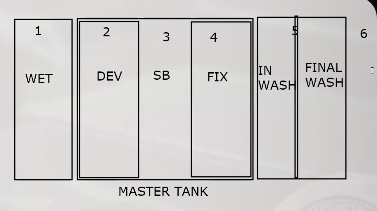
Master tank (water jacket)
Insert tank (2 - one for developer, one for fixer)
Water tank
Washing tank (Cascade compartment - 2 wash tanks for initial and final wash)
Manual processing tanks
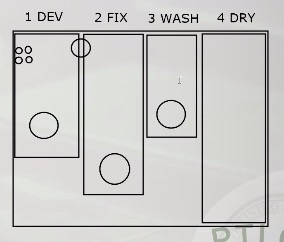
Developer tank
Fixer tank
Water tank
Tanks in automatic processor
Latent/Potential Image
Refers to the invisible image that exists on film after it has been exposed but before it has been processed
Visible/Manifest Image
Composed of black metallic silver, exists on film after exposure and processing
Reduction - Oxidation
Oxidation Produces Electrons; Electrons are Used in Reduction
REDOX = EUR/OPE
REDOX = EUR/OPE
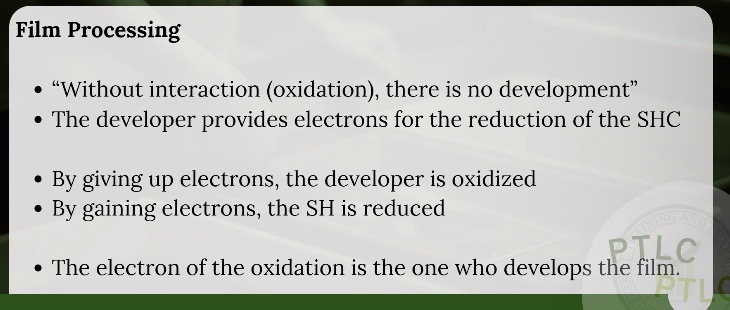
Electrons which is a product of oxidation from developer will be absorbed by the SHC which will be reduced in a simplified form (black metallic silver)
The developer has to undergo oxidation to produce electrons. The produced electrons will be used for reduction of SHC into black metallic silver.
Process of REDOX
Potassium - Auto; Sodium - Manual
PASM
Potassium
(can also be used for manual processing, but has higher concentration)
Liquid concentration for automatic processing
Sodium
(cannot be used for automatic processing, can cause damage to emulsion layer because it is powder)
Powder base for manual processing
Processing chemicals
Temperature, immersion time, pH, and specific gravity or concentration
Developer reacts based on what?
Convert latent image to manifest or visible image
Main function of developer solution
To amplify the amount of the metallic silver on the film by increasing the number of silver atoms on each latent image center (focal point of development)
Secondary function of developer solution
9.6 to 10.6 (alkalinic)
pH level of developer solution
Oxidation is necessary to release electrons but too much will
Presence of bromides indicate the presence of oxidation
Reducing agents
Activator
Restrainer
Preservative
Solvent
Other components
6 developer solution composition
Reducing agents
Also called developing agents
Reduce exposed AgBr crystals to black metallic silver
Function of developing/reducing agents
Hydroquinone, Elon, Metol, and Phenidone (HEMP)
Chemicals in reducing agents
Phenidone (automatic) Elon and Metol (manual)
Build up detail quickly in 1st half of development process
Fast reducing or fast developing agent
Speed indicator - first to take effect as compared to hydroquinone
Produces optical densities of 1.2; responsible for gray shades (Dmin)
(MD - mid-density point or intermediate density or midrange density)
Hydroquinone
Principal component or main component chemical of the developer
Completes development process
Contrast indicator
Build up contrast slowly (slow reducing agents) during development period
For both manual and automatic
Sensitive to light and temperature
Produces OD greater than 1.2
DD (density difference - contrast) Dmax
Synergistic effect
A higher activity when two chemicals are working together
Activator (activates HEMP) / Alkalinizer (increases alkalinity) / Buffing Agent (maintains pH) / Accelerator (speeds up development) / Wetting Agent (swells and softens emulsion)
Sodium hydroxide / bicarbonate and potassium hydroxide / bicarbonate
Maintains alkalinity
Provides necessary alkaline medium
Swells the emulsion gelatin so that the reducing agents can attack the AgBr crystals
9.6-10.6
10-11.5 or
10-12
pH level of wetting agent
Buffing agent
Any chemical that maintains pH
Chemicals: boric acid and Na hydroxide
Purpose: some chemicals of developer are acidic, some are basic
Boric acid
Used to maintain the acidity of Phenidone, sodium bromide and dialdehyde, and glutaraldehyde
Sodium hydroxide
Used to maintain the alkalinity of all the chemicals that is not mentioned in the boric acid example
Wetting stage
First step during manual processing
To swell and soften the gelatin in order for the reducing agents to develop the film (SHC) through penetrating fairly
Function of wetting agent (water)
Activator agent
Swell the gelatin emulsion for the reducing agents to attack the SHC
Sodium hydroxide, sodium carbonate, and Kodalk or sodium metaborate
Chemicals in activator agent
Kodalk does not release oxygen and is considered the most available and widely used activator
Why is Kodalk the most widely used activator?
Sodium hydroxide and sodium carbonate release oxygen
Sodium hydroxide, sodium carbonate, and Kodalk
Chemicals for accelerator agent
Increases pH value
Maintain alkalinity
Provides necessary alkaline alkaline medium
Maintains 9.6 - 10.6 pH
Function of Alkalinizer agent
Restrainer
Grouped into starter, anti-fogging, and regulation solution
Control the activity of the reducing or developing agent (HEMP) or decreases activity of developing agent
Protect the unexposed SHC (underdeveloped)
Function of restrainer
Sodium bromide / iodide or potassium bromide / iodide - acidic chemical that balances HEM
increases when solution is oxidized which means it contains a greater number of bromide
Chemicals for restrainer
Regulator or restrainer
Controls activity of reducing agents
Anti-foggant
Prevents fog formation (chemical or development fog) which is a veil of nonuniform density
Sodium…
Used only at first mixture due to the increased activity, therefore must not be added to developing solution during replenishment, as there is an increased number of bromides in oxidized solution
Benzothiosole
An organic restrainer (not considered a starter solution) which is added to PQ developer, must be replenished
Exclusively for Phenidone to prevent action of Phenidone on unexposed crystals, since it is not restrained by bromide
Where is benzothiosole used?
1956
Date, first roller transport system uses hardener
Preservative/Cycon
Same with fixer solution
Slows down rate of rapid oxidation (aerial) of reducing agents
Function of preservative
Sodium sulfite, potassium sulfite and Cycon (for both automatic and manual)
Chemicals in preservatives
The chemicals react with Quinone (byproduct of hydroquinone which is a dye) capable of staining the film and form colorless compound found on oxidized solution called hydroquinone monosulfate
Oxidation cannot be removed, but can be slowed down
Process of preservation
Contain great affinity with oxygen (can control the oxygen)
Stabilizer: promote balance or equilibrium of chemicals (usually Phenidone and hydroquinone)
Antioxidant : prevents internal oxidation
Function of preservative
External oxidation
Photooxidation
Aerial oxidation
Internal oxidation
Oxidation
It will create air bubbles turning evaporation through oxidation
Pressurized water causes bubbles - artifacts
Why must chemical not be shaken?
Why must water hose not be used?
Distilled water - most appropriate to use since it is balanced or neutral
What is used for solvent?
Rainwater on developer solution - scale of pH is 6 (acidic)
in developer, activity is decreased
In fixer, activity is increased
Increase mAs for automatic processor
Increase immersion time for manual processing
What should be used if there is no distilled water?
Mineral water - scale of pH increases
In developer, activity increases
In fixer, activity decreases but does not affect the film (only affects archival quality)
Solution for automatic: decrease mAs
Solution for manual: decrease immersion time
Alkalinic water
Add sequestering agent (chelates, EDTA, or calgon)
Solvent: Tap water on developer solution
Calcium sludge (use sequestering agent to prevent calcium sludge when using tap water)
Oily substance that can precipitate the chemical at the bottom of the solution and prevent deposition of metallic deposit artifact or calcium deposit artifact, prevents scaling of tank
Dialdehyde or glutaraldehyde
-For automatic processor only
-controls activity of activator or swelling of emulsion
Chemicals for other components: hardener/tanning agents (weak and temporary)
Hardener/tanning agents
Added to developer solution to prevent excessive swelling of emulsion, and to reduce film transportation problems and preventing damage to the emulsion
Developer : weak or temporary
Fixer: strong/permanent
Emulsion pickoff pinholes
Actual holes in the image where the emulsion has been physically picked off the polyester base, and causes gelatin buildup caused by exhausted hardening agent
The roller contains the emulsion leading to sticky processor roller (impeded on crossover)
What causes jamming of film?
Prevents the precipitation of calcium sludge, oily substance and precipitate of aluminum (sa fixer)
Function of sequestering agents
Sequestering agents
Sodium hydroxide/carbonate
Stimulates uniform development
For manual processing, water only
Wetting agents
Antifrothant/anti-foaming
Partnered with sodium hydroxide and carbonate to prevent bubble formation in the solution, prevent aerial and external oxidation
Close-fitting lids
Mixing paddle - must be labeled for developer or fixer
Hose should not be used
Fungicides
Chemical: Chlorox
Fungi develop in complete darkness and moisture
Developer: sodium hydroxide/ carbonate, boric acid or salts
Fixer: acetic acid
Maintains pH
Buffer
Stop bath
2%, 1%, or 10%
Maintains the activity of the fixer solution by adding 10% acetic acid and neutralize the alkaline developer (stop development process)
The presence of acetic acid will not cause oxidation on the fixer but with the water rinse bath, the increase in H2O component of the fixer will decrease acidity
Considered as weak acid
Stop bath
Acid Rinse Bath
Another term for stop bath
bromides and hydroquinone monosulfates
Oxidized developer solution contains _____ and _____ _____