Oncogenesis and Tumor markers
 Call Kai
 Learn
Learn Practice Test
 Spaced Repetition
 Match
Match Flashcards
 Knowt Play
1/38

There's no tags or description
Looks like no tags are added yet.
Name | Mastery | Learn | Test | Matching | Spaced | Call with Kai | Chat |
|---|
No analytics yet
Send a link to your students to track their progress
39 Terms
Define cancer
A state of abnormal, uncontrolled and excessive proliferation or growth of a cell or tissue invading other tissues.
What are the 2 types of tumors and explain them
Benign:- grows by expansion but remains encapsulated in layer of connective tissue.Not life threatening e.g moles, warts
Malignant:- exhibit uncontrolled proliferation and spread to distant places or different tissues (Metastasis) in the body. Life threatening e.g lung cancer, leukemia
Tumors of epithelial origin are called as
Carcinoma
Tumors of connective tissue are called as
Sarcoma
Tumors of lymph nodes are called as
Lymphoma
Tumors of stem cells of haematopoeotic tissue are called as
Leukemia
What are the predisposing factors for cancer
Age ( can happen at any age but more common over age of 55 )
Heredity
Environmental factors
Occupation: Benzene, Asbestos- skin cancer
Diet: - Long term intake of a diet rich in trans-fats, cholesterol
- Food infected with fungus like Aspergillus- Aflatoxin B-Hepatoma
- Pesticides
Life Style: Cigarette smoke: Ca lung
Alcohol: Ca Liver, Ca Pancreas
Tobacco: Ca Oral cavity
Iatrogenic: Certain drugs, exposure to radiations
What are the morphological changes in cancer cells?
Shape : Loses original shape, receptors and transforms the cell to larger size with irregular nucleus, distinct nucleoli, scarce cytoplasm.
Motility & Growth:
Loss of contact inhibition thus grow in multilayer, over one another to form a mass.
Cell cycle changes, 2-5 times increase in mitotic phase
Loss of Anchorage dependence and tissue adherence - can grow without attachment to surface
Loss of Apoptosis (programmed cell death) - thus retain ability to survive & proliferate.
Metastasis: loss of adhesion and increased collagenase, proteinases facilitate migration into other tissues
What are the Biochemical changes in cancer cells?
1.Increased synthesis of DNA & RNA
2.Changes in composition and structures of glycoproteins & glycolipids receptors on surface of cancer cells may cause metastasis.
3.Appearance of new antigens & loss of certain antigens.
4.Inappropriate synthesis of certain hormones and growth factors.
5.Decreased requirement for nutrition - Rapid growth --- high rate of glycolysis --- leads to accumulation of lactic acid.

Fill in the blanks

What are mutagens
substances which increase rate of mutation & enhance incidence of cancer.
all mutagens are carcinogenic.
e.g. Radiations, free radical generators, environmental & dietary factors, chemical carcinogens, oncogenic viruses, certain bacteria & parasites.
What are antimutagens
substances which have the ability to inhibit tumor promotion.
e.g. vitamin A & carotenoids, vitamin E & C, leafy vegetables, curcumin, resvasterol, flavinoids
What are carcinogens
A cancer causing agent is called a carcinogen
What are the 3 types of carcinogens?
Physical : radiation
Chemical: variety of chemical compounds.
Biological : oncogenic viruses
Physical carcinogens (radiation) can cause cancer by 2 ways -
Direct effect
Indirect effect
Explain them
Direct effect:-
- Damages DNA by:
Breaking of double strand
Deletion of purine/pyrimidine bases,
Thymin dimers
Cross linking of strands
Indirect effect:
Excessive radiations by γ-rays & X-rays produce free radicals, which interact with DNA & other macromolecules - increased lipid peroxidation and oxidative stress causing molecular damage.
What are direct acting and indirect acting chemical carcinogens
Direct-acting: interact directly with target molecules.
Indirect-acting : require prior metabolism / activation to become carcinogenic (procarcinogens)

Fill in the blanks

What is the mechanism of action of chemical carcinogens
Mechanism of action of chemical carcinogens:
Ultimate carcinogens are electrophilic (electron deficient),so they attack nucleophilic (electron rich) group of DNA.
May bind to N2, N3 &N7 of guanine (highly prone)
These changes leads DNA alterations à increases probability of mutation.
What are some dna and rna common oncogenic viruses
DNA Viruses:
i) Human papillomaviruses(HPV)- Uterine cervical cancer
ii) Hepatitis B virus (HBV)- Hepatoma
iii) Human herpes virus 8 (HHV8)-Oral cancer
RNA viruses: (Retro- virus)
i) Leukemia virus – Leukemia, lymphoma.

Fill in the blanks

What are oncogenes
•Genes capable of causing cancer.
•They were first identified in tumour causing viruses e.g. Rous sarcoma virus
what are proto-oncogenes
•Genes of normal cells, which play role in cell growth and division
•Proto-oncogenes are important regulatory genes of the cells. More than 100 human proto-oncogenes are known.
Proto-oncogenes are activated to oncogenes by which mechanisms
1) promoter & enhancer insertion
2) chromosomal translocation
3) gene amplification and
4) point mutation
What is promoter and enhancer insertion

What is chromosomal translocation
What is gene amplification

What is point mutation

What are growth factors ? Give some examples also
Growth Factors are polypeptide or protein molecules responsible for differentiation, remodeling, migration and growth of targeted normal cell.
Generally cause mitosis/ differentiation of target cells.
They regulate cell division by signal transduction across the cell membrane to the interior.
Growth factors are products of oncogenes
Play a key role in carcinogenesis
Examples of growth factors
- Epidermal growth factor (EGF)
- Platelet derived growth factor (PDGF)
- Nerve growth factor (NGF)
What are anti oncogenes or tumor suppressor genes , give some examples also
Genes that normally protect the cell from developing cancer.
Mutations in these genes à Inactivation of tumor suppressor gene à loss of growth control
Few widely studied tumor suppressor genes are:
- Retinoblastoma (RB) gene –Retinoblastoma
- p53gene – Lung cancer
- DCC – Colon cancer,
- BRCA: Familial Breast Cancer
What is Mechanism of action of Tumor Suppressor Gene ?
Tumour suppressor gene, p53 encodes a phosphoprotein.
It blocks the cell division of those cells that have damaged DNA until the damage is repaired.
If the DNA damage is severe, the p53 directs the cell to commit suicide by triggering apoptosis.
It is also seen that p53 activates the expression of genes that suppress cell proliferation.
Most tumours have a complete absence of p53, whereas others show mutant non functional p53.
What is apoptosis
Definition: Genetically programmed series of events leading to cell damage that follows cell death.
The events involve cell shrinking, membrane blebbing, absence of inflammation.
Many Caspases (Proteinases) are involved.
Apoptosis is regulated by balance between factors that inhibit and activate the process.
Mutations found in cancer cells enable them to evade apoptosis leading to cell proliferation.
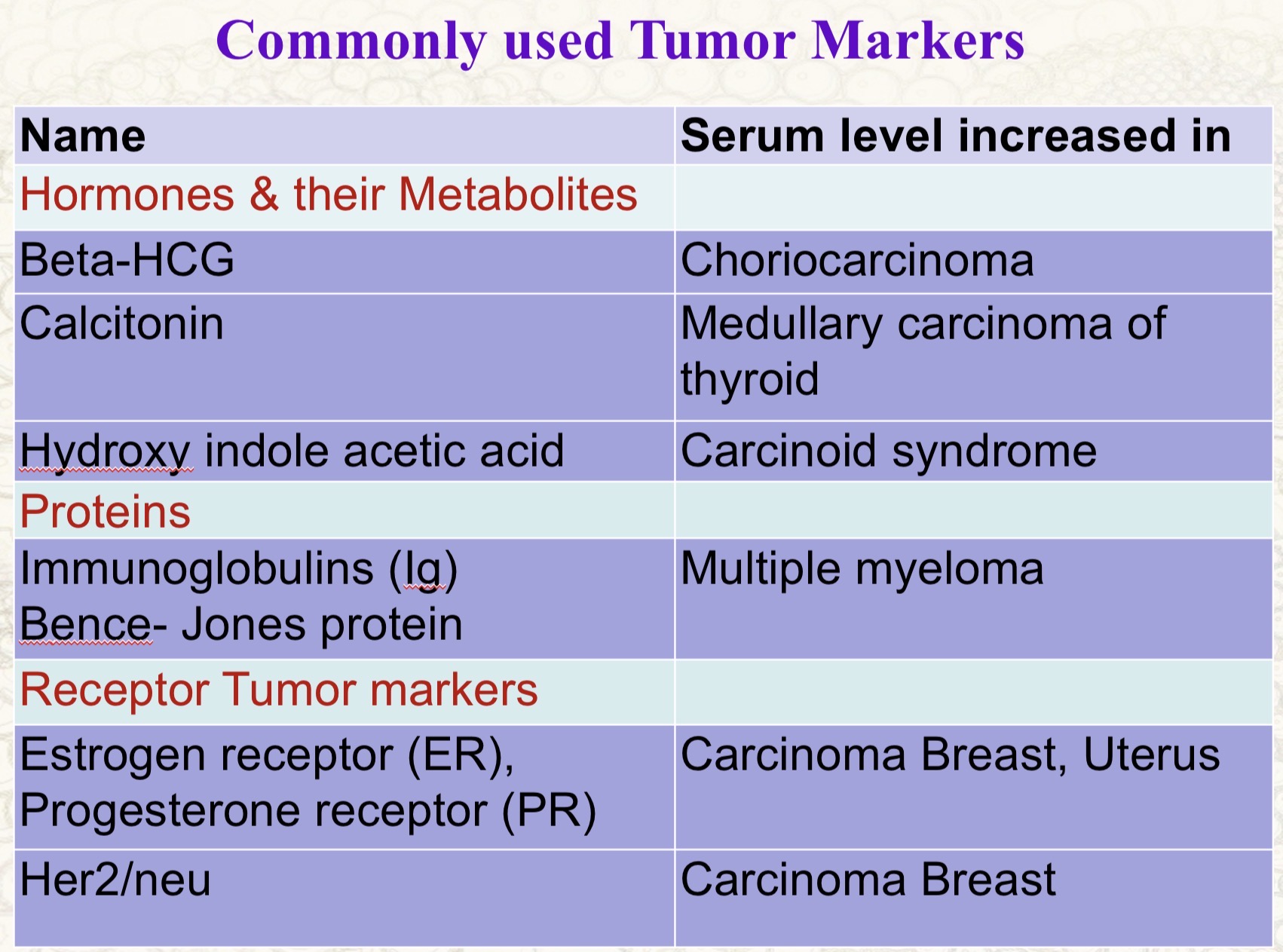
What are tumor markers and what are they used for
Tumor cells produce certain biological substances whose detection in the blood indicates the presence of tumour in the body.
They mainly include enzymes, hormones and tumor antigens.
Tumor markers are used for:
-Screening
-Diagnosis
-Monitoring treatment
-Prognosis & staging of cancer
-Detecting recurrence
Ideal characteristics of a tumor marker
It should:
only specifically increase in malignant cancer.
be at minimum level in healthy subjects & benign conditions.
increase in early stage, thereby enabling early detection and initiating appropriate therapy.
be present in or produced by tumor itself-should not be produced by healthy tissues.
be easy for analysis in routine lab investigation & economical to measure.
Tumor markers can be: Serum based (better) or Tissue based.


What is metastasis
The cancer cells can spread to distinct tissues through blood or lymph. Such spread of cancer cells and colonization of distinct tissues is called metastasis.
On reaching other tissues , the cancer cell invades other tissue and form secondary tumor.
It is the major cause of cancer related morbidity & mortality.
Also shows poor adherence to surface & loss of contact inhibition.
Tell abt treatment of cancer
1)Surgical removal:
Removes as much as tumor as possible.
2) Radiotherapies.
Radiation delivers energy to the tissues causing ionization and excitation of atoms and molecules. This causes damage to DNA and promote apoptosis.
Surgery and radiotherapy are most effective to reduce the initial tumour load.
These are the prime modalities of treatment in solid tumours.
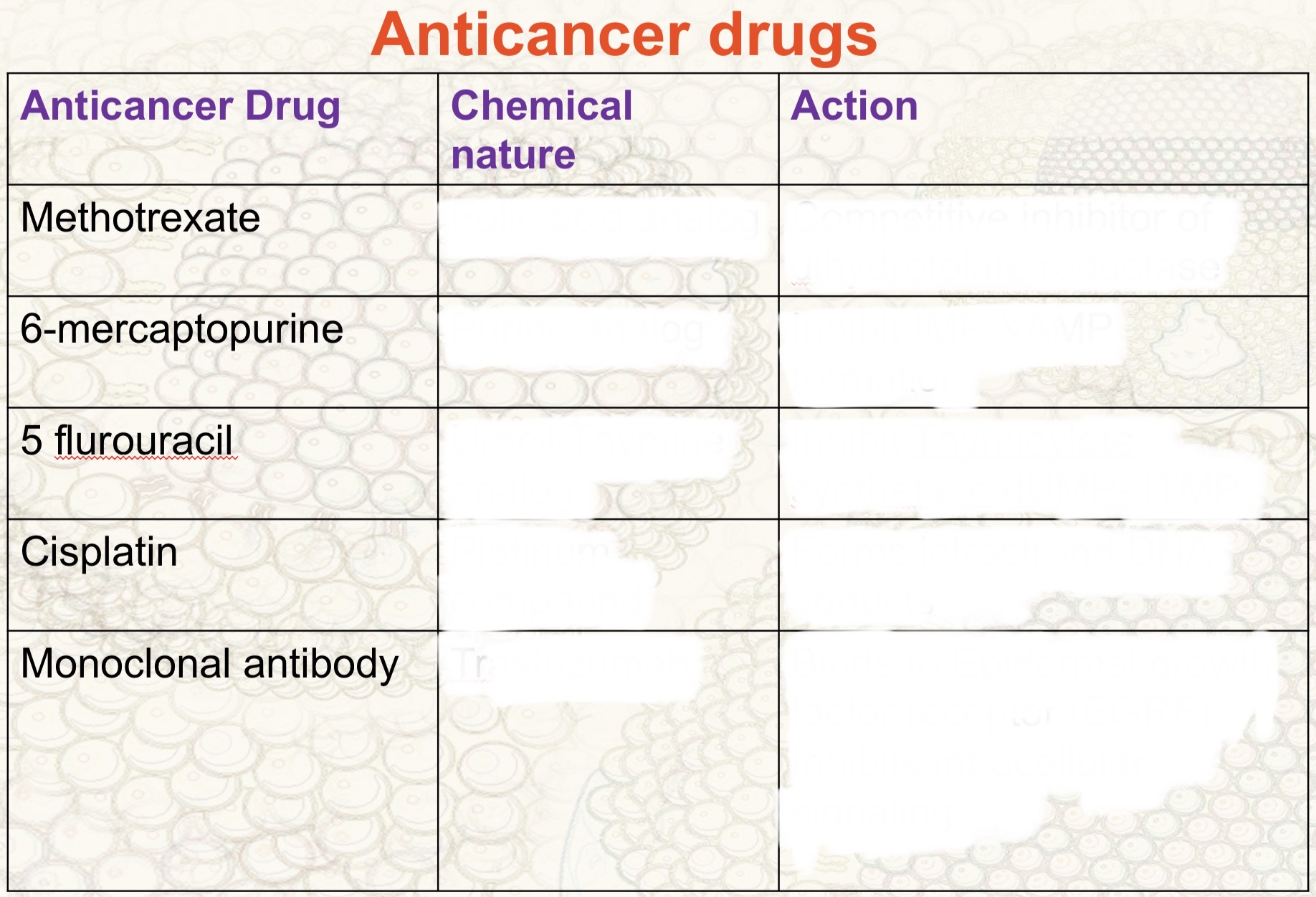
3) Chemotherapy:
Anticancer Drugs that are used to kill cancer cells which are in dividing phase.
a)DNA damaging agents
b)Antimetabolites (interfere with DNA synthesis)
Tell some precautionary measures to reduce occurrence or prevalence of cancer:
•Life Style Changes: Daily exercise, control over Body weight
• Avoid smoking or Tobacco chewing
• Minimal exposure to industrial pollutants and radiations.
• Diet: Low fat diet and fatty food . Consume food rich in antioxidants.
• Routine Screening of Cancer: PAP smear (Ca Cervix), Mammography (Ca Breast).
• Genetic testing: Prophylactic mastectomy for BRCA1,2 gene mutations.
•Vaccination: Effective for Specific type of cancers HPV – cervical cancer, HBV- liver cancer