Psychology Exam Chapter 1
 Call Kai
 Learn
Learn Practice Test
 Spaced Repetition
 Match
Match Flashcards
 Knowt Play
1/31

Earn XP
Description and Tags
I will make an A on this!!
Name | Mastery | Learn | Test | Matching | Spaced | Call with Kai | Chat |
|---|
No analytics yet
Send a link to your students to track their progress
32 Terms
The science that seeks to understand behavior and mental processes and apply that understanding
Psychology
How biological process in the brain and other organs affect, and are affected by behavior and mental processes
Physiological Psycology
Study the psychological changes of humans that takes place over a lifetime
Developmental Psychology
Study human perception, thinking, and memory
Cognitive Psychology
Studies the characteristics that make individuals similar and different from one another
Personality Psychology
Studies how people’s thoughts, feelings, and behaviors are influenced by the real or imagined presence of other people
Social Psychology
Assess, treat, and study mental, emotional and behavioral disorder
Clinical and Counseling Psychology
Who developed the first concepts of Psychology in 1879?
Wihelm Wundt
What did Wihelm Wundt do in 1879?
Breaking consciousness down into basic elements of sensation and feeling. Developed introspection (“looking inward”)
Who developed Wilhelm Wundts ideas into Structuralism?
Edward Titchener
Edward Titchener did what?
Developed Wilhelm Wundts ideas into Structuralism and brought that to the United States
An early school of psychology focused on breaking down mental processes into their most basic components, emphasizing introspection and the analysis of consciousness.
Structuralism
Who developed functionalism in 1890?
William James
When did William James develop functionalism?
1890
How consciousness helps people adapt to their environments and how mental processes guide people’s ability to make decisions
Functionalism
Who developed psychoanalytics?
Sigmund Freud
When did Sigmund Freud develop psychoanalytics
1900
Psychoanalysis
Therapy focusing on bringing unconscious material into consciousness via hypnosis and free awareness
The theory that unconscious conflicts can influence behavior and mental health. Common conflict: personal desire vs. social rules. Early experience also matters
Psychoanalytic theory
Who developed the Gestalt theory?
Wertheimer, Koffka, and Kohlner
Psychology that is against breaking down consciousness into its components. The whole of conscious experience is greater than the sum of its parts.
Gestalt Psychology
Who developed Behavioralism?
John Watson and B.F Skinner
Overt behavior is the only appropriate subject matter. Behavior is shaped by the environment through learning, especially conditioning
Behavioralism
The little albert experiment, Pavlovs dog, Skinners box, are all examples of what??
Classical Conditioning
Who developed the humanistic theory?
Abraham Maslow and Carl Rodgers
An approach to psychology that emphasizes the study of the whole person and the uniqueness of each individual. It prioritizes personal growth, self-actualization, and the inherent goodness of people. The third force.
Humanism
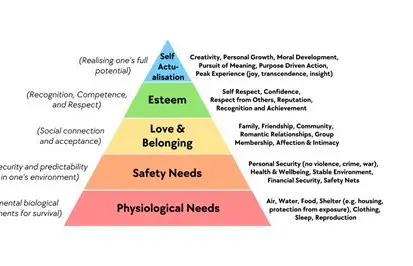
What is this
Moslows heiarchy of needs
The examination of one's own conscious thoughts and feelings
Introspection
Emphasizes the influence of thoughts and mental processes and how they relate to behavior
Cognitive Approach
Links mental processes to activities in the nervous system, brain, & other bodily processes
Cognitive Neuroscience and Biopsycology
Focus on how behavior & mental processes emerge as adaptions to increase survival
Evolutionary Approach
Focus on the effect people have on one another (individually or a culture)
Sociocultural Approach