RETIREMENT ACCOUNTS AND SOCIAL SECURITY
 Call Kai
 Learn
Learn Practice Test
 Spaced Repetition
 Match
Match Flashcards
 Knowt Play
1/32

Earn XP
Description and Tags
Individual Retirement Arrangements (IRAs) Income from retirement plans Social Security income
Name | Mastery | Learn | Test | Matching | Spaced | Call with Kai | Chat |
|---|
No analytics yet
Send a link to your students to track their progress
33 Terms
define IRAs- Overview
An IRA is a personal savings plan (account or annuity) that gives
you tax advantages for setting aside money for your retirement.
Two basic types of IRAs:
Traditional IRA, which (usually) features a tax deduction for contributions and
tax deferred growth, but is taxable when distributed. (Tax benefit is NOW).
Roth IRA, which features nondeductible contributions, tax free growth, and
tax-free distributions. (Tax benefit is LATER).
There are also IRAs for small businesses (SEPs, SIMPLE), which will be
discussed in Part 2 of this series (Business taxation).
what are the two advantages of a traditional IRA
Two advantages
1. Tax deduction for contributions (if you qualify).
Adjustment to income
2. Earnings are not taxed until distributed (tax-deferred growth).
how do you open a Traditional IRA
In order to open or contribute to an IRA, you must have
compensation (e.g. wages or self-employment income).
Can be opened with a bank, mutual fund, life insurance company,
stockbroker, etc.
No age limit for making contributions
what are the limits of a traditional IRA
For 2025, the most that can be contributed is the lesser of:
$7,000 ($8,000 if age 50 or older), or
Total taxable compensation for you and your spouse, reduced by:
Spouse’s contributions to a traditional IRA
Contributions on your spouse’s behalf to a Roth IRA
So the maximum contribution for a married couple is $14,000 (or
$15,000 if one is age 50 or older, and $16,000 if both are).
Not necessary for both spouses to have compensation (MFJ).
These limits apply to all IRAs you and your spouse own combined,
whether traditional or Roth.
what are the deadlines of a traditional IRA
Contributions can be made any time during the calendar year, or
by the original due date of the tax return (i.e. April 15, 2026).
This is a way to save your clients taxes even after the year is over.
You can file your return claiming the deduction even before the
contribution is actually made.
For example, file and claim the deduction on March 1, 2026, and make the
contribution on April 15, 2026.
You do not have to contribute every year.
what are the limits Traditional IRA and which do you add back
There are some limitations on who can make deductible
contributions. These limitations depend on:
Whether or not you or your spouse are covered by an employer’s retirement
plan,
Your filing status, and
Your modified Adjusted Gross Income (MAGI), which is your AGI without regard
to the IRA deduction, plus:
Student loan interest deduction
Foreign earned income exclusion
Foreign housing exclusion or deduction
Excluded US Savings Bond Interest (used for education)
Excluded employer-provided adoption benefits
what are the Traditional IRA filing status limits if you have an employer plan
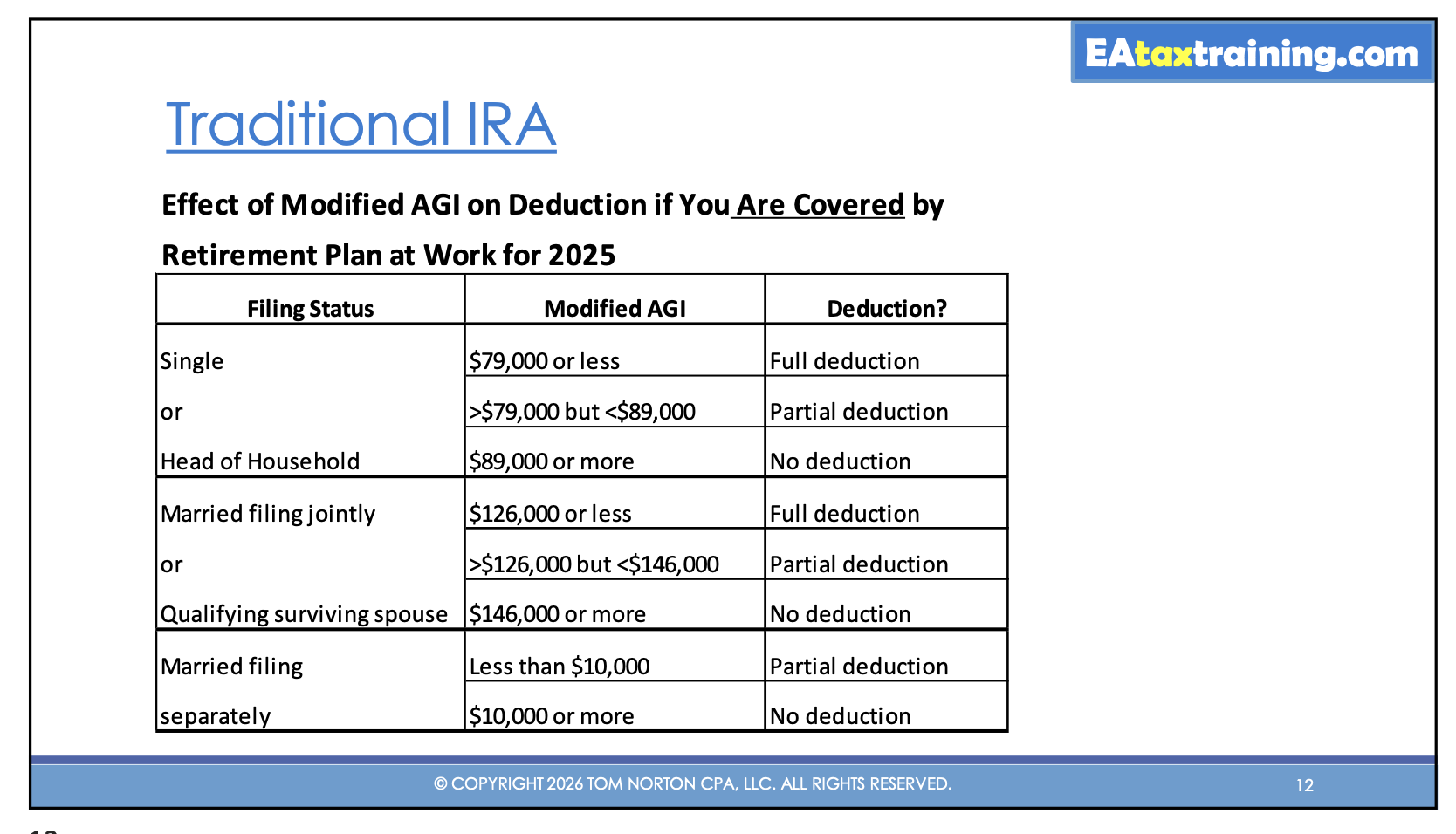
Effect of Modified AGI on Deduction if You Are Not Covered by
Retirement Plan at Work for 2025?
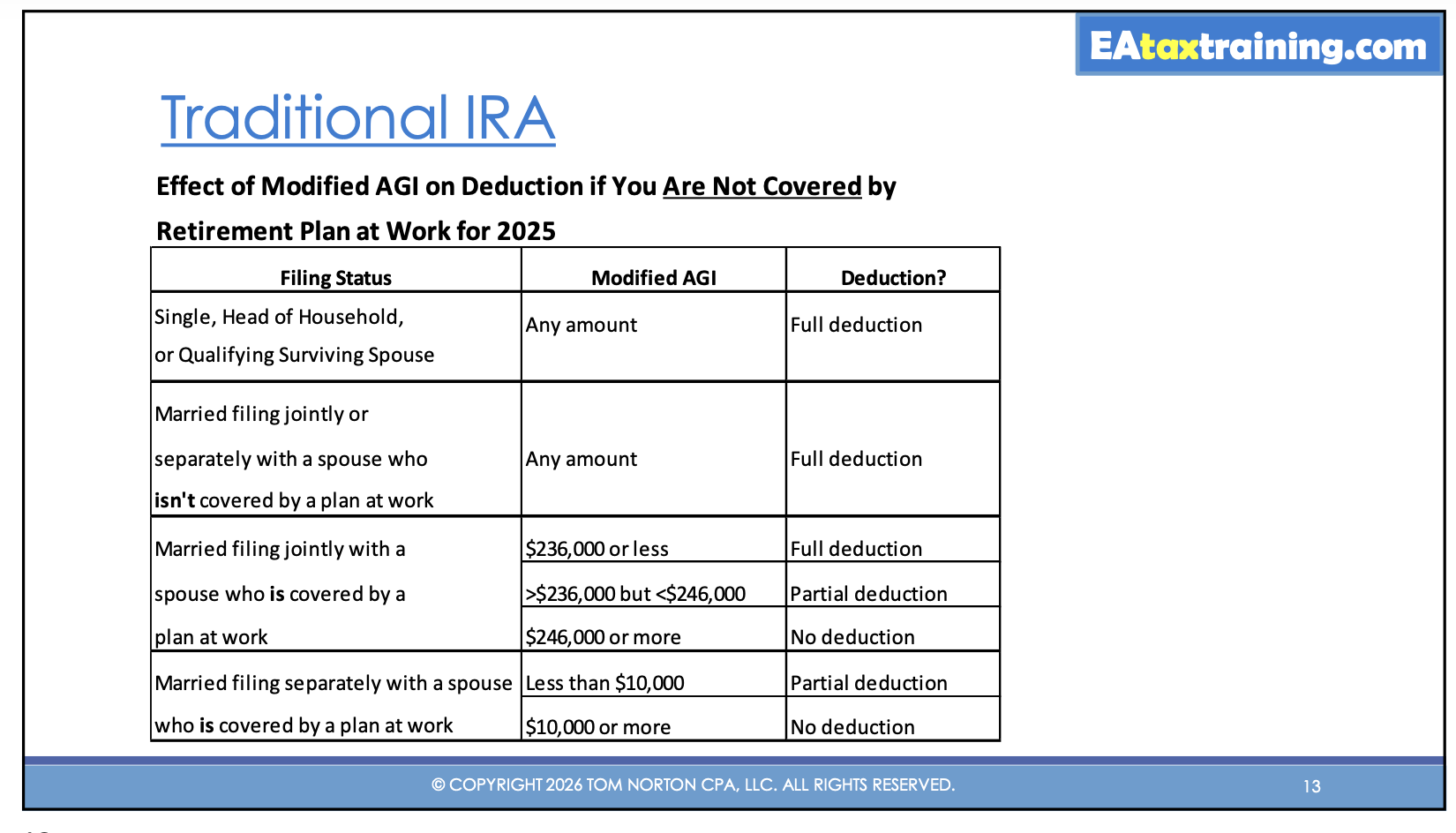
Traditional IRA Nondeductible contributions? and what form
Can still contribute up to the annual limit (e.g. $7,000 or $8,000) even if you
don’t meet the rules for deductibility
Any amounts in excess of what is deductible will be considered nondeductible
When you take distributions (e.g. at retirement), part of each distribution will be
taxable and part nontaxable. Your nondeductible contributions (i.e. your basis) will
not be taxed, but your deductible contributions and ALL earnings will be taxed.
Must report nondeductible contributions on Form 8606 for the year(s) it is
made. (Must file even if not required to file an income tax return.)
define Traditional IRA Rollovers
Transferring money from other retirement plans into a traditional IRA (e.g. 401(k)
to IRA, IRA to IRA)
Trustee-to-trustee transfer
Tax-free
Rollover
Retirement plan sends you a check in your name, withholding 20% for taxes (no mandatory
withholding if IRA to IRA)
You deposit the full amount (before withholding) into a new or existing IRA, within 60 days
Tax-free
If IRA to IRA, must wait one year before doing another rollover (does not apply if trustee-to-
trustee)
Transfer incident to divorce is tax free
explain Traditional IRA Distributions
In general, you pay tax at your regular income tax rates when you
withdraw funds from a traditional IRA.
If you have basis in the IRA (e.g. as the result of making nondeductible
contributions), part of the distribution will be taxable and part will not, in
proportion to your basis.
No capital gains rates
In addition, if you take a distribution before age 591/2, you are
generally subject to a 10% penalty.
Traditional IRA Distributions
When are distributions not taxable?
When are distributions not taxable?
Rollovers
Qualified Charitable Distributions (QCDs)
Distributions directly from your IRA trustee to an eligible organization
Up to $108,000 per person, per year
Must be at least age 70½
Tax free withdrawals of contributions
When you make a contribution and the take it back out in the same year (or by the
extended due date of your return).
Taxed on any earnings.
The portion attributable to nondeductible contributions is not taxable.
explain Qualified Disaster Recovery Distributions
Qualified disaster recovery distributions receive special tax treatment
To qualify, must have suffered a loss due to living in a federally
declared disaster area
Maximum distribution is $22,000 (total from all retirement accounts) per
disaster
Included in income equally over 3 years, though the taxpayer can
elect to include it all in the year received
No 10% penalty for early withdrawal
Can pay the money back into the account and reverse the income
(may need to amend)
explain Required Minimum Distributions
Required minimum distributions (RMDs)
If you are the account owner (as opposed to a beneficiary), you must begin
taking RMDs by April 1 of the year following the year you turn 73.
After that initial requirement, RMDs must be made by December 31 of each year.
RMDs are not eligible to be rolled-over
Qualified Charitable Distributions (QCDs) count toward your RMD.
If you do not take your (full) RMD, you may be subject to a penalty equal to 25% of
the amount that should have been distributed but wasn’t.
Can be reduced to 10% if corrected within two years after the year of the shortfall.
The amount of the RMD is calculated based on the account balance
and IRS life expectancy tables. See Publication 590-B.
where and what form is a Traditional IRA Distributions reported
Distributions are reported on Form 1099-R.
Federal income tax is withheld unless you choose otherwise.
Must file Form 8606 when you receive a distribution if:
You ever made nondeductible contributions, or
You ever rolled-over after-tax amounts to the traditional IRA
explain a Roth IRA
While you receive no tax deduction for contributing to a Roth IRA,
there are very significant tax advantages:
1. 2. The investment grows tax free (no taxes each year on earnings).
When the funds are distributed to you at retirement, they are (generally)
completely tax-free.
No RMDs while the account owner is alive.
how to open a Roth IRA
In order to open or contribute to an IRA, you must have
compensation (e.g. wages or self-employment income).
Can be opened with a bank, mutual fund, life insurance company,
stockbroker, etc.
No age limit for making contributions
Contributions can be made any time during the calendar year, or
by the original due date of the tax return (i.e. April 15, 2026).
what are the Roth IRA imits
For 2025, the most that can be contributed is the lesser of:
$7,000 ($8,000 if age 50 or older), or
Total taxable compensation for you and your spouse, reduced by:
Spouse’s contributions to a traditional IRA
Contributions on your spouse’s behalf to a Roth IRA
So the maximum contribution for a married couple is $14,000 (or
$15,000 if one is age 50 or older, and $16,000 if both are).
These limits apply to all IRAs you and your spouse own combined,
whether traditional or Roth.
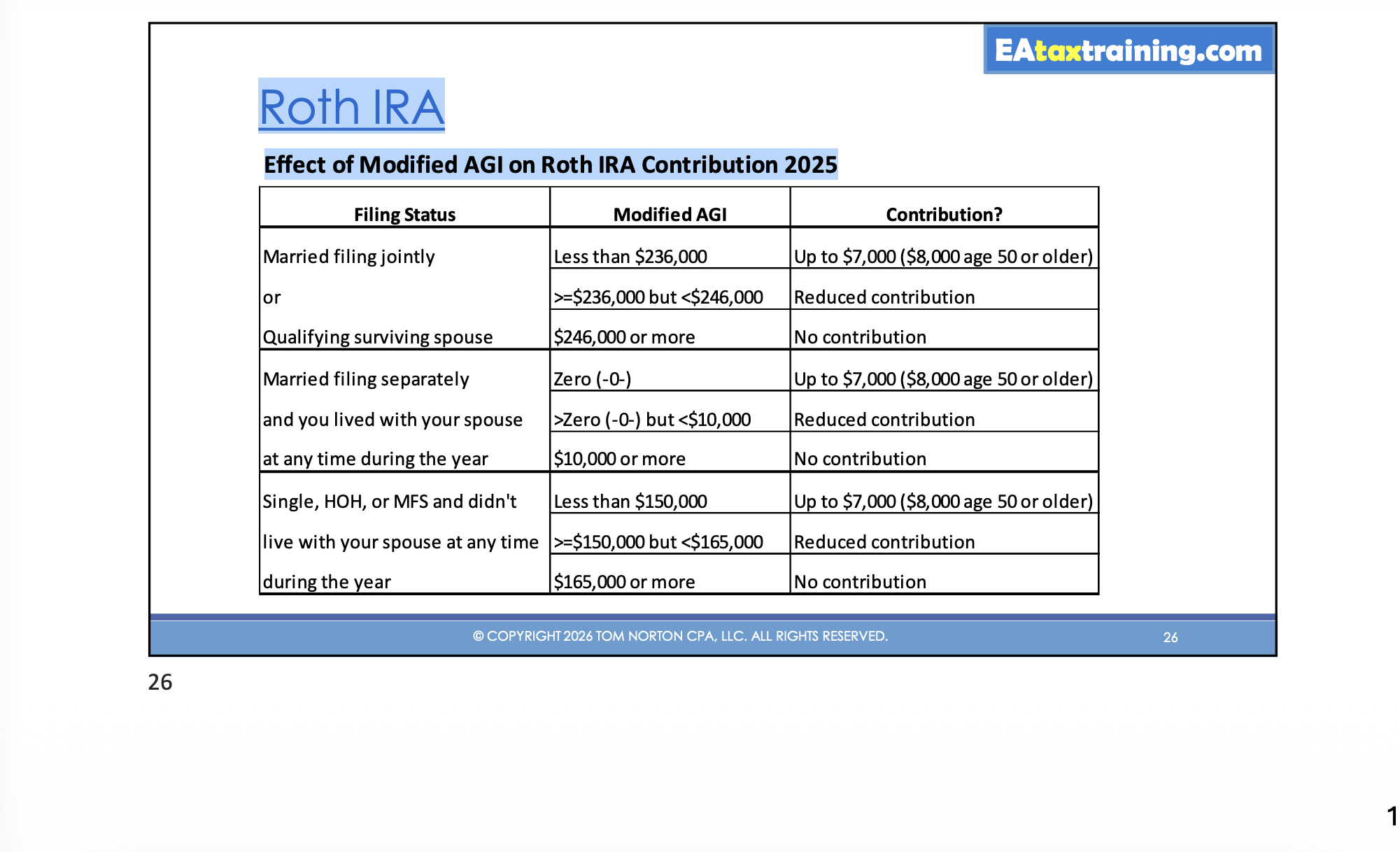
explain Roth IRA phase outs
If your modified AGI is above certain limits, the amount of your
maximum contribution is gradually reduced. The amount of the
reduction depends on:
Filing status
Modified AGI (same as traditional IRA)
Unlike traditional IRAs, whether or not you participate in a
retirement plan at work does not matter.
Roth IRA
Effect of Modified AGI on Roth IRA Contribution 2025
explain Roth IRA- Distributions
Distributions of amounts contributed are always tax and penalty
free.
Distributions of earnings are tax and penalty free it the account is
at least 5 years old and recipient is:
Age 591/2 or older,
Disabled,
A beneficiary of a deceased account owner, or
Using the funds for buying a first home (up to $10,000)
Other distributions of earnings are subject to tax and 10% penalty.
explain Recharacterizations and what form to use
You may be able to treat a contribution made to one type of IRA
as having been made to a different type of IRA.
Must be a trustee-to-trustee transfer made by the due date
(including extensions) of the return for the year during which the
original contribution was made.
All earnings are also transferred, and the date of the transfer
becomes the contribution date.
Report on Form 8606.
Example: Dean makes a $5,000 contribution to his traditional IRA
on August 1, 2025. In February of 2026, he meets with his tax
preparer, who informs him that due to an increase in his salary,
Dean does not qualify for an IRA deduction for 2025. On February
15, 2026, Dean notifies the IRA trustee to transfer the contribution
and any earnings into a Roth IRA, which is done the same day. He
reports this on Form 8606, and it will be treated as a 2025 Roth
contribution made on February 15, 2026, and the original
contribution to the traditional IRA will be ignored.
define Roth IRA- Conversions
Conversion of a traditional IRA to a Roth IRA.
Treated as a rollover, regardless of the conversion method used.
Rollover rules apply, except the 1 year waiting period.
Pay tax on the taxable portion of the distribution from the
traditional IRA, but no 10% penalty for early withdrawal.
Can be done via:
Rollover (check made out to account holder, who then reinvests within 60
days).
Trustee-to-trustee.
Same trustee transfer.
Conversion from a SIMPLE IRA to a Roth IRA.
Cannot convert any amount distributed from the SIMPLE IRA plan
during the first two years you participated in the plan.
Pay tax on the taxable portion of the distribution from the
traditional IRA, but no 10% penalty for early withdrawal.
Can be done via:
Rollover (check made out to account holder, who then reinvests within 60
days).
Trustee-to-trustee.
Same trustee transfer
define Roth to Roth Rollover
You can withdraw, tax free, all or part of the assets from one Roth
IRA if you contribute them to another Roth within 60 days.
Same general rules as other IRA to IRA rollovers.
define Prohibited Transactions, etc.
If you don’t follow the rules, you can incur penalties or owe
additional taxes.
There are two general categories: 1. Prohibited transactions and 2.
Other disallowed activities
define Prohibited Transactions
A prohibited transaction is any improper use of your IRA by you,
your beneficiary, or any disqualified person (e.g. your fiduciary and
family members).
The following are examples of prohibited transactions with an IRA:
Borrowing money from it
Selling property to it
Using it as security for a loan
Buying property for personal use (present or future)
If the owner or their beneficiary engages in a prohibited
transaction, it has the following effects:
The account stops being an IRA as of the first day of that year
The account is treated as distributing all its assets at their fair market values on
the first day of the year. In addition to regular income tax, there may be
additional taxes or penalties.
If someone other than the owner or a beneficiary engages in a
prohibited transaction, that person may be liable for certain taxes.
In general, there is an initial 15% tax on the amount of the
prohibited transaction and a 100% additional tax if the transaction
isn’t corrected.
define Other Disallowed Activities
Other disallowed activities:
Investing in collectibles
Considered distributed to you in the year purchased
Having unrelated business income
Pay tax at Trust tax rates
Making excess contributions
If not withdrawn by the due date (including extensions) of the return, must pay a 6%
excise tax on the excess contributions each year they remain in the account
Can designate excess as next year’s contribution, but will still be subject to 6% excise tax
Failing to take required minimum distributions
Taking early distributions (10% penalty)
explain Early Distribution Penalty Exceptions
• For unreimbursed medical expenses that are more than 7.5% of AGI
• For certain health insurance premiums after you have received
unemployment compensation (or would have been eligible to
receive unemployment compensation but for your self-employed
status)
• Made because you're totally and permanently disabled
• Made to you because you are terminally ill
• Made to a beneficiary or estate on account of the IRA owner's
death
• You are receiving the distributions as part of an annuity.
For qualified higher education expenses
• Not in excess of $10,000 used in a qualified first-time home
purchase
• Made directly to the government to satisfy an IRS levy of the IRA
under section 6331 of the Code
• A qualified reservist distribution
• Not in excess of $5,000 and the distribution is a qualified birth or
adoption distribution
• Excepted from the additional income tax by federal legislation
relating to certain emergencies and disasters
One-time qualified HSA distribution, used to fund HSA account.
Domestic abuse distribution up to $10,000
Within 1 year of becoming a victim
Can be repaid within 3 years
Emergency personal expense distribution up to $1,000
Unforeseeable or immediate financial needs
Once per year
Can repay within 3 years
explain Inherited IRA
If inherited from a spouse, you have three options:
1. 2. Treat it as your own IRA by designating yourself as the owner.
Treat it as your own by rolling over into your IRA or other retirement account
(401(k), 403(b), 457, etc.).
3. Treat yourself as a non-spouse beneficiary rather than an owner.
If inherited from someone other than a spouse (e.g. a parent):
You cannot treat the IRA as your own.
You can take the money and pay any tax now (but not the 10% penalty for
early withdrawals), or
You can roll into another IRA in the name of the deceased person. You must
take distributions each year, and completely deplete the account within 10
years (again, no early withdrawal penalty)
explain Inherited IRA RMDs
Required minimum distributions (RMDs) are required for all inherited IRAs,
including Roths.
For a beneficiary of an inherited account, the RMD depends on whether:
The beneficiary is the surviving spouse
The beneficiary is an eligible designated beneficiary (e.g. minor child, disabled or
chronically ill child) other than the spouse
The beneficiary is an individual or a trust
The IRA owner died before or after the required beginning date for distributions
In most cases, for individuals who are not a spouse or eligible designated
beneficiary, the 10-year rule applies
Must completely deplete the account within 10 years (no early withdrawal
penalty), and if the account holder reached RMD age, beneficiary must take
distributions each year.
For spouses and eligible beneficiaries, typical options are:
1. Rollover the account into their own IRA, and follow the regular RMD rules
based on their own age, or
2. Keep the account and delay distributions until the account holder would
have been 73. They then take distributions based on their own life
expectancy; or
3. 4. Follow the 10-year rule discussed earlier; or
Take a lump sum distribution and pay tax on any taxable amount.
If the account holder was required to take RMDs and did not in the
year of death, the beneficiary must take an RMD on their behalf.
explain Income from Retirement Plans
Distributions from retirement accounts should be reported to the recipient
on Form 1099-R.
The 1099-R should report how much of the distribution is taxable, but
sometimes it does not.
If you did not make post-tax contributions to the plan, it is usually all
taxable (unless Roth-type plan).
You can compute the taxable component yourself, usually using the
“Simplified Method” shown in the 1040 instructions.
Taxpayers with pensions that started paying before July 1, 1986, can use the
“General Rule” found in Publication 939.
The IRS will compute the taxable portion for you, but there is a $1,000 fee.
Most of the rules for distributions from IRAs also apply to distributions
from employer retirement accounts.
Distributions before age 591/2 usually result in a 10% penalty, unless an
exception is met.
Amounts can be transferred to another retirement account or rolled over.
Required minimum distributions must start by April 1 of the year after you turn
73 (except for Roth type plans)
Etc.
If the plan allows it, you can borrow from many employer plans,
and as long as you pay it back on schedule, it is not a distribution
and is not taxed.
define Social Security Income
Social security income is reported to the recipient on Form SSA-
1099, box 5.
Income from social security may be tax free, or may be partially
taxable, depending on your other income. In any case, no more
than 85% is taxable.
To determine if any of your social security benefits are taxable, you
add up:
½ of your social security income, plus
your other income, including tax-exempt interest
And compare it to your “base amount”
S, HOH, QSS: $25,000
MFS, lived apart all yr.: $25,000
MFJ $32,000
MFS, lived together: $-0-
If your computed income is less than your base amount, none of
the social security benefits are taxable.
If more than your base amount, part of the benefits are taxable.
There are worksheets in the Form 1040 Instructions to use to
determine how much is taxable.
Example: Flo and Joseph are married and file a joint return. Flo
received $18,000 in social security, and Joseph received $14,000.
Flo also received a pension of $1,000 per month, and had tax-
exempt interest of $3,000. Half their social security equals $16,000,
the pension is $12,000, and the tax-exempt interest is $3,000, for a
total of $31,000. They have no other income. Since their base
amount is $32,000, none of their social security benefits are taxable.