Chapter 35, Assessment: Cardiovascular System
 Call Kai
 Learn
Learn Practice Test
 Spaced Repetition
 Match
Match Flashcards
 Knowt Play
1/32

Earn XP
Description and Tags
Assessment of Cardiovascular System
Name | Mastery | Learn | Test | Matching | Spaced | Call with Kai | Chat |
|---|
No analytics yet
Send a link to your students to track their progress
33 Terms
What does the nurse include when taking a history of present illness and health history for a patient with cardiovascular disease?
history of present illness, health history, symptoms, and allergies (ask about allergic reaction to contrast media)
Why are medication history and past surgeries or treatments included in a cardiovascular assessment?
because use of noncardiac drugs that can adversely affect the cardiovascular system (ex. aspirin is found in some drugs used to treat cold symptoms and prolongs clotting time)
What questions would the nurse include when completing an assessment of functional health patterns in a patient with a cardiovascular disorder?
Health Perception-Health Management, Nutritional-Metabolic, Elimination, Activity-Exercise, Sleep-Rest, Cognitive-Perceptual, Self-Perception–Self-Concept, Role-Relationship, Sexuality-Reproductive, Coping–Stress Tolerance, and Values-Beliefs
How does the nurse assess the presence of major cardiovascular risk factors, including genetic risk factors?
Assess the patient for health perceptions and health management patterns. Ask the patient about the presence of major cardiovascular risk factors, including:
Abnormal serum lipids
Hypertension
Sedentary lifestyle
Diabetes
Obesity
Tobacco use (pack-years)
Alcohol use
Habit-forming or recreational substance use
Note family members who had heart disease at an early age
Assess for family health history of noncardiac problems that affect the cardiovascular system, including obesity and lung, kidney, or liver disease.
genetic risk alert with what three conditions?
CAD, cardiomyopathy, and hypertension
How are nutritional, metabolic, and elimination patterns assessed in a cardiovascular assessment?
Cardiovascular assessment includes gathering data about nutritional, metabolic, and elimination patterns.
How does a patient’s activity level and sleep patterns affect cardiovascular health?
There are clear benefits of exercise for cardiovascular health, particularly aerobic exercise. and heart failure is associated with Paroxysmal nocturnal dyspnea, Cheyne Stokes respiration, Sleep apnea, and Nocturia (Note the number of pillows needed to sleep or the need to sleep upright (orthopnea)).
Which medication-related adverse effect would the nurse monitor for in a patient taking antidepressants?
orthostatic hypotension
Which question would the nurse include when assessing a patient’s sleep patterns?
“Do you take a daily diuretic?”
“How many pillows do you use to sleep?”
“Do you experience episodes of shortness of breath?”
Which statement by a patient taking nitroglycerin for angina indicates a risk for episodes of significant hypotension?
“I take a phosphodiesterase inhibitor for erectile dysfunction.”
What vital signs would the nurse obtain during a cardiovascular assessment?
obtain BP (can vary between 5 to 15 mm Hg) and obtain orthostatic BP/HR
SBP should not decrease more than 20 mm Hg from the supine to standing position.
HR should not increase more than 20 beats/min from the supine to the standing position.
How would the nurse assess a patient’s peripheral vascular system?
Inspect the skin’s color, hair distribution, and venous pattern.
Check extremities for edema, dependent rubor, JVD, clubbing of the nail beds, cap refill, varicosities, and lesions such as stasis ulcers.
Palpate neck and extremity pulses for rhythm and force of arterial blood flow
0 = Absent
1+ = Weak
2+ = Normal
3+ = Increased, full, bounding

what is a bruit?
A narrowed or bulging artery wall may create turbulent blood flow, resulting in a buzzing or humming
intercostal spaces
The aortic area is in the 2nd ICS to the right of the sternum.
The pulmonic area is in the 2nd ICS to the left of the sternum.
The tricuspid area is in the 5th left ICS close to the sternum.
The mitral area is in the left midclavicular line at the 5th ICS.
Erb point is in the 3rd left ICS near the sternum
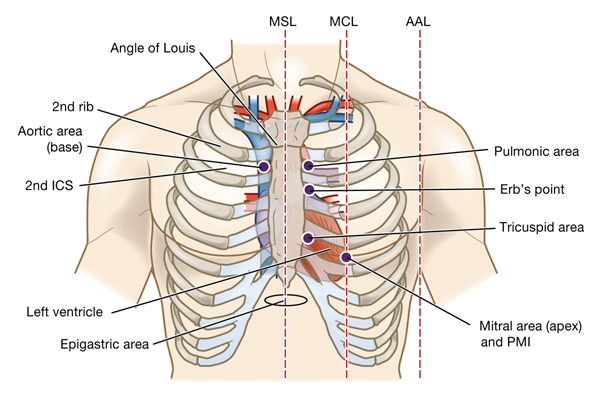
PMI
PMI is the pulsation of the apex of the heart.
The PMI is medial to the midclavicular line in the 4th or 5th ICS.
If the PMI can be palpated, record its position in relation to the midclavicular line and ICSs.
what does s1 represent
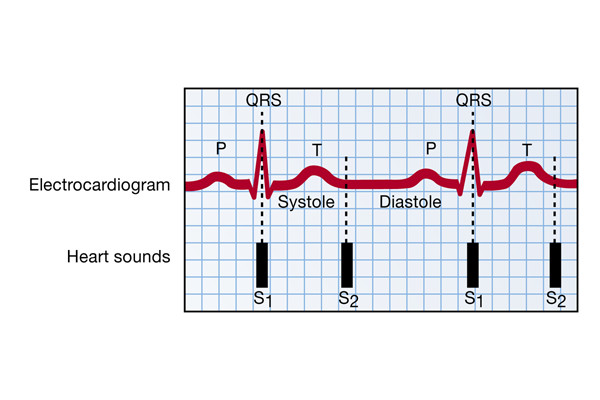
the closure of the tricuspid and mitral valves and it has a soft lubb sound and is the beginning of systole.
what does s2 represent
closure of the aortic and pulmonic valves and it has a sharp dubb sound and is the beginning of diastole
how do you listen to s3 and s4?
with the bell of the stethoscope
what do i do if pulses are not equal?
count the apical pulse while a 2nd person simultaneously counts the radial pulse for 1 full minute
what does s3 represent?
a low-intensity vibration of the ventricular walls
what does s4 represent?
a low-frequency vibration
how do you grade a murmur?
6-point roman numeral scale
I/VI is barely audible with the stethoscope, heard only in a quiet room and then not easily.
VI/VI can be heard with the stethoscope lifted just off the chest wall.
why do Pericardial friction rubs occur?
when inflamed surfaces of the pericardium (pericarditis) move against each other (best heard at the apex).
Normal Physical Assessment of Cardiovascular System
Inspection | No pallor or cyanosis. PMI not visible. No JVD with patient at 45-degree angle |
Palpation | Skin warm. Capillary refill <2 sec. PMI palpable in 4th ICS at left MCL. No thrills or heaves. Slight palpable pulsations of abdominal aorta in epigastric area. Carotid and extremity pulses 2+ and equal bilaterally. No pedal or sacral edema |
Auscultation | S1 and S2 heard. Apical-radial pulse rate equal, 72, and regular. No murmurs or extra heart sounds |
Which disease process would contribute to a finding of absent pedal pulses?
Atherosclerosis
Which assessment finding correlates with a ventricular gallop?
Third heart sound (S3)
Which assessment finding would the nurse recognize as abnormal?
Supine blood pressure (BP) of 115/81 and standing BP of 106/75
Supine heart rate (HR) of 63 and standing HR of 79
Supine BP of 121/82 and standing BP of 100/76
Supine HR of 86 and standing HR of 84
Supine BP of 121/82 and standing BP of 100/76
In which position would the nurse place the patient to auscultate for signs of acute pericarditis?
Sitting and leaning forward
Which assessment would the nurse utilize with auscultation during a patient's cardiovascular assessment?
Palpate the radial pulse while auscultating the apical pulse.
Which action would the nurse take if the patient's point of maximal impulse (PMI) is found below the 5th intercostal space (ICS) and left of the midclavicular line?
Report the finding; position may indicate an enlarged heart.
Which documentation reflects an abnormal cardiac assessment?
“S1 and S2 heard. Apical pulse 76, radial pulse 72. No murmurs or extra heart sounds.”
Which heart sound would the nurse expect to auscultate during the QRS complex of an electrocardiogram (ECG)?
S1
Which patient statement indicates a need for further teaching about cardiac health?
“I use a standing desk at work to decrease the swelling in my legs.”
“Sometimes I have to strain in order to have a bowel movement.”