MATH 1552 Exam 3 - types of series

0.0(0)
Studied by 0 people
call kaiCall Kai
Locked
learnLearn
examPractice Test
spaced repetitionSpaced Repetition
heart puzzleMatch
flashcardsFlashcards
GameKnowt Play
Card Sorting

1/5

encourage image

There's no tags or description

Looks like no tags are added yet.

Last updated 4:03 PM on 7/21/26
Name
Mastery
Learn
Test
Matching
Spaced
Call with Kai
Chat

No analytics yet

Send a link to your students to track their progress

6 Terms

1
New cards

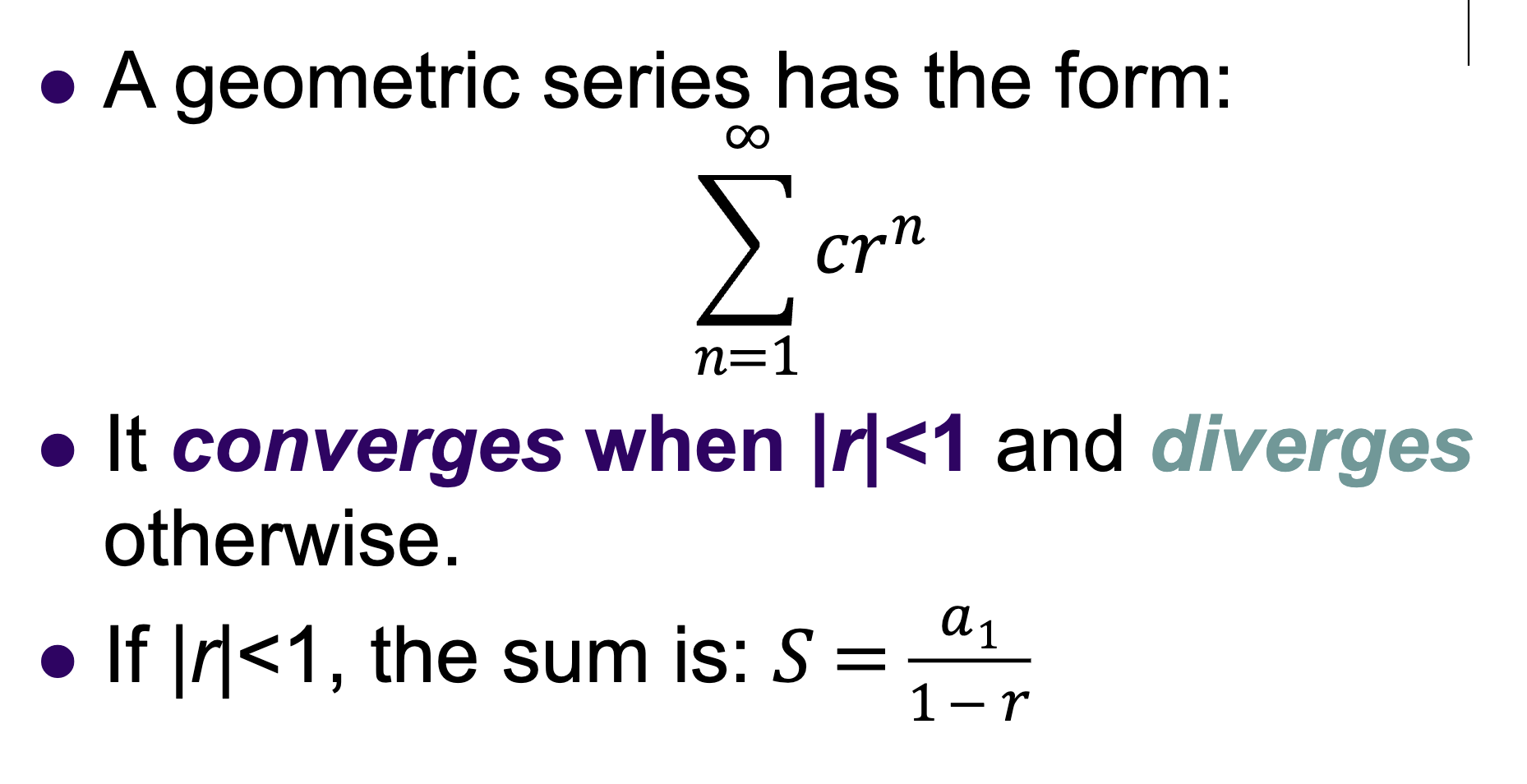
Geometric Series

  • form

  • conv/div conditions

  • sum

  • a1 is the first term in the series

  • r is the ratio

<ul><li><p>a<sub>1</sub> is the first term in the series</p></li><li><p>r is the ratio</p></li></ul><p></p>
2
New cards

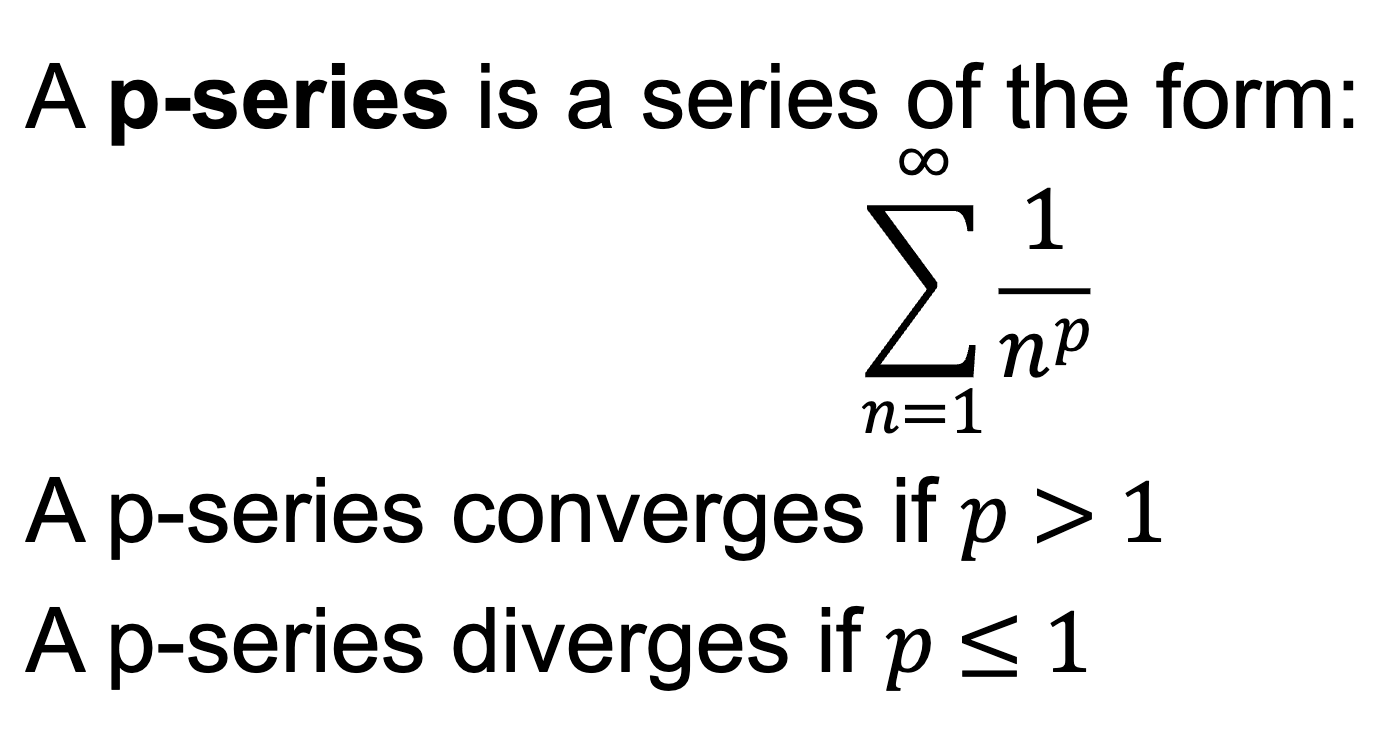
P-series

  • form

  • conv/div conditions

<p></p>
3
New cards

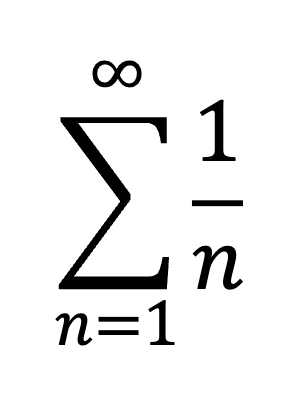
Harmonic Series

  • form

  • conv/div conditions

  • always diverges

  • p-series where p = 1

<ul><li><p>always diverges</p></li><li><p>p-series where p = 1</p></li></ul><p></p>
4
New cards

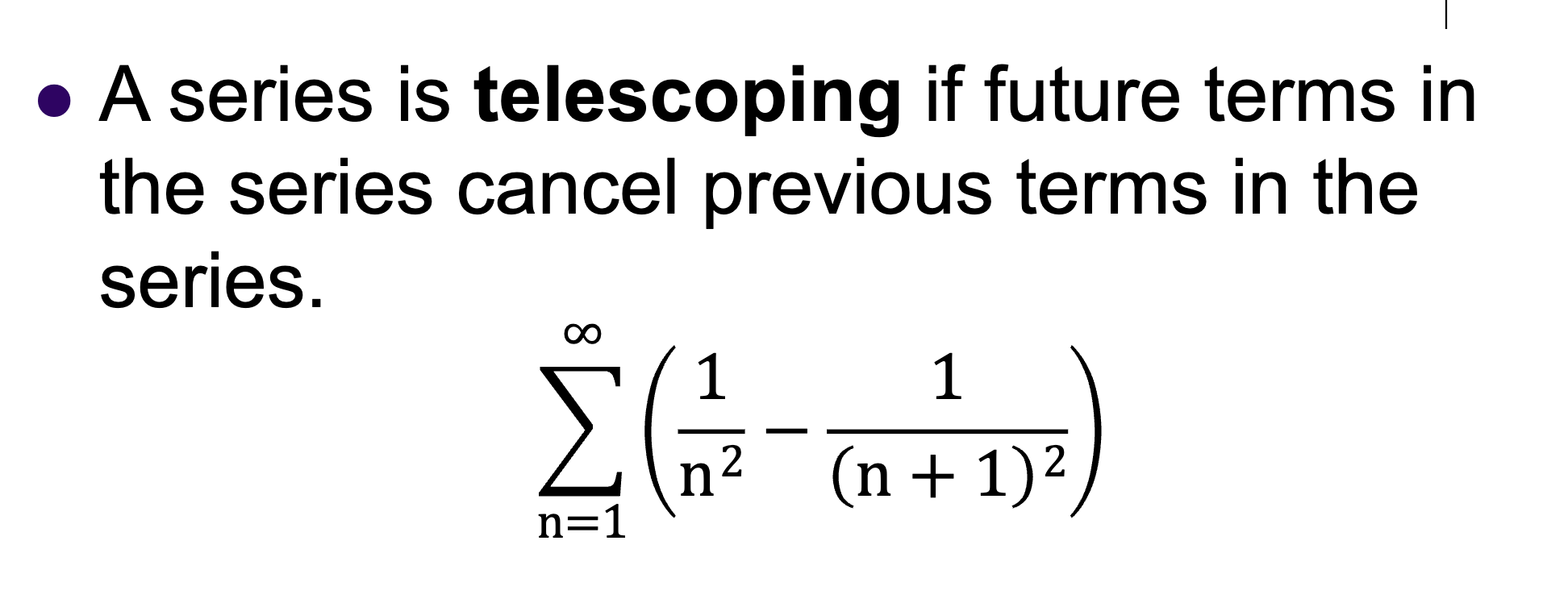
Telescoping Series

  • form

  • conv/div conditions

  • sum

to solve:

  • plug in values and find the general formula

  • take the limit of the general formula

  • if the limit is a finite value, the series converges. Otherwise, the series diverges

  • A result of a finite number means the series is “solved”
<p>to solve:</p><ul><li><p>plug in values and find the general formula</p></li><li><p>take the limit of the general formula</p></li><li><p>if the limit is a finite value, the series converges. Otherwise, the series diverges</p></li><li><p>A result of a finite number means the series is “solved”</p></li></ul><p></p>
5
New cards

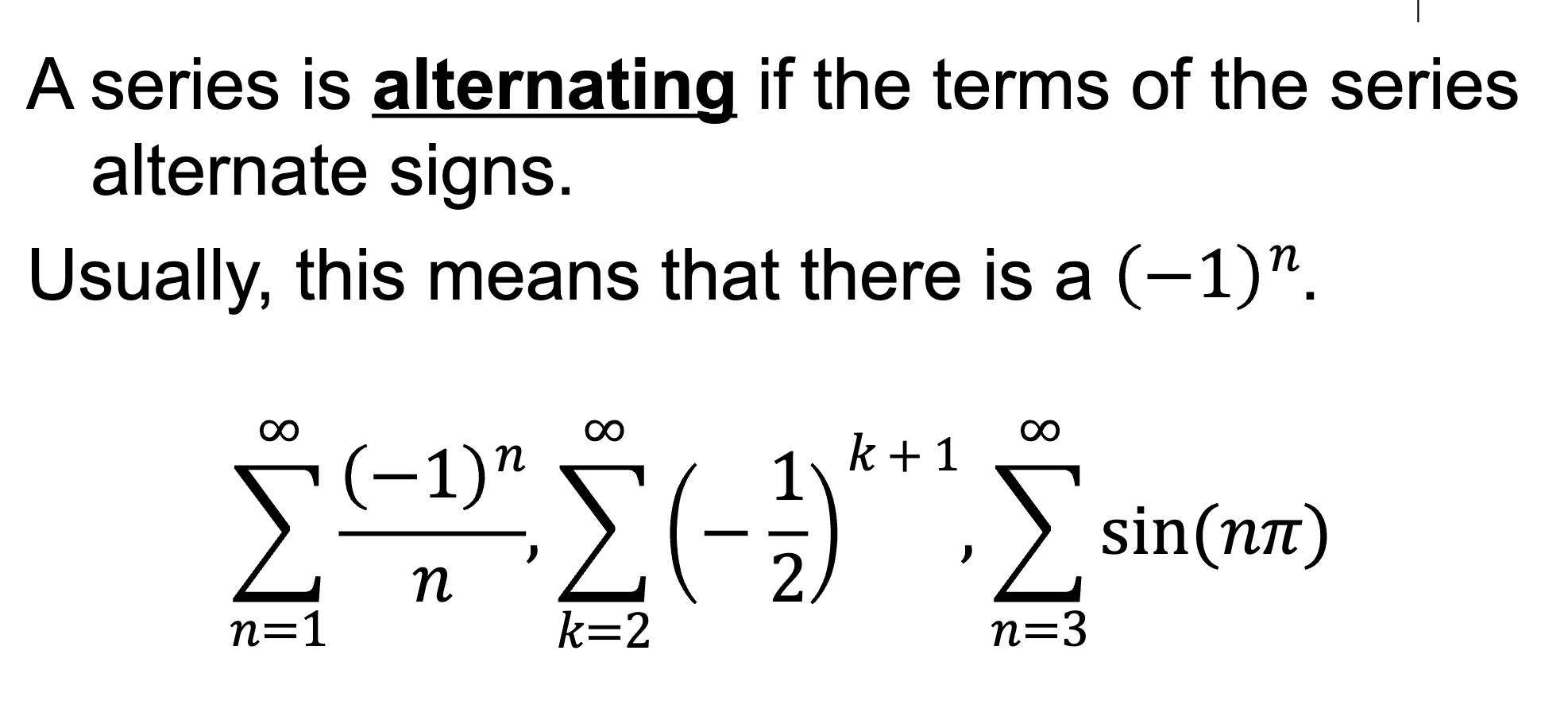
Alternating Series

  • form

  • conv/div conditions

  • If the absolute value of the sequence is decreasing and the limit of the absolute value of the sequence = 0, the sequence converges

  • check if the sequence decreases by comparison inequality or taking the derivative. Can also maybe plug in terms.

Steps:

  1. divergence test of absolute value of the sequence

  2. check decreasing

  3. find type of convergence by looking at the absolute value of the series. If the series diverges, the original series converges conditionally. If the series converges, the original series converges absolutely. Can use any test
<ul><li><p>If the absolute value of the sequence is decreasing and the limit of the absolute value of the sequence = 0, the sequence converges</p></li><li><p>check if the sequence decreases by comparison inequality or taking the derivative. Can also maybe plug in terms.</p></li></ul><p></p><p>Steps:</p><ol><li><p>divergence test of absolute value of the sequence</p></li><li><p>check decreasing</p></li><li><p>find type of convergence by looking at the absolute value of the series. If the series diverges, the original series converges conditionally.  If the series converges, the original series converges absolutely. Can use any test</p></li></ol><p></p>
6
New cards

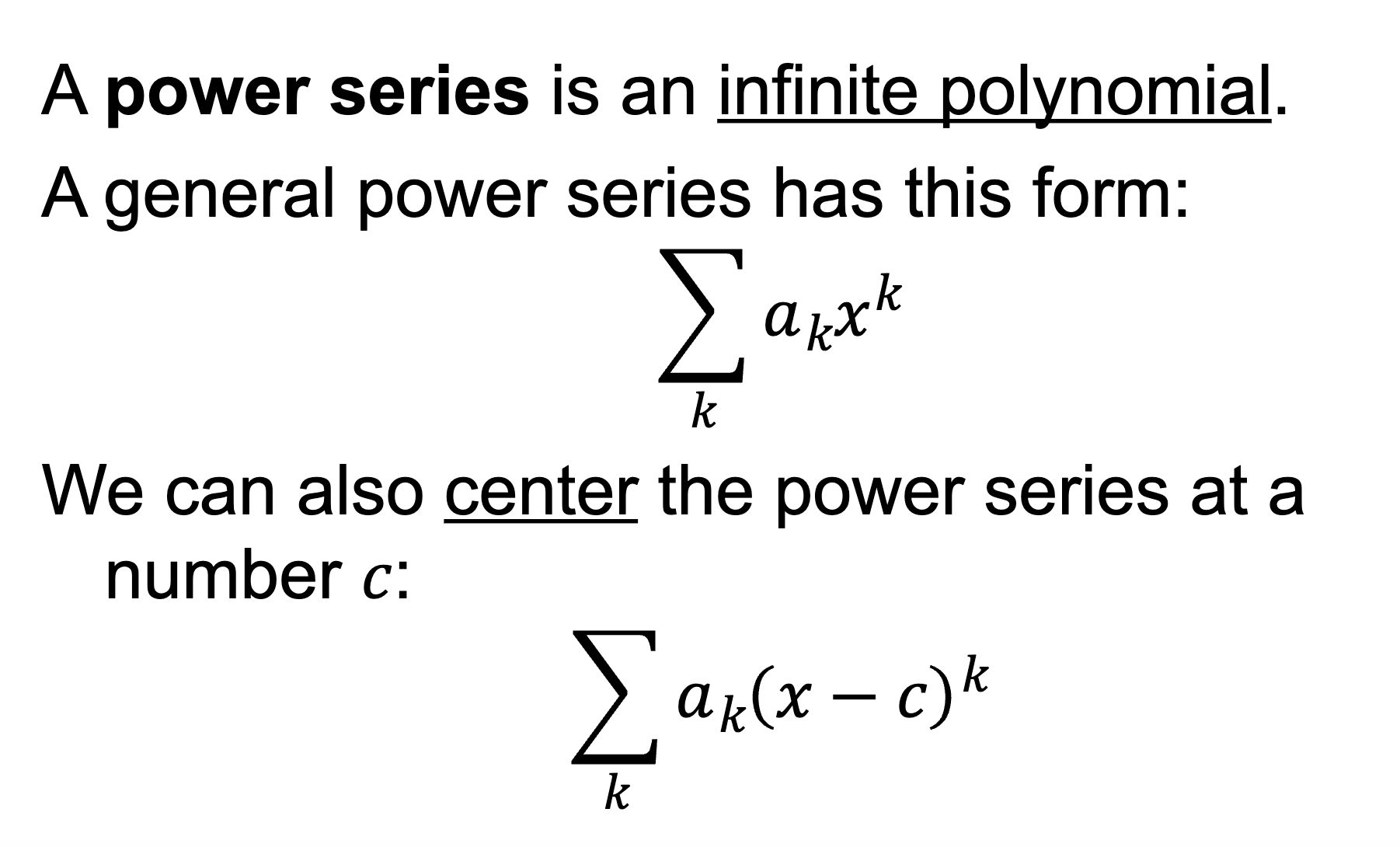
Power Series

  • form

  • conv/div conditions

  • I.O.C. and R.O.C.

  • has 2 “variables”

  • x is treated like a number, and conv/div is dependent on x

To solve:

  1. use Ratio/Root test to determine for which values x the series conv/div

  2. after obtaining the inequality, solve for the “edge cases” of the series

  3. plug in each “edge x” into the series and separately determine if each series conv/div

  4. use all the info to determine I.O.C. and R.O.C

I.O.C. and R.O.C:

  • I.O.C. = range of values for which the series converges

  • R.O.C = half the length of the I.O.C.

    • If I.O.C. = all real numbers, R.O.C = infinity

    • If I.O.C. = just the center, R.O.C = 0
<ul><li><p>has 2 “variables”</p></li><li><p>x is treated like a number, and conv/div is dependent on x</p></li></ul><p></p><p>To solve:</p><ol><li><p>use Ratio/Root test to determine for which values x the series conv/div</p></li><li><p>after obtaining the inequality, solve for the “edge cases” of the series</p></li><li><p>plug in each “edge x” into the series and separately determine if each series conv/div</p></li><li><p>use all the info to determine I.O.C. and R.O.C</p></li></ol><p></p><p>I.O.C. and R.O.C:</p><ul><li><p>I.O.C. = range of values for which the series converges</p></li><li><p>R.O.C = half the length of the I.O.C.</p><ul><li><p>If I.O.C. = all real numbers, R.O.C = infinity</p></li><li><p>If I.O.C. = just the center, R.O.C = 0</p></li></ul></li></ul><p></p>