Bio Module 1 Organisms and life processes Unit 1 Life processes
 Call Kai
 Learn
Learn Practice Test
 Spaced Repetition
 Match
Match Flashcards
 Knowt Play
1/96

There's no tags or description
Looks like no tags are added yet.
Name | Mastery | Learn | Test | Matching | Spaced | Call with Kai | Chat |
|---|
No analytics yet
Send a link to your students to track their progress
97 Terms
What are 5 kingdoms of living things?
Bacteria, Protists, Fungi, Plants, Animals
What are 2 terms used to classify 5 kingdoms?
Eukaryote and Prokaryote
OBJQ
What are 7 characteristics of living things?
Movement, Respiration, Sensitivity, Growth, Reproduction, Excretion, and Nutrition.
OBJR
What are the processes of MRS GREN?
Nutrition—Autotrophs make their own food, and heterotrophs eat other organisms.
Respiration—Break down the glucose with oxygen to release carbon dioxide, water and energy
Movement—Change in position
Excretion—Removal of metabolic wastes
Growth—Permanent increase in size and complexity
Reproduction—Fertile offspring
Sensitivity—Respond to changes in environment
What are the 2 types of environment?
External environment—Temperature, humidity, Light intensity
Internal environment—Body temperature, blood carbon dioxide concentration, blood pH, body water content
P.A
Describe how to carry out a microscopic examination in an animal cell.
(Liver, cheek, skin cells)
Cheek cells are taken by toothbrush/oral swab
Smear it on glass slide
Stain the glass with methylene blue or iodine.
Cover slip is used
Microscopic examination is done
Observe the detailed structure
OBJQ
What is a nucleus and its function?
It is the largest organelle, and its function is to control the activities of the cell.
OBJQ
What is cytoplasm, and what is its function?
Cytoplasm is living material that made up cells and it is the site for cell reaction to take place
OBJQ
What is a cell membrane and its function?
It is a thin layer like skin that all cells are surrounded by and partially permeable. It forms a boundary between the cytoplasm of the cell and the outside and controls what substances to let in and out.
OBJQ
What is mitochondria, and what is its function?
Mitochondria are the powerhouses of cells that are mostly found more in cells that require lots of energy. Its function is to release energy and site of aerobic respiration. EXAMPLE: nerve cell & muscle cell
OBJQ
What is a cell wall and its function?
It is a layer of nonliving material made mainly of cellulose, is freely permeable, surrounds plant cells, and supports plants. Its function is to prevent the cell from bursting.
OBJQ
What is a chloroplast and its function?
They are green cells that are part of a plant. It contains chlorophyll, whose function is to trap light energy for photosynthesis. contains chlorophyll,
OBJQ
What is a vacuole (cell sap), and what is its function?
It is a large central space surrounded by a membrane. Its function is to maintain turgor pressure, and cell sap stores dissolved sugars, mineral ions, and other solutes.
P.A
Describe how to carry out microscopic examination in plant cells.
Stem is scraped
Stain it
Cover it by cover slip
Examine under a microscope.
Observe detail structure
OBJR
Which cells are present in plants but not animals?
Cell walls, chloroplasts, and vacuoles (which only exist in paramecium and only temporarily in animal cells) are present in plant cells but not in animal cells.
Vacuole in plant = permenant
Vacuole in animal = temporary, small
What is the equation of photosynthesis?
Light energy
Carbon dioxide + water ----------------> Glucose + Oxygen
Chlorophyll
Light energy
6CO₂ + 6H₂O ----------------> C₆H₁₂O₆ + 6O₂
Chlorophyll
What is ribosomes and its function?
Tiny granules around the ER and on the surface of cytoplasm. Its function is for protein synthesis.
OBJQ
What are the similarities in plant cells and animal cells?
-Cytoplasm
-Cell membrane
-Nucleus
-Mitochondria
What is a catalyst?
It is a chemical substance that increase rate of reaction without being used up, unchanged and free to catalyse more reactions
What are 2 types of reactions?
Anabolic reaction (synthesis) & catabolic reaction (breakdown)
OBJQ
What is an enzyme?
Enzyme is a biological catalyst that speeds up the rate of reaction. Catalyst is a chemical that speeds up a reaction without being used up itself.
What is the nature of enzymes and active sites?
Enzymes are specific to their substrates, and enzyme’s active site is complementary to their substrates
What are 2 types of enzymes?
Extracellular and Intracellular
OBJR
Which model enzyme-substrate complex follow?
Enzyme-substrate complex follow the lock-and-key model
What is substrate?
The molecule that enzyme acts on
What is an active site?
Small area on surface of enzyme that bind with substrate
What is the process of the lock and key model?
Substrate enters enzyme’s active site
Reaction takes place
Products formed and left the active site.
Active site and enzymes are free again, ready to bind with more substrate.
OBJR
What are 2 factors affecting enzyme-catalyzed reactions?
Temperature and pH
What is the optimal temperature?
A temperature that enzyme works the best
What is secretion?
Release of a fluid or substances from a cell or tissue.
What is kinetic energy?
It is the energy an object has because of its movement.
OBJQ + FAQ
What happens to enzyme-catalyzed reactions at the extreme of temperature?
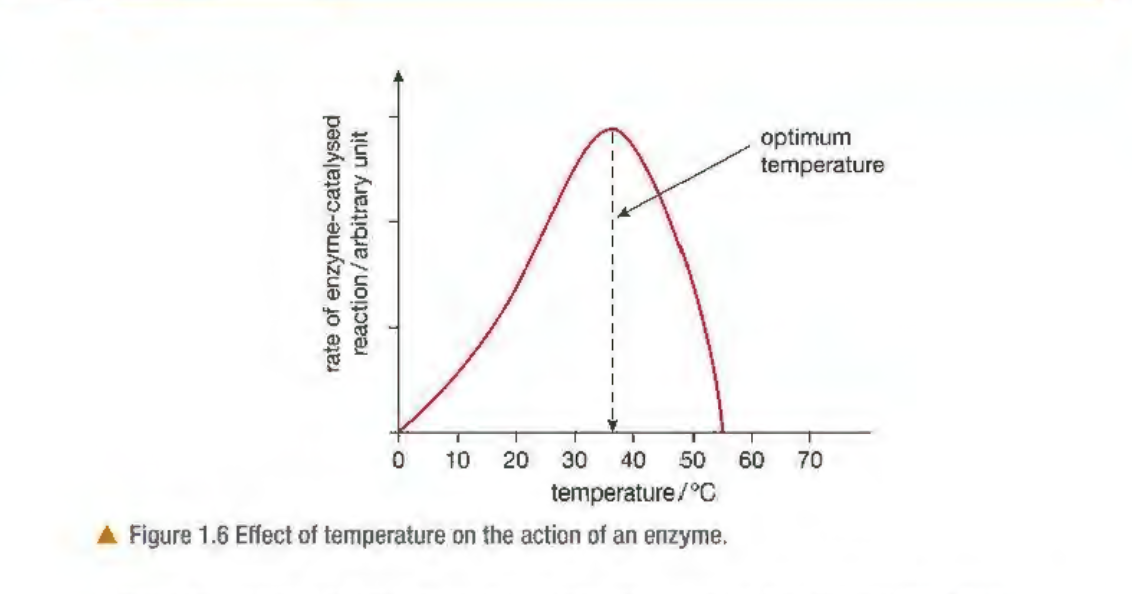
When temperature is extreme, enzymes become denatured because enzymes are made up of proteins.
Shape of active site is deformed
Substrate no longer bind to active site of enzyme
No enzyme-substrate complex is formed.
There is decreased/no rate of enzyme catalyst reaction
OBJQ + FAQ
Observe this graph.What will happen to enzyme catalysis when the temperature increases?
When the temperature is increased, there is increased kinetic energy
Enzyme & substrate molecules get more kinetic energy
Enzyme & substrate molecules get more effective collision
More enzyme-substrate complexes are formed
So, there is an increased rate of enzyme-catalyst reactions.
OBJQ + FAQ
What will happen to enzyme-catalyzed reactions when the temperature increases?
When the temperature is increased, there is increased energy
Enzyme & substrate molecules get more kinetic energy
Enzyme & substrate molecules get more effective collision
More enzyme-substrate complexes are formed
So, there is an increased rate of enzyme-catalyst reactions.
OBJQ + FAQ
What happens to an enzyme-catalyzed reaction when the temperature is decreased?
When there is a decrease in temperature, there is less kinetic energy
Enzyme and substrate get less energy
Enzyme and substrate get less collision
Less enzyme-substrate complex is formed
Decreased rate of reaction
What is optimal pH?
The pH at which enzymes work best.
What is the optimal pH for most enzymes, pepsin, trypsin, lipase & pancreatic amylase?
Most enzyme = pH 7 (neutral) Pepsin = pH 2 (acidic) Trypsin, lipase, and pancreatic amylase = pH > 7 (alkaline) |
What is pH?
It is an acidic or alkaline solution.
What is the pH range scale?
0-14
OBJQ + FAQ
What happens to the enzyme-catalyzed reaction at optimal pH?
At optimal pH, enzyme & substrate get enough collision
Most enzyme-substrate complexes are formed
Increased rate of enzyme-catalyzed reaction
OBJQ + FAQ
What happens to enzyme-catalyzed reactions at extreme pH?
At extreme pH, enzymes become denatured.
Shape of active site is deformed
Substrate no longer fit into active site
Less enzyme-substrate complex is formed
Decreased rate of reaction
OBJR
What is aerobic respiration?
It is a breakdown of glucose using oxygen (oxidation)
OBJQ
What is the balanced chemical symbol equation and word equation for aerobic respiration?
Glucose + Oxygen —-----> Carbon dioxide + water + energy (ATP)
C61206 + 6O₂ —----> 6CO₂ + 6H₂O + energy (ATP)
OBJR
What is anaerobic respiration, and what are its word and balanced equation?
Breakdown of glucose without using oxygen. (Yeast) Glucose—> Ethanol + Carbon dioxide + energy C6H12O6—>2C2H5OH + 2CO2 + energy (ATP) (Animal muscle cell) Glucose —> Lactic acid (Lactate) + some energy C6H12O6—--->2C3H6O3 + energy |
OBJQ
How is ATP formed?
After aerobic respiration, energy is produced, and as ATP is an energy currency, energy is used for ATP synthesis in mitochondria. ATP = Adenosine triphosphate
What are energy currency equations?
(Anabolic) ADP + P —---> ATP + H₂O
(Catabolic) ATP + H₂O —--> ADP + P
OBJQ
How does ATP provide energy for cells?
Muscle contraction, growth, metabolism, cell division, active transport, building large molecule
What is the word equation for the breakdown of lactic acid?
Lactate + Oxygen—> Carbon dioxide + water
(breathing rate increase)
What is oxygen debt, and when does O₂ debt happen?
Oxygen debt is extra oxygen that the body needs after vigorous exercise to break down lactic acid.
It happens because muscles switch to anaerobic respiration and lactic acid builds up in muscles, causing fatigue and soreness
Body need to repay the debt through heavy breathing after vigorous exercise, while liver converts lactic acid back to useful substances.
FAQ
Why does breathing rate/heart rate increase during exercise?
During exercise, more muscle contraction is needed.
Muscle contraction needs more energy.
To supply more energy, more aerobic respiration has to be done
To do more aerobic respiration, more O₂ & glucose are needed.
To supply more O₂ & glucose, breathing rate and heart rate is increased
FAQ
Why is the breathing rate still increased after vigorous exercise?
During vigorous exercise, aerobic respiration as well anaerobic respiration needed
Anaerobic respiration cause lactic acid
Lactic acid accumulation causes fatigue (because pH went down)
To break down lactic acid in the liver, O₂ is needed. This is called oxygen debt.
To repay O₂ debt, breathing rate is increased after vigorous exercise.
What is oxygen debt?
Volume of O₂ needed to completely oxidise lactate that build up in body during anaerobic respiration
OBJQ
What is diffusion?
Net movement of particles (molecules/ions/gas) from a region of higher concentration to a region of lower concentration down the concentration gradient
OBJQ
What are the factors affecting the rate of diffusion (rate of movement of substances in and out of cell)
Concentration gradient (steeper = faster diffusion rate)
Surface area to volume ratio (Large surface area to volume ratio = faster diffusion rate)
Distance (Greater the distance = slower the rate of diffusion)
Temperature (Higher temperatue = higher diffusion rate)
OBJQ
What is osmosis?
Net movement of water molecules from higher water potential to lower water potential (dilute solution to concentrated solution) down the concentration gradient.
What are types of semipermeable membranes?
Visking tube
Dialysis tube/membrane
What are specialized exchange surfaces and their adaptive features?
Alveoli→1 cell thick→shorter diffusion distance
Villi→large surface area→higher rate of absorption
1 cell thick→shorter diffusion distance
Difference between diffusion and osmosis?
Diffusion | Osmosis |
M/V→Molecules,ions,gas | M/V→water |
P.p.m | Special. p.m (only water) |
Along concentration gradient | Along water potential Dilute→concentrated |
OBJQ
What is active transport?
M/V of molecules from lower concentration to higher concentration against the concentration gradient by the use of energy, pump (large protein molecules) or by the help of carrier protein
EXAMPLE: Absorption of glucose in the intestine
OBJR
What are 2 types of cell division?
Mitosis and Meiosis
What are different types of specific proteins?
Structural protein
Haemoglobin
Enzyme
Antibodies
Carrier protein
OBJR
Describe cell division process in humans.
Sperm cell + Egg cell→zygote (fertilized) (meiosis)
Zygote→embryo→fetus→newborn baby→adult (mitosis)
OBJR
What is the purpose of these cell divisions?
Mitosis: growth and repair
Meiosis: sex cell division to get genetically vast organisms
What are specialized cell examples and their functions?
Palisade mesophyll cell→photosynthesis
Sperm cell→fuse with ovum
Ovum→fuse with sperm
Neurones→conduct with nerve impulses
FAQ
Explain the withdrawal of the hand when the finger touches the hot object.
Stimulus = hot object
Receptor = receive the stimulus
Sensory nerve→carry nerve impulses to spinal cord
Coordination = Brain + spinal cord
Motor nerve = Carry impulses from brain to muscle
Effect or organ = muscle or glands
Response = contraction of muscle, withdrawal of hand
OBJQ
What is the division of labor in biology?
Cell→Tissue→Organ→Organ system→Living organisms
What is neuron structure and its function?
Long, has 3 parts: Dendrite, Body, Axon
Dendrite structure: Several branched structure,
Dendrite function: Impulses toward cell body senses
Body structure: Has cytoplasm, nucleus
Body function: Send impulses to axon
Axon structure: Protect with Myelin sheath (protect internal organs) (Carry nerve impulses)
Axon function: Transmit nerves impulses quickly from one cell body to another
What is smooth muscle cell structure from the wall of the intestine and its function?
Smooth muscle structure: Non-striated, as no protein filaments are aligned in the cell. 1 nucleus per cell. Not branched, cells tap the cell at the ends, elongated (involuntary)
Function: move food through the gut
What is a xylem vessel in plant structure, and what is its function?
Structure: Dead, hollow cell with strengthening rings.
Function: Transport water upstream and mineral ions and support the uprightness of the plant.
What are guard cells from the surface of a leaf structure, and what is their function?
Structure: Special shape results in pore between cells
Function: Gas exchange
What is leaf palisade cell structure and its function?
Structure: Packed full of chloroplasts
Function: Photosynthesis
What are sperm cell structure and its functions?
Structure: Head, Middle piece, tail
Head: contains genes from father
Tail: for swimming
Middle piece: many mitochondria→to supply energy
What is the digestive system?
Structure: Gut, pancreas, gallbladder
Function: digest food and absorb the digested
What is the respiratory (gas exchange) system?
Structure: Lung, alveoli, bronchus
Function: Exchange carbon dioxide and oxygen
What is the circulatory system?
Structure: Heart, blood vessels
Function: Transport materials / pump blood around the body
What is the excretory system?
Structure: Kidneys
Function: Filter toxic waste materials from the blood (urea)
What is the nervous system?
Structure: Brain, spinal cord and nerves
Function: Coordinate the body’s actions
What is the endocrine system?
Structure: Glands secreting hormones
Function: Chemical messengers
What is the reproductive system?
Structure: Sperm is in the male and egg is in the female.
Function: Allow the development of embryo
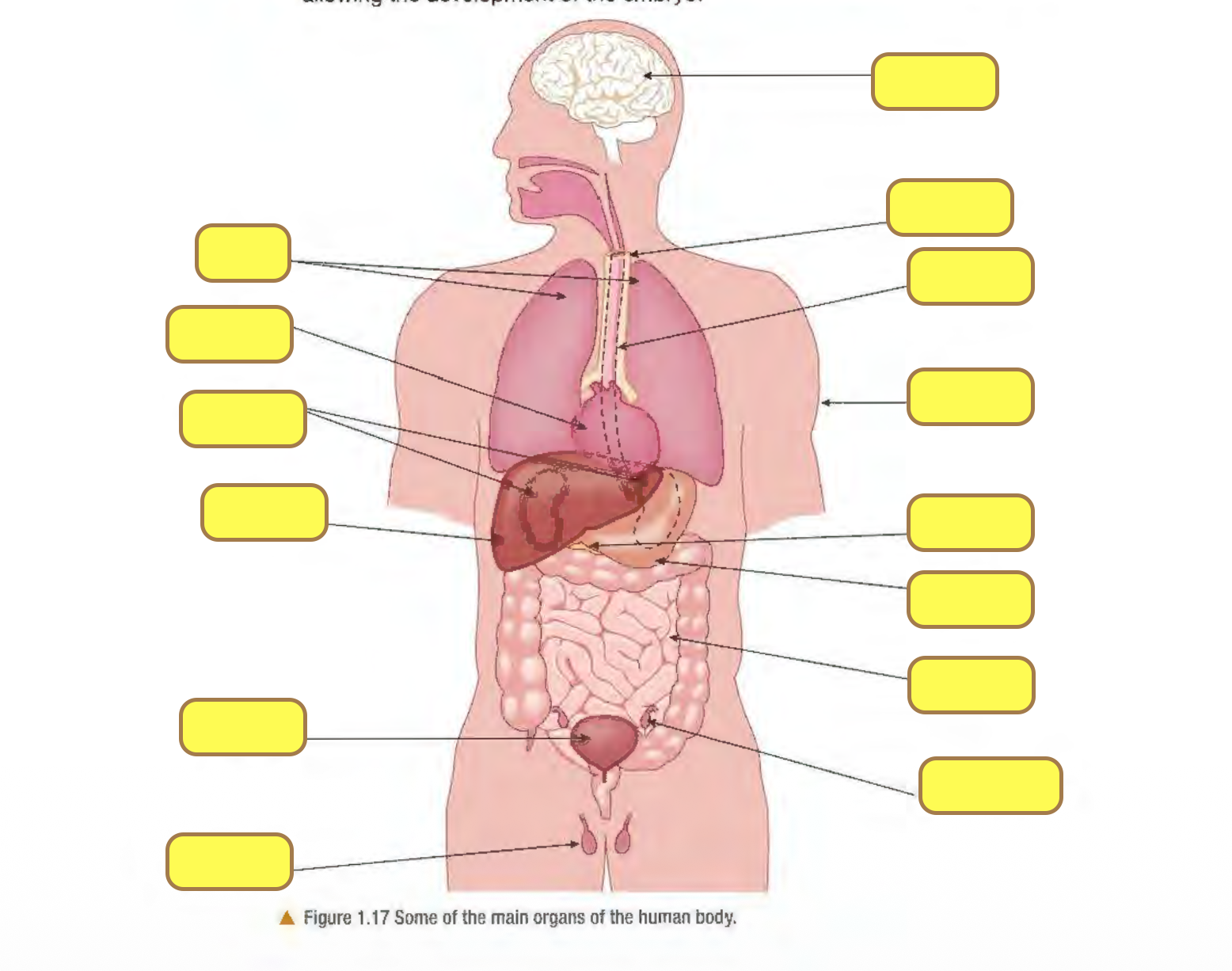
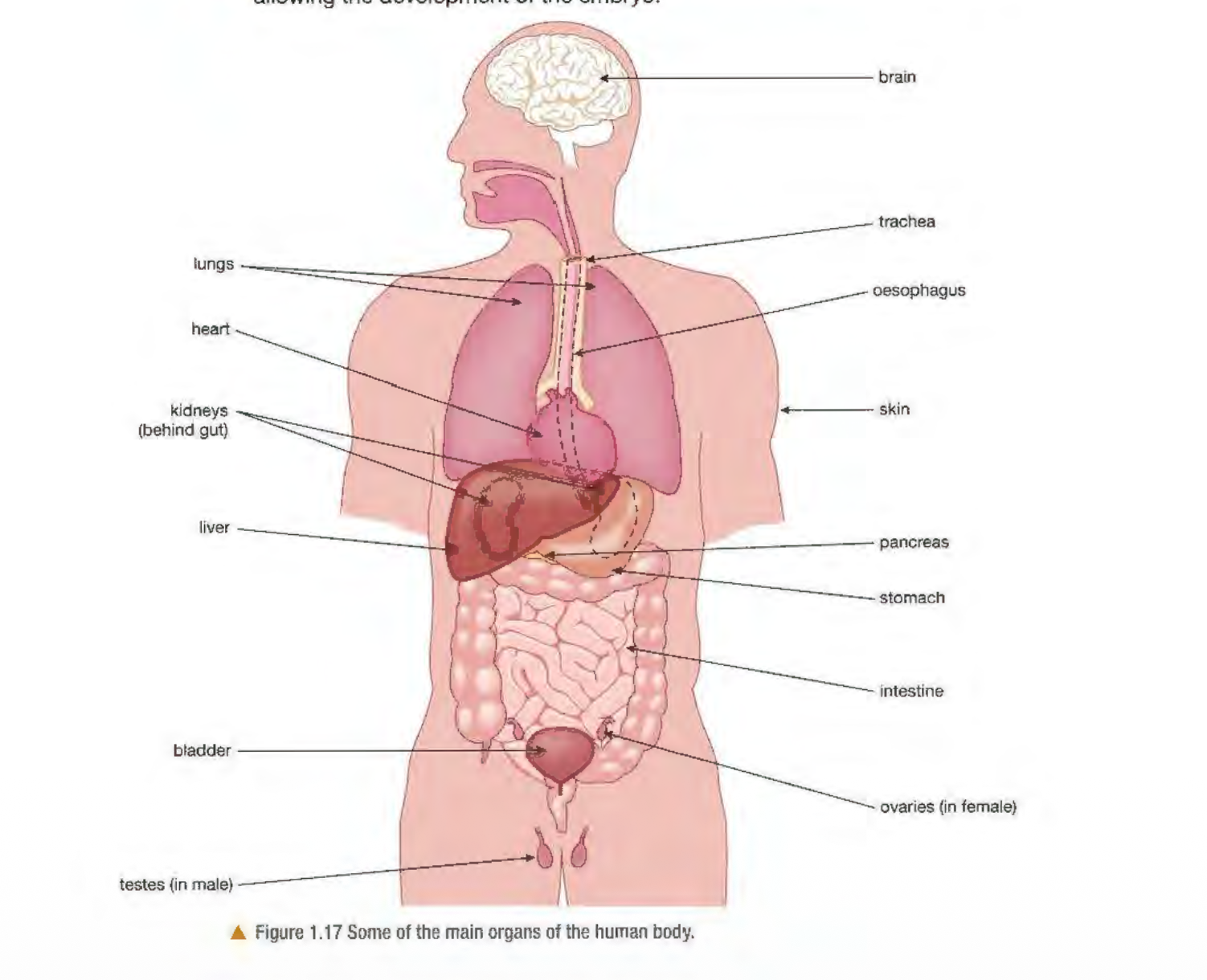
Label these organs
What are some examples of cells that stem cells can divide into?
Hematopoietic stem cell
Nervous tissue
Lung tissue cell
OBJQ
What is a stem cell?
Unspecialized cells that have the ability to divide many times by mitosis while remaining undifferentiated and later specialize into specialized cells. EXAMPLE: Muscle, nerve cells
OBJQ
What is an embryonic stem cell?
Found in the early stage of development of the embryo, able to differentiate into any type of cell.
OBJQ
What is an adult stem cell?
Certain adult tissues, such as bone marrow (most common) (soft tissue inside bone that produce bone cell), skin, and the lining of the intestine Limited to one specific tissue only
What is the most common adult stem cell therapy?
Leukaemia: Blood cancer of white blood cell that can be diagnosed by bone marrow transplant
What are the most common embryonic stem cell therapies?
Parkison disease (nerve cell)
Diabetes (insulin secretion organ, pancreas)
OBJQ
What are the disadvantages of the use of stem cells in medicine?
Embryonic stem cell
-Ethical concern
-Religious issue
-Immune system rejection
-Tumor risk
Adult stem cell
-Limited to 1 specific cell
OBJQ
What are the advantages of using stem cells?
Embryonic stem cell
Variation
Can grow forever in lab
Adult stem cell
Efficiency for target tissue preparation
No risk of immune system rejection
What is tissue?
A group of cells working together to perform similar functions
What is an organ?
A group of different tissues working together to perform a particular function.
What is the equation for the breakdown of starch?
Amylase
Starch—----------------------> Maltose
P.A
Plan the experimental design to test for the “Effect of Temperature on Activity of Amylase".
Test Procedure
-spots of iodine solution are placed into the dips on the spotting tile.
- 5 cm³ (certain) of starch solution is placed in one boiling tube
- 5 cm³ (certain) of amylase solution in another tube,
- Both boiling tubes are placed in the beaker of water for 5 minutes at 20°C (certain)
- the temperature is recorded
-amylase solution is then poured into the starch solution to make the tube containing the
mixture in the water bath
- a small sample of the mixture is added it to the first drop of iodine solution that is added on
the spotting tile
-The colour of the iodine solution is recorded.
-a sample of the mixture is taken every 30 seconds for 10 minutes until the iodine solution
remains yellow (all the starch is used up)
-The experiment is repeated, as above, for different temperatures
(20°C, 30°C, 50°C, 50°C, 60°C).
IDV
-Different Temperature
DV
-Time taken for change of yellow colour of Iodine solution
CV
-Some volume and concentration of Iodine solution, starch solution and amylase solution
Same time interval for adding a sample of Iodine
How to find the number of spotting tiles filled for the experiment in a certain time unit.
Optional based on result (result x time interval unit = x)
Then x / total number of spotting tile cups
P.A
Plan the experimental design to test for the EFFECT OF PH ON ACTIVITY OF CATALASE (Pg-11)
By using potato and hydrogen peroxide
Test Procedure
-A large potato is chopped into small pieces and blended with an equal volume of distilled
water
removed
-5 cm³ (certain) of extract is placed in a boiling tube
-5 cm³ of pH 7 buffer solution (certain) is added to that boiling tube
-The tube is shaken gently to mix the buffer with the potato extract.
- The mixture is left for 5 minutes (certain) (for the reaction to take place)
- The potato debris is allowed to settle to the bottom and the liquid extract above the debris
-5 cm³ of 5% hydrogen peroxide solution (certain) is added to the tube (substrate).
-The delivery tube is quickly inserted into the boiling tube
-The end of the delivery tube is placed in a beaker of water
-The bubbles of oxygen gas produced in the first minute are counted.
-The experiment is repeated, using different buffers.
P.A
Plan the experimental design to test for the
Demonstration of the production of carbon dioxide by small living organisms (Pg-14)
Principle
Hydrogen carbonate indicator solution is normally orange, but turns yellow if carbon dioxide
is added to it. The indicator is sensitive to small changes in carbon dioxide concentration. It can be used to show production of carbon dioxide by small organisms such as woodlice.
maggots (fly larvae) or germinating seeds.
Materials and Apparatus
Woodlice/maggots (fly larvae)/germinating seeds
gauze
Stoppered boiling tube
Hydrogen carbonate indicator
Test Procedure
-The organisms are placed in a stoppered boiling tube with the indicator
-The gauze platform supports the organisms above the hydrogen carbonate indicator solution
and stops them from coming into contact with the chemical
-The control test tube is prepared with dead seeds killed with formalin
P.A
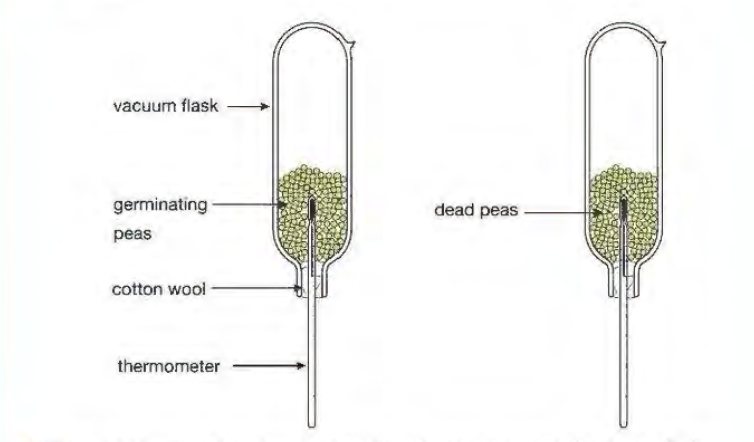
Plan the experimental design to test for the Demonstration that heat is produced by respiration (Pg-15)
Apparatus and Materials
-Living pea seeds
-Killed pea seeds
2 vacuum flasks
2 Thermometers
Cotton wool
Test Procedure
-Some peas are soaked in water for 24 hours, so that they start to germinate
-A second batch of peas is boiled to kill them. Or use formalin.
-Each set of peas is washed in a 1% bleach solution, which acts as a disinfectant, killing any
bacteria present on the surface of the peas.
- The peas are then rinsed twice in distilled water to remove any traces of bleach.
-Each batch of peas is placed in an inverted vacuum flask, leaving some air in each flask.
-A vacuum flask insulates its contents, so that any small temperature change inside the flask
can be measured.
- The apparatus is left set up for a couple of days, and the temperature inside each flask
is measured at the start and end of the experiment
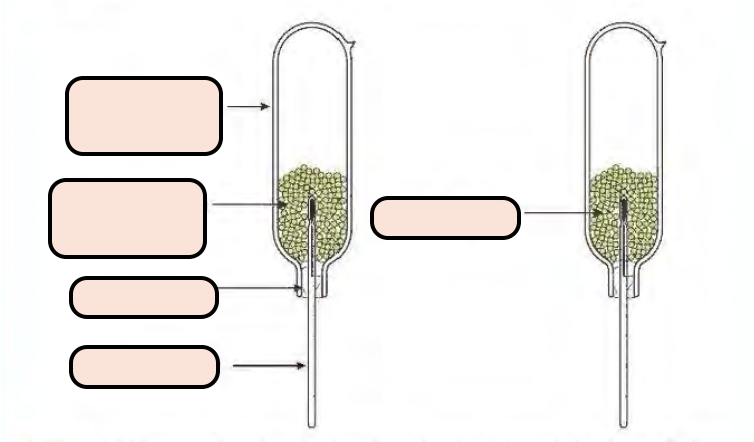
Label the apparatuses