HBS Skeletal Systems Test
 Call Kai
 Learn
Learn Practice Test
 Spaced Repetition
 Match
Match Flashcards
 Knowt Play
1/57

There's no tags or description
Looks like no tags are added yet.
Name | Mastery | Learn | Test | Matching | Spaced | Call with Kai | Chat |
|---|
No analytics yet
Send a link to your students to track their progress
58 Terms

Nondisplaced
fractures are often closed and do not move out of alignment. They are sometimes referred to as incomplete fractures because the bone cracks but does not break all the way through.

Displaced
fractures are generally more complex because the bones are out of alignment, or they may be in several pieces. The broken bone snaps out of place, and the broken ends do not line up correctly.

Complete
The bone is clearly broken, fully through, into two or more pieces.

Incomplete
There is a crack that does not reach across the entire width of the bone.

Open
A fracture associated with an open wound or break in the skin through which bone often protrudes
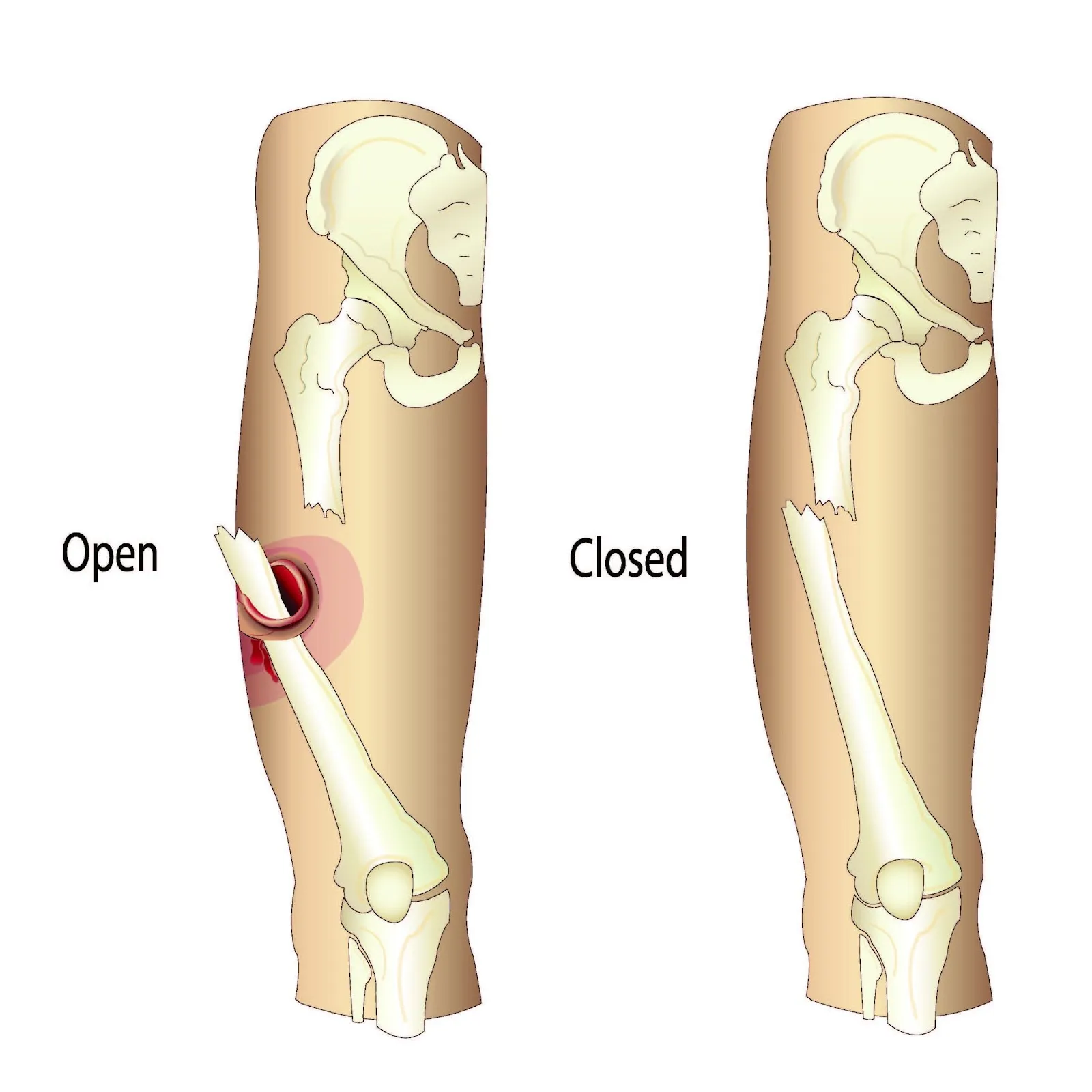
Closed
A fracture in which the skin remains intact with no penetration or protrusion of bone

Comminuted
The bone is broken into more than two pieces.

Depression
Is a type of bone break where a fragment or section of the bone is driven inward below its normal level, creating an indentation or sunken area.

Compression
A compression fracture is a break in a vertebra (a bone in your spine).

Transverse
A fracture that results in the fragment being approximately 90 degrees from the shaft.

Oblique
A fracture that results in the fragment being approximately 45 degrees from the shaft.

Spiral
A fracture whose line is curved, in a spiral-like pattern, instead of straight.
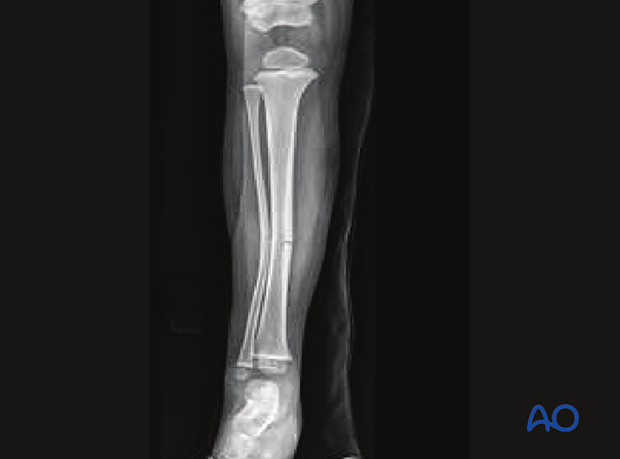
Greenstick
Usually seen in children, this shows a break on one side and a bend or bow on the other side. It’s a type of partial fracture.
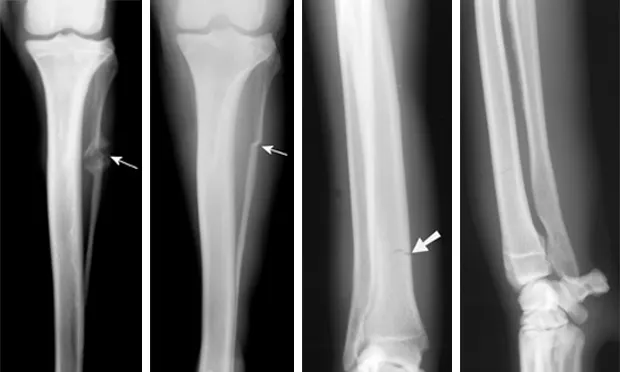
Stress/Hairline
A usually hairline fracture of a bone that has been subjected to repeated stress

Avulsion
The detachment of a bone fragment that results from the pulling away of a ligament, tendon, or joint capsule from its point of attachment on a bone

Epiphyseal
Is a type of bone fracture that affects the growing part of a child’s bone.
What are the stages of repair?
Hematoma forms, fibrocartilage callus forms, bony callus forms, bone remodeling occurs
Reduction
Refers to the process of aligning displaced broken bone ends.
What are the two types of reduction?
Closed and Open
Closed Reduction
Physician uses hands to place bones into position.
Open Reduction
Bones are secured together surgically with screws, plates, pines, wires, rods, etc. Can be internal and external.
What are the two types of Open Reduction?
Internal fixation and External
Internal fixation
Hardware is all internal
External fixation
hardware is internal but also is attached to external stabilizer
What happens after reduction?
The bones are immobilized by a cast or traction for healing.
How do you determine how long a bone needs to heal for?
For simple, small/med bones: 6-8 weeks for young people, longer for elderly (due to poor circulation), longer for large, weight bearing bones such as femur, longer for complicated breaks.
Traction
Is the use of weights, ropes, and pulleys to apply force to tissues surrounding a broken bone
A hematoma forms
A hematoma is a mass of clotted blood at the fracture site that is caused by the tearing of vessels in the bone, the periosteum and in possible surrounding tissues. Often times, the formation of a hematoma is accompanied with swelling and pain. The swelling is dues to increased blood plasma and white blood cells moving into the area to flood the area with nutrients and protection. Pain is triggered by tissue damage and alerts the body to injury and protects it from further damage.
A fibrocartilaginous callus forms
Within a few days, a fibrocartilaginous callus forms. CAPILLARIES grow in the hematoma; PHAGOCYTIC cells clean up debris, and fibroblasts, chondroblasts, and osteogenic cells begin reconstruction of the bone. FIBROBLASTS produce collagen fibers that span the break and connect the broken bone ends. CHONDROBLASTS secrete cartilage that will later calcify, and OSTEOGENIC cells are stem cells that give rise to OSTEOBLASTS (bone building cells), which will later help to form spongy, bone.
A Bony Callus Forms
Within a week, a bony callus forms. OSTEOBLASTS are very active during this phase. New bone trabeculae appear in the fibrocartilaginous callus and gradually converts it to a bony (hard) callus of spongy bone. This process continues until a firm union forms about two months later.
Bone Remodeling Occurs
Bony callus formation continues for several months after the break is healed and is remodeled. Excess material on the diaphysis exterior and within the medullary cavity is removed during remodeling, with the help of OSTEOCLASTS. Compact bone is laid down to reconstruct shaft walls. In the end, the final structure of the remodeled area will resemble the original bone because it responds to the same set of mechanical stressors (Wolf’s Law).
What type of tissue is bone tissue?
Bone is a type of connective tissue.
Tissue
A tissue is a group of cells that work together to form the same function. There are four main types of tissue in the body and these are epithelial, muscle, nervous, and connective tissue.
What is Epithelial Tissue?
Covers/lines body surfaces inside and out
What does Epithelial Tissue do?
Protects, secretes, absorbs, and excretes
Examples of Epithelial Tissue include
Skin, lining of respiratory tract, lining of digestive tract, lining of urinary tract, lining of reproductive tract
What does Muscle Tissue do?
It allows movement
What are the three types of Muscle Tissue?
Smooth muscle, cardiac muscle, and skeletal muscle
Smooth Muscle
Involuntary, found in the walls of hollow internal organs, some examples include the bladder, uterus, small intestine, large intestine, blood vessels, etc…
Cardiac Muscle
Involuntary, found in the heart
Skeletal Muscle
VOLUNTARY, found attached to bones
Nervous Tissue is responsible for what?
Responsible for transmitting electrochemical impulses coming from environmental stimuli to the CNS where this information is processed and the appropriate impulse is then sent out to effectors for the appropriate response and to maintain homeostasis.
Types of Nervous Tissue
Found in peripheral nerves, the spinal cord, and the brain
Where is Connective Tissue found?
Found widely distributed throughout the body
What does Connective Tissue do?
Has a wide range of functions depending on type and location (adipose tissue, cartilage, bone, blood)
What are bones made of?
Living and nonliving components
Living components
osteocytes-bone cells
Nonliving components
Collagen, calcium, phosphate, calcium carbonate
What are the two types of osteocytes?
Osteoblasts and Osteoclasts
What is the function of Osteoblasts?
To build bone
What is the function of Osteoclasts?
To break down bone
What are the parts of a long bone?
Epiphysis, diaphysis (shaft), periosteum
What is the Epiphysis?
The END of a long bone; forms a joint (articulates) with another bone
What is the Diaphysis?
SHAFT in-between the epiphysis
Periosteum
A fibrous covering that is firmly attached to the outside of the bone whose fibers are continuous with ligaments and tendons.
Compact Bone
Bone tissue without spaces, found lining the diaphysis and epiphysis
Spongy Bone
Bone tissue with spaces that consists of branching bony plates (still strong and resists bending), found on the interior region of the epiphysis and lining of the medullary cavity, helps to reduce the weight of a bone without compromising strength and properly distributes forces so bone doesn’t break
The Canal System
Because of the hardness of bone tissue, bones have an extensive network of canals running through them