NRN11 - Exam 1 Seminar (Render)
 Call Kai
 Learn
Learn Practice Test
 Spaced Repetition
 Match
Match Flashcards
 Knowt Play
1/86

There's no tags or description
Looks like no tags are added yet.
Name | Mastery | Learn | Test | Matching | Spaced | Call with Kai | Chat |
|---|
No analytics yet
Send a link to your students to track their progress
87 Terms
What must an order contain to be considered valid?
Patient Identification
The Drug
The Delivery
The Logistics
Authorization & Timing
Valid Order - Elaborate on Patient Identification.
Patient Full Name
Date of Birth (DOB)
Medical Record Number
Unique Patient Identifiers: What does “John/Jane Doe” mean? “Public"?
“John/Jane Doe” = Unknown Patient
“Public” = Protect identity from the public.
What do you do if two patients have the same full name and date of birth?
Refer to their Medical Record Number (MRN)!
Valid Order - Elaborate on The Drug.
Medication
Strength
Double Check: Is the dose safe for the indication?
Valid Order - Elaborate on The Delivery.
Route
Frequency
QS = Daily (Usually 0900)
QHS = At Bedtime (Usually 2100)
BID = Twicw a Day (Usually 0900 & 2100)
Valid Order - Elaborate on Logistics.
Amount to Dispense
Refills
Valid Order - Elaborate on Authorization & Timing.
Provider Signature
Date Written
Time Written
Reminder: Never administer a medication without an order or administer if it is invalid!
Types of Orders: Scheduled
Def: Routine Administrations
Types of Orders: PRN
Def: As Needed
Types of Orders: Stat
Def: Used for life threatening or urgent situations.
What should you do if a STAT order is not complete/ready on time?
If a stat order IS NOT complete:
Escalate the situation (talk to the pharmacy)!
Communicate with the Provider!
Document a Progress Note: “Spoke to ____. Will continue to follow-up.”
Types of Orders: One-Time
Def: A SINGLE Prescribed Dose
How are orders put in? - Computerized Provider Order Entry
Def: Feeds direct, standardized data into Automated Dispensing Cabinets (e.g Pyxis).
*Ensures controlled, traceable, and legible medication access.
What does the CPOE flag?
Allergies
Unchecked Labs (Double-Check)
Contraindications (can be missed)
How are orders put in? - Verbal Orders: What should you do?
Document the following:
T.O/V.O (Telephone Order/Verbal Order)
Drug/Medication
Dose
Route
Reason
Frequency
Who gave the order?
Date
Time
*Include Progress Note: Dr.____, Phone Number, “Read Back & Verified)
*Order MUST be signed within 24 hours.
First Medication Check: Pulling Medication from Dispensing System (Pyxis)
Read Label:
Medication Name
Strength
Expiration Date
Ensure Integrity:
Bar Code MUST NOT be Tampered
Package MUST BE Sealed
Second Medication Check: Comparing it to the MAR (Medication Administration Record)
*Hold up the medication up against the MAR and compare:
Name of Medication
Expiration
Intactness/Integrity
Double-Check Dosage Calculations
Third Medication Check: At the Bedside
*Same as second medication check except performed at the beside.
Fourth Medication Check: Before Throwing Packaging Away (Double-Check It)!
Before you throw out the medication packaging, double-check it!
Rights of Medication Administration: List the PRE-ADMINISTRATION Rights!
Right Reason
Why is the patient recieveing X medication?
Right Assessment
Assess Vital Signs, Labs, [Rely on CURRENT Information]
Utilize Drug Book
Rights of Medication Administration: List the ADMINISTRATION Rights!
Right Patient
Use Patient Identifiers
Right Medication
Right Dosage
Right Route
Right Time
Rights of Medication Administration: List the POST-ADMINISTRATION Rights!
Right Documentation
Right Response
Reassess Patient
Right Education
Teach Patient—-Explain alternatives if refusal occurs.
Right to Refuse (does NOT apply to confused patients)
Routes of Administration: Enteral
Oral
Enteral Tubes
Routes of Administration: Mucosal
Sublingual
Buccal
*FAST ABSORPTION
Routes of Administration: Parenteral/Injectable
Intravenous (IV)
Intramuscular (IM)
Subcutaneous (SubQ)
Intradermal
What are common student medication errors?
Failure to Monitor Labs & Vital Signs
Failure to Check For New Orders
Wrong Route of Administration
List the types of medication errors.
Near Miss (caught before harm occured; REPORT IT!)
No Harm
Caused Harm
Death
Reasons for Medication Errors: Active Failure (Sharp End)
Define. Provide Examples.
Def: Unsafe acts committed by frontline clinicians in direct contact with the patient or system.
Ex:
Misprogramming an IV
Skipping a Barcode Scan
Misreading a Prescription Label
*Immediate Consequences, Easily Identifiable
*Point of Impact
Reasons for Medication Errors: Latent Failure (Blunt End)
Define. Provide Examples.
Def: Pre-existing system weaknesses embedded in the environment, equipment, or organizational policy.
Ex:
Look-Alike Packaging
Understaffing
Rigid Software UI
Low Environmental Lighting
*Hidden accidents waiting to happen; Delayed Consequences; Often Provoke Active Failures
*Landmines Waiting to Happen
What drug administration policies have been instituted to help prevent errors?
Drug administration policies that have been instituted to help prevent errors include: Federal Food, Drug, & Cosmetic Act (1938), Durham-Humphrey Amendment (1952), the Kefauver-Harris Amendment (1962), and the Food & Drug Administration Modernization Act (1997).
Documenting Practices - Standard Practices
Document accurately and legibly.
Use Black or Blue Ink ONLY
Document immediately after administration!
Documenting Practices - How do you handle errors?
To fix a mistake: Cross through the entry with a single line, mark “ME” (Mistaken Entry), and add your initials.
NEVER: Use a Pencil
NEVER: Use white-out or attempt to obscure previous text.
Medication Reconcilliation: What is it? When is it performed?
Def: Ensuring continuity of care by assessing medications——a process used by the health care team where the current medication orders are compared to patient report, the patient’s medical record, and prescriptions that may have been in place before the transition of care.
DONE ON:
Admission
Any Point of Transfer
Discharge
Daily Medication Reconcilliation
Define: Pharmacology
The branch of medicine and biology concerned with the study of drug action, where a drug can be defined as any man-made, natural, or endogeneous (within the body) molecule that exerts a biochemical and/or physiological effect on the cell, tissue, organ, or organism.
Elaborate the role of the doctor.
Assesses the Patient
Prescribed Rx (Drug, Dose, Route, & Frequency)
Uses Clear, Unaminbigous Language
Elaborate the role of the pharmacist.
Verifies the Order
Checks for Interactions & Allergies
Prepares or Dispenses the Drug
Provides Guidance
Elaborate the role of the nurse.
Applies the 11 Rights of Medication Administration
Administers the Medication
Actively monitors and educates the patient.
Define: Generic Drug Name
Usually appears in lowercase and is listed first in a drug reference:
Ex: warfarin (Coumadin)
Ex: acetaminophen (Tylenol)
There is generally one generic name for a medication—-it often reflects or derives from the active ingredient or chemical name.
It is not owned by a specific drug company.
Define: Brand Drug Name
Usually capitalized and listed after the generic name.
Is owned by a pharmaceutical company.
One generic medication may have multiple brand names.
Define: Pharmacokinetics
What the body does to the drug.
*Pharmacokinetics doesn’t follow the ADME pathway; instead of going through the first-pass effect, some drugs bypass these steps and directly enter the bloodstream.
Pharmacokinetics: Absorption
What does the step entail?
What factors should you take into consideration?
Def: The movement from the site of administration into the bloodstream.
Factors:
Route of Administration
Blood Flow
Lipid Solubility
pH Levels
Patient Factors
Presence of Food or Other Medications
Rank the routes of administration from fastest to slowest absorption.
1. IV
2. Inhalation
3. Sublingual/Buccal
4. Injection: Intramuscular (IM)
5. njection: Subcutaneous (SubQ)
6. njection: Intradermal (Ex: TB Test)
7. Rectal or Systemic Topical Routes
8. Oral
9. Vaginal, Eye, & Ear Medications
Define: Distribution
What are factors that impact distribution.
Movement from the bloodstream into body tissues and fluids.
Factors:
Blood Flow to Tissues
Areas with HIGHER blood flow receive medication FIRST.
Capillary Permeability
The ability of medication to cross capillary walls to reach tissues.
Plasma Protein Binding
Distribution Physiological Barrier: Blood-Brain Barrier
Selectively Permeable
Allows only selected molecules to cross, including certain lipid-soluble substances, gases, and small water-soluble molecules.
Medications intended to act in the brain must be designed or selected to cross this barrier.
Distribution Physiological Barrier: Placental Barrier
Semi-Permeable
Any medications and substances in the maternal bloodstream can cross to the fetus.
Pregnancy status must be assessed before administering medications, and fetal safety must be considered.
Metabolism
What is the primary site of metabolism? Other sites?
What is the first-pass effect? What happens?
Primary Site: Liver
Can also happen in:
Kidneys
Lungs
Stomach
Intestines
Plasma
First-Pass effect: the process in which the liver metabolizes a medication before it reaches the general circulation.
The liver:
- Breaks down the medication.
- Separates active medication from inactive ingredients and metabolites.
- Removes substances the body does not need.
- May inactivate part of the medication before it is reactivated or released into circulation.
Define: Metabolites
By products of drug breakdown; TOXIC—-need to be excreted.
Define: Bioavailability
The amount of active medication that reaches the systemic circulation.
*Oral medications may have substantially reduced bioavailability because of the first-pass effect.
Liver Function
What labs are used to monitor liver function?
What does it mean if only one is high?
What does it mean if both are high?
Liver Function Tests: ALT & AST
ALT = Alanine Aminotrasferase
AST = Aspartate Aminotransferase
AST & ALT are often monitored together.
Low ALT/High AST - Indicates non-liver damage (e.g heart).
High ALT/High AST - Indicate Liver Damage
Liver Function Test: Alanine Aminotransferase
What organ(s) they are specific to?
What is the normal range?
What do elevated levels mean?
Specific to: Liver
Normal Range: 8-40
Low levels are normal.
Elevated Levels:
Liver Function Test: Aspartate Aminotransferase (AST)
What organ(s) they are specific to?
What is the normal range?
Specific to:
Liver
Heart
Other Muscles
Normal Range: 10-40
Low levels are normal.
Elevated levels suggest heart or muscle damage.
True/False: Impaired liver disease does not alter metabolism, drastically increasing the risk of dangerous drug interactions and toxicity.
False
Explanation: Impaired liver disease DOES alter metabolism, drastically increasing the risk of dangerous drug interactions and toxicity.
What are clinical manifestations of liver failure?
Elevated Hepatic Enzymes
Jaundice (esp. in skin and eyes)
Dark Urine
Itching (caused by retained toxins)
Abdominal Distention
Chronic Fatigue
GI Upset (esp. Nausea/Vomiting)
Define: Excretion
What are sources of excretion?
What factors should a nurse consider?
Def: The removal of metabolic waste products, via kidneys, lungs, liver, skin, or bowels.
Nursing Considerations:
Age
Kidney Function
Drug properties
Kidney Function
What labs are used to monitor kidney function?
Blood Urea Nitrogen (BUN)
Creatinine
Potassium
Mnemonic: “If you want good BUNS, hit the gym.”
Pre-workout Snack: Bananas (Potassium)
Pre-workout Supplement: Creatine
Kidney Function Test: BUN
What does it measure?
What is the normal range?
What do abnormal levels mean?
Stands For: Blood Urea Nitrogen
Measures the waste product of protein metabolism; occurs primarily in the liver and is transported to kidneys.
Normal Range: 10-20 mg/dL
Elevated Levels: Impaired Kidney Function
Critical: >50 mg/dl
Mnemonic: BUNions on Limbs —> 10 Toes: 20 Fingers/Toes Total
Kidney Function Test: Creatinine
What does it measure?
What is the normal range?
What do abnormal levels mean?
Measures the waste product of muscle metabolism; filtered by kidneys.
Normal Range: 0.5-1.2 mg/dL
Decreased Levels:
Low Protein Diet
Sever Liver Disease
Low Muscle Mass
Elevated Levels:
Impaired Kidney Function
CHF
Dehydration
Mnemonic: CreatiNINE —> 0.9 is in the middle of 0.5 and 1.2.
Kidney Function Test: Potassium
What is the normal range?
What do abnormal levels mean?
Normal Range: 3.5-5.2 mEq/L
Decreased Levels:
Nausea/Vomiting
Diarreah
Elevated Levels:
Renal Failure
End-Stage Renal Disease
Heparin
NSAIDS (e.g Iburprofen & Naproxen)
*Elevated K+ levels can cause arrhythmias.
Mnemonic: Think" “Bananas” usually come in bunches of 3-5!
Diabetes: Most patients die from complications of diabetes, not the disease itself.
List some complications of diabetes.
Retinopathy (eye damage, vision lossO
Neuropathy (nerve damage, loss of sensation)
Nephropathy (Kidney Damage)
Cardiovascular Damage (damage to heart & vessels)
Delayed Wound Healing
Organ Failure
Define: Pharmacodynamics
What the drug does to the body——how it turns on, turns off, promotes, or blocks cellular functions.
Define: Affinity
How strongly a drug binds to the receptor site.
Pharmacodynamics: Agonist Mechanism
What is it? Result?
What is it? A drug binds to receptors and activates them.
Result: FULL ACTIVATION

Pharmacodynamics: Antagonist Mechanism
What is it? Result?
What is it? Antagonists block receotors activation by agonists.
Result: NO ACTIVATION

Pharmacodynamics: Agonist/Antagonist Mechanism
Result?
Result: LESS ACTIVATION

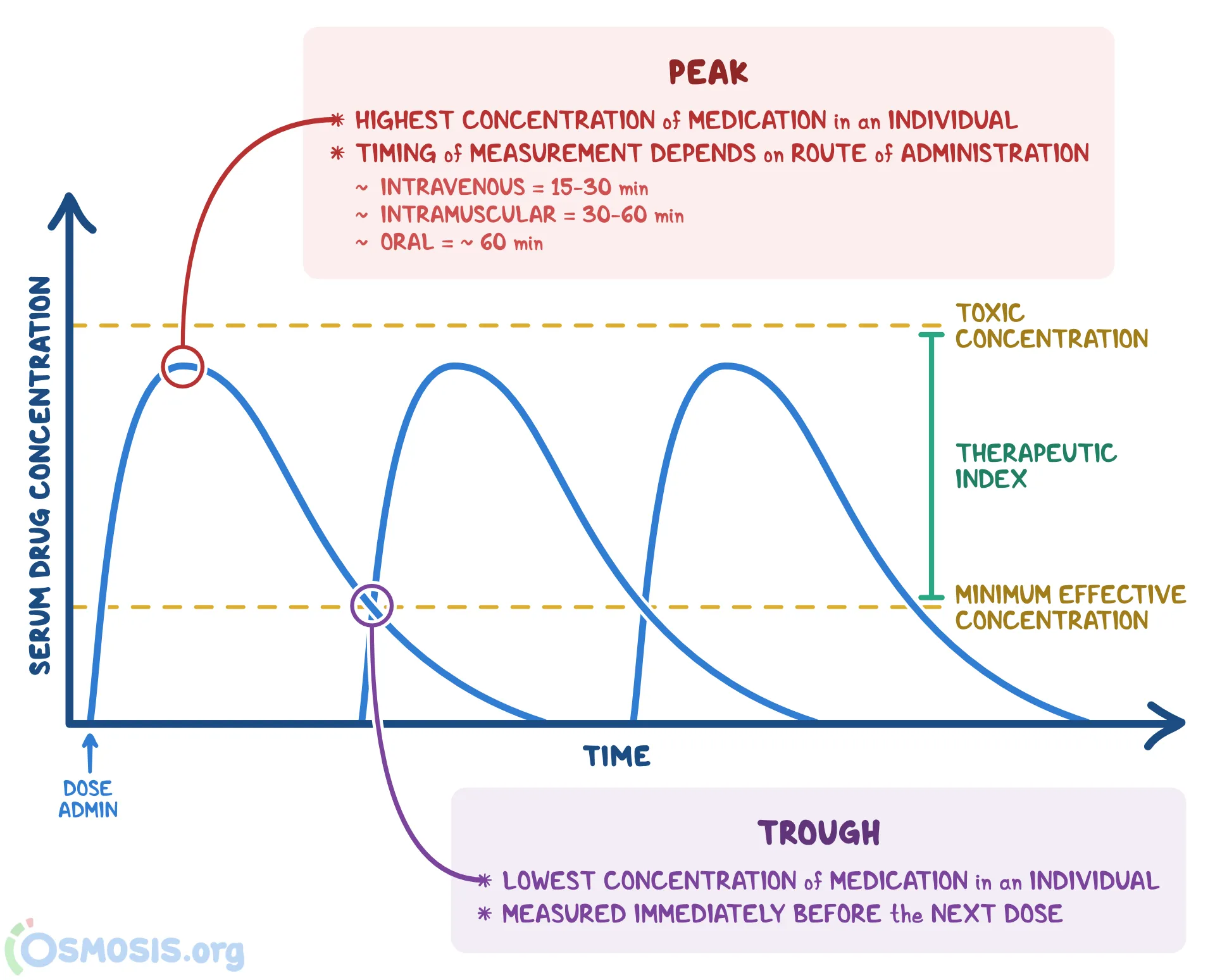
Define: Trough
When is the trough usually drawn?
The lowest concentration level of a drug in the bloodstream.
Drawn: 30 minutes before the next dose.
Define: Peak
When is the peak usually drawn?
What do you do if the peak is too low?
What do you do if the peak is too high?
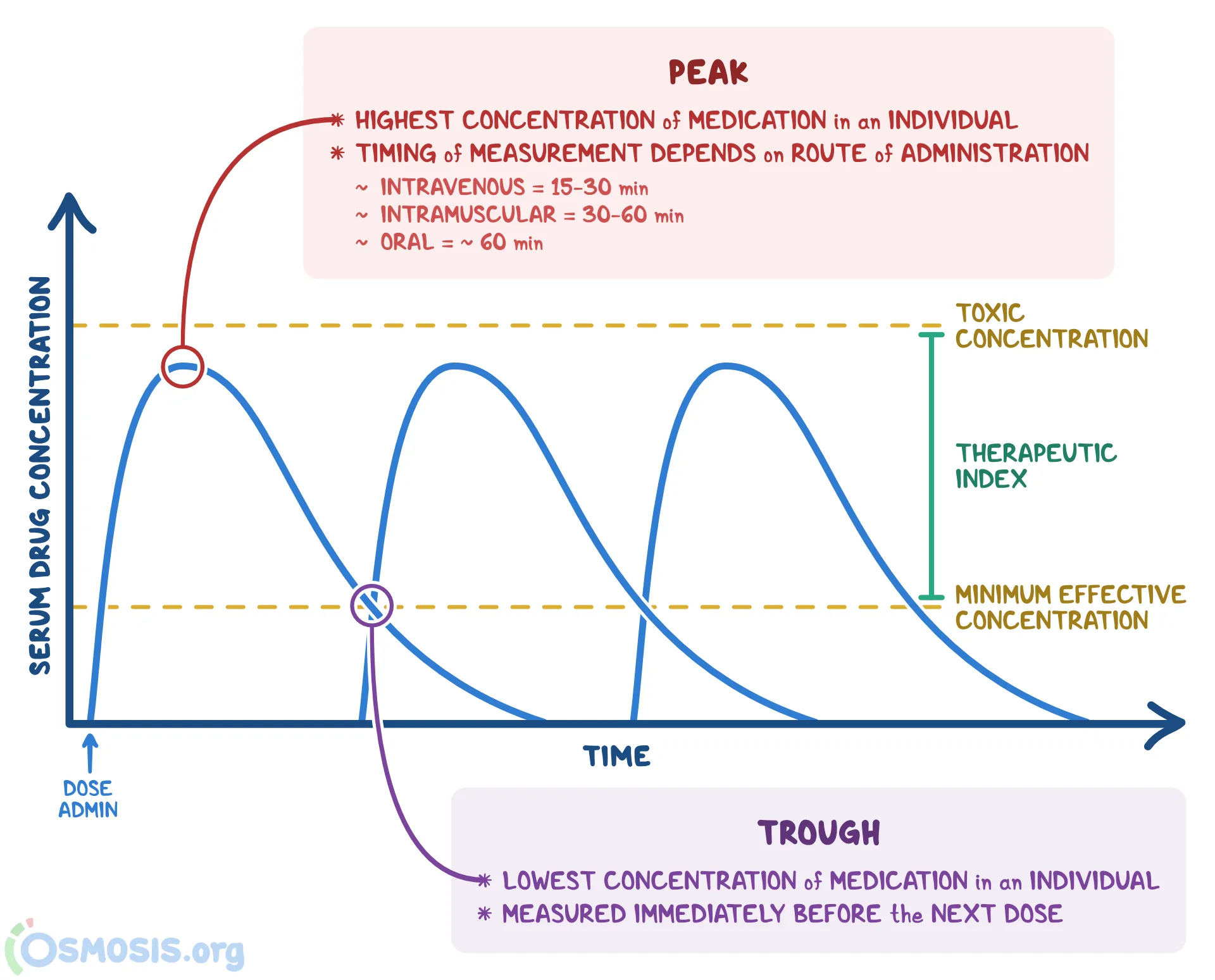
Def: The highest concentration level of a drug in the bloodstream.
Drawn: 1-1.5 hours after medication treatment is done (VARIES)!
Too Low:
Increase Dose
Increase Frequency
Too High: (Above Therapeutic Window—-too much in the system)
Decrease Dose
Space Out Frequency
Antidote (LAST RESORT)!
True/False - Troughs and peaks are drawn for all medications.
False
Explanation: Troughs and peaks are usually drawn for toxic medications—-measuring peaks and troughs keeps medicaions within the therapeutic window.
Define: Half-Life
What are considerations nurses should take into account?
Def: The time it takes for a concentration of a drug to decrease by 50% in the bloodstream.
Nursing Considerations:
Timing of Doses
Toxicity
Non-Compliance
Patient Teaching
Short Half Life v. Long Half Life
Short Life:
Works Fast, Leaves Fast
Frequent Dosing Required
TOXICITY—Stopping the drug clears it from the system quickly!
Missed Dose —> Rapid Drop in Therapeutic Window
Ex:
IV Morphine
IV Analgesics
Anesthesia & Sleep Aids
Long Life:
Slow to Build, Slow to Clear
Less Frequent Dosing Required
Easier to maintain a steady therapeutic level.
TOXICITY—-Takes longer to clear.
Ex:
Psych Meds
BP Meds
Cholesterol Meds
Birth Control
Side Effect v. Adverse Effects
Describe the difference.
Side Effect: Unwanted, Generally Tolerable
Ex:
Nausea
Hiccups
Diarrhea
GI Upset
Adverse Effect: Serious, Possibly, Life-Threatening
Ex: Anaphylaxis
Sever Hypotension
Severe Hair Loss
Steven-Johnson Syndrome
Steven Johnson Syndrome (SJS)
What causes it?
What are hallmark s/s?
What interventions do you perform?
Cause: A severe adverse reaction possible with occur any medication.
S/S:
Early Flu-Like Symptoms
Skin Blistering
Peeling, Raw Skin
Mucous-Membrane Involvement
Dehydration
Sepsis/Pneumonia
Multiple-organ failure
*Can appear even after years on the same drug.
Intervention: All medications may be stopped, then reintroduced one at a time.
True/False: Anticoagulants dissolve existing clots.
False
Explanation: Anticoagulants decrease or prevent clot formation, they DO NOT dissolve an existing clot—thrombolytics (e.g alteplase) do!
Anticoagulant: IV Unfractionated Heparin
When is it administered (acute v. chronic)?
How is it administered?
What are the primary labs you monitor?
What is the therapeutic target?
What is the antidote?
What do you do if the dose is subtherapeutic?
Administration: Acute Settings
How is it administered: Starts as IV Bolus —> Continuous Infusion.
Lab(s):
PTT
Platelets
Therapeutic Target: PTT: 46-70 sec
Antidote: Protamine Sulfate
Clinical Action if Sub-Therapeutic: Increase Dose
Lab Value—Partial Thromboblastin Time (PTT)
What does the lab measure?
What is the normal range?
What is the therapeutic range?
What do you do if PTT is low/normal?
What do you do if PTT is too high?
Measures: The time (in seconds) it takes for your blood to clot.
Normal Range: 21-35 sec (NO HEPARIN)
Therapeutic Range: 46-70 sec
Clinical Actions:
Too Low/Normal: Increase Dose (thins blood)
Too High:
Hold Medication
Adjust Dose
Decrease Dose
Decrease Administration Frequency
Antidote: Administer Protamine Sulfate
Monitor:
CBC
Hemoglobin
Hematocrit
Platelets
Signs of Bleeding
SAFETY RULE for PTT: Two nurses must verify an IV bolus, continuous Infusion. or rate changes.
Anticoagulant: Lovenox (Enxoaparin)
When is it administered (acute v. chronic)?
How is it administered?
What are the primary labs you monitor?
What is the therapeutic target?
What is the antidote?
What do you do if the dose is subtherapeutic?
Reminder: Low-Molecular-Weight Heparin (LMWH)
Administration: Often used when a patient is more stable.
How is it administered: Subcutaneous (SubQ)
Never massage the injection site (risk of increased bruising or bleeding).
Consider: Renal Function
Lab(s):
Platelets
Do not routinely monitor PTT.
Therapeutic Target: Platelets: > 150,000
Antidote: Protamine Sulfate
Clinical Action if Sub-Therapeutic: Assess Platlets
Lab Value—Platelets
What does the lab measure?
What is the normal range?
What are abnormal ranges—-what do they mean and what do you do?
Measures: A platelet count in a blood test shows the number of tiny cell fragments in your blood that help form clots to stop bleeding.
Normal Range: 150,000-450,000
400,000 —> 200,000 is still considered normal by range, BUT A 50% drop from baseline requires immediate provider notification!
Abnormal Ranges:
Thrombocytopenia: < 150,000 (blood too thin/excessive bleeding)
Thrombocytosis: > 450,000 (blood to thick)
Anticoagulant: Warfarin (Coumadin)
When is it administered (acute v. chronic)?
How is it administered?
What are the primary labs you monitor?
What is the therapeutic target?
What is the antidote?
What do you do if the dose is subtherapeutic?
Administration: Chronic/Maintenance
How is it administered: Oral (PO)
Lab(s):
PT
INR
Therapeutic Target: INR: 2.0-3.0 (Standard)
Antidote: Vitamin K
Clinical Action if Sub-Therapeutic: Increase Dose (PT: 1.5-2x Normal)
Therapeutic level on Coumadin should be 1.2-2x higher than normal; if low/normal, the dose must be increased.
Lab Value—Prothrombin Time (PT)
What does the lab measure?
What is the normal range?
What are abnormal ranges—-what do they mean and what do you do?
Measures: How many seconds it takes for a blood sample to form a clot.
Normal Range: 11-13 sec (0.8-1.2)
Lab Value—Internationalized Normalized Ratio
What does the lab measure?
What is the normal range (no tx)?
What is the standard therapeutic range?
Measures: How long it takes for your blood to form a clot.
Normal Range: 0.8-1.2 (NO WARFARIN TX)
Standard Therapeutic Range: 2.0-3.0
What can cause a patient’s INR to decrease? What does this mean?
Vitamin K Vegetables
Avocados
Kale
Spinach
CoQ10
Green Tea
Result: Thicker Blood
What can cause a patient’s INR to increase?
Coumadin
Alcohol
Aspirin
Result: Thinner Blood
What is the difference between PT and INR?
PT measures the actual seconds it takes blood to clot, which can vary by lab/reagent. INR standardizes that PT value into a ratio so results are comparable across different labs and machines.
Antiplatelet: Aspirin
When is it administered (acute v. chronic)?
How is it administered?
What are the primary labs you monitor?
What is the lower dose used for? Higher dose?
Administration: Chronic/Maintenance
How is it administered: Oral (PO)
Lab(s):
Platelets (Most Important)
CBC
Bleeding
*Hold & notify if bleeding occurs.
Typical Dosing:
81 mg (“Baby Aspirin”) - Myocardial Infarction/Stroke Prevention
Higher Dose - Pain Relief
Describe the difference between anticoagulants and antiplatelet?
Anticoagulants (Warfarin, Heparin) interfere with clotting factors. Antiplatelets (Aspirin) stop platelets from clumping together in the first place. Different mechanism, different monitoring, different use cases.