IB Biology HL Unit 1
 Call Kai
 Learn
Learn Practice Test
 Spaced Repetition
 Match
Match Flashcards
 Knowt Play
1/84

There's no tags or description
Looks like no tags are added yet.
Name | Mastery | Learn | Test | Matching | Spaced | Call with Kai | Chat |
|---|
No analytics yet
Send a link to your students to track their progress
85 Terms
Redi’s Experiment
Demonstrated that maggots do not spontaneously arise from decaying meat but rather from eggs laid by flies
Jars with varying degrees of exposure
Prove spontaneous generation false
Pasteur’s Experiment
Bacteria could only grow in sterile broth when exposed to air
Disproved spontaneous generation
Introduced the concept of sterilization and pasteurization
3 Tenets of Cell Theory
All living organisms are composed of cells
Cells are the basic unit of structure and function in living things
All cells come from pre-existing cells
Conditions of Early Earth
Little oxygen
No ozone
Lots of carbon dioxide and methane
High temperature
Miller-Urey Experiment
Simulated early conditions to test the origins of life
Used H2O, CH4, NH3, H2, heat, electricity
Created organic simple molecules including amino acids
Criticism: assumption of these conditions to be true
Protocells
Simple cell-like structures that may have formed the basis of early life
Have genetic material
Exhibit basic metabolic functions
Spontaneous Formation of Vesicles
Phospholipids in primordial soup spontaneously form due to hydrophilic/hydrophobic ends
Created membranes
Reasons for RNA being considered the first genetic material
Catalytic properties
Stores genetic information
Last Universal Common Ancestor (LUCA)
Unicellular, autotrophic microbe
Formed 2.5-3.5B years ago in hydrothermal vents of the ocean floor
Evidence for LUCA
Universal genetic code
Universal machinery for protein synthesis (like ribosomes)
ATP for energy
Universally shared genes for processes like DNA replication
Ribosome structure
Enzymes that synthesize
Metabolism
Chemical reactions take place in their cells
Response to Stimuli
Respond to environmental change
Homeostasis
Maintain constant internal conditions
Movement
Control their position in space
Growth
Increase in size or number of cells
Reproduction
Produce offspring asexually or sexually
Excretion
Facilitate removal of waste
Nutrition
Obtain energy or nutrients from their environment
All cells have…
Cell membrane
Cytoplasm
Ribosomes
DNA
Formula for magnification
image/actual
Differences between prokaryotes and eukaryotes
Prokaryotes
No membrane bound organelles
No nucleus
Older and simpler
Cell wall
70s ribosomes
Naked DNA
Eukaryotes
Membrane bound organelles
80s ribosomes
Mitochondria
Nucleus
Plant VS Animal VS Fungal Cells
Plant
Cell wall of cellulose
1 large, permanent central vacuole
Chloroplasts
Animal
No cell wall
Small, temporary vacuoles
Centrioles
Undulipodia: flagella and cilia
Fungal
Large vacuoles
Cell wall of chitin
Tradeoffs of a cell wall
Limited flexibility
Affected nutrient absorbtion
Atypical cells: Aseptate Fungal Hyphae
Lack compartmentalization and internal membranes
Atypical cells: Red Blood Cells
No nucleus or DNA
Atypical cells: Phloem Sieve Tube Elements
No nucleus and few organelles
Atypical cells: Striated Muscle Tissue (Skeletal Tissue)
Multiple nuclei
Compartmentalization
Functions are split up for benefit
Efficiency
Protection of cellular parts
Organizes cellular processes
Endomembrane System
Parts: nucleus, ribosomes, ER, golgi, vesicles, lysosomes, membrane
Process of producing and transporting proteins: Protein synthesis →mRNA travel to ribosomes on rough ER →transport vesicles go to golgi →golgi vesicles direct protein to final destination
Endosymbiosis
Beneficial relationship inside a cell
Endosymbiotic Theory
Explains origins of eukaryotes
Process: 1 bacteria engulfed another, and it lived inside and got passed down through generations
Likely engulfed in the order of mitochondria then chloroplast
Evidence for the Endosymbiotic Theory
Double membrane
Naked and circular DNA
70S ribosomes
Independent replication
4 Biological Macromolecules
Nucleic Acids
Carbohydrates
Lipids
Proteins
Anabolic Pathway
Synthesizes molecules
Monomers → Polymer
Uses condensation reactions (dehydration synthesis) AKA the removal of water
Endergonic: Requires energy
Catalyzed by enzymes
Catabolic Pathways
Breaks down molecules
Polymer→ Monomers
Uses hydrolysis AKA addition of water
Exergonic: Releases energy
Catalyzed by enzymes
Monomer and Polymer of Nucleic Acids
Monomer: Nucleotide
Polymer: Polynucleotide
Monomer and Polymer of Carbohydrates
Monomer: Monosaccharides
Polymer: Polysaccharides
Monomer and Polymer of Proteins
Monomer: Amino acids
Polymer: Polypeptide
Monomer and Polymer of Lipids
TRICK QUESTION they have no true monomer or polymer
2 Types of Nucleic Acids
DNA and RNA
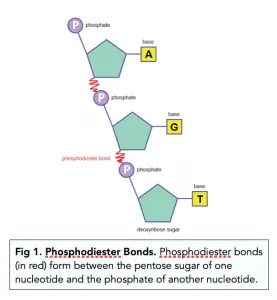
Phosphodiester Bonds
The covalent bonds between nucleotides
3 Parts of a Nucleotide
Phosphate Group
Pentose Sugar (Deoxyribose in DNA, Ribose in RNA)
Nitrogenous Base (AGTCU)
Elements found in nucleic acids
C, H, O, N, P
How are polynucleotides synthesized?
Anabolic pathway, condensation
Sugar Phosphate Backbone
Repeating pattern of pentose Sugar then phosphate along the nucleotide
Held by phosphodiester bonds
DNA VS RNA: Similarities and Differences
Similarities
Contain adenine, guanine, cytosine
Monomers: nucleotides
Polymer: polynucleotide
Contain phosphodiester bonds
Differences
DNA has 2 strands, RNA has 1 strand
DNA has deoxyribose, RNA has ribose
DNA has thymine, RNA has uracil
Purines
Adenine (A) and guanine (G)
2 Rings
Pyramidines
Cytosine (C), thymine (T), uracil (U)
1 ring
Base pairings
A and T/U
G and C
Antiparallel
2 strands which are parallel but in opposite directions
Describes DNA strands
Describe a polynucleotide strand
5’ end is the end with the phosphate
3’ end is the end w/o phosphate
What bonds form between two bases?
Hydrogen bonds
Hershey & Chase
DNA is the genetic material of the cell
Knowledge: Bacteriophages infect bacteria by injecting DNA
Method: labeled proteins with radioactive sulfur and DNA with radioactive phosphorus in the phages →infected bacteria → put through centrofuge to separate cells into pellet
Results: Phosphorus was found in cell pellets and sulfur was in the supernatent (where the bacteriophages were)
Rosalind Franklin
Researched and took x-ray of double helix of DNA
Used x-ray crystallography
Watson & Crick
Used Franklin’s data
Used it and Chargraff’s data to create double-helix model of DNA and base pairings
Erwin Chargraff
Discovered base pairing ratios
Tetranucleotide Hypothesis: all 4 bases occur in equal amounts
Disproved by Chargraff
Showed that A and T occurred in similar % and C and G occur in similar %
Nucleus
Contains DNA in chromosomes
Has double nuclear membrane with nuclear pores
Central dot called nucleolus which produces ribosomes
Rough Endoplasmic Reticulum
Contains ribosomes which produce proteins for out of cell use
Smooth Endoplasmic Reticulum
Produces and stores lipids
No ribosomes
Vesicles
Modify and assist in transport of substances produces by the cell
Fuse with membranes in the cell
Golgi Apparatus
Processes and packages proteins which are released to vesicles
80S Ribosomes
Where protein synthesis occurs
Higher mass than 70S ribosomes
in eukaryotes
Cytoskeleton
Not and organelle
System of protein fibers called microtubules and microfilaments
Hold organelles in place and maintains shape and structure of the cell
Plasma Membrane
Separates internal and external environments
Controls entering and exiting
Semipermeable
Phospholipids bilayer
Lysosomes
Contain enzymes that break down cellular components
Cytoplasm
Water-based, jelly-like fluid filling the cell
Site of metabolic reactions
Not an organelle
Cell Wall
Made of polysaccharides in plants and or chitin in fungus
Protects and provides support
Not and organelle
Vacuole
Maintains osmotic balance
Stores substances
Hydrolytic functions
Chloroplasts
Double membrane
Photosynthesis location
DNA
Not an organelle
Codes for protein
Genetic material
Undulipodia (Cilia and Flagella)
Cilia
Movement
Shorter and more abundant
Made of microtubules
Flagella
Movement
Longer and less abundant
Made of microtubules
Microtubules and Centrioles
Microtubules
Move chromosomes during cell division
Centrioles
Form anchor point for microtubules
Intermembrane Space (Mitochondria)
Creates H+ concentration gradient
Small gap between inner and outer membranes
Matrix (Mitochondria)
Holds enzymes
Cristae (Mitochondria)
Folds on the inner membrane
Increase surface area
Inner Membrane (Mitochondria)
Proteins for electron transportation
Outer Membrane (Mitochondria)
Protection
Thylakoid (Chloroplast) and Granum
Has chlorophyll
Absorbs light to produce ATP
Stacks of thylakoid = granum
Stroma (Chloroplast)
Has enzymes for the Calvin cycle
Immunofluorescence Staining
Uses fluorescently labeled antibodies to bind to target molecules, detecting them within cells.
Light Microscope
Uses light to form images
Magnifies up to 1500x
How to make a wet mound
Place a thin slice of your sample on a slide →Place one drop of water on it →Cover with coverslip at 45 degree angle
Fluorescent Staining
Uses fluorescent dyes to attach to specific cellular structures, making them visible under UV light.