LS microorganisms. (incomplete)
 Call Kai
 Learn
Learn Practice Test
 Spaced Repetition
 Match
Match Flashcards
 Knowt Play
1/19

There's no tags or description
Looks like no tags are added yet.
Name | Mastery | Learn | Test | Matching | Spaced | Call with Kai | Chat |
|---|
No analytics yet
Send a link to your students to track their progress
20 Terms
4 Classifications of micro organisms
Viruses
Bacteria
Fungi
Protists
What micro organism doesn’t have a kingdom
Viruses
Describe a virus
Non-living
Contain nucleus acid
Different shapes and sizes
Are parasitic (many are pathogens)
In which Kingdom is bacteria?
Monera
In which kingdom is fungi?
Fungi
Describe bacteria
Occur in soil, air, water
Single-celled
No true nucleus
Some are pathogens
Define Fungi
Saprophytic or parasitic Moulds and yeast
In what kingdom do protists belong?
Protoctista
Describe protists
Unicellular or multi-cellular
Mainly aquatic
Some plant-like (photosynthesize)
Some animal-like
Some fungi-like
Difference between protist and protoctista
Protist has been used to describe the single celled organisms of the kingdom.
Protoctista has been used to include the multi-cellular organisms.
Types of nuclei acid
DNA (Deoxyribonucleic acid)
RNA (Ribonucleic acid)
Difference between DNA and RNA
What are the smallest micro organisms
Viruses
Define Capsid
Protein coat surrounding nuclei acid
Which 2 phases do viruses exist in?
Active: In contact with host cell, inserts genetic material into host cell taking over cell’s functions. DNA interferes with host cell’s metabolism to replicate.
Inactive: Outside host, has no metabolic activities.
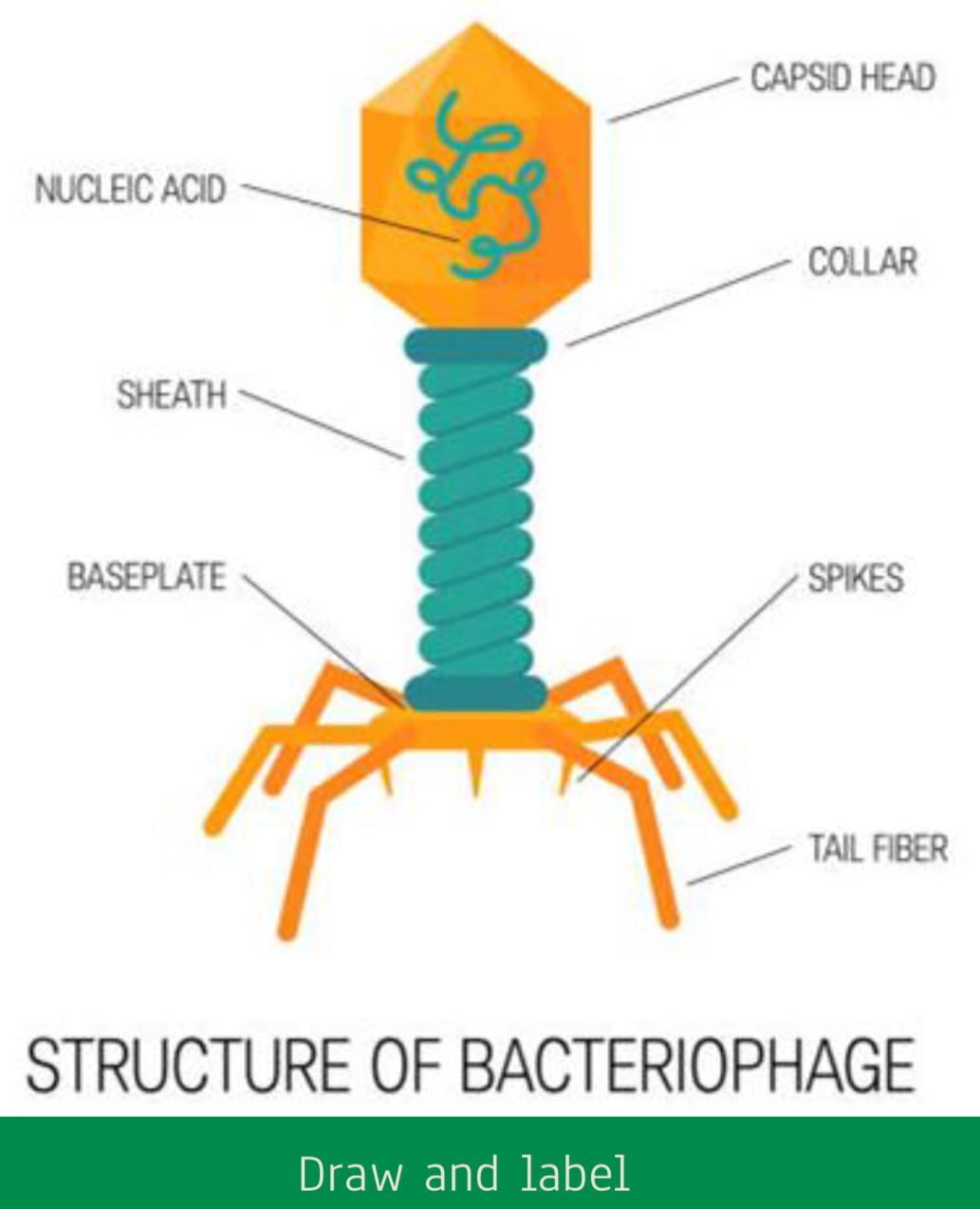
Diagram of a bacteriophage
Describe Tobacco Mosaic Virus
Affects agricultural crops by damaging leaves, flowers and fruit.
Stunts growth, distorts fruit and patches leaves.
Reduces ability to photosynthesis, quality and quantity of crops
Describe rabies
Caused by Rhabdovirus
Contains RNA
Transferred by bite, lick or scratch
Unusual behaviour
Vaccine
Effects of rabies
Virus replication on site and in muscles enters nerve cells and travels to brain causing headeache