Chapter 15 - sensory pathways
 Studied by 0 people
 Call Kai
 Learn
Learn Practice Test
 Spaced Repetition
 Match
Match Flashcards
 Knowt Play
1/24

There's no tags or description
Looks like no tags are added yet.
Name | Mastery | Learn | Test | Matching | Spaced | Call with Kai |
|---|
No study sessions yet.
25 Terms
3 types of sensory receptors
exteroreceptors - monitor external environment
interoreceptors - monitor visceral organs
proprioreceptors - monitor position of skeletal muscles & joints
special senses
smell, taste, vision, hearing, equilibrium
somatic senses
touch, pain, temperature
where in the brain does sensory info go?
cerebrum —> conscious
func. of sensory receptors
monitor changes in specific variables inside & outside the body
usually specific receptors are at the end of an afferent neuron
receptor specificity
each receptor responds to a specific type of stimulus
you have 2 types of senses : general & special
general senses
temperature, pain, touch, pressure, vibration & proprioception (muscle stretch)
receptors - usually on the dendrite ends of afferent (sensory) neurons
ex. tactile receptors
general senses (6 examples)
free nerve endings - pain, touch, pressure, temp
root hair plexus - hair movement
Merkel cells and tactile discs- fine touch, pressure
Tactile corpuscle (Meisner’s) - light touch
Laminated corpuscle - deep pressure
Ruffini corpuscle - distortion
special senses
olfaction, vision, gustation, equilibrium, hearing
receptors are more complex & are located in sense organs (eye, ear,tounge)
Direction of the stimulus
an adequate stimulus acting on a sensory receptor causes a change in the membrane’s permeability
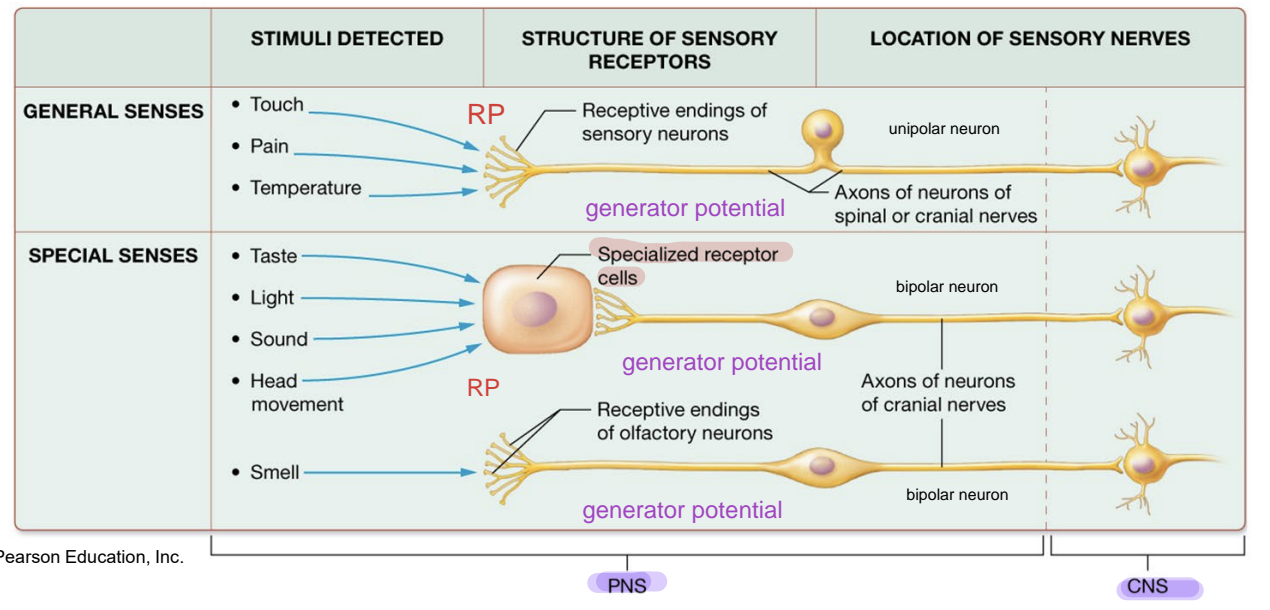
receptor potential
generation of the receptor cell’s graded depolarization/hyperpolarization
generator potential
a depolarization of the sensory neuron (=the receptor cell in general senses,2nd cell in special senses)
Transduction
process of translating stimulus into an action potential
range of detection
the number and type of sensory receptors we have limit what we can sense and become aware of
each of us is unique in our sensory abilities
Receptive field
area of body monitored by one particular afferent neuron and all it’s receptors
interpretation of sensory information
to generate conscious sensation , sensory information must be transmitted to the cerebral cortex
sensation
raw experience, may be unconscious
activity in any & all sensory neurons
perception
SNS (1% of all sensation)
interpretation, meaning given to sensation, conscious awareness of sensation
activity in cerebral cortex, and not just spinal cord & brain stem
not perceived - visceral sensory info delivered to dienchephalon, spinal cord & brain stem only
labelled line - pathway that conducts sensory info from a receptor to specific neurons in cortex
interpretation in cortex
modality (type) of stimulus (touch, pressure, temp, sound) is interpreted by labeled line
information about the type, strength, duration, and variation of the stimulus is coded by
a) type of sensory receptor cell activated
b) the rate of action potentials generated
eg. the harder/stronger the stimulus, the more action potentials generated (AP ARE MORE FREQUENT)
tonic receptors
always active
provide information about:
background level of stimulation
changes indicated by frequency of action potentials generated
called slow-adapting receptors because they show little peripheral adaption
Ruffini corpuscle, Merkel tactile receptors, nociceptors (pain receptors). joint capsule proprioceptor, muscle spindle
phasic receptors
not always active fire only when stimulated
provide information about : intensity and rate of change of stimulus
called fast adapting receptors because they respond strongly at first & then show decline in activity + peripheral adaptation
pacinian corpuscles, meissner’s corpuscles, thermoreceptors,
root hair plexus
adaptation
reduction in sensitivity of nervous system to constant stimulus
higher centres can increase receptor sensitivity or facilitate transmission (eg, RAS heightens awareness - listen carefully)
peripheral adaptation
phasic sensory receptors become less responsive.
(Eg. become used to background noise, feeling of clothing, room temperature)
central adaptation
receptors still responding but central adaptation, involves inhibition at various nuclei
sensory info may still generate reflex responses, but no conscious sensation or perception - awareness is reduced (eg. you get used to new odours in a room)
why does adaptation take place
so that the brain is not overwhelmed and is not using up resources paying attention to things that are not as important. Allows the brain to focus on important things