Human Anatomy Exam 1 Review
 Call Kai
 Learn
Learn Practice Test
 Spaced Repetition
 Match
Match Flashcards
 Knowt Play
1/41

Earn XP
Description and Tags
Professor Aranda @ UTA
Name | Mastery | Learn | Test | Matching | Spaced | Call with Kai | Chat |
|---|
No analytics yet
Send a link to your students to track their progress
42 Terms
Term for the study of the structure of the human body?
Anatomy
Term for the study of the body’s function?
Physiology
What are the subdisciplines of anatomy?
Gross anatomy (ie regional and systemic), surface anatomy, and microscopic anatomy
What is the hierarchy of structural organization? (from simplest to most complex)
Chemical, cellular, tissue, organ, organ system, and organismal
Description of which level of organization:
Atoms combine to form molecules. Molecules combine to form the macromolecules, carbohydrates, lipids, proteins, and nucleic acids.
Chemical level
Description of which level of organization:
Cells and their surroundings are made up of molecules.
For example, a phospholipid molecule is a structural component of the plasma membrane.
Cellular level
Description of which level of organization:
Tissues consist of similar types of cells and associated extracellular material.
For example, epithelial tissue forms the inner lining of blood vessels.
Tissue level
Description of which level of organization:
An organ is a discrete structure made up of multiple tissue types.
Examples include blood vessels, the liver, brain, and femur.
Organ level
Description of which level of organization:
An organ system is a unified group of organs and tissues that perform a specific function.
The example shown here is the cardiovascular system, showing blood vessels, blood, and the heart.
Organ system level
Description of which level of organization:
The whole person is the most complex level of organization, the ___ ___, resulting from the simpler levels working interdependently.
Organismal level
Name the 11 organ systems of the human body.
Integumentary, skeletal, muscular, nervous, endocrine, cardiovascular, lymphatic, immune, respirartory, digestive, urinary, and reproductive
Description of which body system:
Forms external body covering
Protects deeper tissues from injury
Synthesizes vitamin D [signals GI to absorb calcium]
Site of cutaneous receptors
(Pain, pressure, etc.) and sweat and oil glands
Integumentary System
Description of which body system:
Protects and supports body organs
Provides a framework for muscles
Blood cells formed within bones
Stores minerals [ie Ca, and phosphate]
Skeletal system
Description of which body system:
Allows manipulation of environment
Locomotion
Facial expression
Maintains posture
Produces heat
Muscular system
Description of which body system:
Fast-acting (and short lived) control system
Responds to internal and external changes (stimuli)
Activates muscles and glands (ONLY)
Nervous System
Description of which body system:
Glands secrete hormones that regulate:
Growth
Reproduction
Nutrient use
Slow acting, long lasting
Endocrine system
Description of which body system:
Blood vessels transport blood
Blood carries oxygen and carbon dioxide (hydride ion, H-)
It also carries nutrients and wastes
Heart pumps blood through blood vessels
Cardiovascular system
Description of which body system:
Picks up fluid leaked from blood vessels (serves as a drain for the body)
Returns fluid to blood
Disposes of debris in the lymphatic system
Houses white blood cells (lymphocytes)
Mounts attack against foreign substances in the body
Four major body fluid categories: Water, cytosol [intracellular fluid found inside cells], blood [plasma], and interstitial fluid [extracellular fluid that fills the narrow spaces b/w cells and tissues])
Lymphatic System/Immunity
Description of which body system:
Keeps blood supplied with oxygen
Removes carbon dioxide
Gas exchange occurs through walls of air sacs in the lungs
Respiratory system
Description of which body system:
Breaks down food into absorbable units
Indigestible foodstuffs eliminated as feces
Digestive system
Description of which body system:
Eliminates nitrogenous wastes
Regulates water, electrolyte, and acid-base balance of the blood
FYI: Water always follows solute
Urinary system
Description of which body system:
Overall function is to produce offspring
Testes produce sperm and male sex hormones
Male ducts and glands aid in delivery of sperm to the female reproductive tract
Ovaries produce eggs and female sex hormones
Female structures serve as sites for fertilization and development of the fetus
Mammary glands produce milk
Male and Female Reproductive Systems
Fill in the blank:
System of measurement in anatomy is the ___ ___.
Meter
Centimeter
Micrometer
Liter
Milliliter
Kilogram
Gram
metric system
Fill in the blanks:
Anatomical Terminology -
Based on ancient ___ or ___
Provides ___ nomenclature worldwide
Greek, Latin, standard
Fill in the blanks:
An intro to gross anatomy -
Regional and directional terms
___ ___ —a common visual reference point
Person stands erect with feet together and eyes forward
Palms face anteriorly with the thumbs pointed away from the body
Anatomical position
The axial region includes?
head, neck, and trunk (torso)
What are the two regional terms?
axial and appendicular
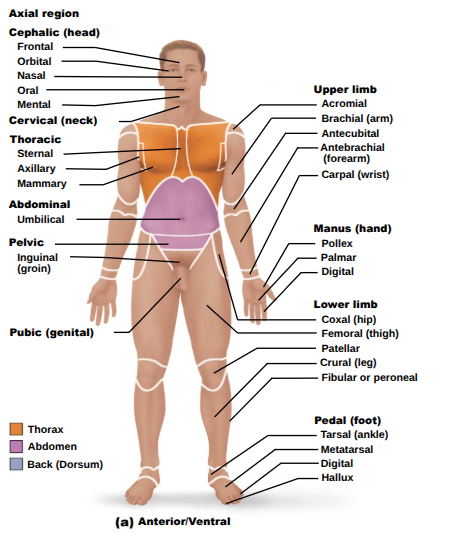
Review: parts of the body and their corresponding regions from an anterior/ventral view
Okay
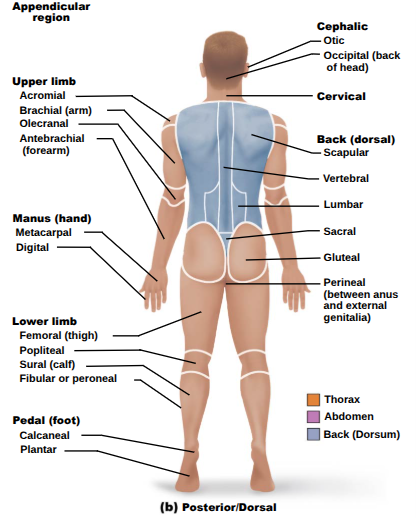
Review: parts of the body and their corresponding regions from a posterior/dorsal view
Okay
Which pair of directional terms apply to both the axial and appendicular systems?
Medial/lateral
Which pair of directional terms apply only to the appendicular system?
Proximal/distal
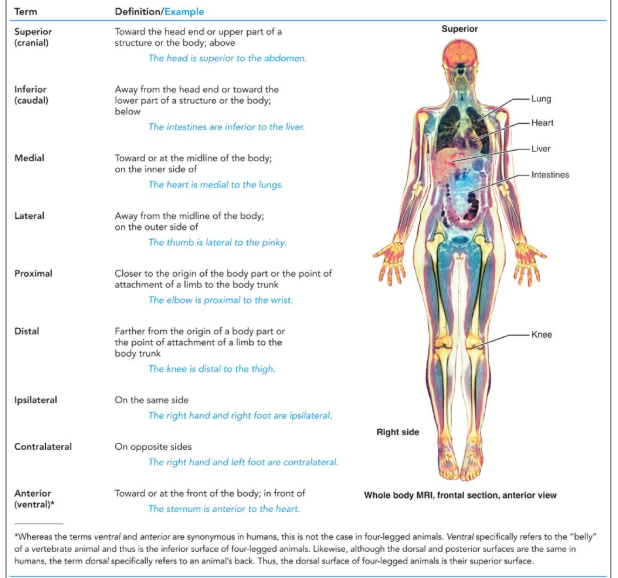
Re: Orientation and Directional Terms
Okay
Fill in the blanks:
Body Planes and Sections
Sagittal planes
Extend vertically
Divide the body into right and left parts
Median (___) plane
Sagittal plane that runs along the midline, results in equal R and L halves
___ planes
A sagittal plane offset from the midline
Midsagittal, parasagittal
Description of which body plane?
Lies vertically and divides body into anterior and posterior parts
Frontal (coronal) plane
Description of which body plane?
Runs horizontally and divides body into superior and inferior parts
Transverse plane