Decision Making and Scarcity
 Call Kai
 Learn
Learn Practice Test
 Spaced Repetition
 Match
Match Flashcards
 Knowt Play
1/3

Earn XP
Name | Mastery | Learn | Test | Matching | Spaced | Call with Kai | Chat |
|---|
No analytics yet
Send a link to your students to track their progress
4 Terms
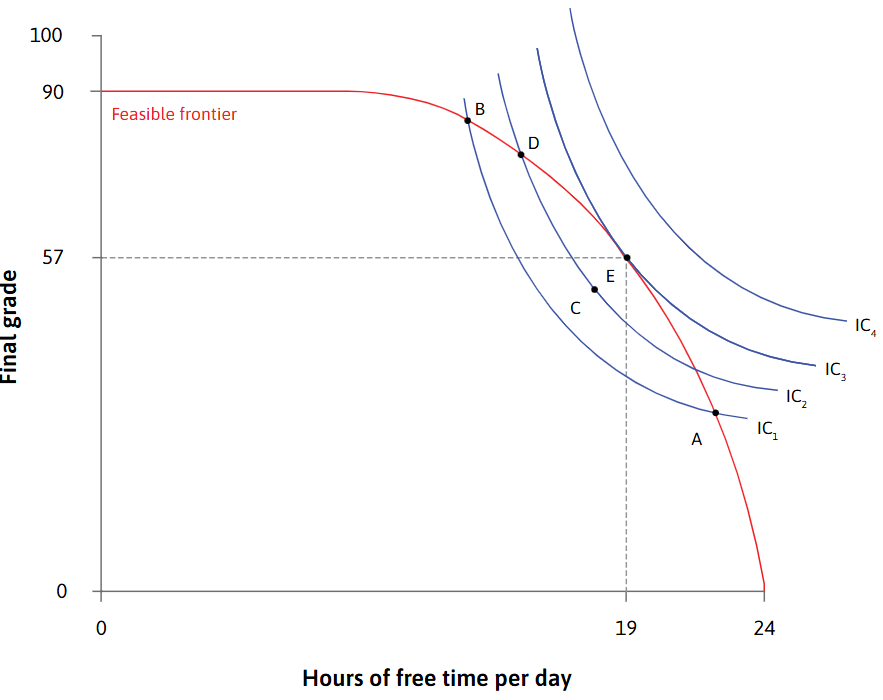
Which point would Jason choose when combining his feasible frontier and his indifference curve? And why
-None of IC4 is accessible to Jason’s frontier, so we can ignore it
-IC1 and IC2 are within, but they both go into Jason’s feasible set, so he can always do better. There is no point sticking with point B when point D is also feasible and gives a higher level of utility
-Thus, point E represents the optimal point - where he can maximise his utility given his feasible frontier
What is the core property that occurs at the optimal point of allocation
-The slope of the indifference curve is the same as the slope of the feasible frontier.
-Thus, the two trade-offs are balanced / at equilibrium
Why does the optimal allocation has the MRT = MRS?
-Should the MRS > MRT, the number of good A one is willing to trade for exceeds the opportunity cost of doing so.
-Should the MRT > MRS, the number of good A being made exceeds the willingness to consume good A
What is a constrained choice problem? And what is the solution?
-A problem is about how we can do the best for ourselves, given our preferences, constraints, and when the things we value are scarce.
-The solution comes from the individual’s optimal choice, which comes about when MRS = MRT