TECH FUNDAMENTALS - OSI 7-Layer Networking Model
 Call Kai
 Learn
Learn Practice Test
 Spaced Repetition
 Match
Match Flashcards
 Knowt Play
1/36

There's no tags or description
Looks like no tags are added yet.
Name | Mastery | Learn | Test | Matching | Spaced | Call with Kai | Chat |
|---|
No analytics yet
Send a link to your students to track their progress
37 Terms
Provide the networking stack of the OSI model
Every device uses some form of the OSI layer model.
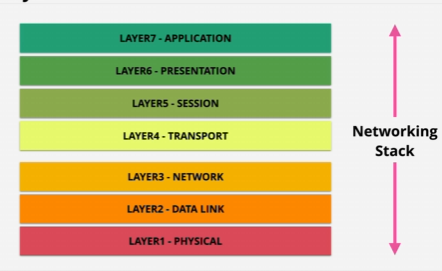
Which ones are the host layer and the media layer?
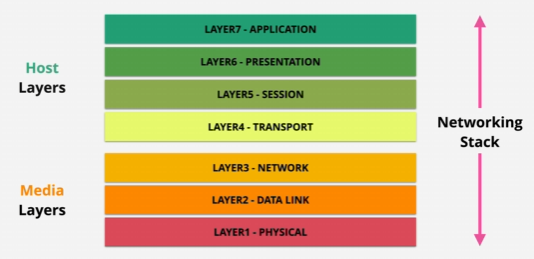
What does the media layer do?
It dictates how data is moved between point A and point B.
What does the host layer do?
It dictates how data is broken down and then reassembled for transport.
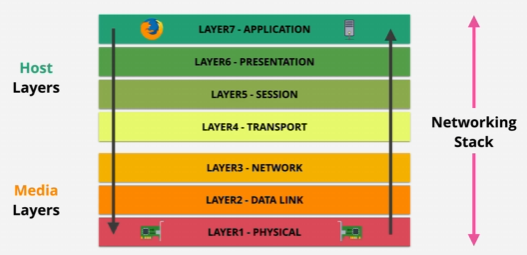
What is in the top layer (Application layer) of the model?
A web browser or a web server.
What is in the bottom layer (Physical layer) of the model?
A physical network card/interface.
How does data move in this model?
Data can be moved up and down the stack.
Describe the physical layer (Layer 1).
It is responsible for the physical transmission of data over a communication channel, such as a wire, cable, or wireless signal.
What does layer 1 define?
This layer defines the physical characteristics of the communication of raw bit streams through a medium, including voltage levels, cable types, and signaling methods, to ensure that data is transmitted accurately and reliably between devices.
For layer 1, what can the physical medium be?
It can be Copper (Electrical), Fibre (light) or WIFI (RF)
What functionalities does layer X contain?
It contains the functionalities of that layer, as well as the other layers below.
Let’s say we want to add more then 2 devices in a network. We can’t just connect them together like how we did with 2 devices. What device does layer 1 use for this to happen?
Use a hub
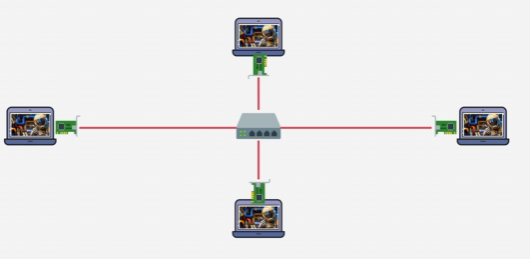
What is the job of the hub?
Anything received on any port is transmitted on every other port, including errors or collisions.
Are there addresses for devices in layer 1 netowrking?
No since all data is processed by all devices because of how the hub works.
What is the main issue with layer 1 architecture?
2 devices may choose to transmit at once, causing a collision to occur.
Does layer 1 have madia access control/forms of collision detection?
No - the network cards can technically transmit their data all at the same time.
Why don’t layer 1 netowrks tend to scale vary well?
The more devices that are added to a network, the higher the chances of collisions/data corruption.
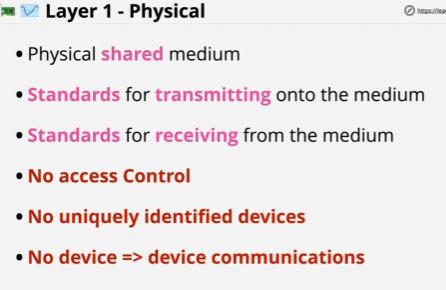
So what are the properties of the physical layer?
There’s a physical shared medium
The same standard is used for transmitting data onto the medium
The same standard is used for receiving data from the medium
My standards, I mean the same NIC or copper wire is used for communication
No access control
Devices can’t be uniquely identified
This means we don’t have device to device communication
What does layer 2 (Data Link layer) consist of?
It consists of layer 1 and layer 2
What 2 things does layer 2 consist of?
MAC address (48 bits long)
Frames
Where is the MAC address attatched?
It’s uniquely attatched to a specific piece of hardware
What are the 2 parts that form a MAC address?
The OUI (Orginizationally Unique Identifier)
NIC (Network Interface Controller)
Together, the MAC address of a device should be globally unique.
What part of the MAC address is the OUI/NIC?
OUI - The first 24 out of 48 bits.
NIC - The last 24 bits
What is the OUI specifically?
It’s the Orginizationally Unique Identifier. It uniquely identifies the specific hardware manufacturer or vendor of a network device.
What is the NIC specifically?
Unique serial number assigned by that manufacturer to that specific piece of hardware.
What is the difference between layer 1 and layer 2?
layer 1 handles the physical transmission of data through the medium. (Contains the Network Interfaces and the shared medium between them)
layer 2 breaks the data down into frames (And other things)
Layer 1 doesn’t know it’s transmitting the frames, it’s just transmitting the signals.
What are the components of the frame?
The Start Frame Delimiter (SFD)
MAC header
Payload
Frame Check Sequence (FCS)

What is the SFD?
The Start Frame Delimiter lets other devices know that this is the start of the frame
What does the MAC header contain?
Source and dest. MAC address
Ether Type (Tells us which layer 3 protocol is putting its data in the frame)
What do you put into the “Destination“ component of the frame so that it can be distributed to every device in the network?
Put all Fs in the dest.MAC address
Known as a “broadcast”
What is contained in the Payload?
The data the frame carries from src to dest.
What is the FCS?
Used to identify any errors within the frame. It lets the destination to check if the frame payload has been corrupted.
Which layer generally provides the data in the payload?
Layer 3.
So how does data transmission work using both layers 1 and 2?
Layer 2 from src destination breaks down data into frames. It’s then sent through to the physical layer, so it can be sent through the medium to the destination device, which takes it froom the physical layer to layer 2 (Data Link layer), and the software in layer 2 will check if the destination address matches, and if it does, it starts to open up the frame to get the payload.
What is CSMA?
Carrier Sense Multiple Access: is a Media Access Control (MAC) protocol used in the Data Link layer (Layer 2) to control when a device is allowed to transmit on a shared communication medium.
How is it CSMA used?
Layer 2 can communicate with the layer 1 part of the network so it can detect or look for any signs of a carrier signal (Basically to see if the transmission line is being used). If any other sevice is sending data along that ethernet line, it will wait until there’s no carrier detected and then it will send.
What is encapsulation?
Process of taking data and wrapping it in comething else.