F&W ECOL 306 - Reptiles
 Call Kai
 Learn
Learn Practice Test
 Spaced Repetition
 Match
Match Flashcards
 Knowt Play
1/134

Earn XP
Description and Tags
Notes and flash cards on the ecology, life history, and characteristics of Wisconsin reptiles and reptile orders of the world.
Name | Mastery | Learn | Test | Matching | Spaced | Call with Kai | Chat |
|---|
No analytics yet
Send a link to your students to track their progress
135 Terms
Reptilia
Class of Reptiles
~11,940 Known Species Worldwide
36 Species in Wisconsin
Reptile Characteristics
Epidermal Scales of Keratin
Amniotic Eggs with Leathery or Calcified Shells
Non-Reliant on Water for Reproduction
Non-Aquatic Larvae
Internal Fertilization
Toes with Claws (Except in Legless Members)
Exothermic
3-Chambered Heart in Most Orders
Reptile Skulls
Single Inner Ear Bone
The Stapes
Several Lower Jaw Bones
Single Occipital Condyle
Amniote Skulls
Anapsid: Solid Skull with No Opening, Turtles
Synapsid: One Opening in Skull, Mammals
Diapsid: Two Openings in Skull, All Reptiles & Birds minus Turtles
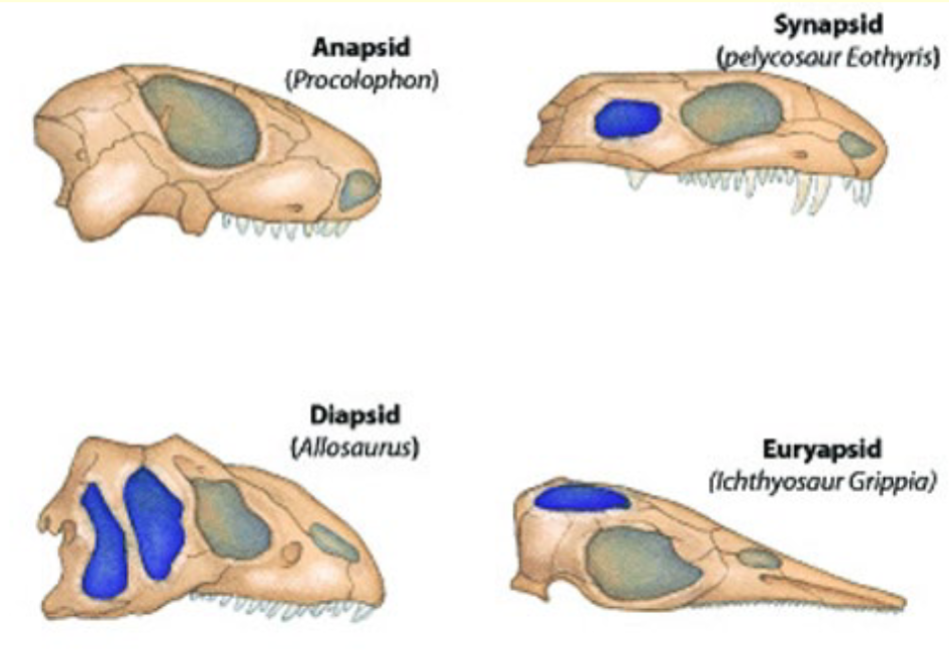
Anapsid Skull
Solid Skull with No Opening
Turtles
Synapsid Skull
One Opening in Skull
Mammals
Diapsid Skull
Two Openings in Skull
All Reptiles except Turtles
Birds
Advantages of Exothermy
Lower Energy Demands
More Efficient
Better Adapted to Environments with Sparse Food
Can Survive in Larger Range of Temperatures
Disadvantages of Exothermy
Activity Limited to Warmer Seasons & Times of Day
Cannot Sustain Long Activity
Absent from Colder Environments
Thermoregulation
Basking
Move Between Sun & Shade
Postural Adjustments
Activity Temperature: ~30 to 37 oC, Body Temperature required for Locomotion, Foraging, Etc.
Majority of Wisconsin Reptiles Limited to Southwestern Corner
The Driftless Area
Functions of Reptile Skin
Defense
Concealment
Mate Attraction
Locomotion
Epidermal Layer
Layer of Reptile Skin made of Keratinous Scales
Dermal Layer
Connective Tissue
Blood Vessels
Nerves
Pigment Cells
Skin Glands of Reptiles
Relatively Few Compared to Other Classes
Musk/Scent Glands in Some Turtles, Snakes, & Crocodilians
Defense or Sexual Recognition
Salt Glands for Osmotic Regulation
Reptile Scales
Composed of Keratin
Arise from Folds in Epidermis
Thin & Overlapping in Lizards & Snakes
Large Scutes Underlain by Bony Osteoderms in Turtles & Crocodilians
Bones & Skeletons of Reptiles
Wide Variation in Number of Vertebrate & Degree if Rigidity
Scleral ossicles around eyes in some groups support eye & assist in focusing.
Absence of bony epiphyses in crocodiles & giant tortoises allow growth throughout life.
Teeth & Dentition of Reptiles
Several Bones on Each Side of Lower Jaw
Thecodont: Rest in Sockets
Acrodont: Attach Directly to Bone Surface
Pleurodont: Arise from Groove in Maxilla/Dentary
Lifelong Continuous Tooth Replacement
No Teeth in Turtles
Thecodont
Teeth Resting in Sockets
Acrodont
Teeth Attached Directly to Bone Surface
Pleurodont
Teeth Arising from Groove in Maxilla/Dentary
Reptile Senses
Good Color Vision in Most Species
Similar hearing to mammals, but no pinnae & only single inner ear bone.
Nasal Olfactory System: Detects Aerial Odors
Vomeronasal/Jacobson’s Organ: Detects Non-Aerial Particulate Odors in Roof of Mouth
Parietal Eye
Vomeronasal/Jacobson’s Organ
Organ in Roof of Mouth
Detects Non-Aerial Particulate Odors
Most Developed in Snakes
Parietal Eye
“3rd Eye”
Associated with Pineal Gland
Maintains Circadian Rhythms & Seasonal Activities
Primarily Only in Tuataras
Sexual Dimorphism in Reptiles
Males Larger in All Crocodilians & Many Lizards + Tortoises
Females Larger in Most Snakes & Some Aquatic Turtles
Males More Brightly Colored in Some Lizards
Reptile Reproduction
Single Penis in Turtles & Crocodilians, Paired Hemipenes in Snakes & Lizards
Fertilization through Cloacal Contact in Tuataras
Parthenogenesis: Asexual Reproduction in Lizards & Snakes
Oviparity: Reproduction through Laying Eggs
Ovoviviparity: Eggs Hatch Internally & Yong Born Live
Genotypic or Temperature-Dependent Sex Determination
Parthenogenesis
Form of Asexual Reproduction
Females produce Eggs that develop without Fertilization
Results in Genetically Identical All-Female Population
Ovoviviparity
Eggs Hatch in Mother’s Body
Young are Born Live
Occurs in Many Snake & Lizard Species
Occurs in Several Wisconsin Species of Snake
Likely helps keep Young Warm in Colder Climates
Genotypic Sex Determination
Sex Determined at Conception by Sex Chromosomes
All Snakes
Most Lizards
Some Turtles
Temperature-Dependent Sex Determination
Sex Depends on Temperature During Development
All Crocodilians & Tuataras
Most Turtles
Some Lizards
Concern of Potential Effects from Climate Change
Order Testudines - Turtles & Tortoises
369 Species Worldwide in 14 Families
Bony Shells
No Teeth
Low Adult Mortality & Extreme Longevity (Type III)
Shell Defends Against Predators
Marine, Freshwater, Semi-Aquatic, or Terrestrial
Hotspot in Southeastern U.S.
Bony Shells of Turtles
Carapace on Top
Plastron on Bottom
Carapace & Plastron Connected by Bridge
Made of Scutes
Attached Part of Body
Vertebrate Fused to Bottom of Carapace
Suborder Pleurodira
Suborder of Side-Necked Turtles
3 Families
Mostly in Southern Hemisphere
Suborder Cryptodira
Suborder of Hidden-Necked Turtles
11 Families
Includes All North American, European, & Mainland Asian Turtles
Aquatic Turtles
Flat & Stream-Lined Shell
Webbed Feet
Long Claws
Terrestrial Turtles/Tortoises
High-Domed Shell
Short & Sturdy Feet
Bent Legs
Male Turtles
Concave Plastron
Easier to Mount
Longer & Thicker Tails
Vent Beyond Posterior Edge of Shell
Longer Claws
Smaller in Most Aquatic Species
Female Turtles
Flat or Slightly Convex Plastron
Shorter & Skinnier Tails
Vent Even with Posterior Edge of Shell
Shorter Claws
Larger in Most Aquatic Species
Respiration in Turtles
Lungs
Cutaneous: Breathing through Skin
Buccopharyngeal: Breathing through Lining of Throat
Cloacal Bursae
Able to Survive Underwater for Long Periods of Time
Winter Behavior of Turtles
Spent Underwater for Most Wisconsin Species
Able to Tolerate Long Periods without Oxygen
Some undergo torpor, others remain semi-active under ice.
Terrestrial Species Burrow & Hibernate
Diet & Foraging in Turtles
Most are Opportunistic & Generalist Omnivores
Eat Sedentary Prey or Plants
Varies with Age
Sea Species Often Specialize in Jellyfish
Use Ambush, “Gape & Suck”, or Luring to Catch Fish
Basking in Turtles
Elevates Body Temperature & Metabolic Rate
Promotes Digestion
Improves Growth Rate
Removes Ectoparasites
Accelerates Egg Development
Can Increase Exposure to Predation
Ecological Benefits of Turtles & Tortoises
Clean-Up Detritus as Scavengers
Egg & Young are Food Source for Predators
Facilitate Seed Germination & Dispersal
Burrowing species are keystone species that create habitats/shelter for other species.
Societal Benefits of Turtles & Tortoises
Popular Ambassador for Reptiles
Easy to Raise in Captivity
Products Formerly Made from Shells
Food Source
Conservation Threats to Turtles & Tortoises
Wetland Loss & Shoreline Development
Habitat Fragmentation
Easily Become Isolated due to Poor Dispersal
Roadkill
Overharvesting: Food, Shells, Medicine, Pet Trade
Predation of Eggs & Hatchlings
Especially from Human Commensal or Invasive Species
Wisconsin Turtles
11 Species: 1 Fully Terrestrial, 2 Semi-Terrestrial, 8 Primarily Aquatic
Mostly Diurnal
Active from About April to October
Breed in Spring or August
Eggs Laid in Self-Dug Nests
No Parental Care: High mortality of young but long lifespan for survivors.
All Overwinter Underwater except for Ornate Box Turtle
Chelydridae
Family of Snapping Turtles
1 Wisconsin Species
Common Snapping Turtle
Kinosternidae
Family of Mud & Musk Turtles
1 Wisconsin Species
Stinkpot
Emydididae
Family of Pond & Box Turtles
7 Wisconsin Species
Wood Turtle, Blanding’s Turtle, Ornate Box Turtle, Painted Turtle, & The Map Turtles
Trionychidae
Family of Softshell Turtles
2 Wisconsin Species
Smooth Softshell Turtle & Spiny Softshell Turtle
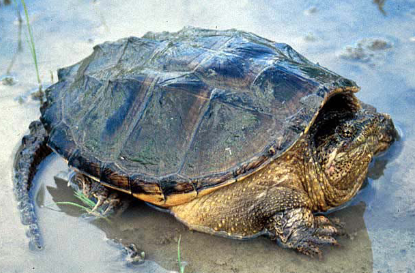
Common Snapping Turtle (Chelydra serpentina)
Largest Wisconsin Turtle
Lives in All Aquatic Habitats
Bottom Forager
Commercially Harvested
Common Statewide but Declining Populations
Primarily Midwest & Eastern U.S. Distribution, Some of Central America
Reduced Plastron
Aggressive Behavior, Especially on Land
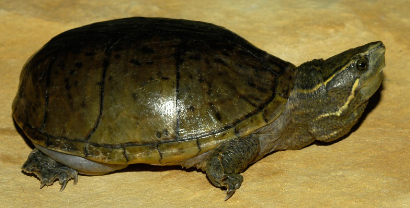
Common/Eastern Musk Turtle or Stinkpot (Sternotherus odoratus)
Smallest Wisconsin Turtle
Emits Foul-Smelling Musk
Bottom-Dweller
Lives in Slow Current & Soft Bottom Habitats
Southeast U.S. Distribution, Southern Third of Wisconsin
Reduced Plastron
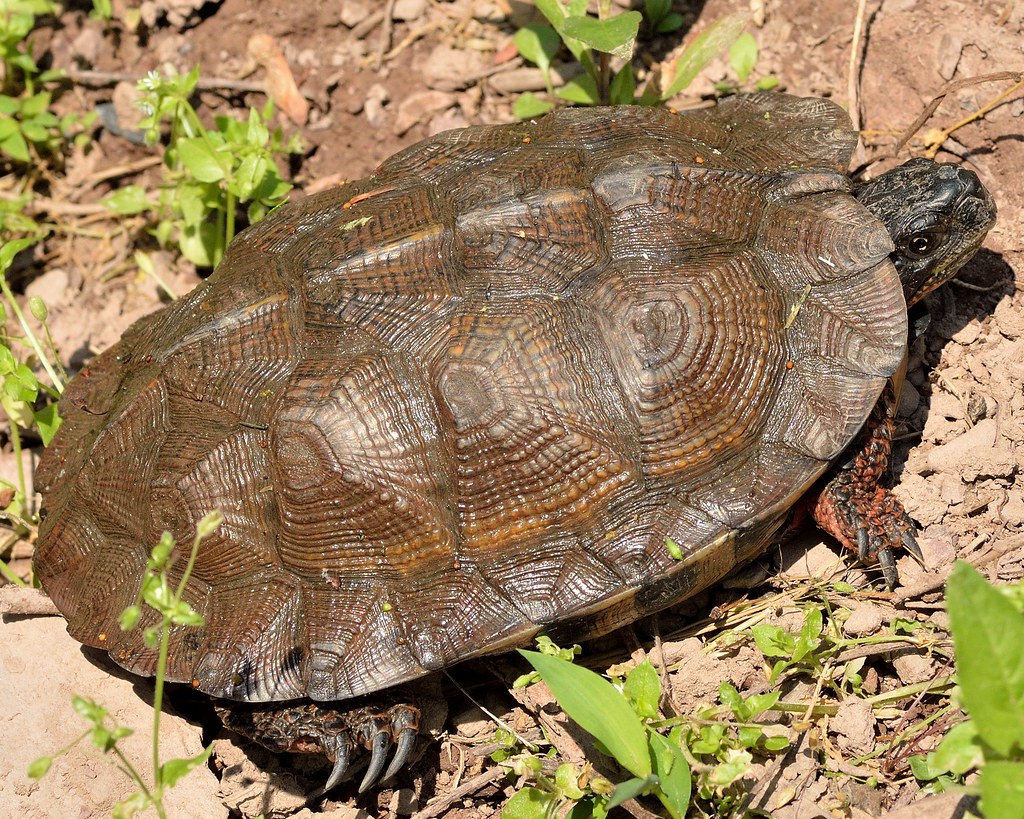
Wood Turtle (Glyptemys insculpta)
Growth Rings on Shell
Semi-Terrestrial
Lives in Forested Areas along Rivers
Norther Two Thirds of Wisconsin
Small Range, Northeast U.S. & Northwest of Great Lakes Region
Threatened Status in Wisconsin
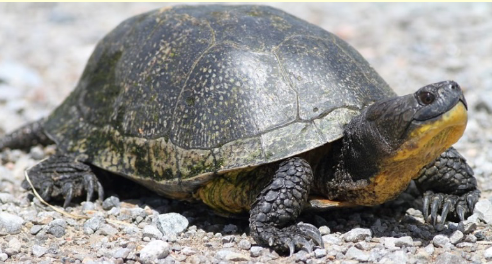
Blanding’s Turtle (Emydoidea blandingii)
Yellow Chin & Hinged Plastron
Semi-Terrestrial
Live in Shallow Wetlands with Submerged Vegetation
All but Northernmost Wisconsin, Primarily Great Lakes Region Distribution
Special Concern Status in Wisconsin
Formerly Threatened
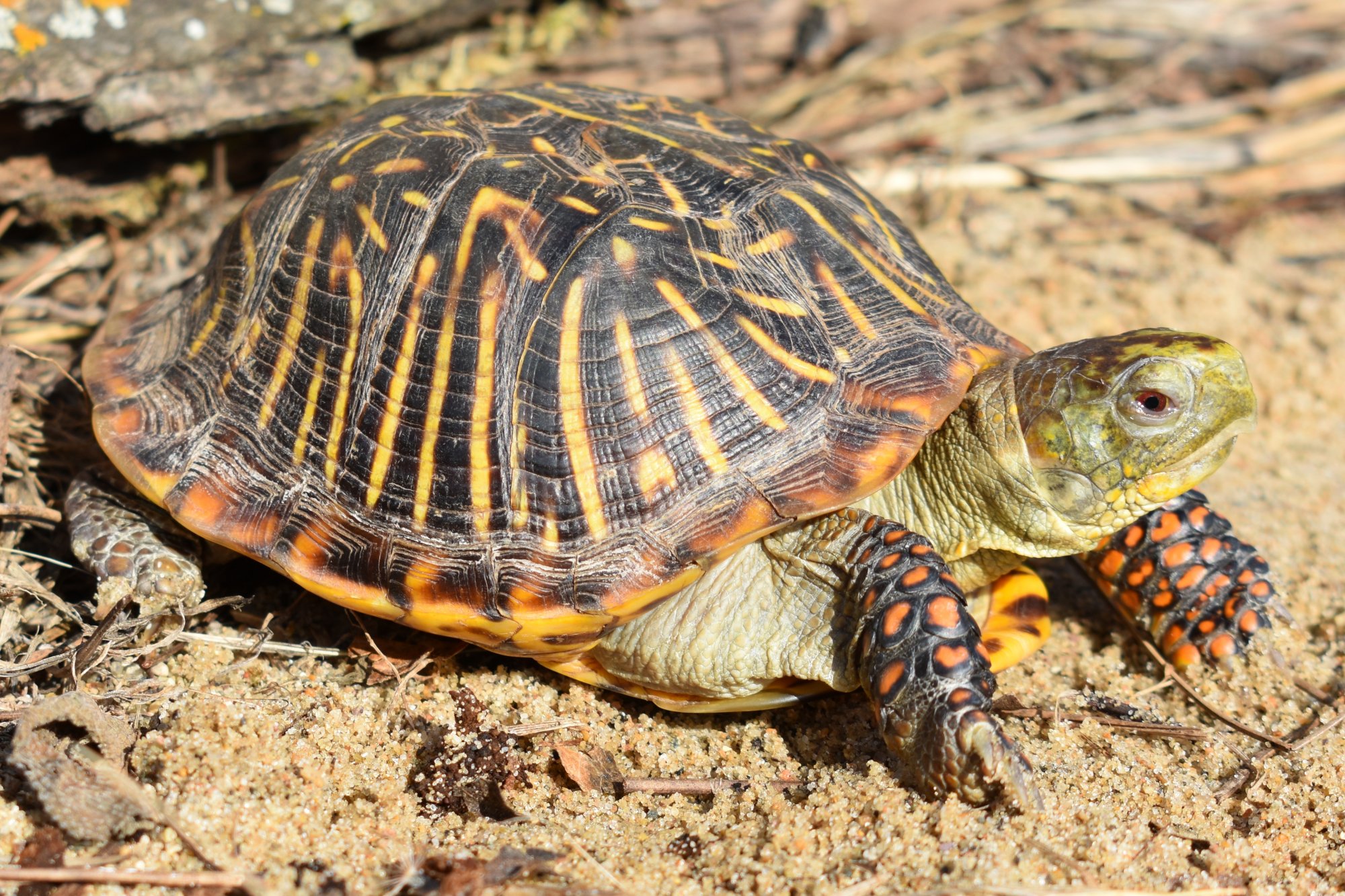
Ornate Box Turtle (Terrapene ornata)
Small with Hinged Plastron
Strictly Terrestrial
Lives in Dry Prairies & Oak Savannas
Shelters & Hibernates in Burrows
Only in Lower Wisconsin Floodplain in Driftless Area
Primarily Midsouth U.S. Distribution
Endangered in Wisconsin
Most Threatened Turtle Species in Wisconsin
Abundant Elsewhere
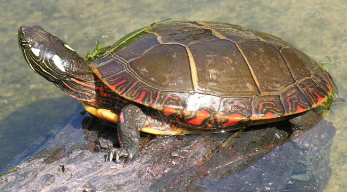
Painted Turtle (Chrysemys picta)
C. p. belli = Western Subspecies Statewide
C. p. marginata = Midland Subspecies in Southeast
Aquatic
Live in Shallow Water with Slow Current
Abundant Throughout Wisconsin
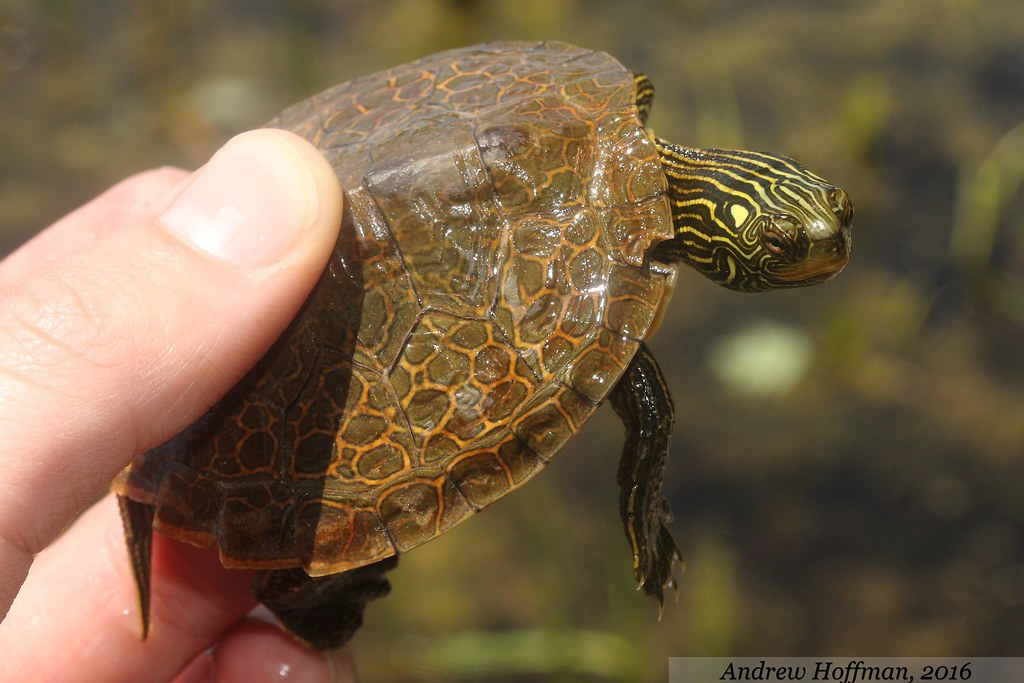
Common/Northern Map Turtle (Graptemys geographica)
Patterning on Carapace Resembles Map
Low Keeled Carapace
Highly Aquatic
Live in Large Rivers
Distributed in Southwest Two Thirds of Wisconsin
Ouachita/Southern Map Turtle (Graptemys ouachitensis)
Strongly Keeled Carapace
Yellow Spot on Chin
Highly Aquatic
Lives in Large Rivers like Mississippi & Lower Wisconsin
False Map Turtle (Graptemys pseudogeographica)
Strongly Keeled Carapace
No Chin Spot
Highly Aquatic
Lives in Large Rivers
Special Concern Status in Wisconsin
Smooth Softshell Turtle (Apalone mutica)
Flat & Scuteless Carapace with Smooth Front Edge
Aquatic
Lives in Large Rivers like Mississippi & Lower Wisconsin
Special Concern Status in Wisconsin
Spiny Softshell Turtle (Apalone spinifera)
Flat & Scuteless Carapace with Spines on Front Edge
Aquatic
Lives in Rivers, Lakes, & Ponds
Common in Most of Wisconsin & Midwest
Order Crocodylia - Crocodilians
27 Species in 3 Families
Largest Living Reptiles
Semi-Aquatic with Pantropical Distribution
Exclusively Carnivores
4-Chambered Heart
Ambush Predators
Provide Parental Care
Crocodilian Hunting Strategy
Ambush Predators
Rely on Concealment
Opportunistic
Often Drown Prey
Typically Swallow Prey Whole
Crocodilian Parental Care
Nest Attendance & Defense
Excavation of Hatchlings
Transport Young in Mouth
Care for Young
American Alligator
1 of 2 American Members of Crocodylia
Live in Southeast Coast of U.S.
American Crocodile
1 of 2 American Members of Crocodylia
Live in Southern Most Florida, Central America, & Northern South America
Crocodilian Families
Alligators & Caimans
Crocodiles
Gharial
Alligators & Caimans
Family in Order Crocodylia
Broad & Blunt Snouts
Teeth Lie Inside Closed Mouth
Crocodiles
Family in Order Crocodylia
Narrow Snouts
Lower Teeth Visible in Closed Mouth
Salt-Excreting Glands
More Aquatic Lifestyle
Gharial
Family in Order Crocodylia
Only 1 Species
Elongated & Slender Snout
Lives in Indian Subcontinent
Crocodilian Adaptations for Aquatic Life
Raised Nostrils & Eyes
Palatal Flap: Prevents water from entering throat when mouth is open.
Partially Webbed Hind Feet
Long & Muscular Tail for Swimming
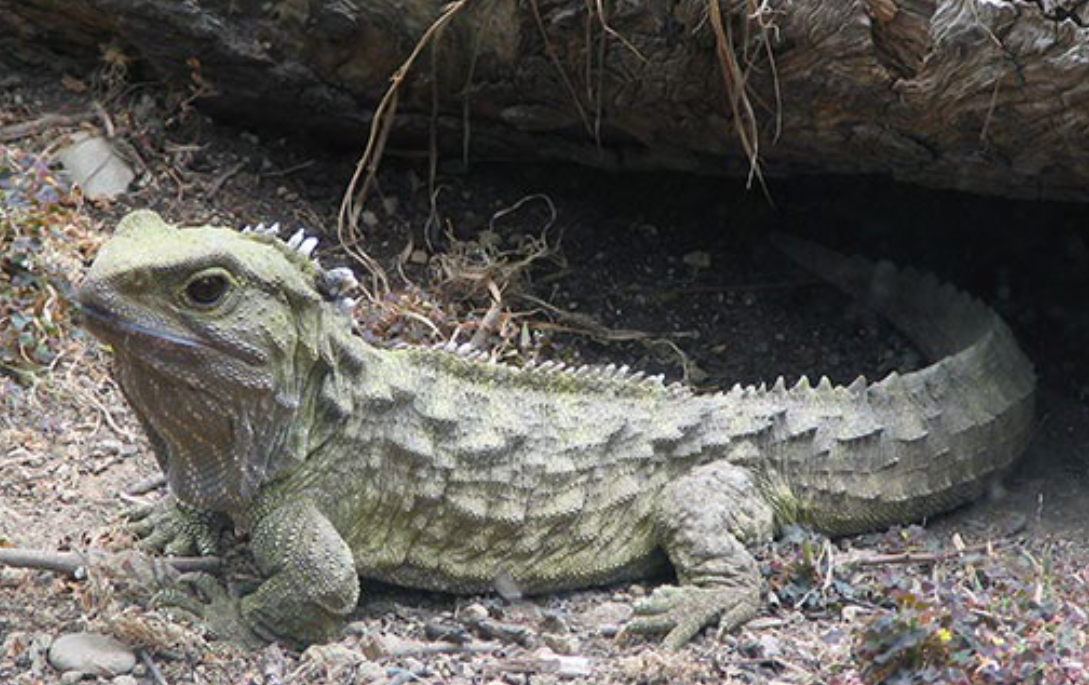
Order Rhynchocephalia - Tuataras
Once diverse group, now only one species.
Limited to Small Islands Off New Zealand
Living Fossils: Diverged much earlier than other reptiles & haven’t changed much.
Dorsal Spines on Neck & Head
2 Rows of Teeth in Upper Jaw
Live in Burrows
Nocturnal
Tolerant of Cool Temperatures
Long Living & Slow Reproduction (k-Selected)
Eat Invertebrates, Vertebrates, & Eggs
Parietal Eye: Sensory Patch on Head
Order Squamata
Order of Lizards, Snakes, & Amphisbaenians
Largest Order of Reptiles
Hemipenes in Males
3 Suborders: Lacertilia, Serpentes, & Amphisbaenia
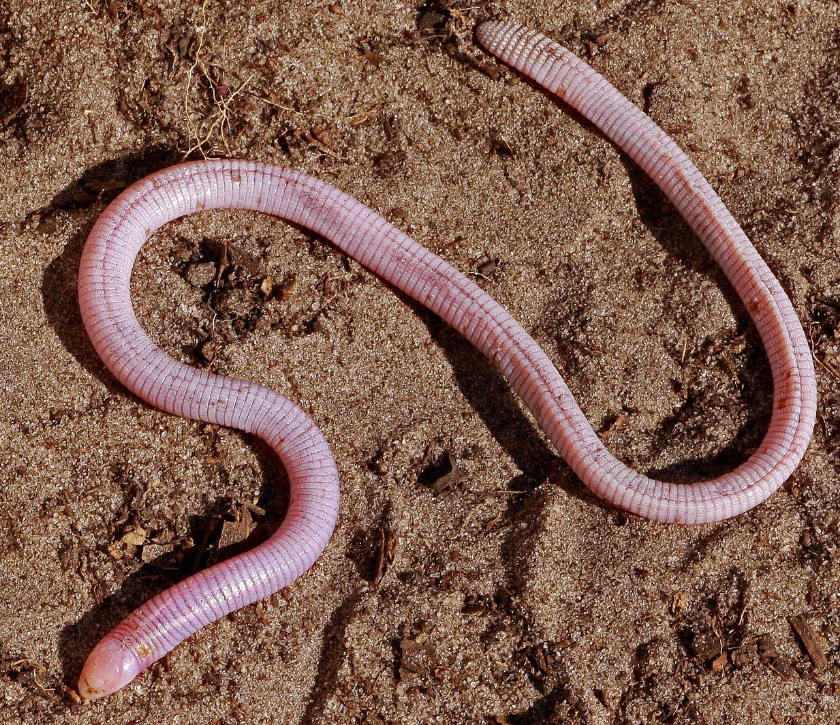
Suborder Amphisbaenia - Amphisbaenians or Worm Lizards
203 Species in 6 Families
1 U.S. Species in Florida
Only Completely Fossorial Group of Reptiles
Legless or Forelimbs Only
Scales Arranged in Rings
Reduced Eyes & No External Ears
Eat Arthropods, Worms, & Small Vertebrates
Push Skull through Soil to Burrow
Require Loose Substrate
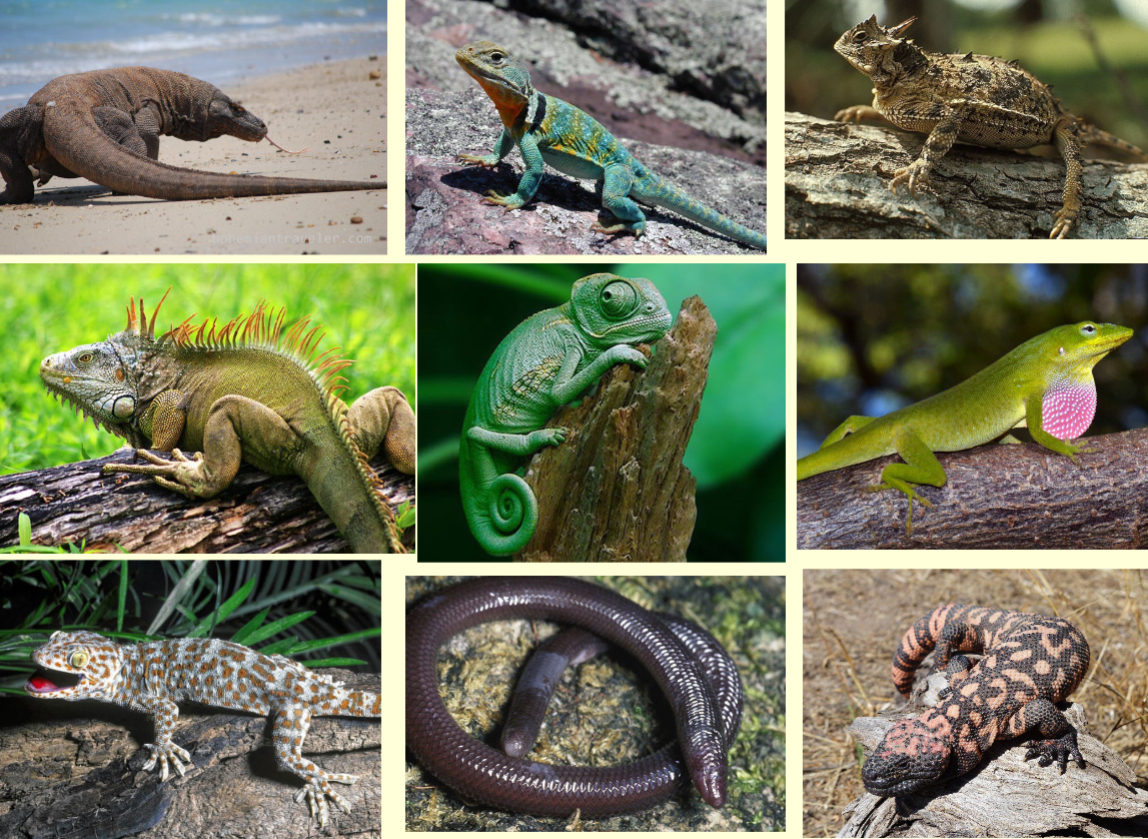
Suborder Lacertilia - Lizards
7739 Species in 37 Families
Generalized Tetrapod Body Form in Most Species
Smooth & Dry Skin
Claws on End of Toes
Movable Eyelids
External Ear Openings
Halves of Lower Jaw Joined in Front
Primarily Carnivorous
Many Lifestyles: Terrestrial, Fossorial, Arboreal, Semi-Aquatic, Marine, Human Commensal
Global Distribution except for Northern Poles & Canada
Diets & Foraging in Lizards
Most (~98%) Species Carnivorous
Mostly Insects & Other Invertebrates in Smaller Species
Often Vertebrate Prey in Larger Species
Foraging Techniques: Active Foraging or Sit-&-Wait
Reproduction in Lizards
Paired Hemipenes in Males
Internal Fertilization
Less Frequent Ovoviviparity
Little or No Parental Care
Annual Breeding in Temperate Species, Continuous in Tropics
Parthenogenesis in Some Species
Communication in Lizards
Communicate Territory, Dominance, Courtship, Etc.
Flash Brightly Colored Dewlap of Belly Skin
Push-Ups, Tail Flicking, & Head Bobbing
Vocalizations in Geckos
Pheromones
Adaptations of Lizards for Arid Environments
Use Basking, Burrowing, & Postural Adjustments to Thermoregulate
Low Demands for Energy & Nutrients
Able to Withstand Large Fluctuations in Electrolyte Balance
Uric Acid Excretion Conserves Water
Defense Strategies of Lizards
Tail Autotomy: Most species have the ability to shed their tail as a defense against predation.
Energetic Cost for Regeneration
Change Color to Match Environment
Intimidating/Startling Predator
Gaping & Hissing
Squirting Blood
Playing Dead
Venom
Wisconsin Lizards
4 Species in 3 Families
All Oviparous
Carnivorous: Eat Mostly Arthropods
Live in Dry, Open, Sandy Habitats
Patchy Distribution & Rarely Seen
Active from Late April/Early May to Early September
Hibernate Underground during Winter
Anguidae
Family of Glass & Alligator Lizards
1 Wisconsin Species
Slender Glass Lizard
Teiidae
Family of Whiptails & Racerunners
1 Wisconsin Species
Six-Lined Racerunner
Scincidae
Family of Skinks
2 Species
Five-Lined Skink
Prairie Skink
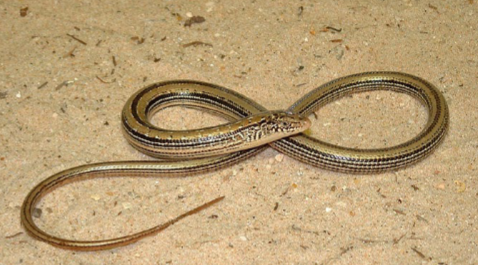
Slender Glass Lizard (Ophisaurus attenuatus)
Legless with Relatively Rigid Body
External Ears & Eyelids
Lateral Grooves
Provide Parental Care
Lives in Oak Savannas & Sand Prairies
Isolated Population in Central Wisconsin
Primarily Distributed in Southeast
Endangered Status in Wisconsin
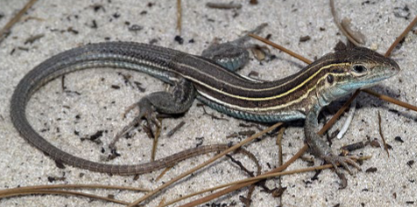
Six-Lined/Prairie Racerunner (Aspidoscelis sexlineatus)
Long & Thin Tail
Rough Scales
Active & Fast
Lives in Dry Prairies
Wisconsin Distribution through Mississippi & Lower Wisconsin Floodplains
U.S. Distribution through Central South to Southeast U.S.
Special Concern Status in Wisconsin
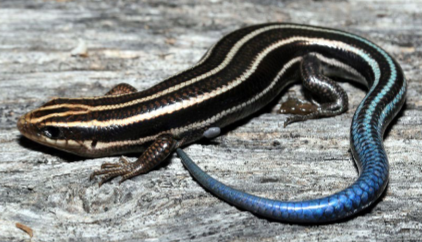
Five-Lined Skink (Plestiodon fasciatus)
Shiny & Smooth Scales with Vertical Stripes
Primarily Black with Orange Stripes
“Y” Pattern on Head
Bright Blue Tail in Young Individuals
Live in Oak & Pine Barrens, Forest Edges, & Openings
Distributed through Central Wisconsin & Much of Southeastern U.S.
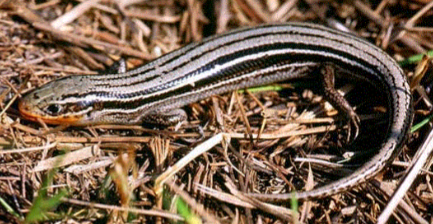
Prairie Skink (Plestiodon septentrionalis)
Shiny & Smooth Scales with Vertical Tan Stripes
Brown & Black Pattern
Orange Chin in Males
Live in Pine Barrens & Bracken Grasslands
Distributed through Northwestern Wisconsin & Central Line of U.S.
Special Concern Status in Wisconsin
Suborder Serpentes - Snakes
4038 Species in 30 Families
Limbless but Some have Slight Girdles
No External Ears or Eyelids
Elongate Body with Extra Vertebrae
Exclusively Carnivorous
Global Distribution except for Northern Most Regions
Skeletons of Snakes
200 to 400 Vertebrae each with Attached Pair of Ribs on Body & Neck
Loosely Articulated to Allow Bending & Coiling
Pectoral Girdle Absent & Pelvic Girdle Absent or Vestigial
Flexible Skulls to Take Large Prey
Halves of Lower Jaw Unconnected at Front
Snake Senses
Poor Eyesight in Most Species
No External Ear Openings
Inner Ear can sense Sound Waves & Vibrations
Primarily Rely on Smell
Aided by Vomeronasal Organ in Palate
Flicking Tongue
Pit Organs
Pit Organs
Sensory Organ
Used by Boas, Pythons, & Pit Vipers
Detect Warm-Blooded Prey
Locomotion in Snakes
Scales allow sliding in only one direction.
Mix of Friction & Weight Distribution
Types: Serpentine, Rectilinear, Concertina, & Sidewinding
Serpentine Locomotion
Movement by Pushing Off of Sides
Rectilinear Locomotion
Movement in a Straight Line
Concertina Locomotion
Movement through Contracting & Expanding like an Accordion
Sidewinding Locomotion
Movement through Parallel Sliding that Requires Loose Substrate
Feeding in Snakes
Exclusively Carnivorous
All Swallow Prey Whole
Able to Catch & Eat Large Prey
Two Halves of Lower & Bones of Upper Jaw can Move Independently
Eat prey headfirst, then “walk” it into esophagus.
May Subdue Prey with Constriction or Venom
Snake Venom
Produced & Stored in Glands on Sides of Head
Causes Broad & Triangular Head
Used to Immobilize & Digest Prey or For Defense
Can Begin to Break Down Tissue
Injected through Hallow Fangs
Constriction
Used Mostly by Non-Venomous Snakes to Kill or Subdue Prey
Snake wraps loops of body around prey, then squeezes intermittently.
Cuts-Off Circulation & Causes Cardiac Arrest in Prey
Does Not Typically Kill through Suffocation
Defense Strategies of Snakes
Cryptic Coloration to Camouflage
Aposematism to Show Venomous
Batesian Mimicry to Trick
Foul-Smelling Musk
Hissing, Rattling, Rearing Up, & Striking
Playing Dead