Chemistry - C1: Structure of the Atom
 Call Kai
 Learn
Learn Practice Test
 Spaced Repetition
 Match
Match Flashcards
 Knowt Play
1/33

Earn XP
Description and Tags
Name | Mastery | Learn | Test | Matching | Spaced | Call with Kai |
|---|
No analytics yet
Send a link to your students to track their progress
34 Terms
What is the charge of a proton?
+1
What is the charge of a neutron?
0
What is the charge of an electron?
-1
What is the mass of a proton?
1
What is the mass of a nuetron?
1
What is the mass of an electron?
1/2000
Where is the proton located?
nucleus
Where is the neutron located?
nucleus
Where is the electron located?
shell
What does the relative atomic mass tell you?
amount of neutrons + protons
What is the name of the bigger number on an element?
Atomic Mass
What is the name of the smaller number on an element?
Atomic number
Atomic Mass purpose
Proton (or electron) number
Simple DIstillation Method
-The salt solution is placed into a flask and heated until it boils.
-The water turns into a gas but the salt stays behind in the flask.
-The steam passes into the condenser. This cools the steam, which turns it back into a liquid.
\-If other liquids evaporate by chance, they condense in the fractionating column back into the flask.
\-The temperature is altered to repeat the process for the second liquid.
\-The three liquids are separated based on differing boiling points with the third remaining in the flask.
\-Heat liquid which has the lowest boiling point to its boiling point
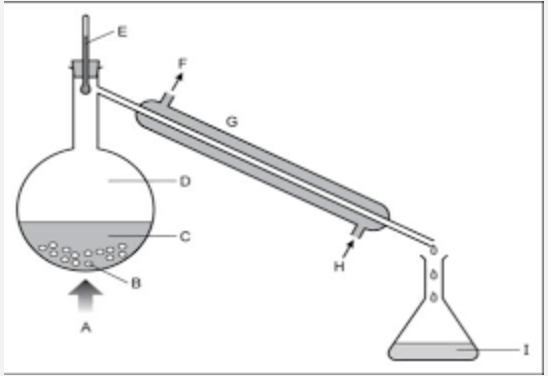
C-Solution
D-Flask
E-Thermometer
F-Water out
G-condenser
H-Water in
I-Beaker
What is an element?
Single type of atom
What is a compound?
2 or more elements chemically bonded
What is a mixture?
2 or more elements not chemically bonded
What is an isotope?
Different forms of the same element that have the same number of protons but a different number of neutrons
What is an atom?
The smallest part of an element that can exist
What is a solvent?
The substance that a solute dissolves in
What is a solute?
The substance that dissolves in the solvent
What is a solution?
When a solute dissolves in a solvent
What is the law of conservation of mass?
No atoms are lost or made during a chemical reaction so the mass of the products must equal the mass of the reactants
What is the method for paper chromatography?
-Draw out line with pencil on chromatography paper
-Put a dot in pen with first color on pencil line
-Then do a dot of the second color
-Place bottom of paper into a solvent
-This moves up the paper and dissolved the ink in the dots and those are then also carried up the paper
-If more than one color, the inks will seperate
What is the plum pudding model?
-Negative electrons embedded
-Spherical cloud of positive charge
-Neutral overall
What is the stationary phase in chromatography?
The paper because it doesn’t move
What are reactants?
A substance that takes part in and undergoes change in a reaction
What are products?
Species formed in chemical reactions
What did the alpha scattering particle show?
-Alpha particles mostly went through so atom must be mostly empty space
-Some got deflected so centre of atom must have positive charge that repelled the alpha particles
-Some bounced straight back so the mass of the atom must be concentrated in the centre
What is an ion?
Charged atom
How are ions formed?
An element losing/gaining an electron