Blood flow regulation
 Call Kai
 Learn
Learn Practice Test
 Spaced Repetition
 Match
Match Flashcards
 Knowt Play
1/40

There's no tags or description
Looks like no tags are added yet.
Name | Mastery | Learn | Test | Matching | Spaced | Call with Kai | Chat |
|---|
No analytics yet
Send a link to your students to track their progress
41 Terms
What determines blood flow?
Relationship between pressure differences and resistance
What three factors influence resistance?
Blood viscosity, vessel length, vessel radius
What equation reflects the relationship determining blood flow?
Flow = pressure / resistance
What creates the resistance that impedes blood flow?
Friction between blood and internal vascular wall
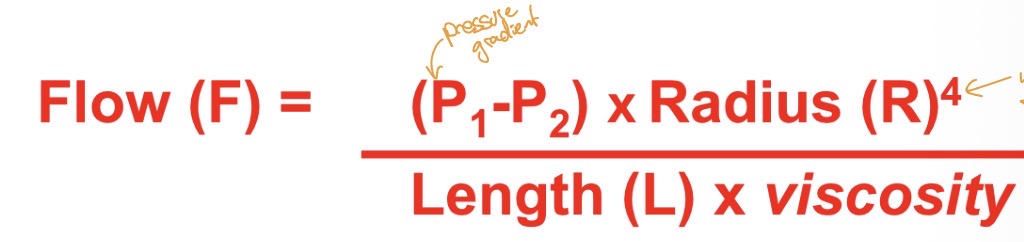
Which law is this?
Poiseuille’s law
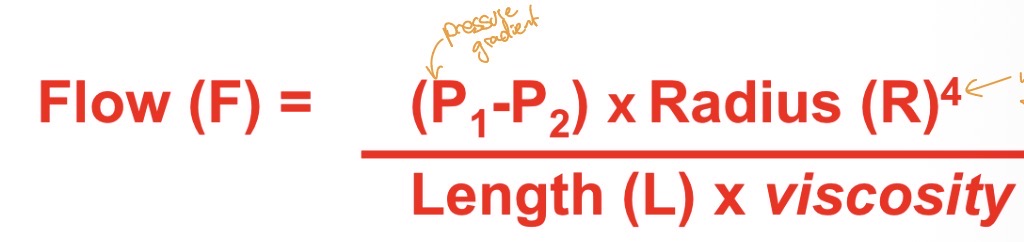
In poiseuille’s law which factor is most significant?
Radius
Why is it that radius is the most significant factor in blood flow?
Even small changes in radius greatly affect flow. This is because radius is the only factor the body can change rapidly during physical efforts.
During exercise what occurs to meet increased oxygen demands in muscles?
Arteriole diameter adjusts through neural and local metabolic control
Which arterioles dilate and which vessels constrict?
Local arterioles of active muscles dilate, vessels to nonactive tissues constrict
What two factors contribute to reduced blood flow to nonactive tissues?
Increased sympathetic nervous system outflow (central and peripheral mechanisms)
Local chemicals that simulate vasoconstriction or enhance effects of other vasoconstrictors
Skeletal muscle blood flow closely couples with what demand whether at rest or maximal exercise?
Metabolic
How many muscle capillaries are open at rest?
1 in 30-40
What does opening dormant capillaries during physical active achievement? (3)
Increase total muscle blood flow
Deliver large blood volume with minimal increases in velocity
Increase effective surface for gas and nutrient exchange between blood and muscle fibers
What initiates cardiovascular changes before and during movement? Where is it located?
Neural command centre above medullary region
Modulation of dilation/constriction optimises what?
Blood flow to needed area while maintaining BP
HR and myocardial contractility increase from feed-forward input from cardiovascular centre which depresses what?
Parasympathetic activation
Define cardiac output?
Volume of blood the heart pumps per minute
What formula determines cardiac output?
Cardiac output = heart rate x stroke volume
Maximal values of cardiac output reflect what?
Functional capacity of the cardiovascular system
What is stroke volume?
Amount of blood ejected per beat
For an average individual, at rest, cardiac output is approximately?
5L/min = 70bpm x 71 mL/beat
What principle links cardiac output to oxygen consumption?
The Fick principle
What difference does the Fick show?
Oxygen content between arterial and venous blood
The Fick equation provides a method to estimate what?
Cardiac output
It is conceptually simple but it requires invasive procedures such as?
Obtaining mixed venous blood near the heart
Cardiac output can vary at rest what are the influencing factors?
Emotional conditions that alter cortical outflow to cardio-accelerator nerves
Nerves that modulate arterial resistance vessels
What is the average cardiac output for males?
(Avg. HR = 70b/min, average SV = 71 mL/beat)
5 L/min
What is the average cardiac output for females?
(Avg. HR = 70b/min, average SV = 50-60 mL/beat)
4 L/min
Why is SV and cardiac output for women 25% below male values?
Generally due to smaller body size and smaller heart size
What does the Frank-Starling law?
Explains how the heart increases its stroke volume in response to an increase in end-diastolic volume
How does the Frank-Starling mechanism help the heart maintain stroke volume when venous return increases?
When more blood fills the heart, myocardial fibres stretch, which optimises actin-myosin cross-bridge formation. This allows the heart muscle to contract more forcefully, increasing stroke volume and maintaining efficient blood circulation.
What initiates a more powerful ejection stroke during systole?
An increase in end-diastolic volume stretches myocardial fibers
What does the Ejection fraction measure?
The percentage of blood pumped from the left ventricle relative to end-diastolic volume
What is a typical ejection fraction?
50-70%
At rest what is the distribution of 5 litre cardiac output?
Liver >1/4, kidneys and muscles ~ 1/5 each, the rest goes to heart, skin, brain and other tissues
At rest how much oxygen does the myocardium extract?
75%
How much can cerebral blood flow increase by during physical activity?
30%
At rest, the body has a substantial oxygen reserve as only how many mL of oxygen /min is used from the 1,000 mL?
250
What does the reserve of oxygen ensure?
The body can meet sudden increases in oxygen demand during physical exertion?
What difference illustrates the oxygen reserve?
Arterial-venous oxygen difference (a-v O2 difference)
At rest, how many mL of oxygen is extracted per 100mL? Leaving how much in reserve?
5ml, reserve of 15ml