Comparative Anatomy Ch. 1 Lecture 1
 Call Kai
 Learn
Learn Practice Test
 Spaced Repetition
 Match
Match Flashcards
 Knowt Play
1/33

There's no tags or description
Looks like no tags are added yet.
Name | Mastery | Learn | Test | Matching | Spaced | Call with Kai | Chat |
|---|
No analytics yet
Send a link to your students to track their progress
34 Terms
Comparative Morphology
A branch of biology focusing on the functional significance of anatomical variations among (intra) and between (inter) individuals or species
What does intra in comparative morphology mean?
Difference between same species
What does inter in comparative methodology mean?
Difference between different classes of animals
Comparative Approach
A tool that provides a structural framework for comparison
What are comparisons based on?
Functional and evolutionary significance
What does functional significance (functional morphology) look at?
Looks at how biological animal parts works today in the current environment
What does evolutionary significance (evolutionary morphology) look at?
Looks at the historical lineage of species
Guides analyses and hypotheses development regarding animal design
Comparative Approach
-cercal
Kerkos tail
Diphy-
Double
Hetero-
Another
Homo-
Same
Proto-
Initial/first
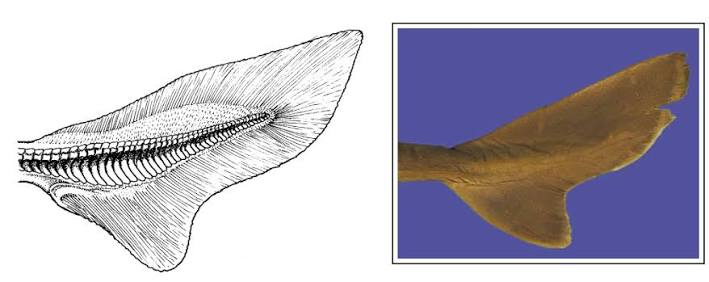
Heterocercal

Protocercal

Diphycercal
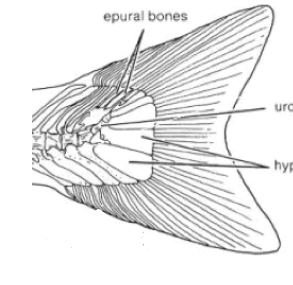
Homocercal
Vertebrate Morphology
Seeks to explain the processes that lead to structural and functional differences
Evolution
Inherited changes in a population of organisms over time leading to the appearance of new forms
Speciation
The process by which new species or populations of living things develop from preexisting species
These concepts of evolution were presented long before_______but explanations of evolutionary mechanisms were not understood
Darwin (3000 years ago)
Linnaean System
Carol Linnaeus developed a system of nomenclature of plants and animals that is still used today
Who is a predominant Swedish medical doctor who gave up the practice to study plants and animals?
Carol Linnaeus
What did Carol Linnaeus philosophically argue (1707-1778)?
Argued that species were unchangeable and their characteristics were divinely created
Evolution by inheritance of Acquired Characteristics
Species change throughout their lifetime
What are the 3 basic beliefs of Acquired Characteristics
Lowly species evolved spontaneously, evolution proceeds towards perfection (human), change is driven by the needs experienced during a single lifetime
The philosophy of evolution by inheritance of acquired characteristics
Jean-Baptiste de Lamarck (1744-1829)
Charles Darwin (1809-1882)
Created the theory of Finches on the Galapagos Island. Spent 5 years as the ship (H.M.S. Beagle) naturalist collecting and documenting characteristics of animals (Evolution by natural selection)
Also a naturalist (like Darwin) but not financially privileged. Collected and sold biologically specimens, primarily from the Amazon and Malaysia. Developed a theory of evolution by natural selection independent of Darwin (waited 20+ years to publish). Lost much of his work in a ship fire in 1852 and did not have the resources to procrastinate.
Alfred Wallace (1823-1913)
Son of a swiss minister. Founded the Museum of Comparative Zoology at Harvard 1860 and the American Academy of Sciences & the Smithsonian Institute. Did not believe in evolution. First to suggest the occurrence of “Ice Ages”
Louis Agassiz (1807-1873)
Three-Fold-Parallelism
Believed that variations in living organism reflected differences in the development stages
Stephen J. Gould (1941-2002)
Evolutionary Biologist, Paleontologist, and Science Historian
Phyletic gradualism
Bad genes are eliminated gradually over time
Punctuated equilibrium
Catastrophic events occur eliminating some genes and population evolve to fill that niche (bad genes vs bad luck)