GDA FINAL
 Call Kai
 Learn
Learn Practice Test
 Spaced Repetition
 Match
Match Flashcards
 Knowt Play
1/551

There's no tags or description
Looks like no tags are added yet.
Name | Mastery | Learn | Test | Matching | Spaced | Call with Kai | Chat |
|---|
No analytics yet
Send a link to your students to track their progress
552 Terms
Which of the following statements is NOT TRUE about the development of the sinuses?
A. Maxillary sinuses expand both vertically and laterally
B. Sinuses occupy the space where the permanent teeth were before eruption
C. Sinuses are fully developed by puberty but can continue to expand
D. Sinuses are always symmetrical unless there is pathology
D. Sinuses are always symmetrical unless there is pathology
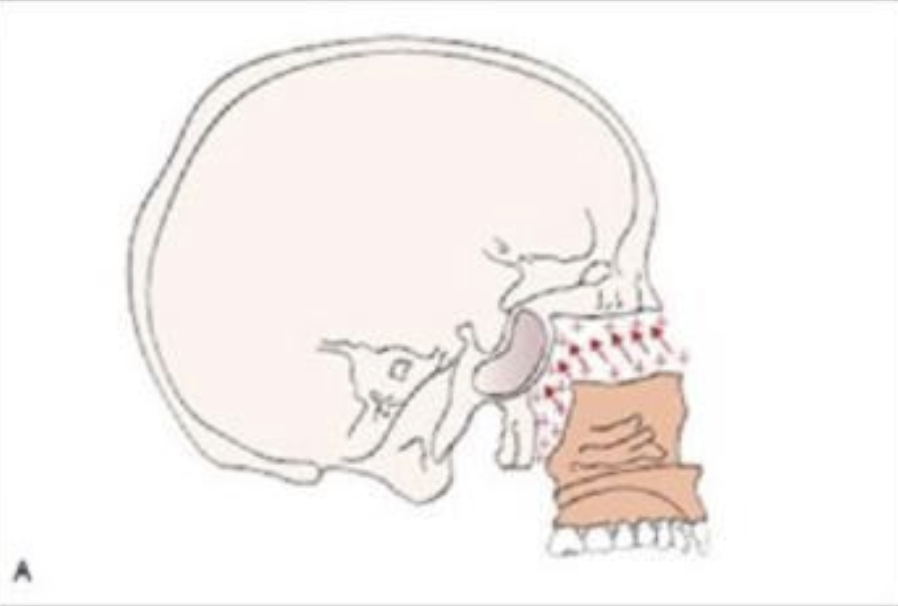
What kind of growth is shown in this figure?
A. Appositional growth
B. Sutural growth
C. Endochondral growth
D. Intramembranous growth
B. Sutural growth
Which of the following is NOT a psychosocial factor that impacts oral health in adolescents?
A. Changes in dietary habits
B. Possible use of tobacco, alcohol and/or drugs
C. Potential for traumatic injury
D. Parents overseeing hygiene and home care
D. Parents overseeing hygiene and home care
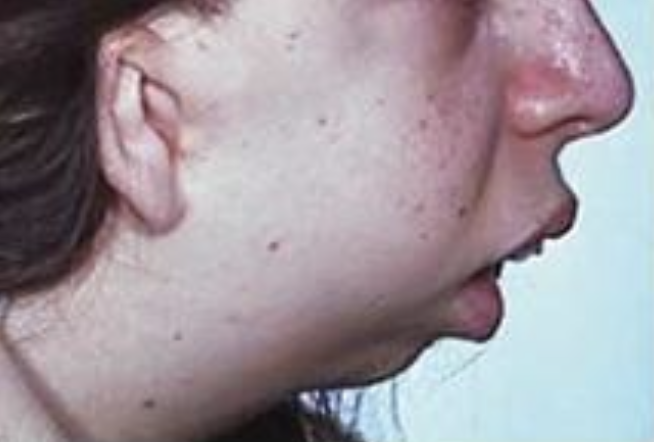
What kind of skeletal deformity is shown in this figure?
A. Mandibular Prognathism
B. Maxillary Prognathism
C. Bilateral Retrognathism
D. Mandibular Retrognathism
D. Mandibular Retrognathism
Which of the following is NOT true of dental management in adolescents?
A. Topical fluoride can be applied until age 16
B. Patients do not need to be educated about dental hygiene and proper home care
C. Sealants should be placed on high risk patients even in adolescence
D. Chose restorations that are most conservative and esthetic
B. Patients do not need to be educated about dental hygiene and proper home care
The root of the teeth except for third molars are usually formed by what age?
A. 9 years old
B. 12 years old
C. 16 years old
D. 30 years old
C. 16 years old
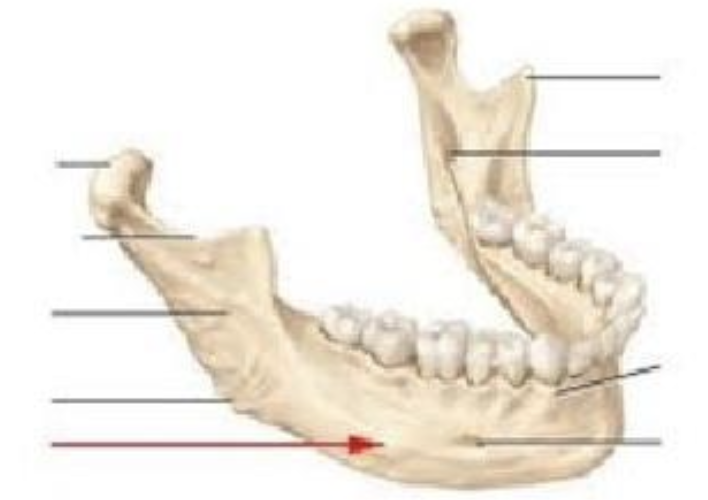
What part of the mandible is shown by the red arrow in the picture?
A. Condyle
B. Coronoid process
C. Body
D. Mental nerve
E. Symphysis
C. Body
By the end of adolescence body fat accounts for what percentage in boys?
A. 10%
B. 16%
C. 30%
D. 50%
B. 16%
Which part of the face does NOT become more prominent during adolescent?
A. Nose
B. Chin
C. Lips
D. Brow
C. Lips
What is the number of chromosomes in a haploid cell (n)?
A. 23
B. 46
C. 2
D. 1/2
E. 48
A. 23
Which of the following germ layers forms the Central Nervous System (CNS)?
A. Endoderm
B. Mesoderm
C. Ectoderm
D. None of the above
C. Ectoderm
Which aortic arch has the adult derivative of the common carotid artery? A. 1
B. 3
C. 4
D. 6
B. 3
Match the correct cranial nerve, name and function.
A. III; Optic Nerve; Sense of sight
B. VIII: Vestibulocochlear nerve; Hearing and equilibrium
C. X; Vagus; Trapezius Movement
D. XII; Glossopharyngeal; Swallowing
B. VIII: Vestibulocochlear nerve; Hearing and equilibrium
Which cranial nerve is responsible for mastication?
A. IV Trochlear
B. V Trigeminal
C. VII Facial
D. X Vagus
B. V Trigeminal
What defines the Veau Classification of palatal clefts Group VI?
A. Defects of soft palate only
B. Defects of hard and soft palate
C. Defects involving the soft palate to the alveolus, usually involving the lip
D. Complete bilateral clefts
D. Complete bilateral clefts
Which of the following is not another name for the primary dentition?
A. Milk teeth
B. Deciduous teeth
C. Succedaneous teeth
D. Baby teeth
C. Succedaneous teeth
Which of the following is NOT true of the bud stage in tooth development?
A. At 10 weeks permanent tooth buds begin to form lingual to the primary tooth buds
B. Crown morphology is not determined until the tooth begins to erupt
C. Buds for permanent second and third molars begin to form after birth
D. Permanent second and third molars are called accesional teeth
B. Crown morphology is not determined until the tooth begins to erupt
Which of the following is a true statment about the eruption patterns of the teeth?
A. Eruption of primary teeth usually begins at 3 months after birth
B. All primary teeth are usually present by the end of the second year
C. Teeth erupt only once the root is completely formed
D. The first teeth to erupt are usually the maxillary lateral incisors
B. All primary teeth are usually present by the end of the second year
When do the permanent canines erupt?
A. 10-12 years old
B. 6-7 years old
C. 8-9 years old
D. 11-12 years old
A. 10-12 years old
At what age are the primary second molars shed?
A. 6-7 years
B. 7-8 years
C. 9-11 years
D. 10-12 years
D. 10-12 years
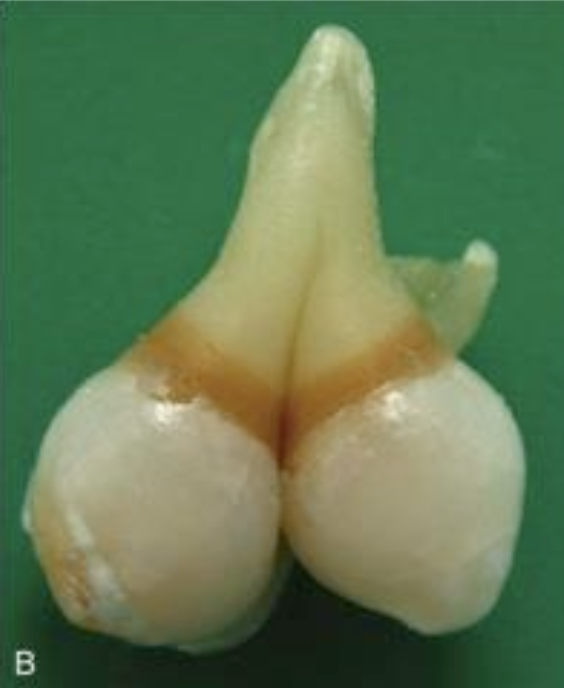
Which of the following tooth abnormalities is shown in the figure?
A. Gemination
B. Fusion
C. Dens Invaginatus
D. Taurodont tooth
A. Gemination
Which class of amelogenesis imperfecta is classified by defective, thin enamel with pits fissures or grooves?
A. Hypomaturation
B. Hypoplastic
C. Hypocalcified
D. None of the above
B. Hypoplastic
Which of the following is NOT true of the ugly duckling stage in tooth eruption?
A. Central incisors appear flared
B. Diastema forms between the maxillary central incisors
C. Occurs around 8-9 years of age
D. Corrected when the first premolars fully erupt
D. Corrected when the first premolars fully erupt
Which of the following is not a characteristic of Crouzon's syndrome?
A. Premature fusion of the skull bones
B. Wide set, bulging eyes
C. Beaked nose
D. Underdeveloped jaw
E. Autosomal recessive trait
E. Autosomal recessive trait
What vitamin deficiency causes scurvy?
A. Vitamin A
B. Vitamin B
C. Vitamin C
D. Vitamin D
C. Vitamin C
Which of the following treatment options for congenitally missing lateral incisors includes reducing the canine teeth to look more like a lateral incisor?
A. Implant placement
B. Fixed partial denture
C. Lateral extrusion
D. Canine substitution
D. Canine substitution
When is it not necessary to make an orthodontic referral?
A. Anterior or posterior crossbite
B. Crowding
C. Diastemas
D. Class I occlusion
D. Class I occlusion

Which of the following syndromes is shown in the radiograph?
A. Crouzon's Syndrome
B. Treacher Collins Syndrome
C. Downs Syndrome
D. Hyperparathyroidism- Jaw Syndrome
D. Hyperparathyroidism- Jaw Syndrome
What does the "A" in OSCAR stand for when evaluating and treatment planning for older patients?
A. Autonomy
B. Abnormality
C. Ability
D. Age
A. Autonomy
Which of the following is the biggest risk factor for squamous cell carcinoma?
A. Age
B. Heavy alcohol use
C. Gender
D. Poor oral hygiene
B. Heavy alcohol use
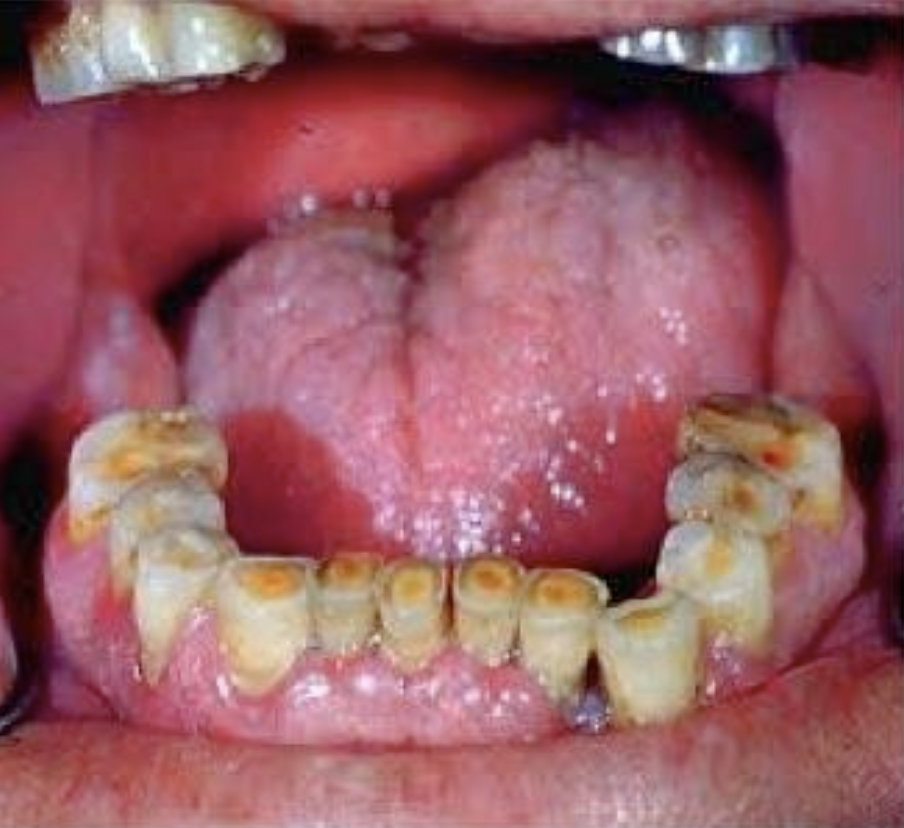
Which of the following is shown in the photo?
A. Attrition
B. Erosion
C. Abfraction
D. Abrasion Attachment
A. Attrition
Which of the following is NOT an appropriate treatment for attrition?
A. Occlusal guard wear
B. Full coverage crowns
C. Correction of abnormalities that cause occlusal trauma
D. Orthodontic treatment
D. Orthodontic treatment
Which of the following is not a cause of dental erosion?
A. Toothpick use
B. Acidic drinks
C. Acid reflux
D. Lemons
E. Bulimia
A. Toothpick use
Which of the following is NOT true regarding root caries in older adults?
A. Women are affected more than men
B. Older adults are more likely to have root caries because of increased recession
C. Glass ioomer is an excellent restorative treatment choice due to its fluroide release
D. Risk factors include cigarettes and smokeless tobacco
A. Women are effected more than men
Which of the following is not a change to the periodontal ligament?
A. Decreased and more irregular fibroblasts
B. Decreased organic matrix production
C. Decreased cell proliferation
D. Increased stability of teeth due to strengthened PDL
D. Increased stability of teeth due to strengthened PDL
Which of the following is NOT an appropriate treatment for dry mouth?
A. Sipping on water or sugarless drinks
B. Saliva substitutes
C. Chewing on sugar-free gum or eating sugar-free candy
D. Eating salty and spicy foods more frequently
D. Eating salty and spicy foods more frequently

Which complication of denture wear is shown in the photo?
A. Stomatitis
B. Candidiasis
C. Angular Chelitis
D. Ulcerations
C. Angular Chelitis
What is the maximum amount of epinephrine that should be administered when giving local anesthetic to older patients?
A. 0.04 mg epi
B. 0.017 mg epi
C. 0.034 mg epi
D. 0.004 mg
A. 0.04 mg epi
A patient presents to your office after falling and hitting their front tooth on the edge of the sink. The tooth is not mobile, there is no displacement and pulp test is positive. Tooth is painful to percussion but there is no bleeding or abnormalities on the radiograph. What is the appropriate term for the diagnosis?
A. Avulsion
B. Lateral luxation
C. Subluxation
D. Concussion
D. Concussion
Which of the following is NOT an appropriate treatment for an enamel fracture?
A. Bonding of broken fragment to the tooth
B. Smoothing of the inicisal edge
C. Composite restoration
D. Root canal treatment
D. Root canal treatment
How long should a displaced tooth be splinted?
A. 1 week
B. 2 weeks
C. 2 months
D. 3 weeks
B. 2 weeks
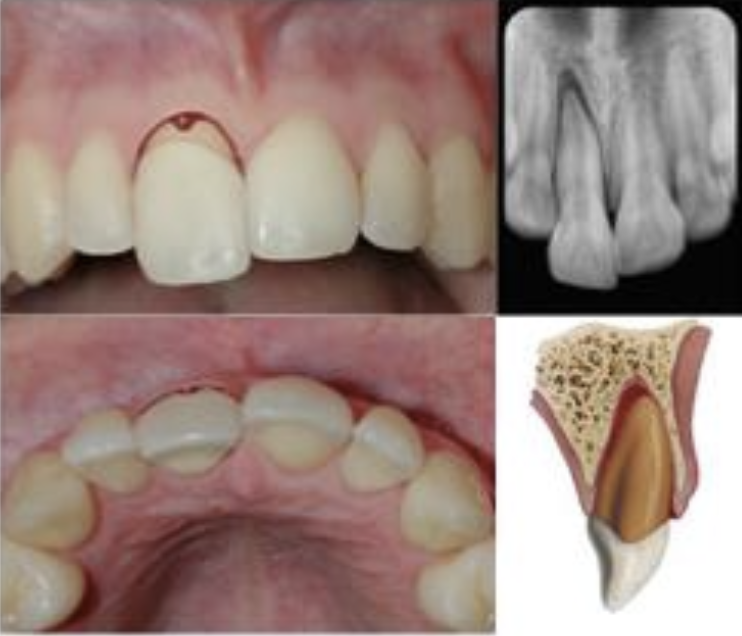
Which of the following injuries is shown in the figure?
A. Extrusion
B. Avulsion
C. Subluxation
D. Lateral luxation
A. Extrusion
Pulp testing is not needed for which of the following injuries?
A. Avulsion
B. Luxation
C. Concussion
D. Intrusion
A. Avulsion
In lateral luxation there is fracture of the labial or palatal/lingual alveolar bone.
A. True
B. False
A. True
Primary teeth should always be replanted if they are avulsed before they are ready for exfoliation.
A. True
B. False
B. False
Which of the following is NOT an appropriate storage medium for an avulsed tooth?
A. Water
B. Hank's Balanced Salt Solution
C. Saliva
D. Milk
A. Water
Which of the following injuries can require root canal treatment?
A. Enamel Infraction
B. Enamel-Dentin Fracture
C. Crown-Root Fracture with Pulp Involvement
D. Concussion
C. Crown-Root Fracture with Pulp Involvement

Which of the following planes of reference is shown in the figure?
A. Sagittal
B. Transverse
C. Coronal
D. Lateral
C. Coronal
Which pharyngeal arch is innervated by Cranial Nerve VII?
A. Arch 1
B. Arch 2
C. Arch 3
D. Arch 4
B. Arch 2
What is the derivative of pharyngeal arch 2?
A. Auditory tube
B. Palatine tonsils
C. Thymus
D. Ultimobranchial body
B. Palatine tonsils
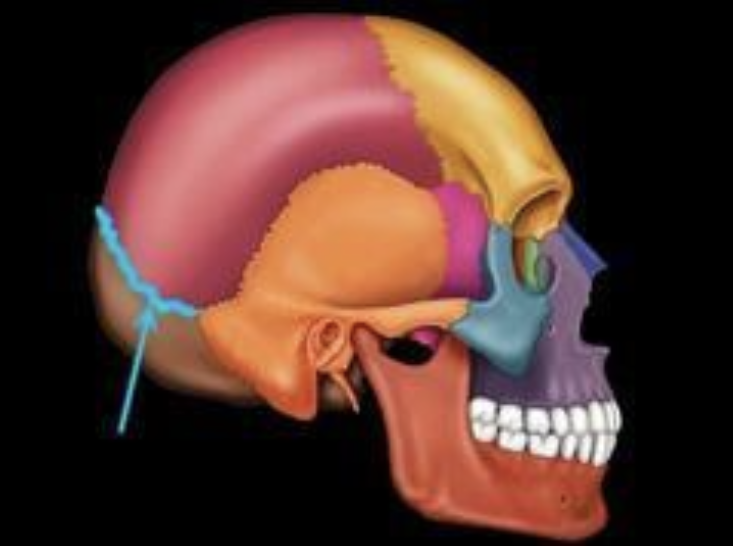
Which suture is shown in the photo?
A. Metopic
B. Coronal
C. Sagittal
D. Lamboidal
D. Lamboidal
Which are the first primary teeth to erupt?
A. Mandibular central incisors
B. Maxillary central incisors
C. Mandibular canines
D. Maxillary lateral incisors
A. Mandibular central incisors
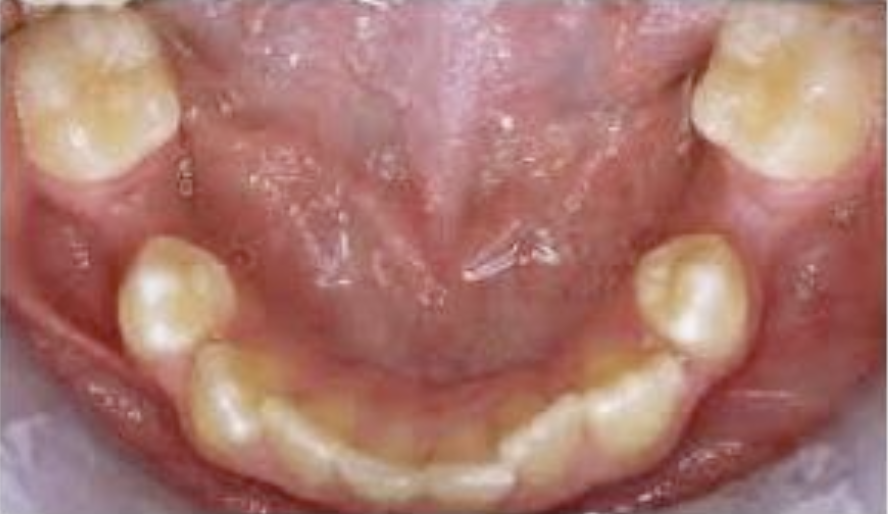
A patient presents to your office and you take the attached clinical photograph. A panoramic film was also taken to confirm that the patient is in fact missing one set of mandibular premolars. The appropriate diagnosis for this patient is what?
A. Supernumerary teeth
B. Hyperdontia
C. Hypodontia
D. Oligodontia
E. None of the above
C. Hypodontia
Which of the following statements is true regarding Dentinogenesis Imperfecta?
A. Teeth are normal in color with decreased translucency
B. Inherited as an autosomal recessive trait
C. Relatively common in Asian children
D. Both deciduous and permanent teeth are usually effected
D. Both deciduous and permanent teeth are usually effected
An individual is not considered to be in the permanent dentition stage until the third molars have erupted.
A. True
B. False
B. False
At what age do girls reach the peak of their growth spurt?
A. 10 years old
B. 12 years old
C. 14 years old
D. 8 years old
B. 12 years old
What is the gonial angle measurement for a person with a narrow face?
A. Less than 120 degrees
B. 120-130 degrees
C. More than 130 degrees
D. None of the above
A. Less than 120 degrees
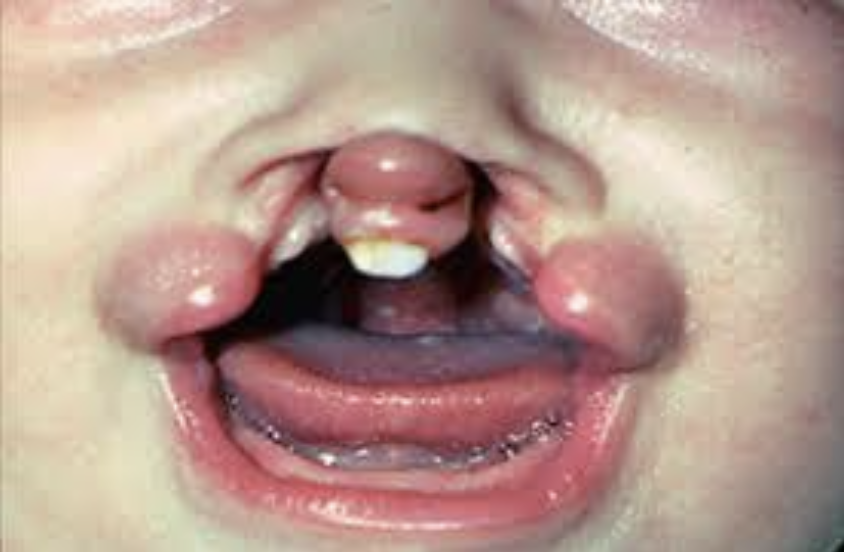
The patient in the photo also has a cleft palate. What is the appropriate classification for this patient?
A. Class I
B. Class II
C. Class III
D. Class IV
D. Class IV
Topical fluoride should only be applied to patients until the age of 12.
A. True
B. False
B. False
Which of the following statements is NOT true regarding the occlusal management of the adolescent patient?
A. Malocclusion is often unimportant and requires no further treatment.
B. Clinical and radiographic examination of third molars should be made regularly.
C. TMJD symptoms may increase as stress increases.
D. Congenitally missing teeth require a long-term treatment plan.
A. Malocclusion is often unimportant and requires no further treatment.
Which of the following is NOT an etiology of orthodontic problems?
A. Heredity
B. Congenital defects
C. Diet
D. Abnormal Pressure Habits
E. None of the above
E. None of the above
When is it possible for a patient to exhibit their tongue thrust habit?
A. When swallowing
B. During speech
C. At rest
D. All of the above
D. All of the above
Statement 1: A diploid cell has 2n or 46 total chromosomes.
Statement 2: A gamete is a diploid cell.
A. Statement 1 is True. Statment 2 is True.
B. Statement 1 is False. Statement 2 is False.
C. Statement 1 is True. Statement 2 is False.
D. Statement 2 is False. Statement 2 is True.
C. Statement 1 is True. Statement 2 is False.

The plane of reference identified in the figure by the DASHED LINE is the median plane.
A. True
B. False
B. False
Statement 1: The endoderm gives rise to the linings of the respiratory tract.
Statement 2: The ectoderm gives rise to the skeletal muscle and central nervous system (CNS).
A. Statement 1 is True. Statement 2 is True.
B. Statement 1 is False. Statement is False.
C. Statement 1 is True. Statement 2 is False.
D. Statement 1 is False. Statement 2 is True.
C. Statement 1 is True. Statement 2 is False.
One adult derivative of the third aortic arch is the common carotid artery. A. True
B. False
A. True
Which of the following is the adult analogue of the sixth aortic arch?
A. Ductus arteriosus
B. Maxillary arteries
C. Right Subclavian
D. Nothing, the arch involutes
A. Ductus arteriosus
Which of of the following statements is not true regarding Pharyngeal Arch 1?
A. Pharyngeal Arch 1 is innervated by the trigeminal nerve.
B. Meckel's cartilage is derived from Pharyngeal Arch 1.
C. The muscles of facial expression are derived from Pharyngeal Arch 1
D. Pharyngeal Arch 1 splits into the maxillary and mandibular prominences.
E. None of the above.
C. The muscles of facial expression are derived from Pharyngeal Arch 1.
Which two pharyngeal arches have parts of the hyoid as their adult derivative?
A. Arch 2 and Arch 3
B. Arch 3 and Arch 4
C. Arch 2 and Arch 4
D. Arch 4 and Arch 6
A. Arch 2 and Arch 3
Both the glossopharyngeal and hypoglossal nerves are involved in the sense of taste.
A. True
B. False
B. False
Fill in the blanks: The function of the _______ nerve is sight, while the function of the ________ nerve is downward and inward eye movement.
A. Optic; Oculomotor
B. Optic; Trochlear
C. Optic; Trigeminal
D. Abducens; Optic
B. Optic; Trochlear
Which of the following pharyngeal pouches have an adult derivative of the the thymus?
A. Pouch 1
B. Pouch 2
C. Pouch 3
D. Pouch 4
C. Pouch 3
Which of the following is not true regarding the thyroid gland.
A. The thyroid gland is not derived from the pharyngeal apparatus.
B. The thyroid forms from mesoderm from the floor of the pharynx.
C. Pharyngeal Pouch 4 gives rise to the C-cells of the thyroid.
D. The thyroid and the and the tongue are connected during embryonic development by the thyroglossal duct.
B. The thyroid forms from mesoderm from the floor of the pharynx.
A child with a cleft described as Veau Classification Group II has clefting of the hard and soft palate only.
A. True
B. False
A. True
During adolescence, it is the head the increases most rapidly in size.
A. True
B. False
B. False
Statement 1: The growth spurt in girls peaks at about 9cm per year at age 14.
Statement 2: The onset of puberty is caused by the release of pituitary gonadotropins released from the thymus.
A. Statement 1 is True. Statement 2 is True.
B. Statement 1 is True. Statement 2 is False.
C. Statement 1 is False. Statement 2 is False.
D. Statement 1 is False. Statement 2 is True.
C. Statement 1 is False. Statement 2 is False.
Which of the following is not consistent with growth and changes to the face that occur during adolescence?
A. Increased brow prominence
B. Increased chin prominence
C. Face becomes more convex
D. Increased prominence of the nose
C. Face becomes more convex
Sinuses that are not symmetric are usually a sign of pathology.
A. True
B. False
B. False
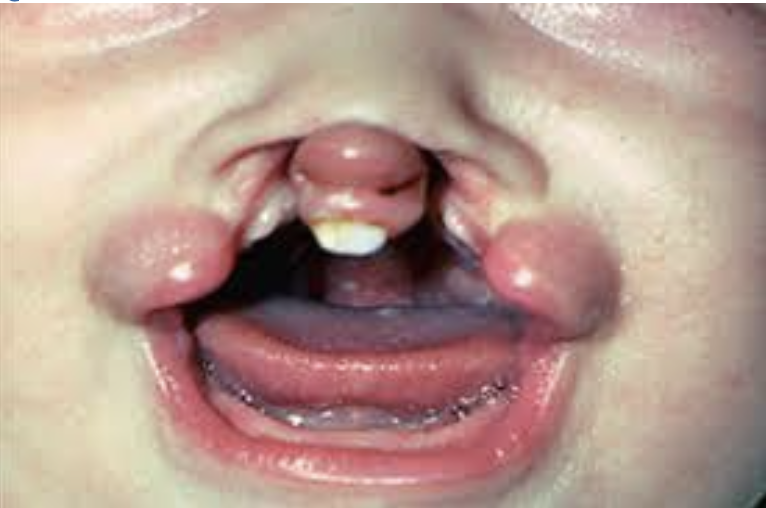
The child shown in the photo can be classified as a bilateral incomplete cleft.
A. True
B. False
B. False
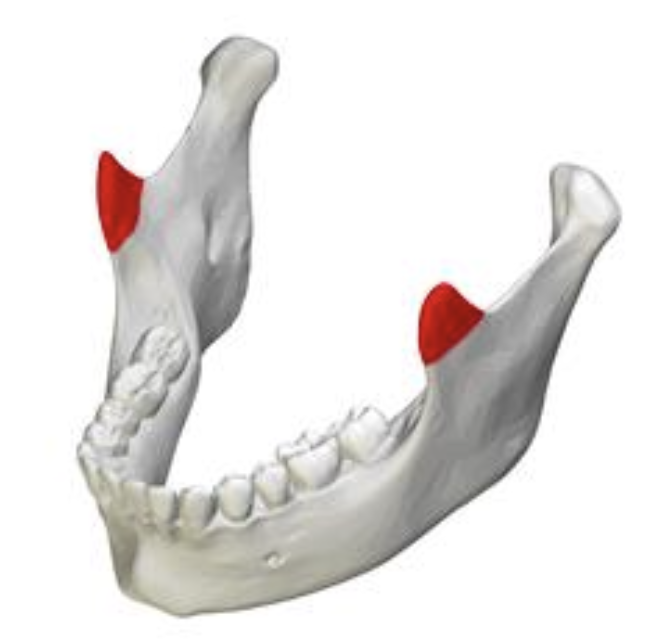
Name the part of the mandible shown in red in the figure provided.
A. Condyle
B. Coronoid process
C. Ramus
D. Angle
B. Coronoid proces
An individual with a squarer face will have a gonial angle of more than 130 degrees.
A. True
B. False
B. False
Statement 1: An individual with maxillary prognathism has a maxilla that protrudes forward of the normal limits of the face.
Statement 2: In an individual with bimaxillary retrognathism both the maxilla and the mandible are anterior to the normal limits of the face.
A. Statement 1 is True. Statement 2 is True.
B. Statement 1 is False. Statement 2 is False.
C. Statement 1 is True. Statement 2 is False.
D. Statement 1 is False. Statement 2 is True.
C. Statement 1 is True. Statement 2 is False.
Adolescents tend to face more traumatic injury to teeth than other age groups because they participate in more athletic activities and are more likely to have intraoral and perioral piercings.
A. True
B. False
A. True
When planning treatment for the geriatric patient, which of the following factors should not be considered?
A. Existing restorations
B. Pharmacologic treatment
C. Financial ability of the patient
D. Transportation to the appointments
E. None of the above
E. None of the above
Abrasion of teeth comes from tooth to tooth wear when a patient has a grinding or clenching habit.
A. True
B. False
B. False
A patient presents to your office with a 40 year history of sucking on lemons daily. The wear to his teeth would be classified as which of the following?
A. Attrition
B. Abrasion
C. Abfraction
D. Erosion
D. Erosion
Which of the following is a change in the teeth that you would expect to find in geriatric patients?
A. Greater responsiveness to pulp testing
B. Decreased susceptibility for root caries
C. Darker and more yellow appearance of teeth
D. Thinner cementum
C. Darker and more yellow appearance of teeth
Gustatory function (taste) in geriatric patient becomes impaired, while olfaction (smell) stays intact.
A. True
B. False
B. False
Which of the following is not a consequence of an atrophic mandible?
A. Increased risk of jaw fracture
B. Difficulty with denture wear
C. Mandibular canal and mental foramen move closer to the border of the mandible
D. None of the above
D. None of the above
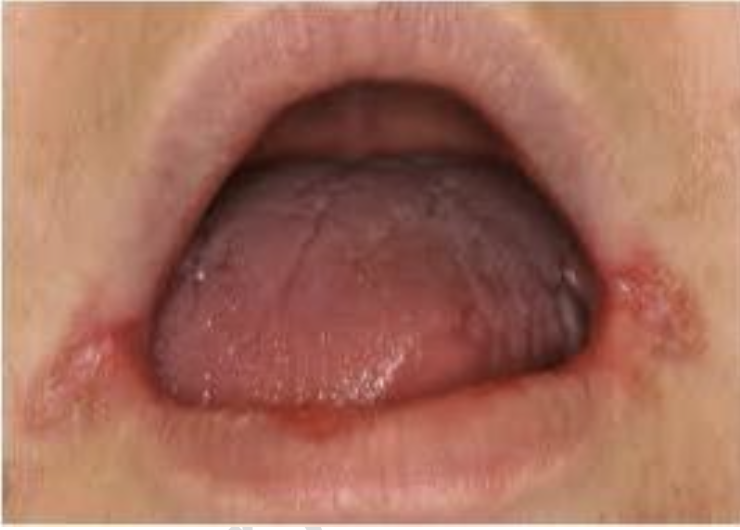
The patient shown in the figure is suffering from denture stomatitis.
A. True
B. False
B. False

Identify the structure that is circled in the provided dental histology slide.
A. Bud of the permanent tooth
B. Dental lamina
C. Inner enamel epithelium
D. Dental papilla
A. Bud of the permanent tooth
During what stage in tooth development does the predentin begin to calcify into dentin?
A. Cap stage
B. Bud stage
C. Bell stage
C. Bell stage
Maxillary teeth generally erupt before mandibular teeth and girl's teeth generally erupt before boy's teeth.
A. True
B. False
B. False
Choose the incorrect statement regarding eruption patterns.
A. Eruption of the deciduous teeth generally occurs between 6 and 24 months.
B. Nutritional deficiencies may cause delay in tooth eruption.
C. In a normal set of dentition, there are 20 primary teeth and 32 permanent teeth.
D. Passive eruption occurs until occurs until contact is made with an opposing tooth.
D. Passive eruption occurs until occurs until contact is made with an opposing tooth.
Which of the following cells is responsible for formation of enamel?
A. Ameoloblasts
B. Cementoblasts
C. Odontoblasts
D. Hertwig's root sheath
A. Ameoloblasts
The usual order of primary tooth eruption is: central incisors followed by…
A. first molars, lateral incisors, second molars, canines.
B. lateral incisors, first molars, second molars, canines.
C. lateral incisors, first molars, canines, second molars.
D. lateral incisors, canines, second molars, first molars.
C. lateral incisors, first molars, canines, second molars.
Radiographs of a patient with __________________ show short roots and bulbous crowns with small or entirely absent pulp chambers.
A. Amelogenesis Imperfecta
B. Dentinogenesis Imperfecta
C. Taurodontism
D. Enamel Dysplasia
B. Dentinogenesis Imperfecta
Which of the following teeth are considered accessional teeth:
A. first and second premolars
B. first and second primary molars
C. first, second, and third permanent molars
D. second and third permanent molars
C. first, second, and third permanent molars
Another name for “mixed dentition” is ‧ ‧ ‧ ‧ ‧ ‧ ‧ ‧ ‧ _____________________ dentition.
A. “adolescent“
B. “heterogeneous”
C. “homogeneous”
D. “transitional”
D. “transitional”
The dentition of a normally developed 7 year old child usually consists of:
A. 8 primary and 8 permanent teeth.
B. 10 primary and 10 permanent teeth.
C. 18 primary and 6 permanent teeth.
D. 20 primary teeth.
E. permanent teeth only.
C. 18 primary and 6 permanent teeth.