RCM Level 10 History
 Call Kai
 Learn
Learn Practice Test
 Spaced Repetition
 Match
Match Flashcards
 Knowt Play
1/99

There's no tags or description
Looks like no tags are added yet.
Name | Mastery | Learn | Test | Matching | Spaced | Call with Kai | Chat |
|---|
No analytics yet
Send a link to your students to track their progress
100 Terms
Middle Ages- Dates
476-1450 (approx.)
monophonic texture
- "mono" means one
- music consisting of a single line of melody (referred to as a "voice")
- no harmony or accompaniment
polyphonic texture
- "poly" means many
- two or more independent melodic lines (or voices) heard simultaneously
- referred to as contrapuntal texture
a cappella
- Latin for "in the chapel"
- vocal music without instrumental accompaniment
- characteristic feature of music in Middle Ages and Renaissance
modes
- scale patterns distinguished by their unique order of half steps and whole steps
- served as the source for melodies in the Middle Ages and Renaissance
- generally referred to by their original Greek names (Dorian, Phrygian, etc.)
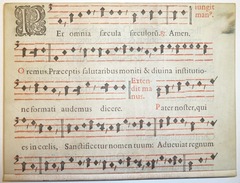
neumes
-the earliest form of notation in Western art music
-small notational symbols; originally indicating the direction of the melodic line
-later in the shapes of squares or diamonds positioned on a staff and representing specific pitches (Example in picture)
Gregorian Chant
-a form of plainchant
-sacred, liturgical music of the Roman Catholic Church, generally with Latin texts
-modal, monophonic melodies with unmeasured rhythm
-named after Pope Gregory the Great
plainchant
- sometimes called "plainsong"
- monophonic texture
- modal melodies
- relatively narrow melodic range
- unmeasured prose rhythm
Mass
-the most important service in the liturgy of the Roman Catholic Church
-includes prayers, readings from the Bible, and a reenactment of the Last Supper, referred to as the Eucharist or Holy Communion
-consists of texts that are variable according to the Church calendar (Proper) and texts that remain the same (Ordinary)
-became and important genre, particularly during the Renaissance era
Mass Proper
-changing, variable prayers of the Mass
-linked to Church calendar
-sections include: Gradual, Introit, Communion, Alleluia
gradual
-the fourth section of the Mass Proper (variable texts)
-texts of the gradual are based primarily on the Psalms (poetic texts from the Old Testament)
-generally melismatic and performed in a responsorial style
responsorial singing
- a method of performance
- solo voice alternates with chorus
- solo passages referred to as "verse"
- choral passages referred to as "respond"
melismatic text setting
- many notes for a single syllable of text
- the most elaborate and florid form of text setting
neumatic text setting
- several notes (two to four) for a single syllable of text
syllabic text setting
- one note for a single syllable of text
- text can be clearly understood
Haec dies (chant)- genre, composer, composition date and Mass component
genre- Gregorian chant
composer- anonymous
composition date- early Middle Ages
Mass component- Gradual, from the Mass for Easter Day
Haec dies (chant)- source of text, language, performing forces and texture
source of text- Psalms 118: 1/24, Old Testament
language- Latin
performing forces- soloist and chorus
texture- monophonic
Haec dies (chant)- additional personal notes
-melismatic text setting
-unmeasured rhythm
-range= a 9th
-movement mainly by step
-when movement isn't by step, it is usually by thirds
-fifths and fourths close the piece
-monophonic texture
-responsorial singing
Pope Gregory 1
-a.k.a Pope Gregory the Great
-born 540, died 604
-became Pope in 590
-he organized Gregorian chants, which is why they are named after him
-he did not make any Gregorian chants
-he expanded 'schola cantorum', which are schools for musicians and performers.
organum
-polyphony based on plainchant; from the 9th to 13th centuries
-vocal music in which one or more new melodic lines are added to existing Gregorian chants (cantus firmus)
-early styles featured perfect intervals: fourths, fifths and octaves; often with parallel motion between the voices
-later styles featured more independent melodic parts and a greater variety of intervals
cantus firmus
- Latin for "fixed song"
- borrowed material, often from a Gregorian chant
- serves as structural skeleton for a new polyphonic composition
- originally found in the lowest voice
tenor
-from Latin 'tenere', "to hold"
-in a polyphonic composition from the Middle Ages, it refers to the voice that contains the cantus firmus (borrowed material)
rhythmic modes
-an early step in the evolution of rhythmic notation; developed by Notre Dame composers in the late-12th to 13th century
-six basic rhythmic patterns, related to poetic poetic meters used in Latin grammar, were used to provide rhythmic structure
Mode 1= long-short
Mode 2= short-long
Mode 3= long-short-long
Mode 4= short-short-long
Mode 5= long-long
Mode 6= short=short=short
organal style
- a style of free organum in which the notes from the original chant are sung by the lower voice in long note values
- sometimes called "sustained-note organum", organum purum, or florid style
discant style
- a style of organum in which there is more rhythmic movement of the cantus firmus
- sometimes features "note-against-note" movement between the voices
Haec dies (organum)- genre, composer, composition date and source of text
genre- organum (Notre Dame style)
composer- anonymous (in the style of Leonin
composition date- ca 1175
source of text- Old Testament; Psalms
Haec dies (organum)- language, performing forces, texture and number of voices
language- Latin
performing forces- soloist and chorus
texture- polyphonic (with monophonic sections)
number of voices- two
Haec dies (organum)- additional personal notes
-tenor voice has cantus firmus
-upper voice is more active than bottom voice
-both organal and discant style
-rhythmic modes in discant style sections
-fourths, fifths and octaves are common
Musica Enchiriadis
-Latin for "Music Handbook"
-anonymous 9th-century treatise
-contains the earliest examples of notated polyphony in Western art music
-scholars believe that this was a book for the theorists and not just used in performance, as singers likely could not read the specific notation employed
-includes parallel organum, with new melodic lines added above or below the original chant
Notre Dame school
-composers in the 12th-13th century
-were the first major composers of polyphony to put their names on their work
Leonin
-1150-1201
-first composer of polyphony known to us by name
-active in Paris in the late 12th century
-he produces two-part organum, using organal and discant style and employing rhythmic modes
-wrote 'Magnus Liber Organi' (Great Book of Organum)
Perotin
-1175-1225
-active in Notre Dame Cathedral in the 13th century
-expanded polyphonic technique by composing three-and-four-part polyphony
-composed "substitute 'clausulae'" to replace sections within organa originally composed by Leonin
motet
-from the French word 'mot' (word), referring to the addition of new texts to existing music
-a vocal composition with or without instrumental accompaniment
-can be sacred or secular
-flourished from the 13th to the 16th centuries
polytextuality
- two or more texts heard simultaneously
- as a result, the words can sometimes be hard to distinguish
- a characteristic feature of the 13th-century motet
O mitissima/Virgo/Haec dies- genre, composer, composition date and sources of text
genre- polytextual motet, from Bamberg Codex
composer- anonymous
composition date- 13th century
sources of text- poems in praise of the Virgin Mary; 'Haec dies'
O mitissima/Virgo/Haec dies- language, performing forces and texture
language- Latin
performing forces- three voices (lowest voice sometimes played by an instrument)
texture- polyphonic
O mitissima/Virgo/Haec dies- additional personal notes
-top voice= triplum
-middle voice= duplum
-bottom voice= tenor/cantus firmus
-ostinato= long-long-short-long
-triplum and duplum have the same range and rhythmic activity
-triplum and duplum are syllabic and neumatic, the tenor is melismatic
-harmonies are in fourths, fifths and octaves
chanson
-'___________' is french for "song"
-a secular song with French text
-monophonic ____________s were composed in the 12th centuries and often performed with improved accompaniment
-from the 14th century on, polyphonic settings were generally preferred
trouvere
-French for "finder" or "inventor"
-aristocratic poet-musicians
-composed and performed original poems and songs
-sang of courtly love
-lived and worked in northern France
strophic form
- a song structure in which the same music is performed for each verse of the poem
- as a result, little connection can be achieved between the words and music
Ce fut en mai- genre, composer, composition date and source of text
genre- monophonic chanson
composer- Moniot d'Arras
composition date- mid-13th century
source of text- secular poem
Ce fut en mai- language, performing forces and texture
language- old French
performing forces- solo singer
texture- monophonic (sometimes with improvised accompaniment)
Ce fut en mai- additional personal notes
-strophic form
-five verses, each with twelve short lines
-internal structure= AABB
-the ending of A is open, the ending of B is closed
-overall rhyme scheme is AABB AABB CCBB CCBB
-melodic range= 9th
-no relationship between music and text
estampie
-one of the earliest Medieval dances
-stately character
-involves elaborate body movements
-danced by couples
heterophony
-simultaneous variation involving two or more voices or instruments playing the same melody in more than one way at the same time
-one part plays the original melody; the added voices are often improvised
bas
-French for "low" indicating a low level of volume (soft)
-Medieval designation for indoor instruments
-includes dulcimer, lute, psaltery, rebec, recorder, vielle
dulcimer
-a stringed instrument with a wooden sound box; strings are struck with small hammers producing a delicate sound
-bas
lute
-a plucked instrument of Middle Eastern origin having a rounded body and frets; its delicate sound served as an ideal accompaniment to the voice
-bas
psaltery
-an ancient stringed instrument with a wooden sound box; strings are struck with small hammers producing a delicate sound
-bas
vielle
-a bowed string instrument with a figure eight-shaped body; ancestor of the violin
-bas
haut
-French for "high", indicating a high level of volume (loud)
-Medieval designation for outdoor instruments
-includes cornetto, crumhorn, sackbut, shawm
sackbut
-a brass instrument with a slide; ancestor of the trombone
-haut
shawm
-a reed instrument with a piercing tone; ancestor of the oboe
"Royal Estampie No. 4" from Chansonnier du Roy- genre, composer and composition date
genre- dance music
composer- anonymous
composition date- late 13th century
"Royal Estampie No. 4" from Chansonnier du Roy- texture, form and performing forces
texture- monophonic
form- sectional structure, with open and closed endings
performing forces- variable (instruments)
"Royal Estampie No. 4" from Chansonnier du Roy- additional personal notes
-suggests Dorian mode
-open and closed ending options allows performers to either end or continue the song
-embellishment s often added
-narrow range
Chansonnier du Roy
- French for "Songbook of the King"
- anonymous 13th-century French manuscript
- contains troubadour and trouvere songs as well as eight monophonic dances, including "Royal Estampie No. 4"
Mass Order
Introit (Proper), Kyrie (Ordinary), Gloria (O), Gradual (P), Alleluia (P), Credo (O), Offertory (P), Sanctus (O), Agnus Dei (O), Communion (P)
Mass Ordinary
-unchanging prayers of the Mass
-the components are: Kyrie, Gloria, Credo, Sanctus, Benedictus, Agnus Dei
ars nova style
- Latin for "new art", from the title of a treatise by composer Philippe de Vitry
- used in reference to French music of the 14th century; the previous era came to be known as ars antiqua
- involved greater complexity in melody, harmony, and rhythm and included use of isorhythm, hocket, and musica ficta
isorhythm
- a compositional device perfected in the Ars nova
- combines melodic patterns (color) with rhythmic patterns (talea)
- color and talea are typically not the same length, overlapping rather than coinciding
musica ficta
-Latin for "false music"
-performance practice applied in modal music of the late Middle Ages and Renaissance
-performers raised or lowered pitches by chromatic semitone to avoid undesirable intervals
-much like modern-day accidentals
hocket
- from French word hoquet meaning "hiccup"
- a rhythmic and melodic technique frequently employed in ars nova style
- two voices combine to create a single melody: one resting while the other sings
Kyrie from 'Messe de Nostre Dame'- genre, composer, composition date, source of text and language
genre- kyrie, from the first movement of the Mass Ordinary
composer- Guillaume de Manchaut
composition date- ca 1350
source of text- Mass Ordinary
language- Greek
Kyrie from 'Messe de Nostre Dame'- texture, number of voices, performing forces, borrowed materials and form
texture- polyphonic
number of voices- four (triplum, motetus, tenor and contratenor)
performing forces- singers; parts may have been reinforced by instruments
borrowed materials- cantus firmus in tenor is based on the plainchant 'Kyrie cunctipotens genitor Deus' from Gregorian Mass IV
form- three sections; text follows ABA form
Form of a Kyrie
Kyrie eleison (Kyrie 1-chant- K 1)
Christe eleison (chant- Christe- chant)
Kyrie eleison (Kyrie II- chant- K II)
Kyrie from "Messe de Nostre Dame"- additional personal notes
-Dorian mode
-triple meter
-isorhythms in tenor
-wide melodic leaps are common
-a few hockets with triplum and moteus
-vocalists employ musica ficta
Gulliame de Machaut
-the most celebrated and significant composer of French ars nova style
-contributed to both sacred and secular music
-used a greater variety of intervals (including thirds and sixths) and employed highly sophisticated contrapuntal techniques
-14th-century rhythmic complexity is demonstrated in his use of devices such as syncopation, hocket and isorhythm
-wrote both monophonic and polyphonic chansons; monophonic chansons represent a continuation of the trouvere tradition
-Manchaut frequently wrote about his own poetry, using the fixed poetic forms: rondeau, ballade and virelai
-his works were often longer and more complex than those of the Ars antiqua
-composed the first complete polyphonic setting of Mass Ordinary- 'Messe de Nostre Dame'
Philippe de Vitry
-1291-1361
-author of the treatise 'Ars nova' (1322)
-innovator in the notation of rhythm, including the "imperfect" division of notes into two equal units (a move away from the division of notes into three equal units considered "perfect")
-broke free from the older patterns and rhythmic modes
-used isorhythm, the repetition of an extended pattern, in which melodic patterns and rhythmic segments of different lengths are combined
ars nova
-in the 14th century, a major shift from sacred to secular happened.
-Philippe de Vitry wrote a treatise called 'Ars nova' outlining the new changes of music and art that were occuring
-it was a high point in music for the Middle Ages, and foreshadowed he development of the Renaissance
-polyphony had particularly advanced in both sacred and secular styles
-a new notation was developed that allowed more complex rhythms to be shown in a much clearer way
-chanson became elegant and courtly
-vocal music began to adopt elements of poetry
Renaissance Era- Dates
1450-1600
Renaissance
-French for "rebirth"
-the period spanning the years of ca 1450-1600 in European history
-a time of continued change and development in musical style
imitative counterpoint
-a type of polyphony associated with Renaissance style
-"counterpoint" comes from the Latin "punctis contra punctum" (note against note)
-"imitation" refers to the passing of a motive or theme from one voice to another
Franco-Flemish School
-a group of composers who flourished in the 15th and 16th centuries
-"Franco" refers to France; "Flemish" refers to Flanders, a region encompassing Belgium and Holland on the modern map of Europe
-leading figures included Johann Ockegham, Josquin de Prez and Jacob Obrecht
-known for vocal polyphony and highly developed contrapuntal style, particularly in the motet and Mass
-also referred to as the "Dutch School" and the "Netherlanders
point of imitation
-in imitative counterpoint, a series of thematic entrances
-a motive or theme is passed from one voice to another
homorhythmic texture
-in a multi-voiced composition, all voices sing in the same rhythm
-a chordal texture (homophonic) results
-coupled with syllabic text setting, this technique delivers the text clearly
-the listener's attention is drawn to the top voice
Ave Maria...virgo serena- genre, composer, composition date, source of text and poetic structure
genre- motet
composer- Josquin de Prez
composition date- ca 1470s-1480s
source of text- rhythmic, strophic poem
poetic structure- opening couplet; five quatrains (four lines); closing couplet (two lines)
Ave Maria...virgo serena- language, translation of title, performing forces and texture
language- latin
translation of title- Hail Mary
performing forces- four voices, a cappella
texture- polyphonic
Ave Maria...virgo serena- additional personal notes
-based on Gregorian chant
-points of imitation in bars 1-6 on "Ave" and later "gratia plena"
-paired imitation: soprano and alto followed by tenor and bass
-harmonic sixths create a sweet-sounding consonance
-textual clarity achieved
-homorhythmic texture: all four voices sing mostly the same rhythm, creating a chordal texture
-uses triadic harmony
-impact of the words is heightened by the use of rests
-ends with open fifths
-relatively simple rhythm, well balanced between all four voices
-shift to triple meter on "Ave vera virginitas"
-the text is mostly syllabic, with short melismas emphasizing key words
-thirds and sixths abound, but important cadences land on open intervals (fifths and octaves)
Josquin des Prez (1450-1521)
-the most successful and renowned composer of the Franco-Flemish School
-a great master of contrapuntal techniques: canonic writing, imitative counterpoint
-his music is rich in emotion expression, embodying the humanism of his time
-his vocal settings sought to express the meaning of the text setting, and closer matching of musical stresses with accentuation of the text and vivid word painting
-his music employs modal harmonies, featured triadic (thirds and sixths) often spiced with
The Reformation
-16th-century Christian reform movement in Europe
-led by Martin Luther
-resulted in formation of many new Protestant denominations and churches
Martin Luther
-Leader of the Protestant Reformation and founder of the Lutheran Church
-posted his "Ninety-Five Theses" in 1517
-his reforms included conducting the service in German instead of Latin and engaging the congregation by replacing elaborate polyphonic settings of the Mass with simpler music: German monophonic hymn tunes that were easy to sing
-because of the translated bible, the congregation could now actively participate in the music of the service using their native language
The Counter-Reformation
-mid-16th century reaction of the Catholic Church to the Protestant Reformation
-the Church's attempt to win back support and regain political power and authority
-response included convening the Council of Trent
Council of Trent
-A series of meetings of the highest Catholic Church officials
-took place in Trento, Italy, from 1545-1563
-condemned "Protestant heresies" and reaffirmed the doctrines of Catholicism
-recommendations regarding liturgical music included: 1. the text should be clear and intelligible 2. the counterpoint should not be overly dense or think 3. except for the organ, instruments should not be used 4. use of secular cantus firmus banned 5. displays of virtuosity should be avoided
Gloria from 'Missa Papae Marcelli'- genre, composer, publication date, source of text
mass, Giovanni Pierluigi da Palestrina, 1567, Mass Ordinary
Gloria from 'Missa Papae Marcelli'- language, performing forces, texture
latin, six voices/ a cappella, polyphonic (with homorhythmic passages)
Gloria from 'Missa Papae Marcelli'- additional personal notes
-opens with the customary monophonic intonation of "Glory to God in the highest"
-sung by the priest or cantor in the context of a church service
-six voices (SATTBB) but all voices are rarely used together
-texture changes frequently as different combinations of voices are used
-predominantly syllabic and homorhythmic text setting makes the words easy to understand
-restrained approach to contrapuntal writing, with limited and controlled use of imitation
-melismatic setting on the word "Fili" is an example of word painting
-all six voices sing together at m. 34- "Domini Fili" (Lord, only the begotten son)- further emphasizing these words
-the text delivers the spiritual message, the music enhances the delivery of that message without distracting from it
Giovanni Pierluigi da Palestrina (1525-1594)
-associated with the Counter-Reformation
-a reverent, spiritual character in his compositions reflects his deep personal faith
-his music exhibits vocal polyphony, in a cappella style
-polyphony is balanced with homorhythmic textures (chordal declamation)
-his approaches to Mass composition include cantus firmus, parody, paraphrase, and canon; performing forces range from four to six voices
-individual vocal lines moved mostly by step or narrow leap
-clarity in text setting was achieved through chordal texture, clear-cut phrases, and musical accents that corresponded with the text
-dissonance was avoided or used with care (for example, as passing notes or off the beat; if on the beat, resolved immediately)
-the "Palestrina style" has served as a model for counterpoint students to this day
Moro, lasso, al mio duolo- genre, composer, composition date
madrigal, Carlo Gesualdo, 1611
Moro, lasso, al mio duolo- language, performing forces, texture, number of voices
Italian, a cappella voices, polyphonic, five
Madrigal
-a popular secular vocal genre that flourished in the 16th century
-based on an intimate between poetry and music
-featured vivid word painting
word painting
- musical pictorialization
- in vocal works, the music reflects the meaning of the text
- employed in madrigals, operas, oratorios
nonsense syllables
-syllables with no meaning, such as "fa-la-la" or "nonny-nonny-no"
-a characteristic feature of the English madrigal
chromaticism
-from the Greek chroma ("color")
-melodies/harmonies that include all the notes available within the octave, in either tonal or modal context
ballett
-Italian for "little dance"
-16th-century Italian and English strophic song type
-generally in simple dancelike style
-often included "fa-la-la" refrains
-embraced by English madrigalists
Moro, lasso, al mio duolo- additional personal notes
-highly chromatic opening passage
-virtually every half step within the octave is employed within the first four measures, creating musical tension and emotional intensity
-descending chromatic line represents death and grief
-this passage recurs when the words "moro lasso" return later in the madrigal
-diatonic passage on "E chi mi può dar mi vita" contrasts with the chromaticism on "moro lasso"
-imitative texture contrasts with earlier chordal passages
-word painting on "vita" (life)- more rhythmic activity to reflect the energy of life
-imitation and sequential repetition of this motive
Carlos Gesualdo (1566-1613)
-aristocratic Italian composer and lutenist
-intensely emotional, highly mannered experimental style
-extravagant word painting
-exaggerated chromaticism with high level of dissonance
-abrupt harmonic shifts and chord changes
-frequent use of repetition
-wrote his own texts, often reflecting on guilt and remorse
-virtuosic style requires skilled performers
Musica Transalpina
Latin for "Music From Beyond the Alps"
-published in London in 1588
-compiled by editor and singer Nicholas Yonge
-represents the first printed collection of madrigals in England
-the first volume contains fifty-seven pieces by eighteen Italian composers, including Luca Marenzio
My Bonny Lass She Smileth- genre, composer, publication, language
English madrigal (ballett), Thomas Morely, 1595, English
My Bonny Lass She Smileth- Performing forces, texture, number of voices, song type/form
a cappella voices, homophonic/polyphonic, five, strophic text (ABBA within each stanza)