The Behaviourist Approach to explaining phobias
 Call Kai
 Learn
Learn Practice Test
 Spaced Repetition
 Match
Match Flashcards
 Knowt Play
1/37

There's no tags or description
Looks like no tags are added yet.
Name | Mastery | Learn | Test | Matching | Spaced | Call with Kai | Chat |
|---|
No analytics yet
Send a link to your students to track their progress
38 Terms
Who came up with The Two Process Model?
Orval Hobart Mowrer
When did he come up with The Two Process Model?
1947
Hobart Mowrer (1947) - The Two Process Model: what are phobias learned through?
conditioning
Hobart Mowrer (1947) - The Two Process Model: what are phobias acquired through?
classical conditioning
Hobart Mowrer (1947) - The Two Process Model: what are phobia maintained through?
operant conditioning
Who carried out the Little Albert study?
Watson and Rayner
When did Watson and Rayner carry out the Little Albert study?
1920
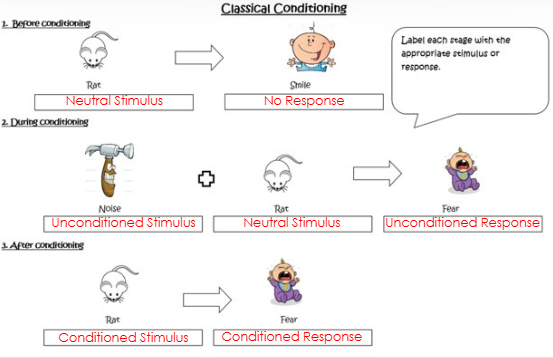
Watson and Rayner (1920): before conditioning - rat?
neutral stimulus
Watson and Rayner (1920): before conditioning - Albert?
no response
Watson and Rayner (1920): during conditioning - loud noise?
unconditioned stimulus
Watson and Rayner (1920): during conditioning - rat?
neutral stimulus
Watson and Rayner (1920): during conditioning - Albert showing fear?
unconditioned response
Watson and Rayner (1920): after conditioning - rat?
conditioned stimulus
Watson and Rayner (1920): after conditioning - albert showing fear?
conditioned response
Watson and Rayner (1920): diagram?
…
How operant conditioning could help maintain a phobia: when does operant conditioning take place?
when behaviour is reinforced or punished
How operant conditioning could help maintain a phobia: what does reinforcement do?
encourages/increases a behaviour
How operant conditioning could help maintain a phobia: what is negative reinforcement?
taking something bad away to encourage a behaviour
How operant conditioning could help maintain a phobia: what does avoiding a phobic stimulus cause?
causes you to not feel anxious and no harm comes to you
How operant conditioning could help maintain a phobia: therefore, how are you rewarding yourself?
by avoiding the phobic stimulus - results in a desirable consequence meaning the behaviour will be repeated
How operant conditioning could help maintain a phobia: how is the avoidance behaviour maintained negatively reinforced - maintaining the phobia?
whenever we avoid a phobic stimulus we avoid the fear and anxiety that is associated with it
Evaluation ✔ - P: what has the two-process model theory led to?
treatments of phobias
Evaluation ✔ - Ev: what two treatments of phobias have been developed following the behaviouist explanation?
systematic desensitisation and flooding
Evaluation ✔ - Ex: why can phobias be treated?
through understanding the conditioning behind the development of phobias - can therefore be treated and improving the quality of life for paitients
Evaluation ✔ - L: therefore, what does the two-process model have?
the two-process model has real-life application
Evaluation X - what is wrong with this explanation?
an incomplete explanation
Evaluation X - Ex: what should always lead to a phobia, that doesn’t always?
if a neutral experience is paired with a fearful stimulus
Evaluation X - Ev1: what research suggests that some of us are more genetically predisposed to gaining a phobia than others?
Di Nardo et al.1988
Evaluation X - Ev2: what is the model Di Nardo et al. 1988 came up with?
the diathesis-stress model
Evaluation X - L: therefore, what may there be more to?
more to what makes us develop a phobia than just conditioning
Strength - P: what does the two-process model work alongside?
social learning theory
Strength - Ev: what does SLT suggest we learn our phobias through?
imitation - For example, a parent responding to a spider with extreme fear could lead to a child learning and then imitating that reaction
Strength - Ex: While this explanation does not explain phobias through conditioning, what does it consider?
the effect of the environment (as opposed to biological factors) as the two-process model does
Strength - L: therefore, what does the two-process model fit with?
other nurture theories such as SLT
Weakness - P: what is the reason that phobias sometimes don’t develop due to?
biological preparedness
Weakness - Ex: why may phobias sometimes not develop following conditioning?
as we are more likely to develop a phobia for something that would have been dangerous to us in an evolutionary past
Weakness - Ev: what would this explain about the different phobias people develop?
explain why people are more likely to develop phobias for things such as snakes and spiders - rather than modern objects like toasters and cars (that are much more dangerous)
Weakness - L: therefore, what can biological preparedness explain, that the two-process model can’t?
explain why some phobias develop and others don’t