Psych 4.1 Sleep
 Call Kai
 Learn
Learn Practice Test
 Spaced Repetition
 Match
Match Flashcards
 Knowt Play
1/75

There's no tags or description
Looks like no tags are added yet.
Name | Mastery | Learn | Test | Matching | Spaced | Call with Kai |
|---|
No analytics yet
Send a link to your students to track their progress
76 Terms
What is the awareness of objects and events in your external world and awareness of our internal state - of our existence and mental experiences at any given time?
Consciousness
What are the two types of consciousness?
NWC and ASC
What is the type of consciousness when an individual is awake and aware?
Normal waking consciousness
What is the type of consciousness that is distinctly different from NWC in terms of quality of experience and levels of awareness?
Altered state of consciousness
What is an agreed upon description and understanding of psychological phenomena that cannot be overtly (directly) measured or observed?
Psychological construct
What is a regular and naturally occurring ASC that involves a loss of awareness and disengagement with internal and external stimuli?
Sleep
What is the type of sleep characterised by rapid eye movement, ⬆ levels of brain activity and ⬇ levels of physical activity?
REM sleep
What is the type of sleep characterised by a lack of rapid eye movement and is subdivided into 3 stages?
NREM sleep
What is a sleep episode?
The full duration of time spent asleep, comprised of sleep cycles, which are multiple repeated cycles of REM and NREM sleep.
Explain the consciousness continuum.
A visual representation of the different states of consciousness that progress from lower levels of awareness to higher levels of awareness.
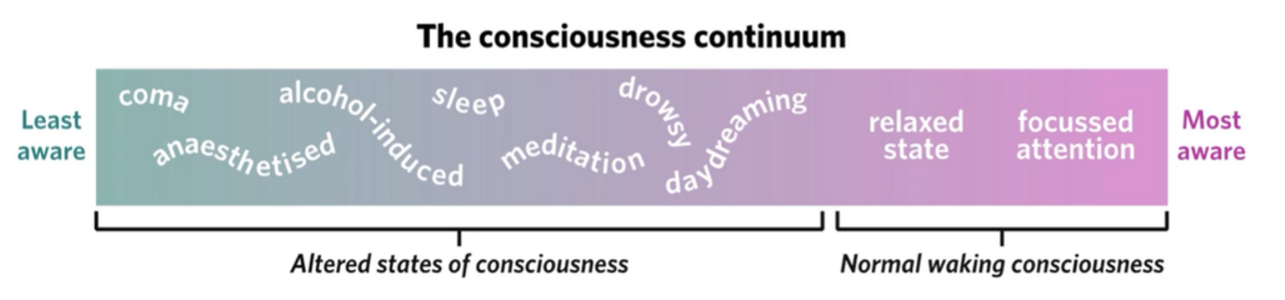
Explain the two types of consciousness.
NWC: An individual is awake and aware (thoughts, feelings, behaviours and internal/external events)
ASC: State of consciousness distinctly different from NWC in terms of quality of experience and levels of awareness.
What is the device used to DARE in the brain?
EEG (electroencephalogram)
What is the device used to DARE in the muscles in the body?
EMG (electromyogram)
What is the device used to DARE in the muscles responsible for eye movement?
EOG (electrooculogram)
A record for self-reported descriptions from an individual about their sleeping periods, which include their duration of sleep and their quality of sleep.
Sleep diaries
The use of camera or audio technologies to record a person as they sleep.
Video recordings
What is the stage of NREM sleep characterised by a transition between a state of being awake and light sleep, and where the sleeper starts to lose awareness of their surroundings, but are still able to be easily woken up?
NREM stage 1
What is the stage of NREM sleep where it is believed true sleep begins, and in which the sleeper spends the majority of their time during a sleep episode?
NREM stage 2
What is the stage of NREM sleep where it is believed deep sleep occurs, it is difficult to wake the sleeper and which becomes shorter and further apart from each other as the night progresses?
NREM stage 3
What is polysomnography?
An intensive study of a sleeping person, monitoring and recording of various physiological responses of the sleeper during the course of the night.
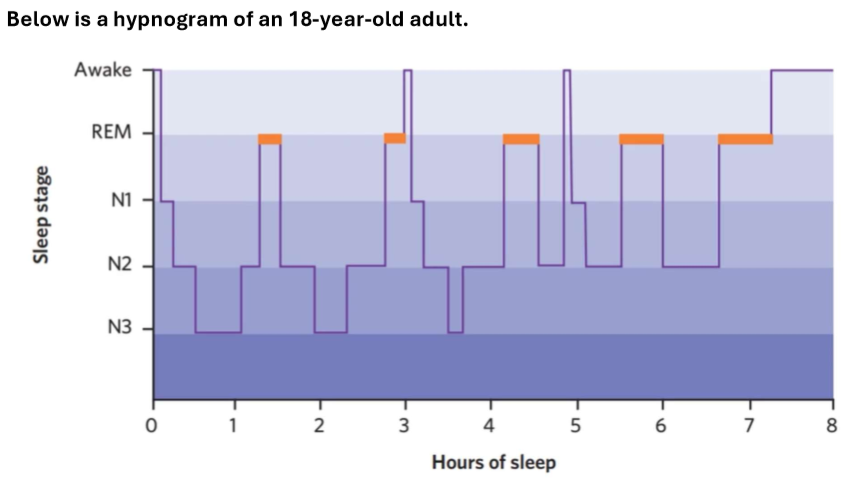
Describe this hypnogram of an 18-year-old adult (total hours of sleep/ no. of cycles, expected or not, no. of brief wake ups, trend of REM sleep/NREM sleep throughout the night, approx. duration of one sleep cycle).
total hours of sleep (expected or not) - about 7.5 hours, expected
no. of cycles (expected or not) - 5, expected
no. of brief wake ups - 2, typical
trend of REM sleep - longer and closer together, typical
NREM sleep throughout the night - shorter and further apart, typical
approx. duration of one sleep cycle - 90 minutes, typical

Frequency and amplitude? Justify.
Highest frequency + lowest amplitude, because the individual is awake, focused and alert.
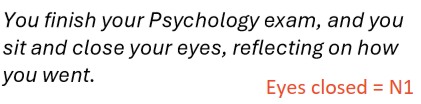
Frequency and amplitude? Justify.
High frequency + low amplitude, because the individual is closing their eyes (in N1)
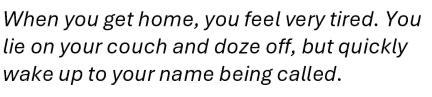
Frequency and amplitude? Justify.
Low frequency + high amplitude, because the individual is closing their eyes (in N1)
Frequency and amplitude? Justify.
Lowest frequency + highest amplitude, because the individual is closing their eyes (in N1)
What is the measure of the number of complete cycles a wave completes in a second?
Frequency
What is the maximum distance a wave travels from its resting position?
Amplitude
What is sleep?
A regular and naturally occurring altered state of consciousness that involves a loss of awareness and disengagement with internal and external stimuli.
What are the biological and behavioural changes that occur as part of a cycle that lasts for around 24 hours?
Circadian rhythm
What are some examples of circadian rhythms?
Sleep-wake cycle, hormone release (melatonin or cortisol), digestion.
What are the biological and behavioural changes that occur in a cycle that lasts less than 24 hours?
Ultradian rhythm
What are examples of ultradian rhythms?
Sleep cycle (90-minute), basic rest-activity cycle, hormone secretion.
What is the full duration of time spent asleep called?
Sleep episode
What is a repeated approximate 90-minute period in which an individual progresses through stages of REM and NREM sleep?
Sleep cycle
What is the hormone released by the pineal gland that induces drowsiness as part of the sleep-wake cycle?
Melatonin
What is the part of the brain that releases melatonin?
Pineal gland
What is the area of the hypothalamus that receives internal and external cues to regulate a person’s sleep-wake cycle?
Suprachiasmatic nucleus
What are the external cues (such as light) that syncs our circadian rhythm with the 24-hour cycle?
Zeitgeber
What are biological rhythms?
Natural, recurring physiological or behavioural cycles, regulated by internal biological clocks.
How is melatonin released?
Suprachiasmatic nucleus (SCN) detects internal and external cues.
SCN sends signals to the pineal gland to promote melatonin secretion.
Melatonin is released and induces drowsiness.
Examples of zeitgebers?
Light, diet, exercise, temperature, loud noises.
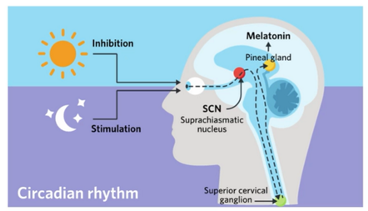
What happens when this is out of sync?
Sleep phase disorders
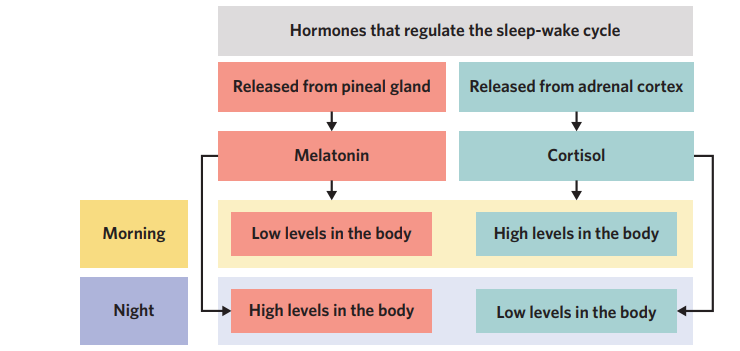
What can you tell me about this diagram?
Melatonin is in higher levels at night, whereas cortisol is in higher levels in the morning. This means that cortisol is involved in promoting wakefulness and alertness in the morning, and it is released by the adrenal cortex.
What are the characteristics of sleep in newborns?
Sleep duration: ~16 hours
Proportion of REM: 50%
Proportion of NREM: 50%
No established circadian rhythm. Their sleeping patterns are erratic, with their sleep distributed across the full 24-hour day.
What are the characteristics of sleep in infants?
- Sleep duration: 12-13 hours
- Proportion of REM sleep: 35%
- Proportion of NREM sleep: 65%
Sleep becomes more nocturnal, and begin to have a fairly consistent circadian rhythm.
What are the characteristics of sleep in children?
- Sleep duration: approximately 10 to 12 hours
- Proportion of REM sleep: 20%
- Proportion of NREM sleep: 80%
Slight variations of sleep across this period. We are able to move them while they sleep without awakening them because they enter deep NREM3 sleep.
What are the characteristics of sleep in adolescents?
- Sleep duration: 9-10 hours
- Proportion of REM sleep: 20%
- Proportion of NREM sleep: 80%
They also experience biological delayed sleep onset by one to two hours, meaning they are more likely to become sleepier later and wake up later.
What are the characteristics of sleep in adults?
- Sleep duration: approximately 7-8 hours
- Proportion of REM sleep: 20-25%
- Proportion of NREM sleep: 75-80%
A gradual loss of NREM3 sleep
What are the characteristics of sleep in elderly people?
- Sleep duration: 6 hours. However, the amount of sleep we need remains constant throughout adulthood. Recommended sleep is seven to eight hours.
- Proportion of REM sleep: 20%
- Proportion of NREM sleep: 80%
NREM3 sleep disappears altogether. Increased night-time awakenings due to medical problems, stress, or the need to go to the toilet more frequently. Prevalence of sleep disorders increases with age.
They tend to experience Advanced Sleep Phase Disorder, which is a biological shift forward in their sleep-wake cycle, meaning they become sleepier earlier and wake up earlier.
What are the characteristics of sleep in adults?
- Sleep duration: approximately 8 hours
- Proportion of REM sleep: 20-25%
- Proportion of NREM sleep: 75-80%
A gradual loss of NREM3 sleep
When does circadian phase delay usually occur in the lifespan?
Usually occurs during adolescence, which is the preference for going to sleep later
When does Circadian Phase Advance occur throughout the lifespan?
It occurs after adolescence, which is the preference for going to sleep earlier.
Are awakenings during sleep more frequent or less frequent throughout the lifespan and
Increase from adulthood to old age.
What happens to NREM3 sleep over the lifespan?
It decreases and is replaced mostly by NREM 2 sleep.
What is the percentage of the time in bed that is spent asleep called?
Sleep efficiency
What happens to sleep efficiency across the lifespan?
It reduces
Why does a baby need a higher proportion of REM sleep?
Neural connections in the brain are believed to be strengthened during REM sleep, enabling the rapid development of a baby's sensory abilities, such as visual and auditory functions.
Why do children need to have a consistent bedtime?
Their bodies rely on a predictable circadian rhythm, and they have to get the ideal amount of sleep, which is eight to ten hours a day. This pattern of sleep is greatly influenced by the bedtimes established by their parents.
What is the timeframe that occurs from birth to death?
Lifespan
What is the difference between amount and proportion of sleep?
Amount of sleep is the duration of sleep, whereas proportion of sleep is the amount of either REM or NREM sleep in comparison to the total amount of sleep experienced in a sleep episode.
What does composition of sleep mean?
It means what the sleep episode is comprised of. For example, the proportion of REM sleep and NREM sleep.
What is the inadequate quantity or quality of sleep?
Sleep deprivation
What is it called when an individual has no sleep within a 24-hour period?
Full sleep deprivation
What is it called when an individual sleeps for some duration within a 24-hour period, but the sleep duration is too short or the quality of sleep is poor?
Partial sleep deprivation
What do you call the changes in emotions and emotional responses that arise from sleep deprivation?
Affective effects
What are some examples of affective effects of sleep deprivation?
1. Poor emotional regulation
2. Irritability and moodiness
3. Increased negative emotions
4. Reduced ability to cope with stress
5. Impaired ability to appropriately respond to situations
6. Increased aggression and impatience
What do you call the changes in actions and the ability to control them that arise from sleep deprivation?
Behavioural effects
What are some examples of behavioural effects of sleep deprivation?
1. Sleep inertia [sense of disorientation after waking]
2. Excessive sleepiness during the day
3. Increased likelihood of engaging in risk-taking behaviours
4. Fatigue, lack of energy
5. Slowed reaction time
6. Involuntary lapses into micro-sleeps [where the individual briefly falls asleep for a few seconds without awareness of doing so]
What do you call the changes in mental processes that arise from sleep deprivation?
Cognitive effects
What are some examples of cognitive effects of sleep deprivation?
1. Reduced concentration
2. Impairment of short-term memory
3. Diminished ability to perform cognitive tasks
4. Lapses in attention
5. Impaired decision-making processes
6. Impaired visual and spatial ability.
What is a measure of how much alcohol is in a person's bloodstream called?
Blood alcohol concentration (BAC)
What is a BAC of 0.05 roughly equivalent to in hours of sleep deprivation?
17 hours (partial sleep deprivation)
What is a BAC of 0.10 roughly equivalent to in hours of sleep deprivation?
24 hours (full sleep deprivation)
What are the affective effects of sleep deprivation compared to blood alcohol concentration?
They both have different effects. However, they both alter an individual's emotional state when compared to how the individual typically experiences emotions. For example, they may have difficulty judging the emotions of others and experience more amplified emotional responses.
What are the cognitive effects of sleep deprivation compared to blood alcohol concentration?
1. Slower mental processes, such as reduced speed in processing and understanding information.
2. Decreased ability to reason and problem solve.
3. Greater difficulty making sense of the world.
4. Reduced ability to make decisions quickly and effectively.
5. Cognitive distortions.
What interferes with the typical regulation of the circadian rhythm of sleep, leading to a change in the sleep-wake cycle?
Circadian rhythm sleep disorders