Hepatic Diseases I/II + Liver Refresher
 Call Kai
 Learn
Learn Practice Test
 Spaced Repetition
 Match
Match Flashcards
 Knowt Play
1/74

There's no tags or description
Looks like no tags are added yet.
Name | Mastery | Learn | Test | Matching | Spaced | Call with Kai | Chat |
|---|
No analytics yet
Send a link to your students to track their progress
75 Terms
T/F: Hepatic Dysfunction normally presents as unique and easily identifiable clinical signs
False, it often presents with non-specific signs (Anorexia, V+/D+, lethargy)
T/F: PU/PD is only seen in cases of renal issues, not hepatic dysfunction
False, PU/PD is commonly seen with hepatic dysfunction
Why is PU/PD seen with hepatic dysfunction?
When the liver is not functioning properly, it produces less urea
Urea is produced by the liver metabolizing ammonia (important for hepatic encephalopathy)
While urea is excreted by the kidneys in urine as waste, some of it is also reabsorbed to aid the kidney in properly concentrating the urine, this happens in the medulla
How does hepatic dysfunction cause Stranguria via the formation of urate stones in the bladder?
When the liver doesn’t function normally it results in a decrease in the production of urea, however, the building blocks that make up urea continue to accrue
These building blocks are ammonia and Uric Acid
When these reach high enough concentrations in the urine they interact to form ammonia biurate crystals, which gradually precipitate and coalesce into solid stones known as ammonium urate uroliths
A key sign of hepatic dysfunction is _______ ________ (caused by a buildup of ammonia in the blood)
Hepatic Encephalopathy
The most well known clinical sign of hepatic dysfunction is ______, what causes this discoloration?
Icterus
Buildup of bilirubin as a result of the liver not being able to process it

What are the main diagnostic tools that can be used to assess the health of a patient’s liver? (use hint for #)
CBC
Chemistry
UA
Pre/Post Prandial bile acids
Coagulation tests PT/PTT
Radiographs
Ultrasound
CT
FNA/Biopsy
What abnormalities would you expect to see on a CBC for a patient that has hepatic dysfunction? Are these findings specific for Liver dysfunction?
Inflammatory Leukogram for infectious causes of hepatic dysfunction
Left Shift
Neutrophilia
Monocytosis
Anemia for chronic hepatic disease
Lymphopenia
Non-specific
What are the hepatocellular leakage enzymes? If elevated what do they indicate?
AST/ALT
They indicate irritation to or death of hepatocytes
What are the Cholestatic liver enzymes? If elevated what do they indicate?
Alk Phos and GGT
Inflammation in the bile duct, obstruction, cholestasis
What 4 liver products would you expect to be decreased on the chem profile of a patient with a failing liver?
Glucose
Urea
Albumin
Cholesterol
GUAC
What does elevated bilirubin indicate?
Indicates an imbalance between the production of bilirubin and the liver's ability to conjugate and excrete it, which clinically manifests as icterus (jaundice)
What are the 3 potential causes of elevated bilirubin? Provide at least one disease for each option
Pre-Hepatic
Increased breakdown of RBCs, so much so that the liver can’t keep up
Ex: IMHA, oxidative damage (e.g., zinc or allium toxicity), infectious hemoparasites (e.g., Babesia)
Key indicators:
Characterized by a marked decrease in packed cell volume (PCV), regenerative anemia, hemoglobinemia, and hemoglobinuria.
Liver enzymes are often initially normal unless secondary hypoxic injury occurs.
Hepatic
Caused by primary liver dysfunction that impairs the hepatocytes' ability to uptake, conjugate, or excrete bilirubin into the biliary canaliculi.
Common causes:
Chronic hepatitis, copper-associated hepatopathy, infectious diseases (e.g., Leptospirosis, Canine Adenovirus-1), severe hepatotoxicity, or hepatic neoplasia.
Key indicators:
Typically accompanied by marked elevations in hepatocellular leakage enzymes (ALT, AST).
If hepatic failure is severe (>70% loss of functional mass), synthetic products like albumin, BUN, glucose, and cholesterol will also be decreased.
Post-Hepatic
A blockage of the gall bladder/bile duct is preventing the excretion of bile, causing a backup
Common causes: Gallbladder mucocele, cholelithiasis (gallstones), severe acute pancreatitis (causing common bile duct compression), biliary neoplasia, or biliary tract rupture.
Key indicators:
Accompanied by marked elevations in inducible cholestatic enzymes (ALP, GGT) and hypercholesterolemia.
Diagnostic imaging (ultrasound) is required to identify the obstructive lesion or dilated bile ducts.

T/F: In causes of liver failure the USG in a UA should be normal
False, it should be decreased (bc less urea to help concentrate the urine)
Are urate crystals indicative of only liver dysfunction?
Yes and no
Certain breeds can be predisposed to forming urate crystals
Otherwise, they are strongly indicative of liver dysfunction
What is the purpose of the Pre/Post-prandial bile acid test?
It tests the liver's ability to efficiently extract and clear bile acids from the bloodstream after they have been released for digestion
In patients with hepatic dysfunction, what is the expected results with a Pre/Post prandial bile acids test?
You would expect to see elevated bile acids
The pre-prandial bile acids serves as a baseline
During the postprandial blood work, A healthy liver will efficiently extract >95% of these returning bile acids from the portal blood on the first pass, keeping systemic blood concentrations low.
T/F: Elevated bile acids are indicative of hepatic dysfunction alone
False, it could also be caused by a bile duct obstruction or rupture
T/F: There is no need to measure bile acids in cases of elevated bilirubin, as they you know that they will be low
False, while it is true you don’t need to measure them, it is because they will be ELEVATED
What is another product of the liver that in instances of hepatic dysfunction would affect normal hemostasis?
PT/PTT (Clotting factors)
Hepatic dysfunction increases clotting time
Usually only noticeable during liver failure
T/F: A mild increase in clotting time for PT/PTT is suggestive of liver failure
False, it is considered to be a mild artifact or patient variation

What is wrong with this radiograph? What condition could be causing it?
Microhepatica
Cirrhosis

What is wrong with this radiograph? What condition could be causing it?
Hepatomegaly
Cushings
Infections
Neoplasia
Heart Failure
What is the best diagnostic tool for visualizing the liver (that is widely available)?
Ultrasound
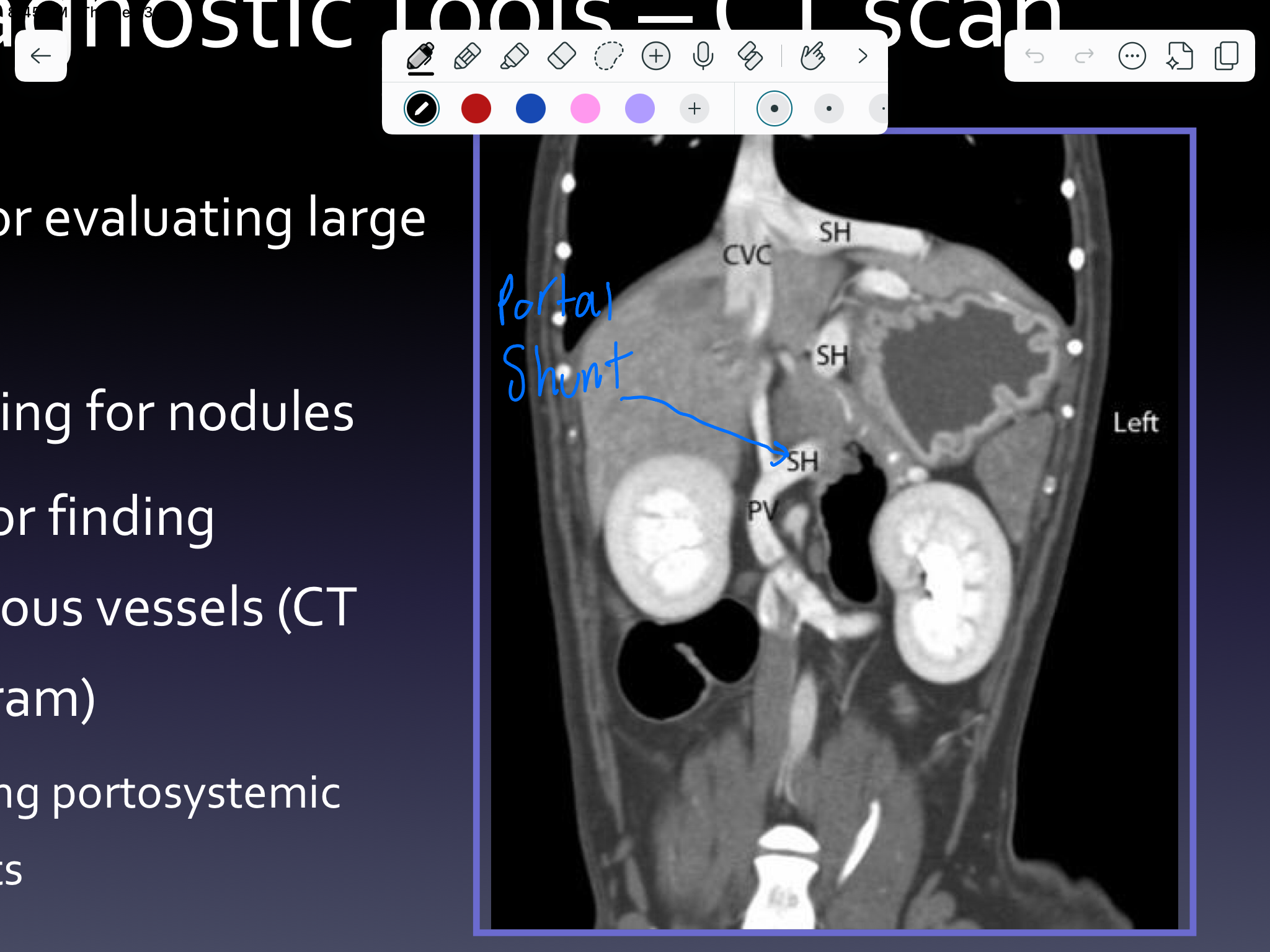
What is the best diagnostic tool for diagnosing anomalous vessels in regards to hepatic dysfunction?
CT
T/F: Full anesthesia is normally required for US guided FNA
False, only sedation is required
Describe the pros and cons of a punch biopsy of the liver vs a FNA
Biopsy
Pros:
More information
Cons:
More expensive
Requires full anesthesia
Laparoscopic or exploratory procedure
FNA (Best suited for diagnosing masses, lymphoma or lipidosis)
Pros:
Less invasive
Only requires sedation
Cheaper
Cons:
Tiny sample with no architecture
When trying to diagnose hepatic dysfunction, what is the diagnostic approach you would take, in order
Signalment, history, physical exam
CBC, Chem, UA
Bile acids or PT/PTT
Diagnostic imaging
Ultrasound first, provides the most information
FNA/Biopsy
What role do antibiotics play in treating cases of hepatic dysfunction?
They are only required when we have confirmed that the dysfunction is due to bacterial causes
This is determined via liver/bile culture
Say you have a patient who has hepatic dysfunction due to Immune-mediated chronic hepatitis, you are deciding between giving them prednisone and prednisolone, which should you give and why?
Prednisolone, it is the active form and doesn’t need to be activated by the liver
Which of these is not an immunosuppressive medication that could be used to treat hepatic dysfunction?
Ursodial
What is the function of Ursodial?
It is a synthetic bile acid
It promotes more watery bile, and less inflammation

**What is the clinical use of ursodial?**
Helps with cholestasis
What is cholestasis?
It is when normal flow of bile from the liver slows down or stops


How does Milk Thistle/Silymarin work? When is it best utilized
It is a strong free radical scavenger that can help treat cases of toxicity
T/F: Milk Thistle/Silymarin can be used empirically for patients with hepatic dysfunction to see if it helps
True
What is SAMe? How does it help the liver?
S-adenosyl-L-methionine
It is a building block of glutathione (a free radical scavenger)
Essentially it provides the liver with subtrate that helps it do its job
Why does lactulose, a medication that helps treat constipation, used in some cases of hepatic dysfunction?
Promotes the growth of beneficial bacteria
Speeds food through the gut
Acidifies the stool to trap ammonia
What very serious side effect of hepatic dysfunction/liver failure is lactulose used to treat?
Hepatic encephalopathy
Since it traps ammonia it can decrease the levels that is causing the altered mentation
In hepatic encephalopathy in dogs, why is the gut bacteria so important to the condition?
Gut bacteria are critical in the pathogenesis of hepatic encephalopathy (HE) because they are the primary producers of ammonia and other enteric neurotoxins that the compromised liver is unable to clear from circulation.
When the liver isn’t functioning normally (dysfunction/failure) it can no longer keep up and that results in accumulating levels of ammonia in the blood

Which of these drugs can’t shouldn’t be used to treat hepatic encephalopathy in dogs?
Sodium bicarbonate
Describe the clinical progression/cause of Steroid Hepatopathy
Hyperadrenocorticism or prednisone therapy → High levels of circulating glucocorticoids → Hepatocytes to become engorged with lipid and glycogen → Liver to be unable to do its job
What CBC/Chem/UA changes and radiograph results would you expect to see in a patient experiencing steroid hepatopathy?
Elevated liver enzymes (especially alk phos)
Hepatomegaly
How do you treat steroid hepatopathy?
Treat the underlying cause (hyperadrenocorticism or prednisone therpay)
A dog presents with lethargy, vomiting, PU/PD, and icterus. Serum biochemistry reveals marked increases in ALT and AST. Which of the following best describes what these enzymes primarily indicate?
Hepatocellular leakage associated with hepatocyte injury
A dog with severe liver disease has decreased glucose, urea, albumin, and cholesterol concentrations. Which important concept does this pattern demonstrate?
Decreased production of hepatic products associated with liver failure
A dog has an increased total bilirubin concentration. Which finding would be most useful in distinguishing post-hepatic icterus from hepatic icterus?
Evidence of bile duct or gall bladder obstruction
A dog with hepatic encephalopathy is being treated medically. What is the primary rationale for using lactulose?
It acidifies intestinal contents and helps trap ammonia while altering intestinal bacterial activity
A dog is diagnosed with copper storage disease. Which diagnostic test is most appropriate for confirming the diagnosis?
Liver biopsy with measurement of hepatic copper concentration
What causes Non-specific Reactive Hepatopathy (Hint: It’s in the name)?
It’s caused by sepsis from endotoxemia
Any disease of the guyt can affect the liver since it receives part of its blood supply (portal vein) from the GIT
An immunocompromised patient presents with the following
Mildly Increased ALT and Alk Phos
Increased bilirubin
Fever
Diarrhea
What disease process of the liver are you suspecting?
Non-specific Reactive Hepatopathy
The patient has GI inflammation and endotoxemia which are both affecting the liver and causing elevated values
T/F: Periodontal disease can cause Non-specific reactive hepatopathy
True!
A cat presents to your clinic that hasn’t been eating well for the past week. They moved into a new house and the cat was too stressed to eat, now they are not themselves, and have been very lethargic. They used to be tempted by treats but now won’t eat anything. The BCS of the cat is 7/9. What is your main differential?
Hepatic Lipidosis
Describe the disease process of hepatic lipidosis
Obese cats suddenly go anorexic
They mobilize fat too rapidly, resulting in it being deposited into the hepatocytes
The hepatocytes become filled with lipid and can no longer function
How do you correct cases of hepatic lipidosis?
Feeding tube and correct any underlying diseases

Which of these images has the liver abnormality?
The right has an intra-hepatic PSS
What is a Portosystemic shunt? Why are they so dangerous?
An abnormal vessel from the hepatic portal vein that bypasses the liver and enters system circulation
They let blood from the GIT enter systemic circulation without being filtered by the liver first
A patient with a PSS most often presents with ________ __________
Hepatic Encephalopathy, typically seen after meals
What is the difference between a PSS and Portal Vein Hypoplasia? Is the treatment different?
PSS
A large shunt that bypasses the liver
Tx
Surgical ligation or coil embolization
PVH
Abnormal hepatic vasculature on a microscopic level
Essentially a bunch of tiny shunts through the liver
Tx
Supportive care if needed
Condition is often not life threatening
T/F: A CT angiogram can be used to diagnose both PSS and PVH
False, only PSS
Name 3 different causes of Acute Hepatic Diseases
Hepatotoxins
Bacterial infections
Viral
One of the most important things to do if a patient has liver dysfunction as a result of hepatotoxins is to give IV fluids, describe why this is so beneficial
They increase liver perfusion
Cause diuresis
Aid with excretion of toxin
T/F: In cases of toxin ingestion → hepatic damage SAMe or milk thistle could be beneficial drugs to give
True, they are or help make antioxidants!
T/F: Lepto can only affect the kidney
False, it can affect the liver too
What is bacterial cholangiohepatitis?
It is when GI bacteria enter the liver via the bile duct or blood and cause inflammation that affects the bile ducts, gallbladder, and surrounding liver tissue

What is the most common etiology of Viral hepatitis in dogs?
Canine Adenovirus type 1 (CAV-1) aka Infectious canine hepatitis
However, it is incredibly rare since the vaccine is so effective
What is immune-mediated cholangiohepatitis, and how is it diagnosed/treated?
An inflammatory liver condition where the body’s immune system mistakenly attacks its own bile ducts, gallbladder, and surrounding liver tissue → Fibrosis/Cirrhosis
Dx
Biopsy
Tx
Immunosuppressant meds (Pred, cyclosporin)
T/F: Immune-mediated cholangiohepatitis presents acutely and severely
False, it often is asymptomatic for years because the liver compensates for it until it can’t
Copper storage disease is a congenital disease in what dog breed?
Bedlington Terriers

How does Copper storage disease cause liver dysfunction?
Copper accumulates in the liver resulting in oxidative damage
T/F: When submitting a liver biopsy for a suspected case of Copper Storage Disease you should place the whole sample in a formalin jar ASAP to preserve the copper
False, save part of the sample outside of the fixative, otherwise it cannot be tested
What are the 2 main types of 1° Hepatic Neoplasia?
Hepatocellular carcinoma
Cholangiocellular carcinoma
What is a Gall Bladder Mucocele?
Abnormal formation of bile-laden mucus in the gall bladder → Causes the gall bladder to slowly grow in size → Pressure necrosis of the wall → Rupture of the gall bladder → Peritonitis

What is the primary treatment of gall bladder mucocele?
Surgical excision

What is Cholelithiasis?
Gall bladder stones