Human Development (Slide 2)
 Call Kai
 Learn
Learn Practice Test
 Spaced Repetition
 Match
Match Flashcards
 Knowt Play
1/54

There's no tags or description
Looks like no tags are added yet.
Name | Mastery | Learn | Test | Matching | Spaced | Call with Kai | Chat |
|---|
No analytics yet
Send a link to your students to track their progress
55 Terms
What domains do we study in development?
physical (health, growth, fine motor, gross motor, oral motor)
cognitive (language)
psychosocial
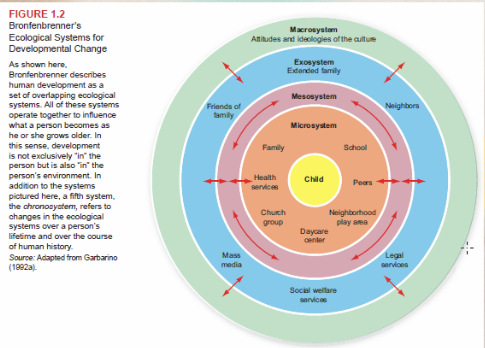
What are bronfenbrenner’s Ecological systems for developmental change? (briefly describe them)
microsystem (face-to-face contact with influential others) ex. family, school, work
mesosystem (relationships between microsystems) ex. home→school, work→ family
exosystem (settings in which the person does not participate but who affect individuals that interact with the person) ex. spouse’s place of employment, local government
macrosystem (“Blueprints” for defining and organizing the institutional life of the society) ex. ideology, social policy
What is the purpose of understanding development?
Describe
What is normal vs. non-normative development
Explain
How does development happen
Predict
When will an event change or modify
Control or Modify
Try to ensure that development is not negatively impacted
What are 4 common developmental themes?
Role of maturation versus experience
Nature vs. nurture
Is development continuous or discontinuous
Ramps vs. Steps
The active versus passive role of the child
How much can the individual control
The area of Focus
What areas are being considered
What are the 4 main types of developmental theories?
Psychodynamic
Behavioral
Cognitive
Contextual
This theory believes that development is an active process influenced by inborn, biological drives and conscious and unconscious experiences
Psychodynamic theories
this theory believes that
Learning is generally defined as relatively permanent changes in observable behavior as a result of experience
Learning experiences that occur during the course of a person’s life are the source of developmental changes
Behavioral
This theory:
specifically examines the development of children’s thinking and problem solving
Cognitive
This theory emphasizes that an individual’s development is based on the interplay of their environments. Such as cultural, society, and historical factors.
Contextual theory
What are the 3 parts of personality in Freud’s psychodynamic theory?
Id- unconscious desires
Superego- moral and ethical part
Ego- rational conscious part
How did Freud believe development happens?
Through conflicts between psychosexual stages.
Freud believed: Unresolved conflicts can lead to ….
fixations
What is a fixation?
a blockage in development
What are the 5 psychosexual stages that Freud proposed? (Only need to know first 3 for test)
Oral
Anal
Phalic
Latency
Genital
What is the approximate age range of the first stage?
Oral: birth-1 year
What is the approximate age range of the second stage?
anal: 1-3 years
What is the approximate age range of the third stage?
Phallic: 3-6
What is the approximate age range of the fourth stage? (don’t need to know yet)
Latency: 6-12
What is the approximate age range of the fifth stage? (don’t need to know yet)
Genital: 12- adult
What is the focus of the oral stage?
The mouth is the focus of stimulation and interaction; feeding and weaning are central.
What is the focus of the anal stage?
The anus is the focus of stimulation and interaction; elimination and toilet training are central.
What is the focus of the phallic stage?
The genitals are the focus of stimulation; gender role and moral development are central.
What is the focus of the latency stage? (don;t need to know yet)
A period of suspended sexual activity; energies shift to physical and intellectual activities.
What is the focus of the genital stage? (don’t need to know yet)
The genitals are the focus of stimulation with the onset of puberty; mature sexual relationships develop.
He believed that personality development involves a lifelong process of attempting to achieve a sense of identity by mastering conflicts. He also studied with Freud’s daughter Anna.
Erickson
What did Erickson believe were the 3 interrelated developmental forces that impacted conflicts?
Biological and physical strengths and limitations
Unique life circumstances and developmental history
Social, cultural and historical forces
Each stage of Erickson’s theory of development had a —— that must be mastered to achieve your adult identity.
psychosocial crisis
What are Erickson’s 8 Psychosocial stages? (only need to know first 3 ish)
Trust vs. Mistrust (Birth to 1) Hope
Autonomy vs. Shame & Doubt (1-2) Will
Initiative vs. Guilt (3-6) Purpose
Industry vs. Inferiority (6-12) Competence
Identity vs. Role confusion (12-9) Fidelity
Intimacy vs. Isolation (19-25) Love
Generativity vs. stagnation (25-50) Care
Ego Integrity vs. despair (50 +) Wisdom
*the ages are estimates
What does trust vs. mistrust involve?
develops trusting relationships with others
What does autonomy vs. shame & doubt involve?
Child learns control over bodily functions and activities
What does initiative vs. guilt involve?
Child tests the limits of self assertion and purposefulness
What does industry vs. inferiority involve?
the child experiences the challenge of mastering new tasks
What does identity vs. role confusion involve? (don;t need to know yet)
attempt to form an identity and self concept
What does intimacy vs. isolation involve? (don’t need to know yet)
the young adult must develop close and committed relationships
What does generativity vs. stagnation involve? (don’t need to know yet)
occurs in adulthood and midlife. The individual attempts to help future generations
What does ego integrity vs. despair involve? (don’t need to know yet)
how people accept their own lives as they approach death
What does Pavlov’s theory of classical conditioning involve?
unconditioned stimulus
unconditioned response
neutral stimulus
conditioned stimulus
conditioned response
What is an example of classical conditioning?
unconditioned stimulus- nipple
unconditioned response- sucking reflex
neutral stimulus- bottle
conditioned stimulus- bottle
conditioned response- sucking reflex

What are the two factors of operant conditioning?
reinforcement (increases behavior) and punishment (decreases behavior)
Compare positive vs negative reinforcement and punishment

He believed thinking develops in a series of increasingly complex stages, each incorporating and revising those that precedes it
Piaget (Cognitive Theory)
How do people move from stage to stage in Piaget’s Cognitive Theory
through the processes of direct learning, social transmission, and physical maturation
What are Piaget’s four cognitive stages?
Sensorimotor
Preoperational
Concrete operational
Formal operational
What happens during the sensorimotor stage and when does it occur?
Coordination of sensory and motor activity. Development of object permanence ).(understanding that objects still exist even when you can’t see them).
(Birth-2 years)
What happens during the preoperational stage and when does it occur?
Use of language and symbolic representation, egocentric view of the world
(2-7)
What happens during the concrete operational stage and when does it occur?
Solution of concrete problems through logical operations
(7-11)
What happens during the formal operations stage and when does it occur?
Systematic solutions of actual and hypothetical problems using abstract symbols
(12+)
What is a scheme (Piaget)
an organized pattern of thought or behavior
What is assimilation? (Piaget)
Person interprets new ideas or experiences to fit existing schemes
What is accomodation? (Piaget)
Person changes existing schemes to fit new ideas or experiences
What is adaption (Piaget)?
Interplay between assimilation and accommodation, resulting in development
What is Equilibrium (Piaget)
Harmonious balance of a person’s schemes and experiences with the environment

As children grow there are Developmental changes in information processing - Such as…
—- changes allow them to process information more efficiently
Improved —— of the — ——- they are receiving - lead to more learning
Develop ——— - understanding of how learning and thinking happens
Overall increase in knowledge base
As children grow there are Developmental changes in information processing - Such as…
Cognitive changes allow them to process information more efficiently
Improved processing of the sensory information they are receiving - lead to more learning
Develop metacognition - understanding of how learning and thinking happens
Overall increase in knowledge base
What impacts development in Adult Lifespan Theories?
timing of events
ex:
Children - go to school
Young adults - marriage and parenthood
Midlife - Career, parenthood
Late life - Retirement, family, loss of spouse