ASA 101-Practice test Diagram | Quizlet
 Call Kai
 Learn
Learn Practice Test
 Spaced Repetition
 Match
Match Flashcards
 Knowt Play
1/100

There's no tags or description
Looks like no tags are added yet.
Name | Mastery | Learn | Test | Matching | Spaced | Call with Kai | Chat |
|---|
No analytics yet
Send a link to your students to track their progress
101 Terms
When sailing, always be aware of the wind's ______ and _______
speed, direction
The desirable force generate______.
lift
The direction relative to the wind in which the sailboat cannot sail is called the_______.
no-sail zone
Sailboats can reach an upwind destination by sailing a _______ course.
zig zag
The point of sail at the edge of a no-sail zone is called_________.
close-hauled
A boat sailing across the wind is said to be __________.
reaching
Sailing straight downwind is called ________.
running
As the sailboat's direction changes relative to the wind, so should the sail's _________ to the wind be adjusted.
angle (or trim)
The combination of the true wind and wind created by the boats motion (that we feel on the boat) is call ___________ wind
apparent
The ___________ is an underwater fin fixed on the bottom of the sailboat that provides stability and lateral resistance.
keel
The sailboat's direction through the water is controlled by the ________ , which can be turned by means of either a _________ or a _______ ________.
rudder, tiller, steering wheel
Name parts with the lettered items in the diagram
(k) hull (c) deck (i) cockpit (a) transom (f) bow (h) stern (e) rudder (d) helm [tiller or wheel] (b) stanchion (g) lifeline (j) pulpit
![<p>(k) hull (c) deck (i) cockpit (a) transom (f) bow (h) stern (e) rudder (d) helm [tiller or wheel] (b) stanchion (g) lifeline (j) pulpit</p>](https://assets.knowt.com/user-attachments/76fda571-4cb6-49c8-91b6-ab4b22a83b47.jpg)
Name parts with the lettered items in the diagram
(d) mast (a) boom (k) gooseneck (m) spreader (h) shroud (n) headstay/forestay (l) backstay (b) mainsail (i) headsail/jib (f) halyard (e) mainsheet (c) jib sheet (g) boom vang (j) boom topping lift
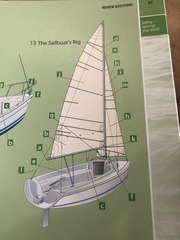
Name parts with the lettered items in the diagram
(g) head (a) tack (d) clew (c) luff (f) leech (e) foot (b) batten

Name parts with the lettered items in the diagram
(a) port (f) starboard (c) forward (g) aft (h) ahead (i) abeam (e) astern (b) windward (d) leeward
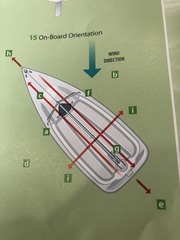
The mainsail should be raised when the sailboat is oriented ________ to ___________.
head, wind
When turning the boat toward the wind, sails should be __________ in.
trimmed
When turning the boat away from the wind, the sails should be _________ out.
eased
"Fluttering" sails are said to be ______________.
luffing
The best way to steer the boat on a straight course is to look toward the ________ and pick a ________ to steer toward
shore, landmark
When you turn the bow of the boat toward the wind you are __________ ______.
heading up
When you turn the bow of the boat away from the wind you are ________ _________.
bearing away
The "golden rule" of sail trim is: "when in __________, let it______."
doubt, out
When the boat is stopped, pointed toward the wind with the sails luffing, it is said to be _____________.
in irons
Match the point of sail with eh letters in the illustration
(a) close reach (b) broad reach (c) closed-hauled (d) run (e) beam reach (f) in irons/no sail zone
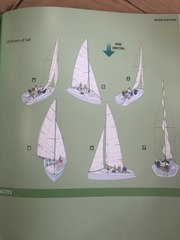
When the wind is blowing on the port side, the boat is said to be sailing on a ______ ______.
port tack
When the wind is blowing on the starboard side, the boat is said to be sailing on a ______ _______.
starboard tack
Turning the boat so the bow passes through the wind, bringing the wind to blow onto the opposite side of the boat is called: _____________
tacking
Changing tacks by turning the boat so it's stern passes through the wind is called _________.
jibing
The helmsman's command for tacking the boat (also called coming about) are "__________,___________" and "___________".
ready about, helm's a lee
To jibe safely, it's very important to ________ the _______ in toward the centerline as the boat bears away onto a run
trim, main sail
Sailing on a run with the mainsail and jib on opposite sides of the boat is called sailing _______ on ________.
wing, wing
If the wind is on the same side of the boat as the mainsail while sailing downwind, the boat is said to be ________ by the _______.
sailing, lee
The danger of sailing by the lee is the increased risk of an ________ _______.
accidental jibe
The helmsman's commands for jibing the boat are "_____ to _______" and "_____-_____"
Prepare to jibe, jibe-ho
The fastest way to change the sail's power is to change its________to it's ___________.
angle, wind
The outhaul changes the depth of the ________ of the mainsail.
draft
Tightening the downhaul or Cunningham moves the draft of the mainsail__________.
forward
Tightening the________ _______holds the boom down on a downwind point of sail.
boom vang
To get full power and optimum use out of the mainsail,___________it until it just starts to luff, then trim the mainsail in so it just stops___________.
ease, luffing
Two ways to change the sail's angle to the wind are:
a.__________or__________the sail
b._________ _________or _________ ________.
(a) ease, trim
(b) head up, bear away
The tendency for the boat to head up toward the wind on its own is called_________helm.
weather
The tendency for the boat to bear away from the wind on its own is called___________helm.
lee
While sailing close-hauled, four ways to decrease the heel of the boat are:
a. Move the crew to the________side of the boat.
b.________ ______slightly, into the edge of the no-sail zone.
c.________the main_______.
d. Move the________leeward.
(a) windward (b) head up (c) ease, sheet (d) traveler
Reducing the size of a sail so that less area is exposed to the wind is called ____________.
reefing
When you want a break while sailing, you can make the boat lie_______-___________.
hove-to
You heave-to by backing the________, easing the__________, and putting the____________to leeward.
jib, mainsail, helm (tiller)
Which line or hitch secures the bow of the boat to the dock
bow line
Which line or hitch secures the stern of the boat to the dock
stern line
Which line or hitch secures keeps the boat from moving aft
forward spring
Which line or hitch keeps the boat from moving forward
aft spring lines
________________are used to protect the hull from contact with the dock or other boats.
fenders
The ideal point of sail on which to approach a mooring ball is on a ________ ________.
close reach
Which of the illustrations show the best conditions under which to approach a dock under sail?
(a) upwind approach
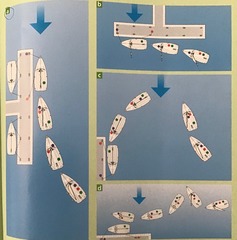
In the Navigational Rules, Rule 5 (the lookout rule) requires all vessels to maintain a proper lookout using ___________ and _____________ and any other available means (e.g. radar).
sight, hearing
It is the responsibility of every vessel operator to avoid a________.
collision
The_________-___________ vessel's obligation to maintain___________and speed.
stand-on, course
The_________-__________vessel is required to maneuver out of the way of the stand on vessel.
give-way
A vessel overtaking another vessel must ____ _____ to the vessel being overtaken.
give way

When two sailing vessel's are approaching on opposite tacks, the vessel with the wind on the __________side is the stand-on vessel.
starboard
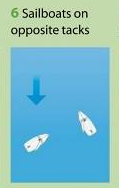
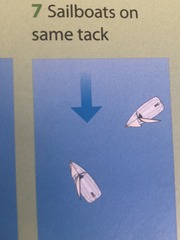
When two vessels are sailing with the wind on the same side, the vessel to ____________is the give-way vessel
windward
When a sailboat has its engine running and in gear, it is defined as
__________-_________ vessel, regardless of whether the sails are raised.
power-driven
A powerboat, not in a channel or restricted in its ability to maneuver, should________ ________to a sailboat under sail, unless the sailboat is_________ the powerboat.
give way, overtaking
When two power-driven head-on, ___________ boat is the stand-on vessel. Instead, both vessels should alter course to ___________ and pass port-to-port.
neither, starboard

In a crossing situation, if powerboat A sees powerboat B on its starboard side, then powerboat A shall ____________ ____________.
give way
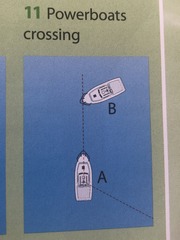
The give-way vessel shall take _________ and________action to keep clear. If the give-way vessel does not seem to be taking early or substantial enough action, then the _________-_________vessel must take action to avoid collision.
early, substantial, stand-on
Nearly all vessels must be__________with the state in which they operate, and/or___________throughout the U.S. Coast Guard Vessel Documentation Center.
registered, documented
There must be at least Type I, II, III or IV_________on board for_________person.
life jacket (or PDF), each
Examples of visual distress signals include
a._______
b._______
c._______
d._______
flares, smoke signals, distressed flag, electric distress light
An_______ _________can serve as a sound-producing device.
air horn
Any sailboat under 26 feet in length with an engine must carry a ___ _____.
fire extinguisher
A sailing vessel over 23 feet in length under way at night or in restricted visibility is required to display a _________ sidelight on the port side, a green sidelight on the __________ side, and a ________ light on the stern.
red, starboard, white
When a sailboat 23 feet or longer is navigating at night with its engines operating in gear it must also display a white __________ light in addition to the sidelights and stern light.
steaming
The Federal limit for blood alcohol content is ________ percent
0.08
In the Aids to Navigation system, a _________ is a floating aid anchored to the bottom. A beacon is a_________mark and can be on land or in the water.
buoy, fixed
Lateral Aids to Navigation are identified by three features,________ _______ and _______.
color, shape, number
A way to remember which side to keep the starboard-hand (red) markers when entering a channel from seaward is the phrase "_______ _______ ___________."
"red right returning"
A ________ __________ buoy has red and white vertical stripes and is safe to pass on either side.
safe water
The procedure for recovering a crew member who has fallen overboard (a MOB) is:
(a) appoint someone as a _________ to keep the MOB in sight
(b) throw_________device(s) to the MOB
(c) Maneuver the boat back to the MOB and approach on a______ ________point of sail.
(d) Stop the boat by_________the sails and bring MOB aboard
(a) spotter (b) floatation (c) close reach (d) luffing
The Figure-8 recovery method works well on small boats since there is no__________, thereby reducing the risk of a second MOB.
jibe
Checking the_________forecast is one of the most important steps to take before going sailing.
weather
A_________plan can be provided to a friend or relative who is willing to be responsible for contact the authorities if you to not make contact or schedule.
float
Primary use of a bowline knot
Form a non-slipping loop, tie jibsheets to clew of jib
Primary use of a figure 8 knot
Keep line from slipping through fairlead or block
Primary use of a square knot
tie two ends of a line together
Primary use of a cleat hitch
secure a line to a horn cleat
Primary use of a clove hitch
temporary tie-up to docking piling, attach fender to stanchion
Primary use of a round turn and 2 half hitches
More secure tie-up to dock piling
The shape of a mainsail may be changed by adjusting tension in the edges of the sail. Match the sail control with the edge of the sail it affects: Foot, Luff or Leech
a. Outhaul
b. Halyard or downhaul or Cunningham
c. Boom vang
a.foot
b. luff
c. leech
transom
pulpit
stern
helm
cockpit
hull
lifeline
pulpit
bow
deck
stanchion