Anatomy Exam #1
 Call Kai
 Learn
Learn Practice Test
 Spaced Repetition
 Match
Match Flashcards
 Knowt Play
1/42

There's no tags or description
Looks like no tags are added yet.
Name | Mastery | Learn | Test | Matching | Spaced | Call with Kai | Chat |
|---|
No analytics yet
Send a link to your students to track their progress
43 Terms
Describe the three subdivisions of anatomy and the two subdivisions of physiology
Anatomy
gross- study large visible structures
developmental- studies anatomical and physiological development
throughout life
microscopic- studies structures too small to see with the naked eye
Physiology
cellular
molecular
how body is dependent on chemical reactions in the cell
Describe the principle of complementarity of structure and function and explain how it relates to human anatomy and physiology
shape dictates function
the shape of something dictates what you can do with it
the shape of your teeth dictate chewing food, this is apart of everything in the human body
Describe the humans bodys structural organization levels from smallest to largest
chemical level→cellular level→tissue level→organ level→organ system level→organismal level
Describe the eight functions necessary for life
my mom reads my emails really good
maintaining boundaries- keeping things where they belong, digestive enzymes not getting out etc.
movement- skeletal system must be able to move
responsiveness digestion- breaking down+absorbing food
metabolism- chemical reactions, breaking stuff down to keep you alive
excretion- get rid of waste
reproduction- in order to keep species around
growth- development to survive, increase size of body+organism
Describe the five survival needs of humans
nutrients
lipids, carbs, minerals, proteins, vitamins
oxygen
essential for release of energy from foods
water
life doesn’t exist without it
required for chemical reactions
needed for fluid base for secretions+excretions
Body temperature
needed for chemical reactions, needs to stay at 37 degrees Celsius
Appropriate atmospheric pressure
specific pressure of air needed for adequate breathing and gas exchange in lungs
Describe homeostasis and explain its importance to human health and disease
the maintenance of relative stability internal conditions despite continuous changes in environment
keeping the chemical reactions in your body consistent, needed for your body to adapt to constant change
Describe negative feedback; include an example in your answer
you go back and fourth to keep homeostasis
ex. maintaining blood sugar levels
reacts to stimulus
Describe positive feedback, include an example in your answer
goes in one directions until something is done
ex child birth
enhances or exaggerates stimuli
Describe anatomical position and explain why it is important for medical professionals
you’re standing upright, feet slightly apart, hands to sides, palms facing forward, thumbs pointing away
its a baseline because someone’s left and right can be different from someone elses so this keeps it all the same
Using examples explain the following: Anterior/posterior, Superior/inferior, Lateral/medial, proximal/distal, superficial/deep
superior- towards head
inferior- towards feet
anterior- front
posterior- back
Medial- middle
lateral-sides
proximal-close to the point of attachment of the body
distal- further away from point of attachment
superficial- on skin
deep- in skin
Describe how the three plains divide the body
sagittal plane- divides vertically (left and right)
frontal- divides perfectly on midline
Transverse- divides at a 90 degree angle from midline (up and down )
Describe the subdivisions of the dorsal and ventral cavities
Dorsal
cranial cavity- brain
vertebral cavity - spinal cord
Ventral
thoracic- heart lungs
Abdominal pelvic'
abdominal cavity- stomach intestines spleen liver
pelvic cavity bladder
Describe the nine abdominopelvic regions
ONLY NEED 1 EX. OF EACH
right hypochondriac region
liver, gall bladder, right kidney
epigastric region
stomach, liver, pancreas, right and left kidneys
left hypochondriac region
stomach, liver, left kidney, spleen
right lumbar region
liver, small intestines, ascending colon, right kidney
umbilical region
stomach, pancreas, small intestines, transverse colon
left lumbar region
small intestines, descending colon, left kidney
right iliac region
small intestines, appendix, cecum, and ascending colon
Hypogastric
small intestines, sigmoid colon, bladder
Left iliac region
small intestine, descending colon, sigmoid colon
Little snakes sleep (liver, stomach, spleen)
kids in kitchen (right kidney, small intestine, left kidney)
Apples become sweet (appendix, bladder, siqmoid colon)
Describe matter and explain the three different forms of it
Something that has mass + occupies space
solid
liquid
gas
Describe kinetic and potential energy and explain the four different forms of energy
kinetic
energy in action
something in motion
potential
stored energy
chemical energy
stores in bonds of chemical substances
electrical
results from movements of charged particles
mechanical
directly involved in moving matter
radiant
travels in waves
heat/light
Describe an element and explain the importance of the four most common elements found in humans
substances you cant break down chemically
carbon, oxygen, hydrogen, nitrogen
96% of the human body
found in organic molecules
Describe trace elements and explain their importance to humans
very important chemical elements that are needed in extremely small quantities
important for enzyme activation, oxygen transport, metabolic control, immune system, and structure
Describe the structure of an atom including electron orbital and the location and charge of the primary components
protons
carry positive charge
add weight
neutrons
no charge
also add weight
electrons
negative charge
so tiny, no weight
Describe what isotopes and radioisotopes are and explain why they are biologically useful
isotopes- different # of neutrons than normal
radioisotopes
isotopes that decompose to more stable forms
as isotopes decays subatomic particles release energy
-can be a valuable tool for biology research and medicine
Describe the differences between molecules and compounds
molecules- general term for 2 or more atoms bonded together
compounds- specific molecule that has 2 or more different elements bonded together
Describe three basic types of mixtures
Solution
homogenous mixtures
solvent- greatest amount
solute
Colloids
heterogenous mixtures
sometimes undergo sol-gel
Suspensions
heterogenous mixtures
ex. water and sand
large visible solutes that don’t settle out
Describe the three ways that the concentration of a solution can be determined
measuring percentage of the solute in total solution
milligrams per deciliter (mg/dl)
molarity- number of moles of solute per liter
one mole of compound= molecular weight
Describe the three differences between mixtures and compounds
mixtures can be separated by physical means
mixtures don’t involve any chemical bonding between components
Mixtures can be heterogeneous or homogeneous
Describe the role of electrons in chemical bonding, including electron and valence shells
They determine whether a chemical reaction will take place and if so, what type of chemical bond is formed
Electrons can occupy areas around nucleus called electron shells
• Outermost electron shell is called valence shell
– Electrons in valence shell have the most potential energy because they are farthest
from nucleus
– These are electrons that are involved in chemical reactions
Describe the octet rule and explain why elements do not exist in a pure form in nature
Atoms desire to have 8 electrons in valence shell
once 8 electrons is reached they don’t want to react anymore and become stable
there is no elements in pure form in nature because natural elements don’t have 8 electrons in valence shell therefore they react and bond with other elements
Describe the 4 types of chemical bonds, include an example of each
ionic (weakest)
either give up or accept electrons
become ions
Polar Covalent bonds
formed when sharing 2 or more electrons
strongest bonds
Polar (share electrons equally)
Non polar covalent bonds
formed when sharing 2 or more electrons
strongest bonds
non-polar (share electrons unequally)
hydrogen bonding
attractive force between electropositive hydrogen of one molecule and electronegative atom of another molecule
weak magnetic attraction
Describe synthesis, decomposition, exchange, and redox reactions
decomposition
breakdown
involve catabolic reactions
exchange
displacement reactions- synthesis and decomposition
bonds made+broken
redox reactions
moving electrons
atoms reduced when they gain electrons and oxidized when they lose electrons
Describe exergonic and endergonic reactions, give an example of each
exergonic- chemical reactions where net overall release of energy
ex. cellular respiration
endergonic- result in a net absorption of energy
ex. photosynthesis
Describe the 5 properties of water that make it an important compound for humans
high heat capacity
ability to absorb and release heat
prevents sudden change of temp
high heat of vaporization
evaporation requires large amounts of heat
useful cooling mechanism (sweating)
polar solvent properties
dissolves and dissociates ionic substances
forms water layers around charged molecules
bodys major transport medium
reactivity
neccasary for hydrolysis + dehydration synthesis reactions
cushioning
protects certain organs from physical trauma
Describe salts and explain their importance to human physiology
ionic components that dissociate into seperate ions in water
Seperates into cations+anions
all ions called electrolytes
can conduct electrical currents in solution
ionic balance is vital for homeostasis
Describe the pH scale, including the differences between acids, bases, and neutral substances
acid base concentration
pH scale- measure of hydrogen ion concentration
the more hydrogen ions→ more acidic
below 7 acidic, neutral 7, more than 7 basic
Acids- proton donors, release hydrogen ions
bases- proton acceptors, completely dissociate, when base dissolves releases hydrogen
neutralization- acids+bases mixed together
Describe how a buffer can regulate pH explain the importance of them in a biological system
buffers help maintain pH range
can release/bind hydrogen ions based on needs
convert strong acids bases into weak ones
in healthy individuals it keeps your pH range for your body to work it’s best
Describe how dehydration synthesis and hydrolysis reactions make or break chemical compounds
polymers are synthesized by dehydration synthesis
removing of water molecule at the site of bond formation
oppositely hydrolysis reactions break the polymers down
adding water molecule to the monomers
Describe the composition and functions of the three different types of carbohydrates
monosaccharides- one single, simple sugar
disaccharide- double sugars, too large to pass through cell membrane
polysaccharides- polymers of monosaccharides, formed by dehydration synthesis
Describe the composition and functions of the four different types of lipids including the differences between saturated and unsaturated fats
triglycerides
fats when solid, oil when liquid
composed of 3 fatty acid chains
energy storage, insulation, protection
Saturated fats- unhealthy, sticky
unsaturated fats, healthy, not sticky because of bend
phospholipids
modified triglyceride
head and tail region have different properties
Describe the composition and functions of the six types of proteins
comprise 20-30% of cell mass
have most varied function of any molecules
structural
mechanical support
enzyme
catalysis, biochemical reaction in body
transport protein
moving substances
contractile
movement
communication
transmitting signals between cells
Defensive
protect against disease
Some eggs travel, cats communicate defensively
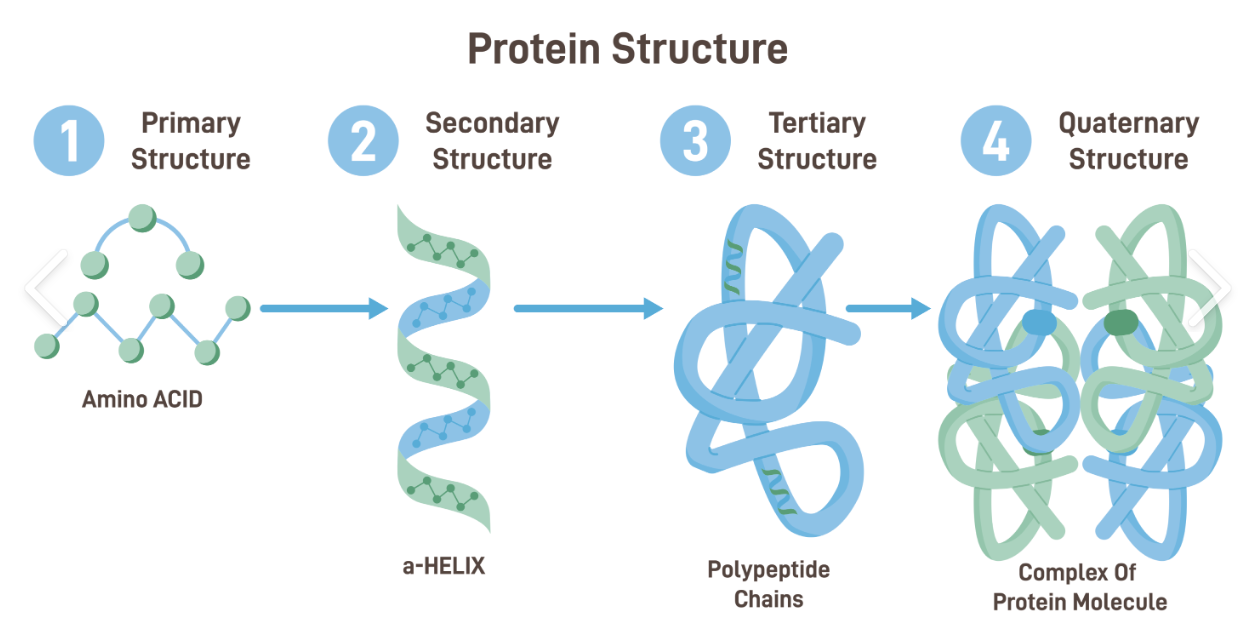
Describe the 4 levels of protein structure
primary- sequence of amino acids
secondary- how primary amino acids interact with each other, alpha helix coils to resemble a spring, beta pleated sheets resemble an accordion
tertiary- 2 or more proteins fold into each other
quaternary structure- how 2 or more polypeptide chains with their own tertiary structure come together to form functional protein
Describe the two categories of protein shape
Fibrous- structural proteins
strandlike, water-insoluble, stable
most have tertiary/quaternary structure
provide mechanical support+ strength
ex. keratin or collagen
Globular
Compact, spherical, water-soluble, and sensitive to environmental changes
Tertiary or quaternary structure
Specific active sites
Examples: antibodies, hormones,
Describe protein, denaturation, and explain the consequences of it occuring
Denaturation- protein loses 3d shape
caused by decreased pH or increased temp.
usually reversible if normal conditions restored
irreversible if changes are extreme
ex. cant uncook an egg
Describe holoenzymes, apoenzymes, coenzymes, and cofactors and explain their importance
holoenzyme- most functional enzymes
2 portions
apoezyme- protein
cofactor- metal ion or coenzyme
those two make an active sight
apoenzyme holds into a 3d shape but cant function so it binds to cofactor which brings a positive charge
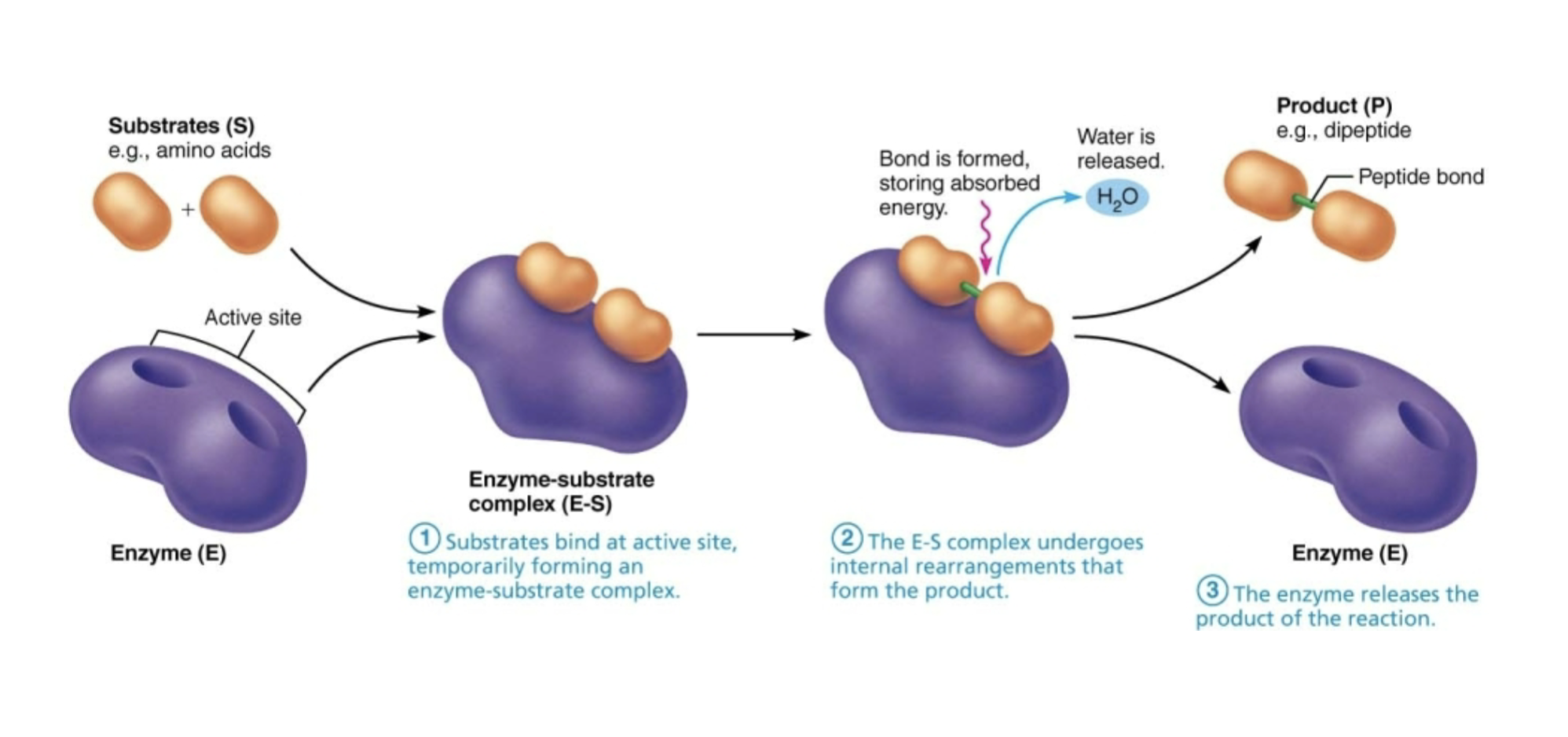
Describe the induced fit model of enzyme substrate interactions and explain the role of enzymes in biological systems
substrate binds at active site, which forms a temporary enzyme- substrate complex
the E-S complex undergoes interal rearrangements that form the product
the enzyme releases the product of reaction
this process is important because it helps the enzyme lower activation energy and speed up reactions
Describe the composition and functions of the two types of nucleic acids
DNA
made of nucleotides
double stranded
cells use for genetic storage
instructions for anything an organism could make
RNA
made of nnucleotides
information transfer
single stranded
temporary
carry out the DNA orders for protein synthesis
mRNA, tRNA,rRNA
Describe the structure and function of ATP
modified nucleotide used for energy
nitrogen base, sugar, phosphate group makes nucleotide + phosphate groups
the more phospate groups determines AMP,ADP or ATP
ATP- adenosine triphosphate