Cognitive Development KINE 3500
 Call Kai
 Learn
Learn Practice Test
 Spaced Repetition
 Match
Match Flashcards
 Knowt Play
1/55

There's no tags or description
Looks like no tags are added yet.
Name | Mastery | Learn | Test | Matching | Spaced | Call with Kai | Chat |
|---|
No analytics yet
Send a link to your students to track their progress
56 Terms
Cognition refers to
the various faculties or mental processes through which knowledge is acquired and manipulated.
Cognition processes include
thinking, making memories, retrieving information, executive functions, language acquisitions, etc.
Cognitive Development is the changes in
structure and function in mental processes throughout the lifespan
Cognitive Development occurs as a result of what?
dynamic and reciprocal relationships occurring between genetics and environments.
Psychomotor Development Chart
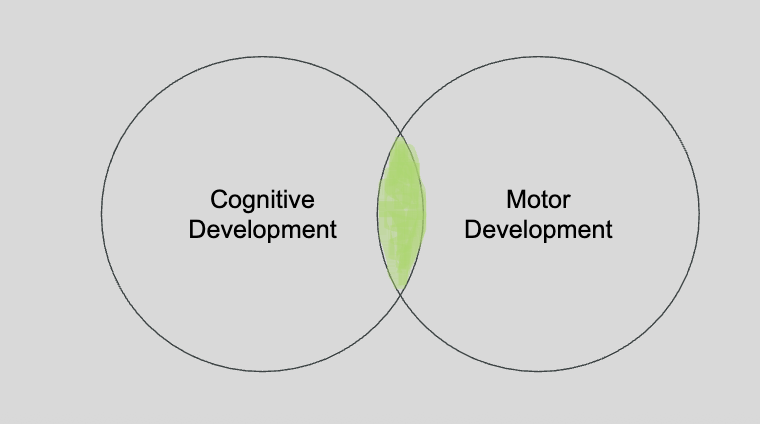
is the relationship between the two
The brain consists of
Neurons, Hemispheres, and Lobes
The Brain - Neurons
Nervous System
Basic Unit: Neuron
Myelination : gradually increases as we develop, better quicker responses and connections

The Left Hemisphere of the brain is responsible for
- Sequential Processing
- Analytic Thought
- Logic
- Language
- Science and Math
The Right Hemisphere of the brain is responsible for
Simultaneous processing
Holistic thought
Intuition
Creativity
Art & Music
The Brain Lobes
Compromised of 4 lobes
◦ Frontal – decision making, inhibition, motor control
◦ Parietal – interprets touch and proprioception
◦ Temporal – House memories, emotions, language
◦ Occipital – Interprets visual stimuli
Picture of Brain Lobes

What are the different theories of Cognitive Development
Jean Piagets : Cognitive Development Theory
Lev Vygotsky’s : Sociocultural Theory
Bronfenbrenner’s : Bioecological Theory
Information Processing Theory
Jean Piaget Theory of Cognitive Development
Viewed intelligence as a process that helps an organism adapt to its environment.
Constructivism (How children create their own understandings of things)
Interactionist (thinking and experiences interacting)
Jean Piaget Theory of Cognitive Development used what kind of method to collect data
Clinical
system of asking questions and obtaining answers
Jean Piaget Theory of Cognitive Development stages are
Invariant, children pass through each, and each stage is more complex

Jean Piaget Theory of Cognitive Development : Sensorimotor Stage
Birth-2 Years
Intelligence develops because of movement and sensing
Creeping and Crawling allow for the interaction with new objects, new situations, new surfaces, new people, that facilitate learning
Object Permanence : cover an object with a blanket, but baby things it disappeared all the way
Jean Piaget Theory of Cognitive Development : Preoperational Stage
2 to 7 Years Old
Egocentric
Play
Motor activities such as walking increase interactions with others and increases awareness of others and their needs
cannot put themselves in others shoes
Jean Piaget Theory of Cognitive Development : Concrete Operational Stage
7 to 11 years old
child begins to think logically
Ability to mentally modify, organize, or even reverse thought processes; mental representation; aware of alternate solutions; decentering; seriation
Jean Piaget Theory of Cognitive Development : Formal Operational Stage
11- 12 years old
child understands abstract ideas, concepts
Not based on observation or reality
Hypothetical deductive reasoning, can sort out various propositions to arrive at a solution
Postformal Operations has been suggested by
other researcher’s
involves how individuals deal with large quantities of information
flexible, logical and complex
What are some criticisms of Piaget’s Theory?
Clinical method lacks scientific control
Observation was of own children
Highest level of intellectual development is thought to occur at age 11, what about adulthood?
Does not account for motivation or emotion
Piaget says little about the role of parents
Lev Vygotsky’s Sociocultural Theory states that cognitive development occurs in
sociocultural context and evolves out of social interactions with other members of one’s culture
Knowledge is dependent on social experiences
Lev Vygotsky’s Sociocultural Theory states that cognitive development varies from
society to society due to differences in language, values, customs, etc.
Lev Vygotsky’s Sociocultural Theory Chart

Lev Vygotsky’s Sociocultural Theory states that the concept of Zone of Proximal Development
is the gap between what a learner can accomplish alone and what a learner can accomplish with guidance and assistance from another
In Lev Vygotsky’s Sociocultural Theory, the concept is the process of Scaffolding is
modifying level of support or guidance another individual needs to accomplish a task
Is how (provide support, guidance) an individual can accomplish a task
Urie Bronfenbrenner’s Bioecological Model states that cognitive development occurs
in context of several nested systems that interact with each other and the individual
This means there are many reciprocal/bidirectional influences occurring to bring about development
What is the Bioecological Model

What is Microsystem
the immediate physical and social environment of the individual
(Bioecological Model)
What is the consistent interrelationship between 2+ microsystems
Mesosystem
(Bioecological Model)
What is Exosystem
consists of social settings that are not experienced directly, but they still influence development
(Bioecological Model)
What is Macrosystem
consist of the culture and society contexts
(Bioecological Model)
What is Chronosystem
embodies all systems and captures the idea that people, their environments, their relationships will change overtime.
(Bioecological Model)
Information Processing Model states that the
brain acts like a computer and cognitive development occurs in the same way that a computer processes information
What is the Information Processing Theory (flow chart)
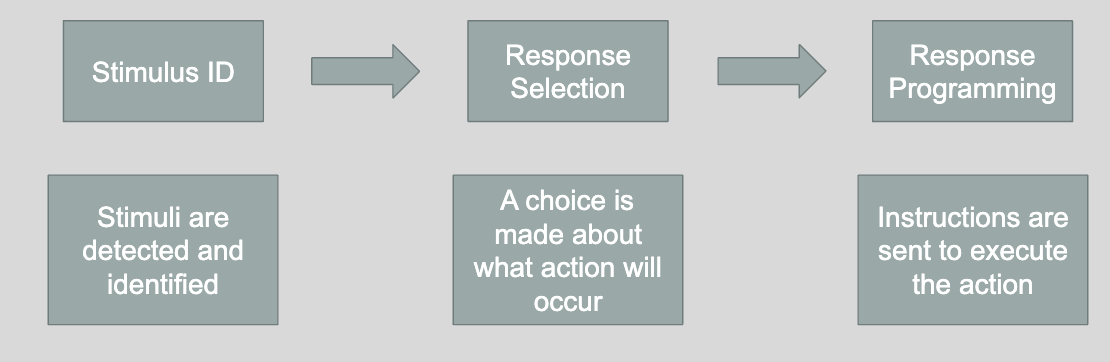
What are some different concepts from the Information Processing Theory
Memory is the process of identifying, storing, and retrieving information (Sigelman and Rider, p. 234)
Primary Memory/Short Term Sensory Storage
Secondary Memory/ Short Term Memory
Long Term Memory
What is Primary Memory
Short Term Sensory Stage Memory
information is held for a second, unlimited capacity
What is Secondary Memory?
Short Term Memory
information is stored and can be transformed to long term memory
What is Long term memory
Where information is stored and can be transformed to long term memory
Children do not use there
memory systems as effectively as adults; thus memory may be the cause of differences in motor performance
Differences in memory of children vs adult could be due to
the capacity of mental space or use of strategies
Children have a _____ data based on fewer experiences
smaller
Memory and Children Forgetting curve , __________ and ___________
Primacy and Recency Effect
The primacy effect-information of the forgetting curve
presented first is remembered more
( list of 12 grocery items, you remember the first 3)
Recency Effect-Information of the forgetting curve
presented last is also remembered more
list of 12 grocery items and you lose list, you remember the last 3 items
What is knowledge?
information, understanding, or skills gained from experience or education
Declarative, Procedural, and Strategic
Declarative Knowledge
factual information
Procedural Knowledge
how to do something
Strategic Knowledge
knowing general rules or strategies
Movement is ________ for cognitive processes
Essential
Doing movement shows Improvements in cognition , _________, _____________
academic achievement, neuropsychological test
(2018 Physical Activity Guidelines)
Greater amounts of physical activity are associated with
a reduced risk of developing cognitive impairment (i.e., Alzheimer’s disease)
Physical Activity Guidelines for Americans chart

Cognition takes part of your entire life
Habitual - Everyday
Acute - Maybe once in awhile
REMEMBER THIS CHART
How is Cognition Measured?
Behavioral Rating Inventory of Executive Function
Inhibition, working memory, planning
Instructions for how Stroop Test is Measured
Measures Executive Function, Processing Speed
Words are presented in a certain color, however individuals are required to say the color of the word not what the word says.
◦ Example: RED, you should say "Blue."
How is HTKS-R Cognition measured
Head, Toes, Knees, and Shoulders Raised
Executive Function and Behavioral Self-Regulation
Instruction:
Children are first asked to follow rules: “Touch your head, touch your toes, etc.” Then they are told to switch and respond opposite to what they are told
(e.g., When asked to touch head, child would touch their toes)