(L10) IMED2003 - Understanding RCTs
 Call Kai
 Learn
Learn Practice Test
 Spaced Repetition
 Match
Match Flashcards
 Knowt Play
1/71

There's no tags or description
Looks like no tags are added yet.
Name | Mastery | Learn | Test | Matching | Spaced | Call with Kai | Chat |
|---|
No analytics yet
Send a link to your students to track their progress
72 Terms
What are the four learning outcomes for understanding randomised controlled trials (RCTs)?
1. Understand the characteristics of and identify issues in group allocation for RCTs, including randomisation and blinding.
2. Understand the characteristics of and identify issues in data collection for RCTs.
3. Understand the characteristics of and identify issues in data analysis for RCTs, including Intention-to-Treat (ITT) versus Per-Protocol (PP) analysis.
4. Understand the CONSORT statement and why it is used.
Lecturer emphasis:
The key focus is recognising how RCT rigour comes from allocation, blinding, data collection, analysis and standardised reporting rather than from mathematical calculation.

Which types of PICO(T) questions may require an RCT study design?
Most commonly:
- Therapy questions
- Diagnostic questions
.
May also sometimes be used for:
- Prevention
- Aetiology/cause
However, prevention and aetiology questions may require retrospective or observational designs when an RCT would be unethical or impractical.
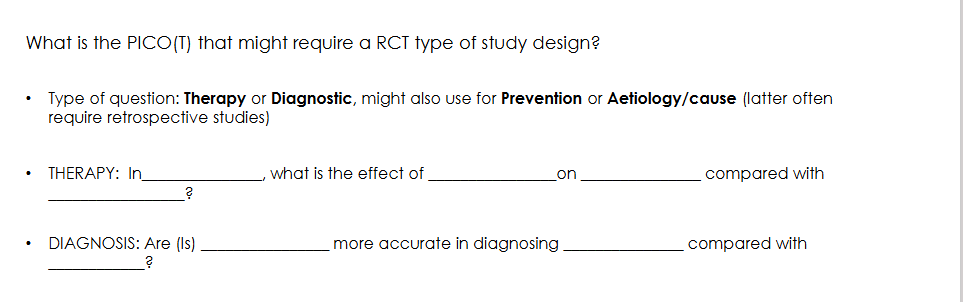
What are the generic PICO(T) forms for therapy and diagnosis questions that may use an RCT?
Therapy:
In [population], what is the effect of [intervention] on [outcome] compared with [comparison]?
Diagnosis:
Is/are [index test] more accurate in diagnosing [condition] compared with [comparison test]?
![<p>Therapy:</p><p>In [population], what is the effect of [intervention] on [outcome] compared with [comparison]?</p><p>Diagnosis:</p><p>Is/are [index test] more accurate in diagnosing [condition] compared with [comparison test]?</p>](https://assets.knowt.com/user-attachments/ad731d18-147c-494c-8dc8-716a72f0c79d.png)
When is an RCT especially useful?
When the research question asks about the direct effect of an intervention on an outcome.
Examples of interventions:
- Drug
- Therapy
- Medical device
RCTs are considered the gold-standard interventional/experimental study design because they can reduce bias and provide stronger evidence about causal effects.
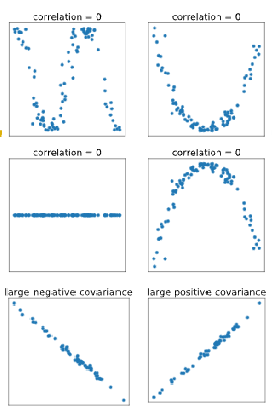
What does "correlation does not mean causation" mean in the context of RCTs?
A correlation shows an association between variables, but does not prove that one variable caused the other.
An RCT can help investigate causation because the researcher controls the intervention and comparison conditions.
.
Lecturer emphasis:
A correlation may reflect a causal relationship, but correlation alone is not enough to establish causation.
What is bias, and how do RCTs reduce it?
Bias:
Any systematic error in collecting and interpreting data.
.
RCTs reduce bias through:
- Effective randomisation.
- Appropriate control groups.
- Blinding where possible.
- Standardised data collection and analysis.
Bias cannot necessarily be eliminated completely.
Why is the control group important in an RCT?
It provides a basis for comparison with the intervention group.
The control group should be as similar as possible to the intervention group at baseline.
This strengthens internal validity because differences observed later are more plausibly attributable to the intervention.
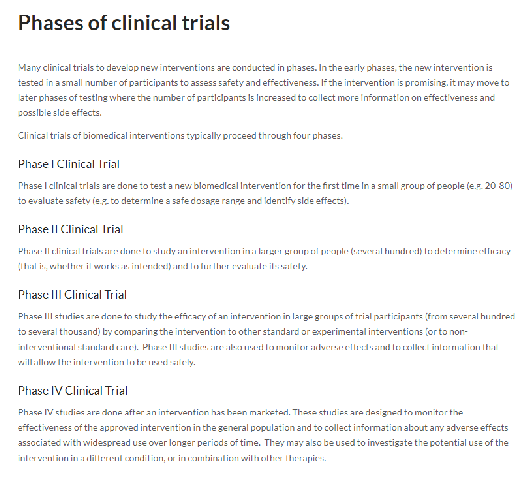
How does an RCT differ from a clinical trial?
Clinical trial:
A human intervention study.
.
RCT:
A specific study design that uses random allocation and a control/comparison group.
Not every clinical trial is an RCT, although later-phase clinical trials often use RCT methods when ethically and practically possible.
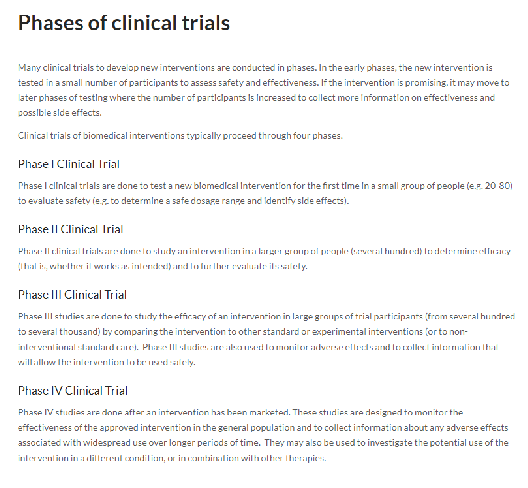

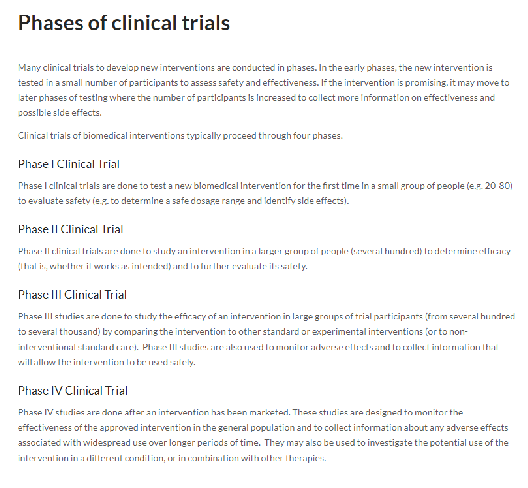
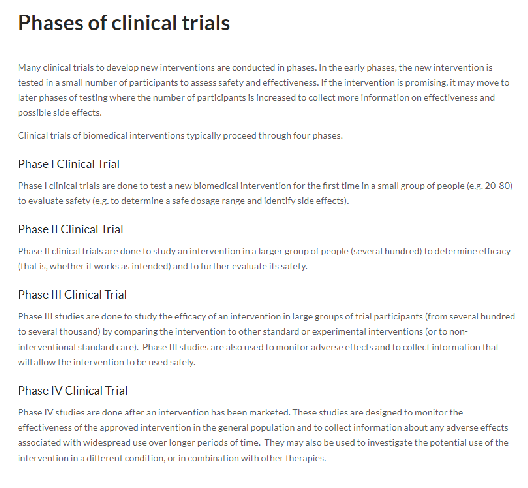
What is the general purpose of clinical trial phases?
A non-approved therapeutic, medical device or biologic typically progresses through phases to build evidence before regulatory approval.
General progression:
- Early phases emphasise safety.
- Later phases recruit more participants and increasingly assess efficacy.
- Evidence is accumulated for regulatory bodies such as the TGA.
.
Lecturer explanation:
Phase 1 may involve very small numbers when a treatment is genuinely novel.
What did the lecturer's gene-therapy example illustrate about early clinical trials?
The lecturer described an early gene-therapy trial for macular degeneration.
.
Because it was a new class of therapy:
- The study began with very small numbers.
- Participants were treated one at a time.
- The first priority was safety, not efficacy.
- A serious problem in an early participant could trigger stopping of the trial.

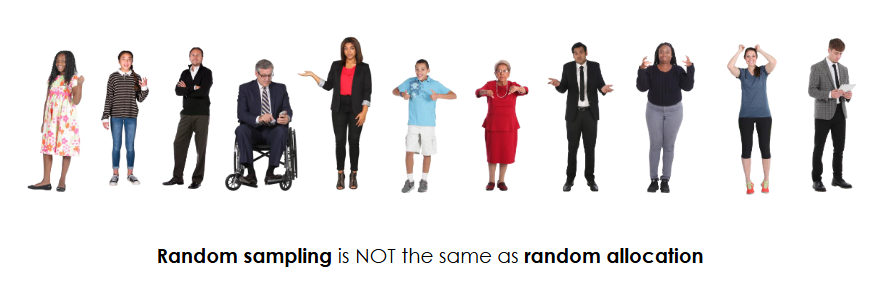
What does the word "random" mean in a randomised controlled trial?
It refers to random allocation of eligible participants to study groups.
It does NOT mean random sampling from the entire population.
.
Lecturer emphasis:
RCT participants are usually selected using specific inclusion and exclusion criteria before random allocation occurs.
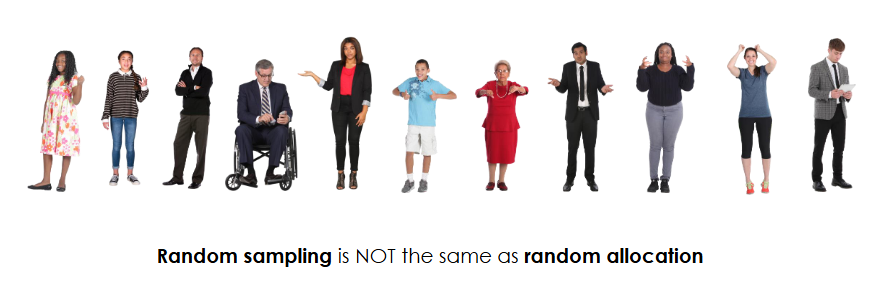
Why is random sampling usually inappropriate for an RCT?
RCTs generally require a very specific study sample.
Researchers may need participants with:
- A particular diagnosis.
- A defined disease severity.
- Specific prior treatments.
- Specific inclusion and exclusion criteria.
Only after eligible participants are selected are they randomly allocated to groups.
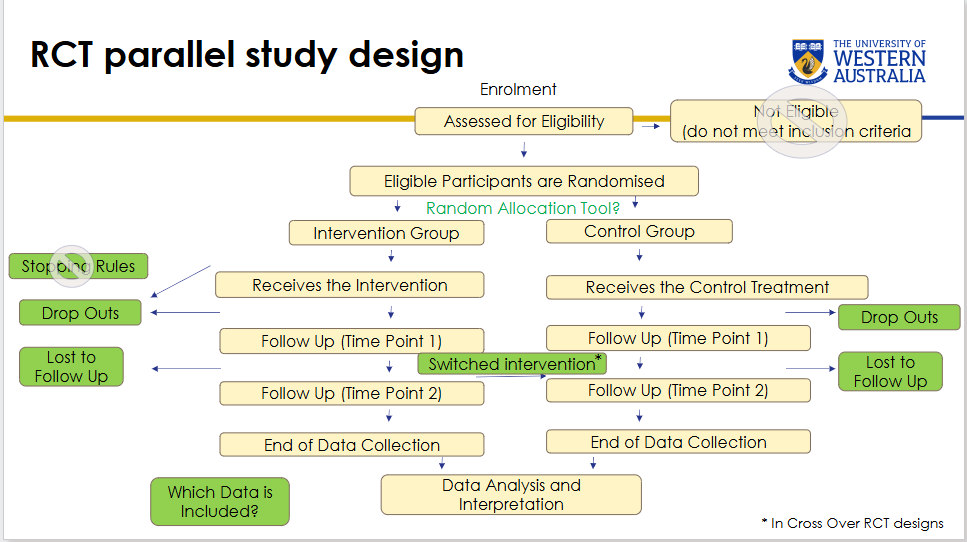
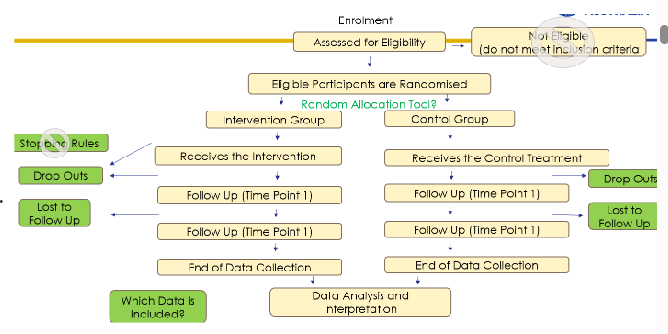
What is the typical sequence in a parallel RCT design?
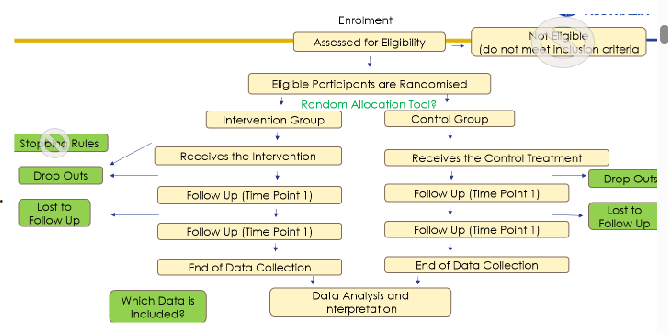
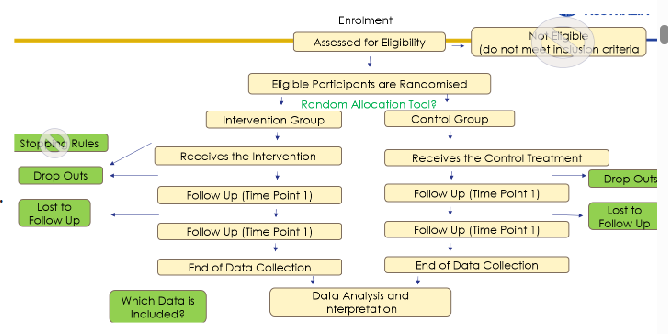
1. Enrolment.
2. Assess eligibility.
3. Exclude those not meeting inclusion criteria.
4. Randomise eligible participants.
5. Allocate to intervention or control.
6. Deliver intervention/control treatment.
7. Conduct follow-up at planned time points.
8. Manage drop-outs, loss to follow-up, stopping rules and any crossover.
9. End data collection.
10. Decide which data are included.
11. Analyse and interpret the data.
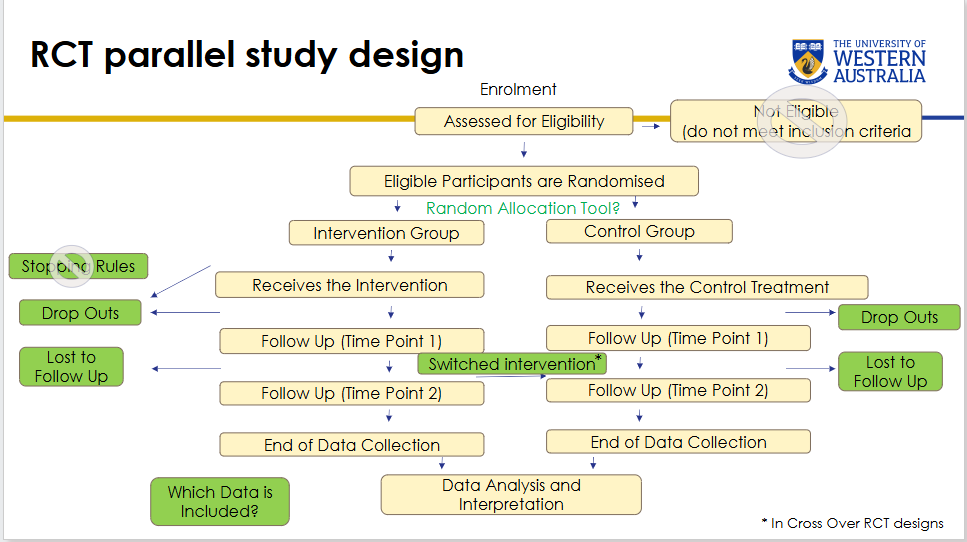

What is the usual role of the control treatment in a parallel RCT?
The control group commonly receives:
- Standard/current therapy, or
- A placebo where appropriate.
The intervention and control arms run in parallel over the same general time period with comparable follow-up.
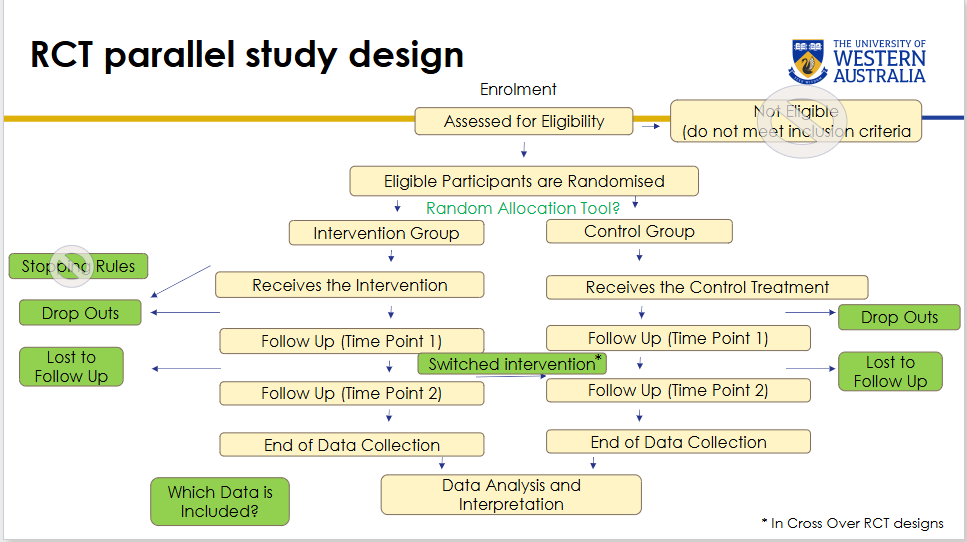

What events can alter participant numbers during an RCT?
- Drop-outs
- Loss to follow-up
- Stopping rules
- Switched intervention in crossover designs
These events affect which data remain available for final analysis.

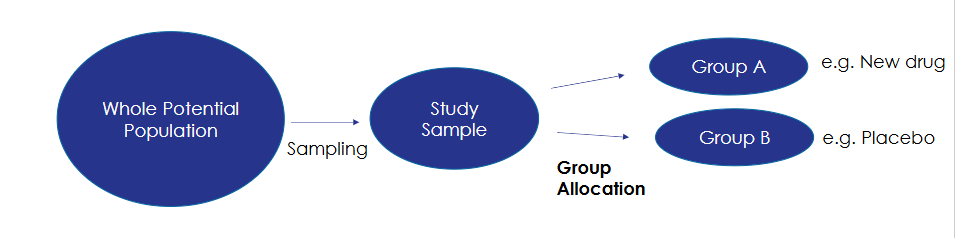
When does group allocation occur in an RCT?
After the study sample has already been selected.
Sequence:
Whole potential population → sampling → study sample → group allocation → intervention/control groups.

Why is randomisation used during RCT group allocation?
To reduce:
- Allocation bias
- Researcher bias
The aim is to distribute important participant characteristics across groups so intervention and control groups are as similar as possible at baseline.
Why is alternating allocation not good randomisation?
Alternating allocation, such as assigning participants 1-2-1-2, is predictable and may fail to balance participant characteristics.
It can also allow researchers to anticipate or influence allocation.
Therefore, it can increase allocation bias.
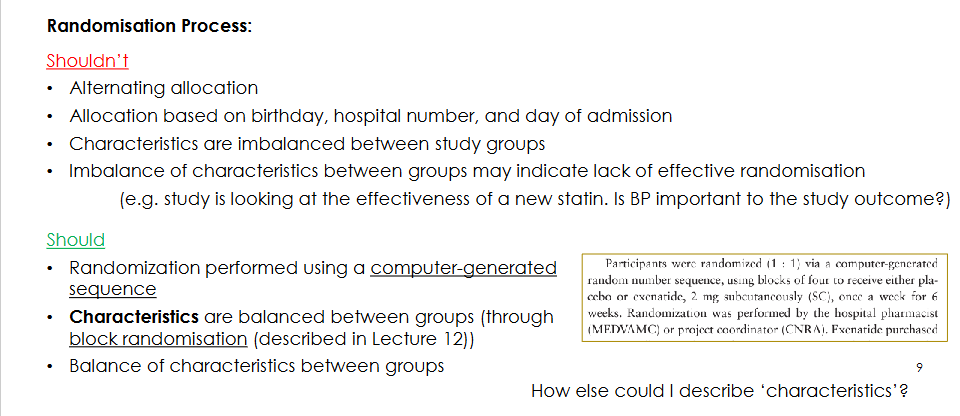
Which allocation methods should NOT be used as randomisation methods?
- Alternating allocation.
- Allocation based on birthday.
- Allocation based on hospital number.
- Allocation based on day of admission.
These are predictable and may result in imbalanced study groups.
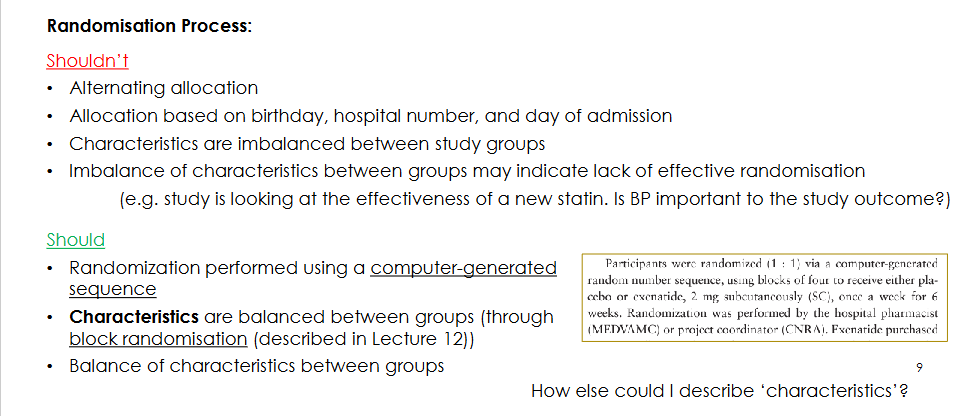
Which randomisation methods are preferred in an RCT?
Preferred approaches include:
- Computer-generated randomisation sequences.
- Block randomisation.
.
The aim is to balance important characteristics between groups.
What participant "characteristics" should ideally be balanced between RCT groups?
Potentially relevant confounding variables such as:
- Age
- Sex
- Blood pressure
- Relevant co-existing diseases
- Other factors that could affect the study outcome
.
Lecturer example:
Blood pressure could matter in a trial evaluating a new statin.
How can baseline imbalance suggest a problem with randomisation?
If important participant characteristics are substantially different between groups before treatment begins, randomisation may not have worked effectively.
Effective randomisation should make the groups as comparable as possible at baseline.
What is blinding in an RCT?
Blinding means keeping people unaware of treatment allocation where possible.
.
People who may be blinded include:
- Participants.
- Investigators/researchers.
- Outcome assessors.
- Data collectors.
- Statisticians.
Why is blinding important in RCTs?
Knowledge of treatment allocation can influence:
- Participant expectations.
- Researcher behaviour.
- Outcome measurement.
- Data interpretation.
Blinding reduces observation and researcher bias.
What is SNOSE, and what is it used for?
SNOSE:
Sequentially Numbered, Opaque, Sealed Envelopes.
Purpose:
Allocation concealment.
It helps prevent researchers or participants from knowing upcoming group allocation before assignment.
Why are participants often coded or numbered during data collection?
Coding helps conceal treatment allocation.
Assessors and analysts can work with participant numbers rather than knowing who received which intervention.
This reduces the risk that knowledge of treatment group influences measurement or interpretation.
Why can blinding be impossible in some RCTs?
The intervention itself may make allocation obvious.
Lecturer example:
Back-pain study:
- Control = NSAID.
- Intervention = NSAID + acupuncture.
Participants and some researchers would know whether acupuncture was delivered.
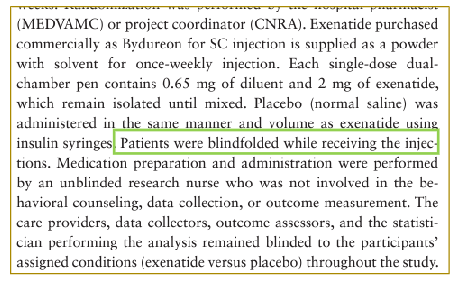
How did the lecture illustrate that blinding can sometimes literally mean blindfolding?
In one study:
- Participants were physically blindfolded while receiving an injection.
- The administering nurse was not blinded.
- Assessors, data collectors and statisticians were blinded.
The purpose was to conceal treatment information that could not otherwise be hidden.

What is a drop-out in an RCT?
A participant who withdraws from the study.
Participant autonomy requires that consent can be withdrawn at any time.
Possible reasons:
- Death
- Moving away
- Adverse events
- Personal choice
Researchers should report drop-out numbers and reasons.
Why is the drop-out rate informative?
High drop-out may indicate:
- Poor acceptability.
- Adverse events.
- Burden of treatment.
- Other problems with the intervention or study.
Drop-outs also reduce sample size and can reduce statistical power.
What is loss to follow-up (LTFU)?
When a participant stops attending care or evaluation and researchers no longer obtain follow-up data.
Unlike a formal drop-out, the participant may not explicitly withdraw consent.
LTFU creates missing data and reduces sample size.
What level of loss to follow-up was described as ideal in the lecture?
Ideally:
Less than 5% of participants.
Some LTFU is generally expected, but numbers should be reported.
How do drop-out and loss to follow-up affect an RCT?
They can:
- Reduce sample size.
- Create missing data.
- Reduce statistical power.
- Increase uncertainty or bias in interpretation.
Researchers should anticipate some attrition when planning sample size.
What are stopping rules in an RCT?
Predefined or ethically necessary reasons to stop a trial early.
Examples:
- Severe adverse events.
- Harms outweigh benefits.
- Interim analysis appears to show a large treatment effect.

Why can stopping an RCT early for apparent benefit be misleading?
An early interim analysis may show a large statistically significant effect that would not persist if the study continued.
This risk is greater with smaller sample sizes.
Lecturer explanation:
If a trial was designed for longer follow-up, stopping at an early favourable time point may exaggerate efficacy.
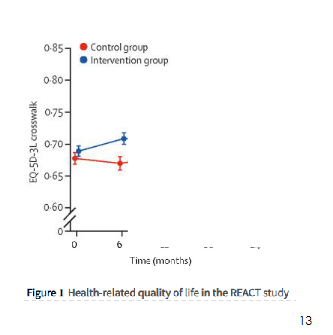
What is a valid ethical reason to stop an RCT early?
Severe adverse events where harms outweigh the benefits of continuing the trial.

What is Intention-to-Treat (ITT) analysis?
ITT includes all participants who were randomised and analyses them according to the group they were originally assigned to, regardless of what treatment they actually received or whether they completed it.
What is Per-Protocol (PP) analysis?
PP includes only participants who completed the treatment originally allocated according to the study protocol.
If PP is the only analysis reported, bias can increase.


What is the key conceptual difference between ITT and PP?
ITT asks:
What is the effect of assigning the treatment?
PP asks:
What is the effect of actually receiving/completing the treatment as planned?
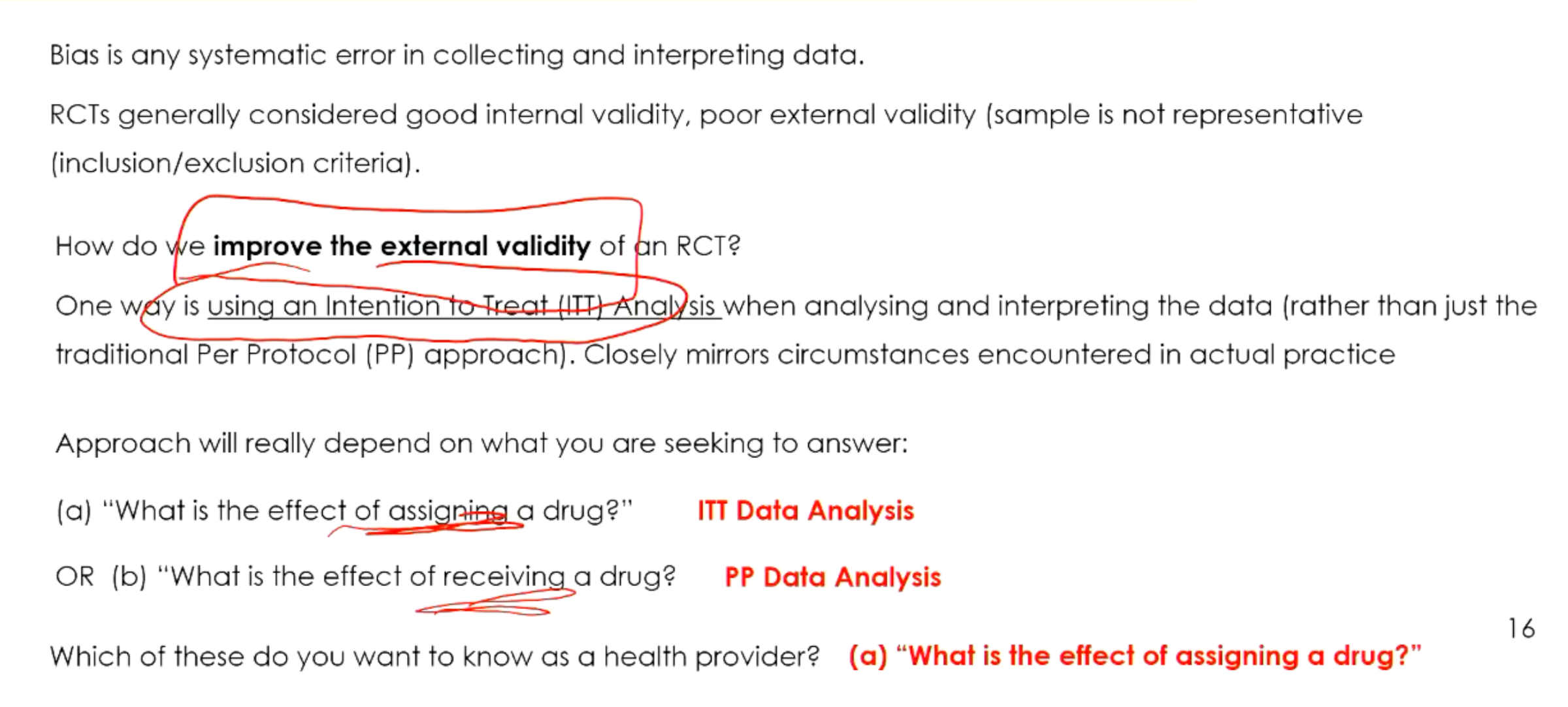
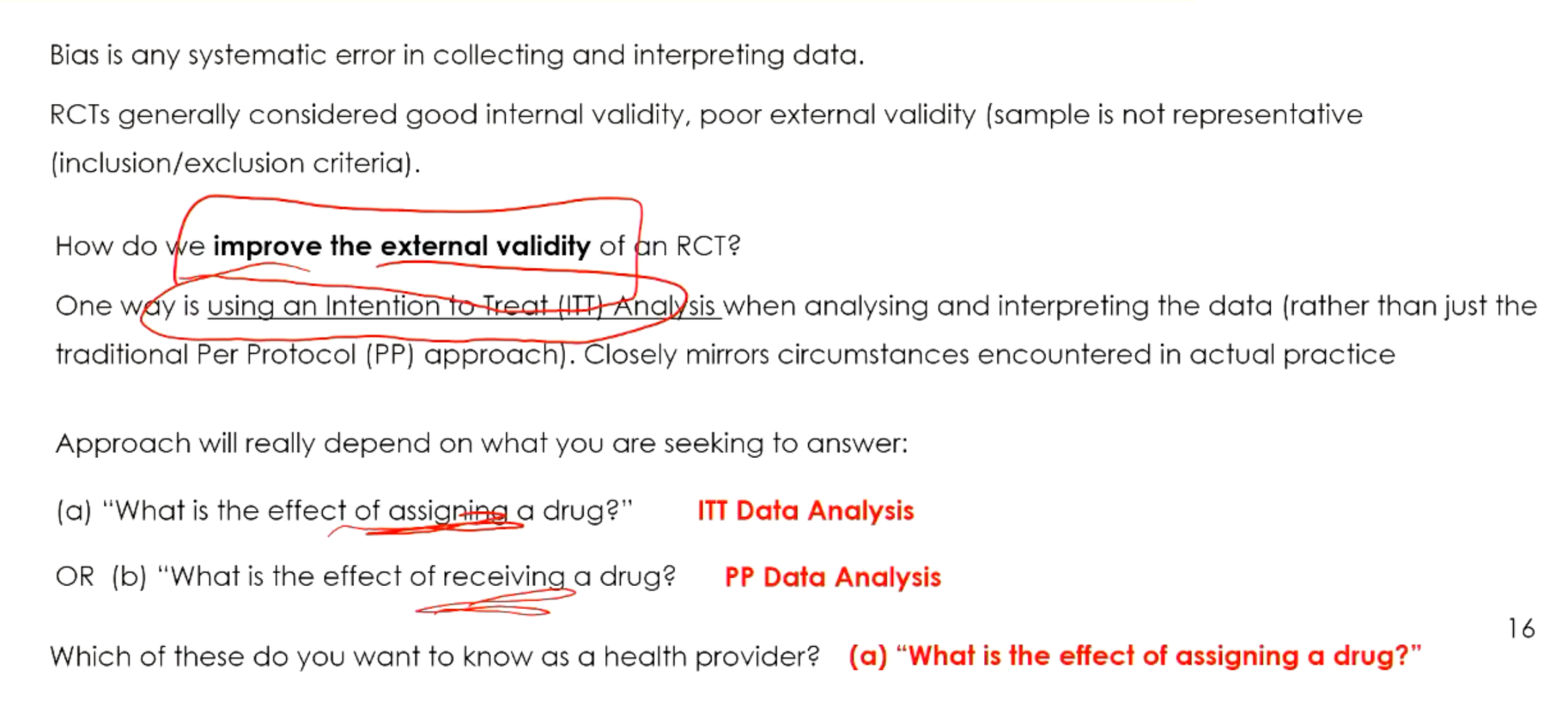
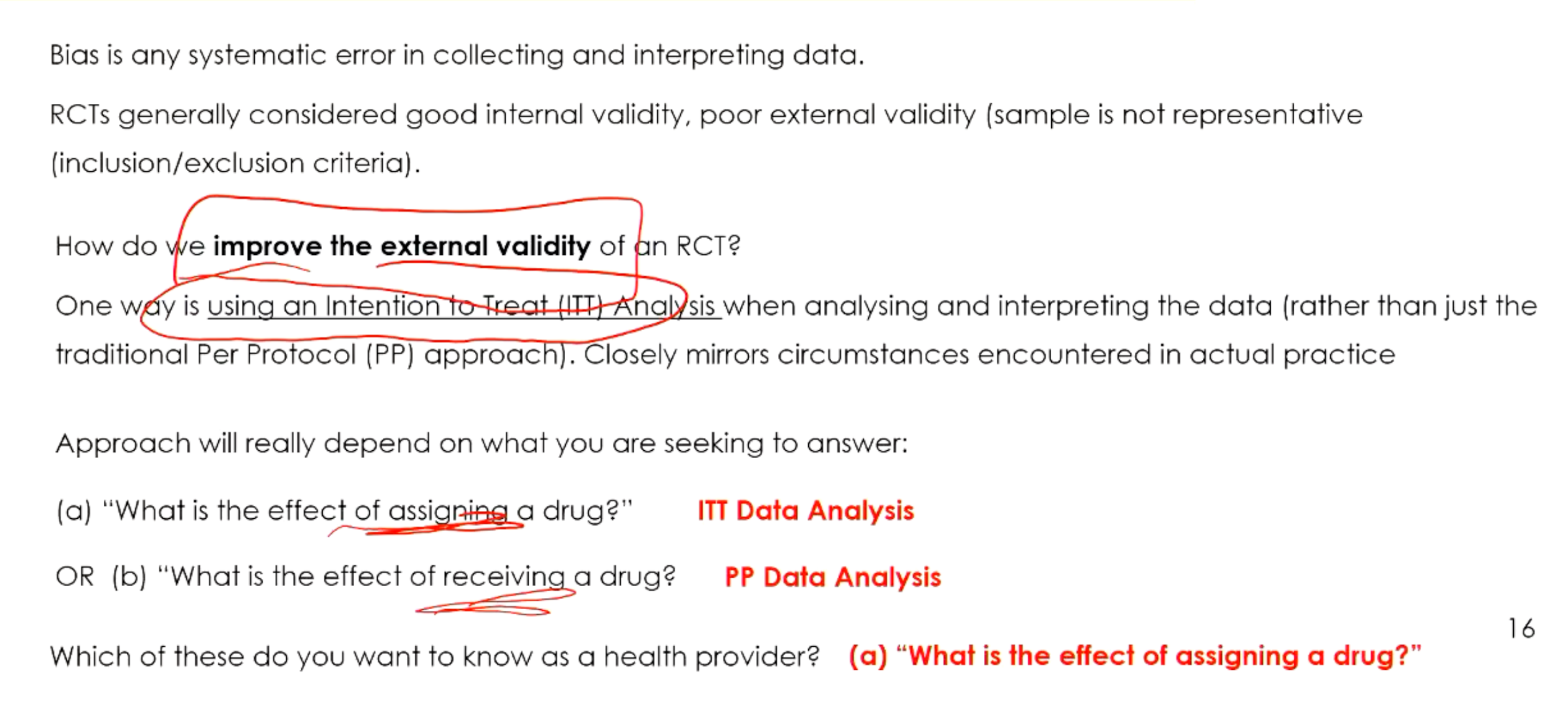
Why can ITT improve the external validity of an RCT?
It more closely reflects real-world clinical practice, where:
- Patients may not adhere fully.
- Some stop treatment.
- Some are lost to follow-up.
Therefore, ITT can better estimate what happens when a clinician prescribes or assigns a treatment in practice.
Why are RCTs often strong in internal validity but weaker in external validity?
Internal validity is strengthened by:
- Randomisation.
- Control groups.
- Blinding.
- Controlled procedures.
.
External validity may be weaker because strict inclusion/exclusion criteria produce a study sample that may not represent the broader patient population.

For a clinician, why may ITT be more useful than PP?
A clinician assigns or prescribes treatment but cannot guarantee perfect adherence.
ITT answers the more practical question:
"What is likely to happen if I prescribe this treatment?"


When might PP data be especially useful?
When treatment adherence is likely to be tightly controlled and completion of the protocol is realistic.
Then the question of interest may be:
"What is the effect when the treatment is actually received as planned?"

Which analysis would be most useful for an outpatient psychiatrist prescribing antipsychotic medication: ITT or PP?
ITT.
Lecturer explanation:
Compliance with antipsychotic medication is often a major real-world problem, so ITT better reflects what happens after treatment is prescribed.

Which analysis might be especially useful for a podiatrist treating a professional athlete with supervised shockwave therapy: ITT or PP?
PP.
Lecturer explanation:
A professional athlete working within a tightly supervised environment is more likely to complete the protocol as intended, so PP may be particularly informative.
What does CONSORT recommend regarding ITT and PP reporting?
Both ITT and PP analyses should be reported for planned outcomes so readers can interpret:
- Real-world effects of treatment assignment.
- Effects among participants who complete the protocol.
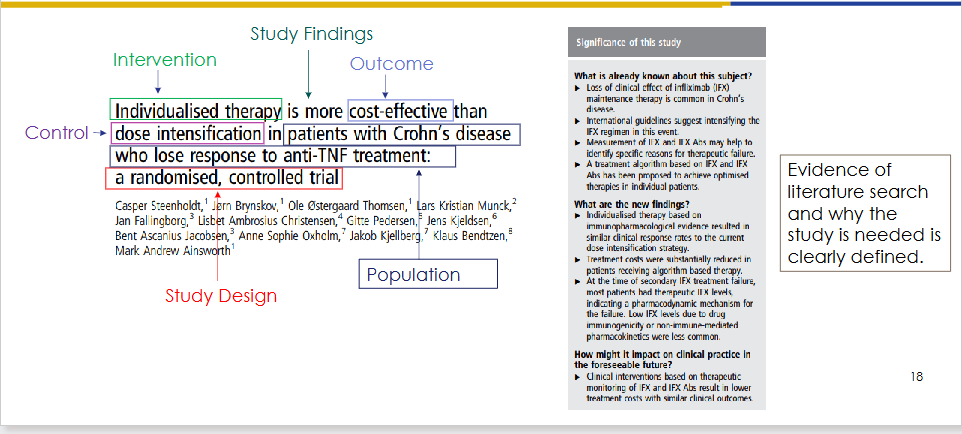
What was the key PICO-style structure of the Crohn's disease RCT example?
Population:
Patients with Crohn's disease who lost response to anti-TNF treatment.
Intervention:
Individualised therapy.
Control:
Dose intensification.
Outcome:
Cost-effectiveness, with response-related outcomes also assessed.
Study design:
Randomised controlled trial.
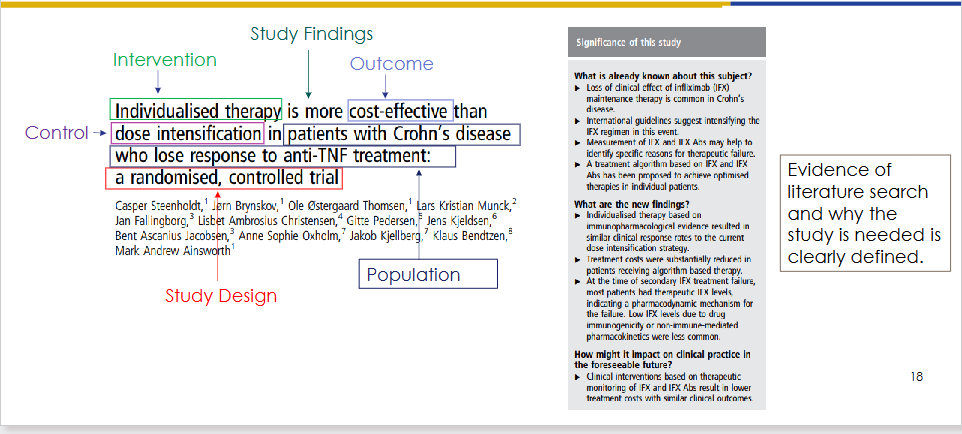
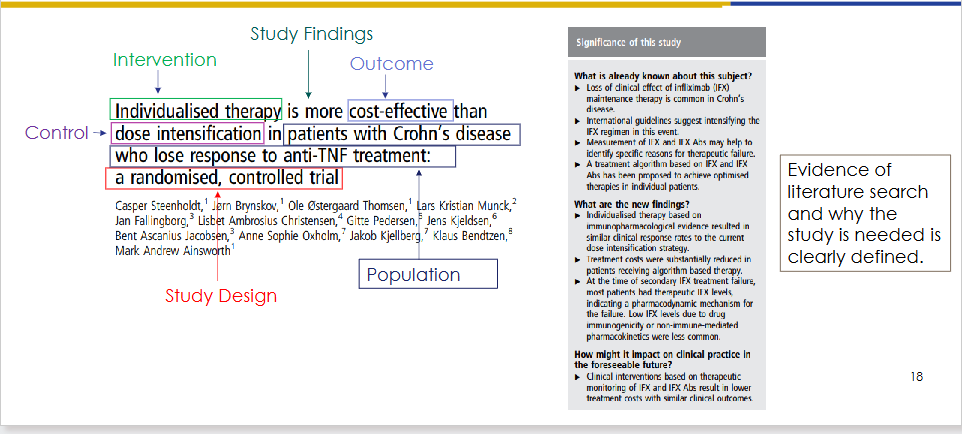
What did the Crohn's disease RCT introduction demonstrate about good study reporting?
It clearly showed:
- Evidence of a literature search.
- What is already known.
- Why the study is needed.
- The population, intervention, comparison, outcome and study design.
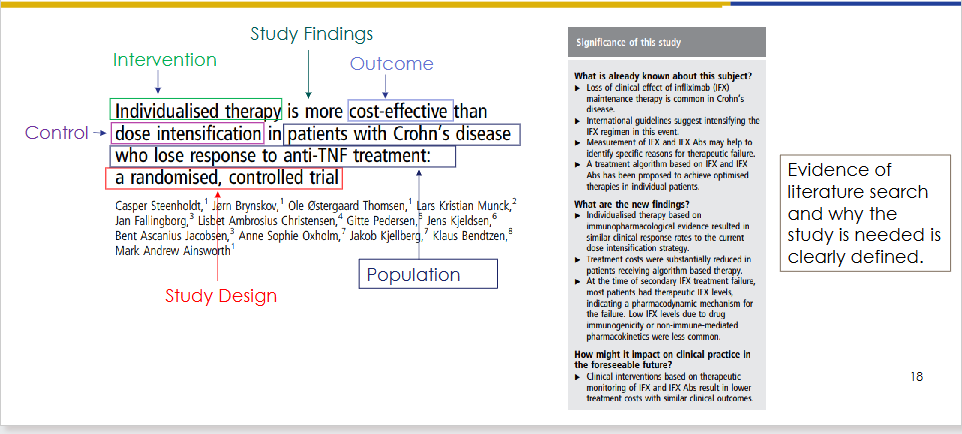

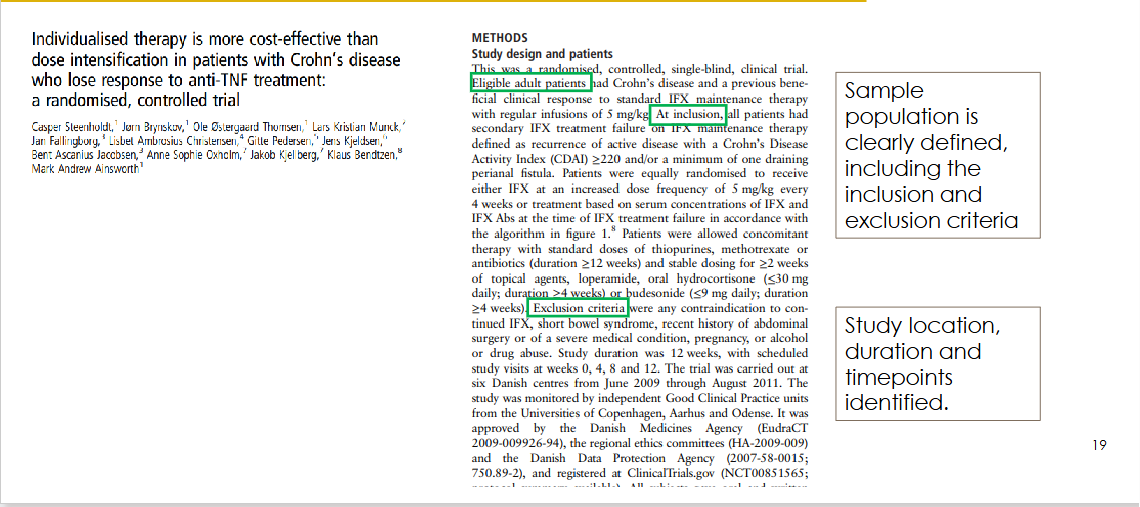
What methodological details were clearly reported for the Crohn's disease RCT sample?
- Clearly defined study population.
- Inclusion criteria.
- Exclusion criteria.
- Study location.
- Study duration.
- Study time points.
.
Lecturer explanation:
These details are necessary so another researcher could reproduce the study as closely as possible.

What outcomes were clearly defined in the Crohn's disease RCT?
Primary outcome:
Cost-effectiveness.
Additional/co-primary outcome:
Response rates.

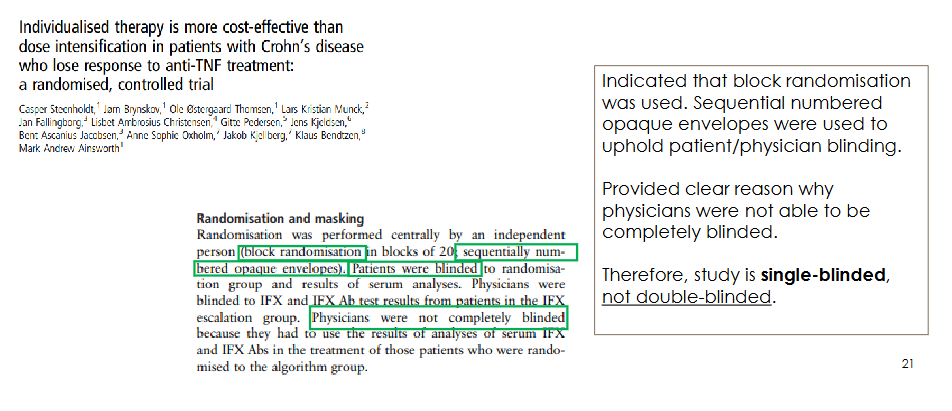
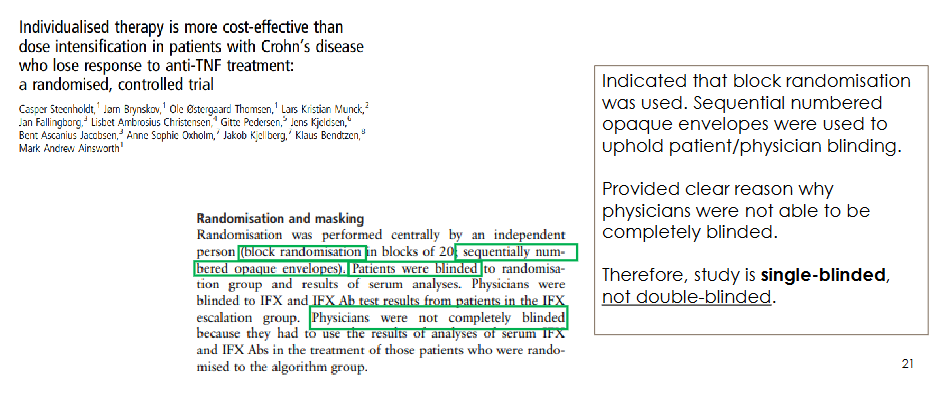
How was randomisation and blinding handled in the Crohn's disease RCT?
- Block randomisation was used.
- Sequentially numbered opaque envelopes were used for allocation concealment.
- Patients were blinded.
- Physicians could not be completely blinded because treatment information was required.
Therefore:
The study was single-blinded, not double-blinded.
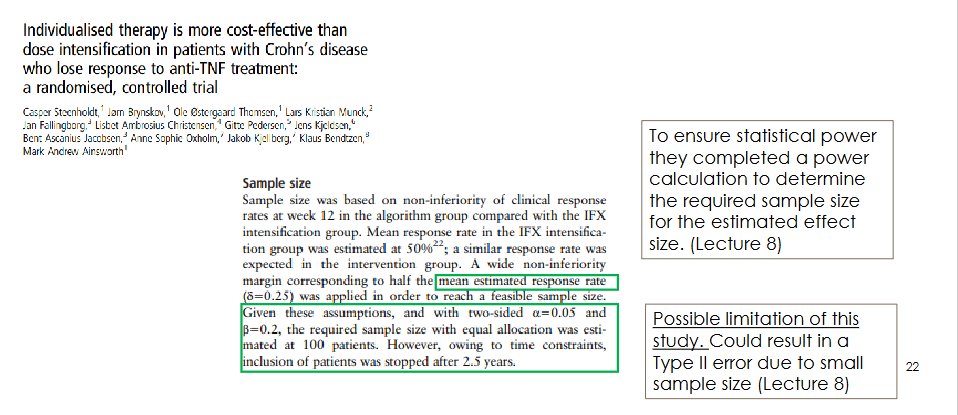
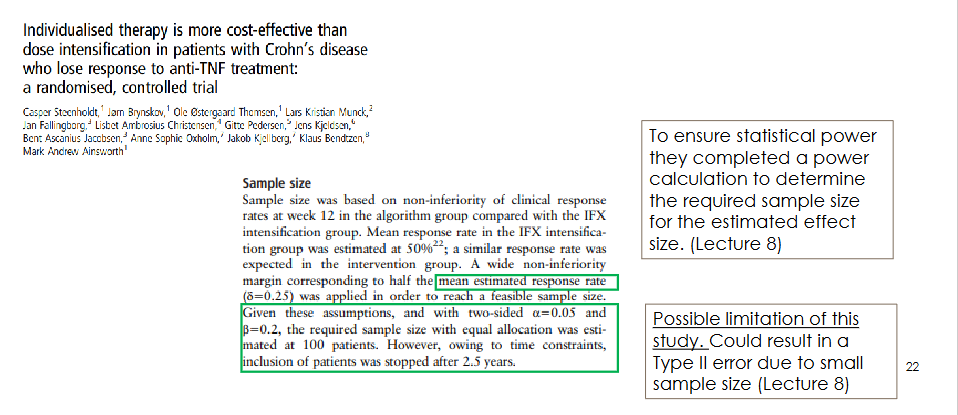
Why was sample size a potential limitation in the Crohn's disease RCT?
The researchers performed a power calculation to determine the required sample size for the estimated effect size.
However:
Recruitment stopped before the intended sample was reached.
Possible consequence:
Insufficient statistical power and increased risk of a Type II error.

What features of the Crohn's disease RCT analysis were reported as strengths?
The study:
- Identified statistical analyses based on data type and distribution.
- Explained how drop-out and missing data were handled.
- Reported both ITT and PP analyses.


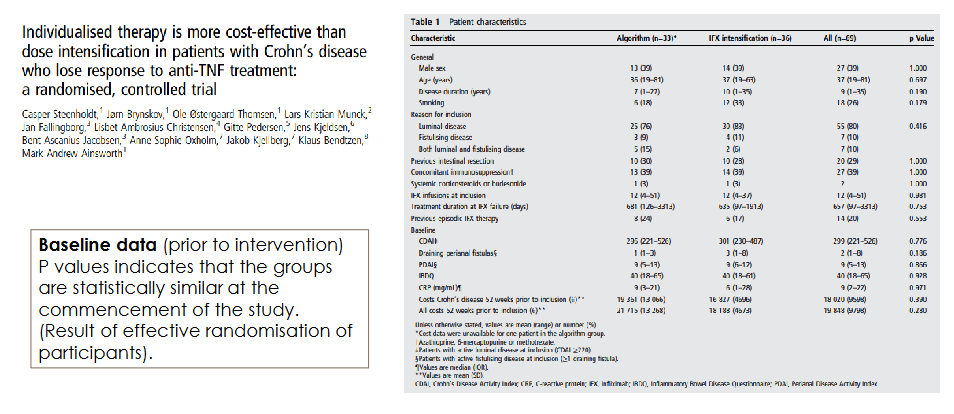
What did the baseline data in the Crohn's disease RCT indicate?
The intervention and control groups were statistically similar before treatment.
.
Lecturer explanation:
Large p-values at baseline indicated closer similarity between groups.
A p-value of 1 indicated identical values for that characteristic.
This supported effective randomisation.
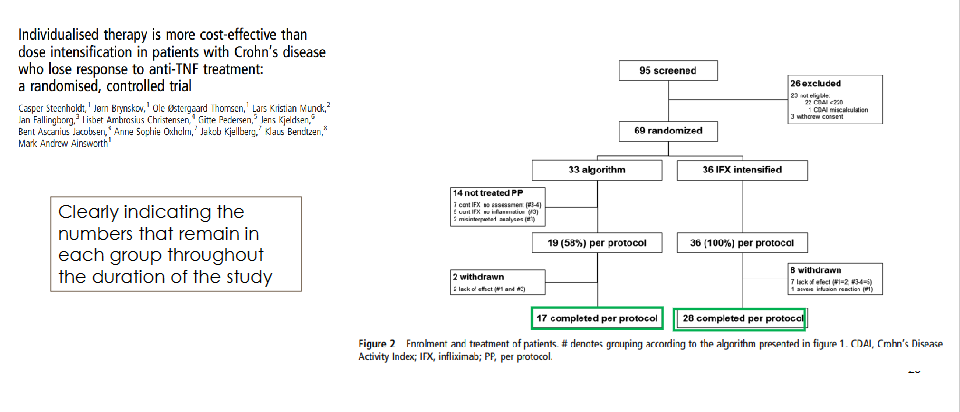
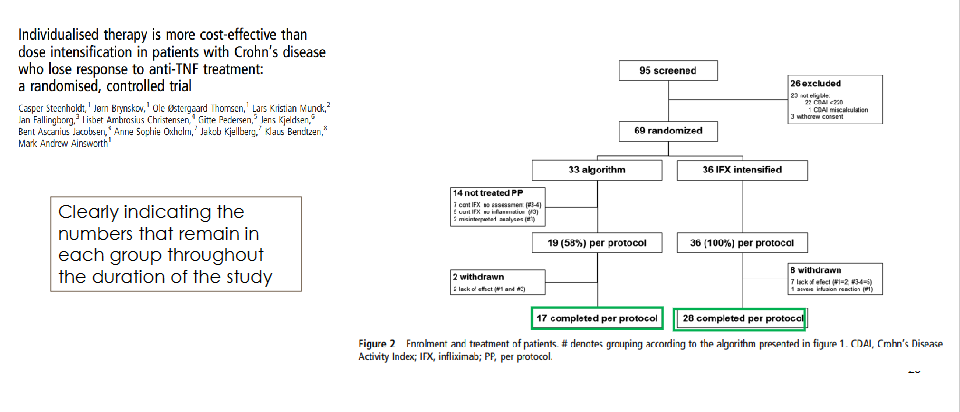
What did the participant-flow diagram in the Crohn's disease RCT show?
It clearly showed:
- Number screened.
- Number excluded.
- Number randomised.
- Allocation to each group.
- Withdrawals/drop-outs.
- Number remaining.
- Number completing per protocol.
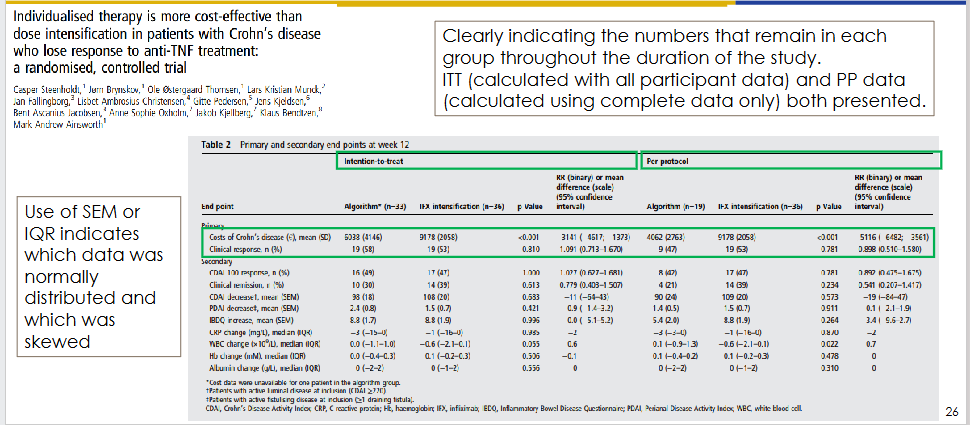
What did the Crohn's disease RCT show by reporting both ITT and PP outcome data?
ITT:
Used data from all randomised participants according to original allocation.
.
PP:
Used complete data from participants who completed the protocol.
Reporting both allows readers to compare real-world assignment effects with protocol-completer effects.


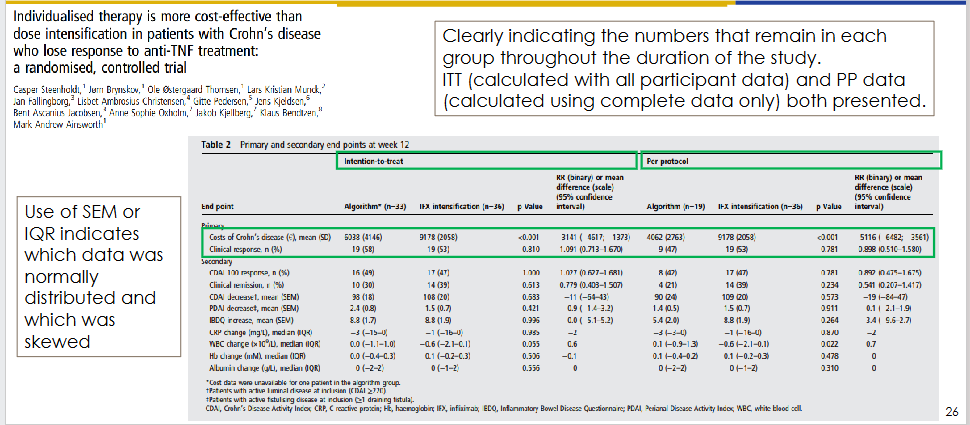
What did the use of SEM and IQR indicate in the Crohn's disease RCT results?
It indicated that different outcome variables had different distributions.
Lecturer explanation:
- IQR was used for skewed/non-normally distributed data.
- SEM was used for data treated as normally distributed.
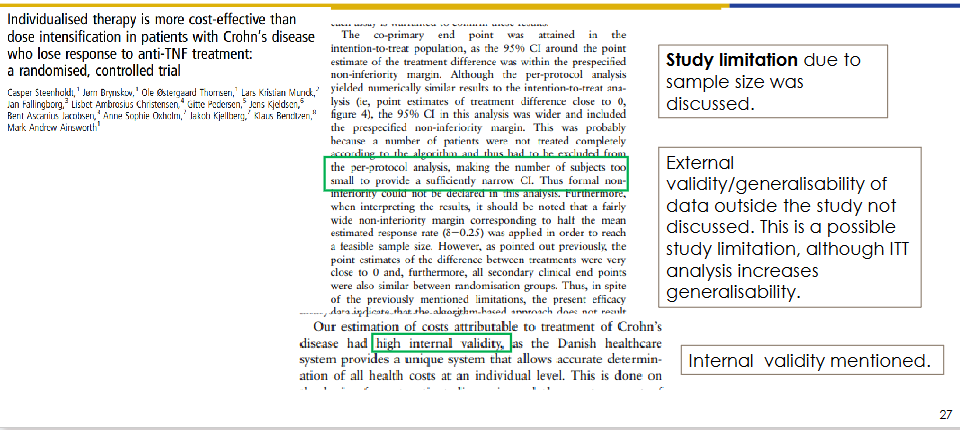
What limitations and validity issues were identified in the Crohn's disease RCT?
- Small sample size was discussed as a limitation.
- Internal validity was addressed.
- External validity/generalisability outside the study population was not adequately discussed.
- ITT analysis helped improve generalisability.

What does CONSORT stand for, and what is its purpose?
CONSORT:
Consolidated Standards of Reporting Trials.
.
Purpose:
- Standardise RCT reporting.
- Improve reproducibility.
- Improve transparency.
- Improve international uniformity.
- Support clear interpretation of trial design, analysis and results.
Which regulators were given as examples of organisations benefiting from consistent RCT reporting?
- TGA in Australia
- FDA in the United States
- EMA in Europe
What are the key features of the CONSORT statement described in the lecture?
- 30-item checklist in the 2025 version.
- Provides a framework for constructing and presenting an RCT.
- Sets standards for trial design, analysis and interpretation.
- Has been revised multiple times since 1996.
- Includes CONSORT-AI for trials involving AI components.
- Prefers reporting ITT rather than only PP.

What changes were highlighted in the 2025 CONSORT updates?
Greater emphasis on:
- Transparency.
- Data-sharing requirements.
- Better operational definitions.
.
Operational definition:
Providing enough detail for another researcher to reproduce the study methods.

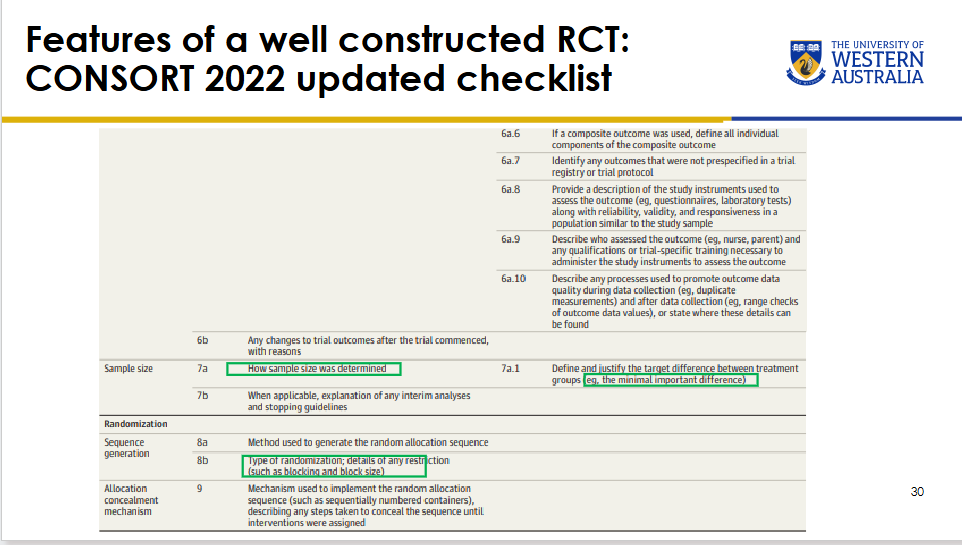
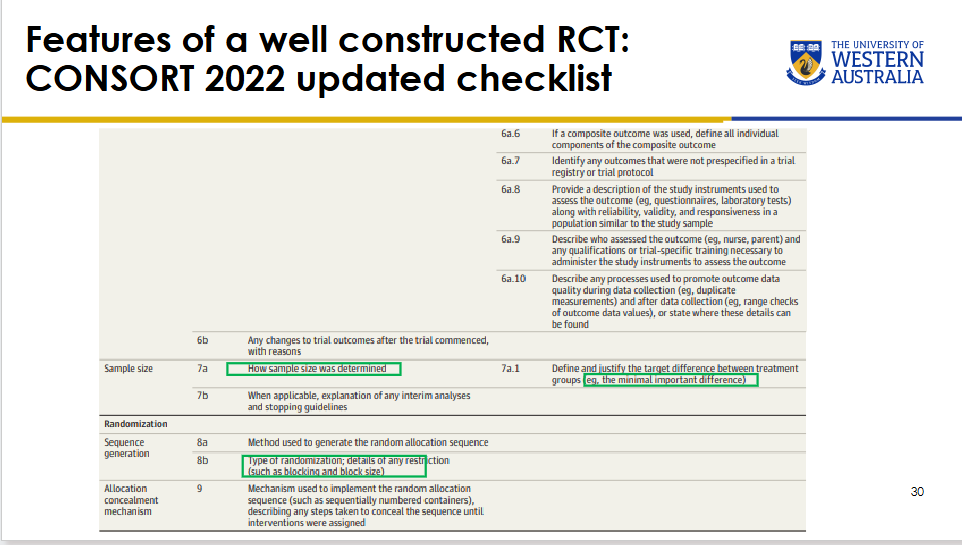
What sample-size and randomisation details are highlighted in CONSORT reporting?
- How sample size was determined.
- Definition and justification of the target difference or minimal important difference.
- Method used to generate the random allocation sequence.
- Type of randomisation.
- Restrictions such as blocking and block size.
- Mechanism used to implement allocation.
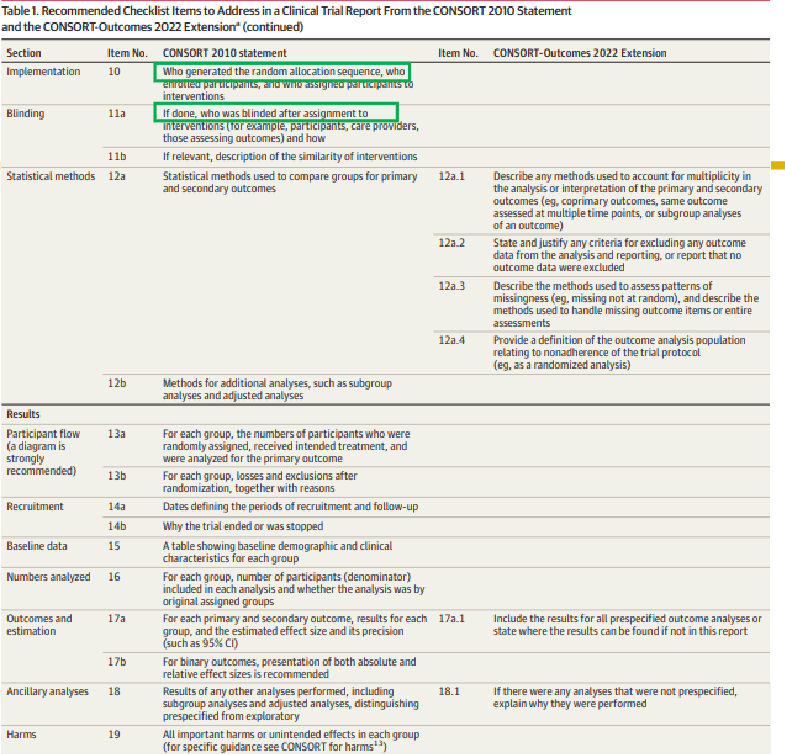
What blinding and statistical-analysis details are highlighted in CONSORT reporting?
- Who generated the random sequence.
- Who enrolled participants.
- Who assigned participants to interventions.
- Who was blinded after assignment.
- Statistical methods for primary and secondary outcomes.
- Methods for subgroup and adjusted analyses.
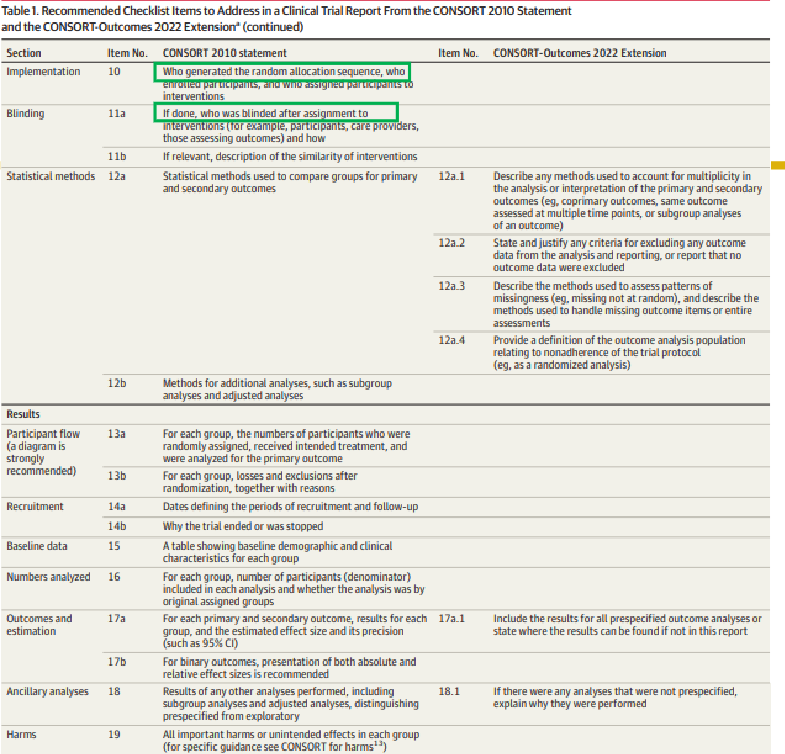

What participant and outcome reporting does CONSORT emphasise?
- Participant flow.
- Recruitment.
- Baseline data.
- Numbers analysed.
- Outcomes and estimation.
- Ancillary analyses.
- Harms.

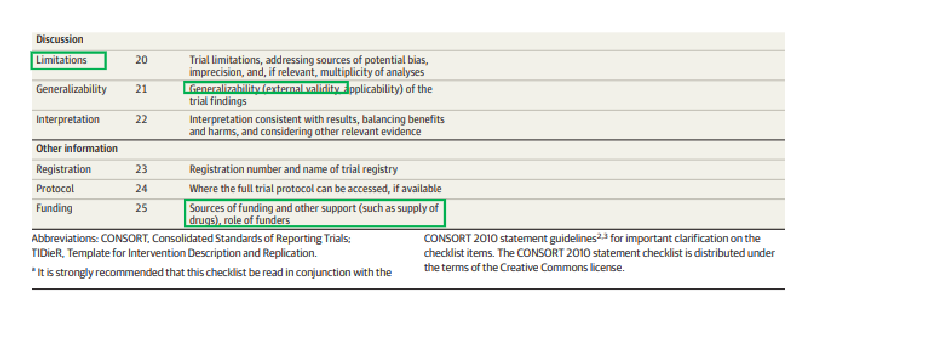
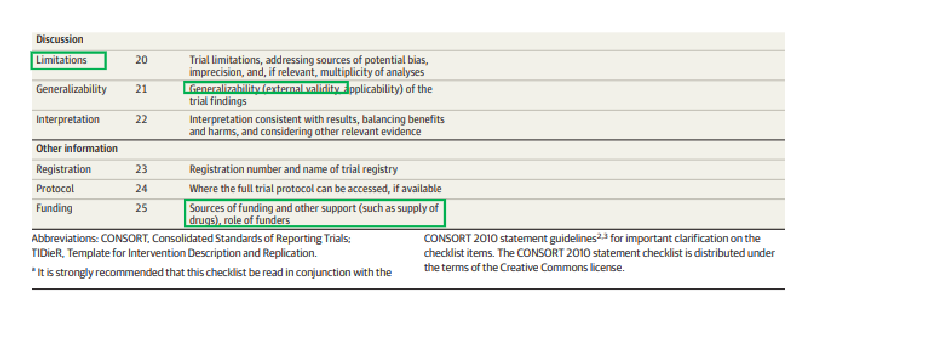
What discussion and administrative information does CONSORT require authors to report?
Discussion:
- Limitations.
- Generalisability/external validity.
- Interpretation.
Other information:
- Trial registration.
- Protocol.
- Funding.

Why does knowing that a paper follows CONSORT not remove the need to read the study carefully?
CONSORT improves reporting, but the study details still determine whether the evidence is meaningful.
Lecturer emphasis:
The label "RCT" or use of CONSORT does not guarantee that the study question, population, procedures or context are clinically sensible.
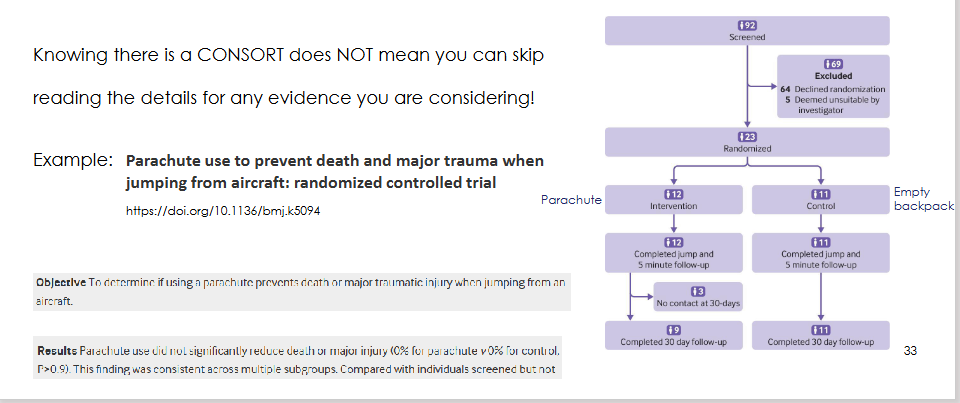
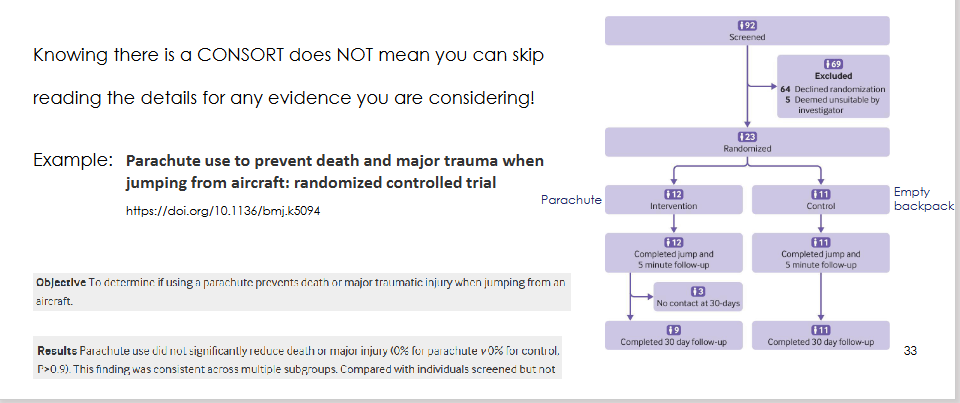
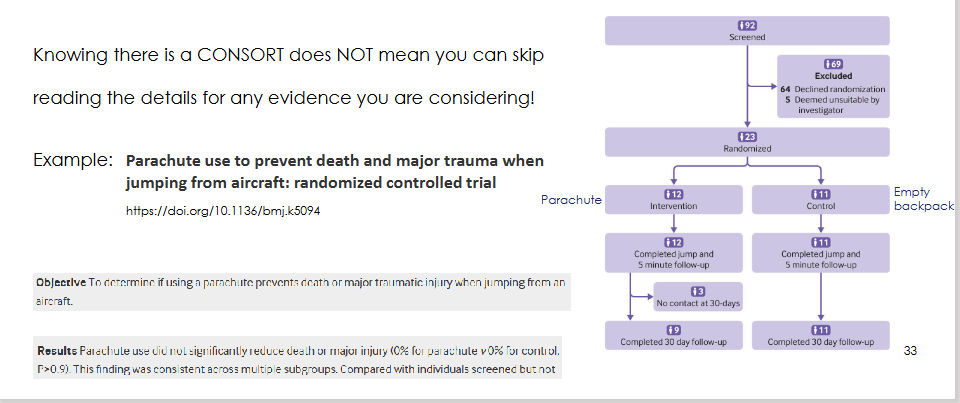
What did the parachute RCT demonstrate?
The study compared:
- Parachute
- Empty backpack
.
It found no significant difference in death or major injury.
Critical methodological detail:
Participants jumped from a grounded aircraft.
Conclusion:
Reading only the study title/design label without the methods can be highly misleading.
Q1 A researcher allocates patients to treatment groups based on odd or even hospital record numbers. What is the major methodological concern?
A. Effective allocation concealment
B. Increased allocation bias
C. Improved external validity
D. Reduced observation bias
Correct answer:
B. Increased allocation bias
Why it is correct:
Odd/even hospital record numbers are a predictable allocation method rather than true randomisation, allowing imbalance or researcher influence.
Why the other options are incorrect:
A. The method does not provide effective allocation concealment.
C. It does not improve external validity.
D. It does not primarily reduce observation bias.
Q2 In an RCT evaluating a new injectable drug for metabolic disease, which approach best reduces observation bias?
A. Allocation based on date of birth
B. Participants, investigators and outcome assessors all wear blindfolds
C. Participants, investigators and outcome assessors are blinded where possible
D. Participants choose their treatment and don't tell the observer/investigator.
E. Statisticians shouldn't know patient group allocation
Correct answer:
C. Participants, investigators and outcome assessors are blinded where possible
Why it is correct:
Blinding these groups reduces the chance that expectations or knowledge of treatment influence behaviour or outcome measurement.
Why the other options are incorrect:
A. Date of birth is a predictable allocation method.
B. Literal blindfolding is unnecessary and generally inappropriate; "blinding" normally means concealing treatment allocation.
D. Allowing participants to choose treatment destroys random allocation.
E. Blinding statisticians can help, but this option alone is less complete than blinding participants, investigators and assessors where possible.
Q3 A participant randomised to the intervention group stops taking the medication after 2 weeks. Under an intention-to-treat analysis, how should the participant be analysed?
A. Excluded from analysis
B. Analysed according to original allocation
C. Moved to the control group
D. Included only in PP analysis
Correct answer:
B. Analysed according to original allocation
Why it is correct:
ITT keeps participants in the group to which they were originally randomised, regardless of whether they completed treatment.
Why the other options are incorrect:
A. Exclusion would violate the ITT principle.
C. Participants are not reassigned based on adherence.
D. PP analysis is different and includes only those completing the protocol.
Q4 What is the primary purpose of the CONSORT statement?
A. To help researchers achieve significance when calculate p-values
B. To standardise reporting and improve reproducibility of RCTs
C. To replace ethics approval
D. To eliminate all bias
E. To make the research findings generalisable to all populations.
Correct answer:
B. To standardise reporting and improve reproducibility of RCTs
Why it is correct:
CONSORT provides standardised reporting guidance so RCT methods and results are transparent, interpretable and reproducible.
Why the other options are incorrect:
A. CONSORT is not designed to manipulate statistical significance.
C. It does not replace ethics approval.
D. It cannot eliminate all bias.
E. It does not make findings automatically generalisable to every population.