Human Bio Unit 4 Chp 3 Microorganisms
 Call Kai
 Learn
Learn Practice Test
 Spaced Repetition
 Match
Match Flashcards
 Knowt Play
1/57

There's no tags or description
Looks like no tags are added yet.
Name | Mastery | Learn | Test | Matching | Spaced | Call with Kai | Chat |
|---|
No analytics yet
Send a link to your students to track their progress
58 Terms
OBJQ
What are 3 causes of disease?
Microorganisms (pathogenic)
Lifestyle
Genetic
What is disease?
A condition with a specific cause in which one or all parts of the body function less effectively and abnormally.
What are 4 types of pathogens?
Bacteria, virus, fungi, protozoa
Explain how bacteria, viruses, fungi and protozoa affect the organisms.
Bacteria→release toxins as they multiply. Affect tissues
Virus→enter living cells to disturb metabolic systems of the cell. The genetic material of the virus takes over the cell→produces more viruses
Fungi→hyphae secrete digestive enzymes→break down tissue→growth of hyphae→physically damage tissue
Some fungi→toxins→allegic reactions
Protozoa→no set pattern
Explain about bacteria
- Unicellular
-Decomposer
- No nucleus and membrane-bounded organelles
- Plasmid and flagellum (only ⅔)
-Asexual reproduction of binary fission
-Spherical
-Rods
-Spirals
Explain bacterial cells and their functions
Capsule—> Hydration, prevents itself from antibiotics and WBC attack
Call wall—>Made out of peptidoglycan—>Extra protection
Cell surface membrane—>Control movement of substances in and out
Chromosome (nucleoid)—>Division and reproduction
Plasmid—>Extrachromosomal DNA—>Genetic engineering
Flagellum—>Movement
How to grow bacteria?
In a Petri dish containing agar or liquid called broth.
Binary fission of bacteria formula
2^n x number of bacteria given
Name the viruses and diseases caused by them, including symptoms.
Virus | Disease |
Common cold | Cold အအေးမိ |
Measles | Measles ဝက်သက် |
Influenza | Flu တုပ်ကွေး |
SARS-CoV-2 | COVID-19 |
Disease HIV (Human Immunodeficiency Virus) | Syndrome AIDS (Acquired Immune Deficiency Syndrome) |
Plant Tobacco mosaic virus | Impaired chloroplast synthesis→discoloration of leaf→imparied photosynthesis |
Dengue virus | Dengue သွေးလွန်တုပ်ကွေး |
Poliomyelitis virus | Polio |
Mumps virus | Mumps ပါးချိတ်ရောင်ရောဂါ |
Rubella virus (German measles) | Rublella virus (ဂျိုက်သိုးရောဂါ or ဂျာမန်ဝက်သက်) |
Ebola virus | Ebola |
Name the bacteria and diseases caused by them
Bacteria | Disease / infection |
Pneumococcus | Pneumonia (အဆုတ်ရောင်ရောဂါ) |
Staphylococcus | Skin infection |
Streptococcus | Pneumonia (အဆုတ်ရောင်ရောဂါ) |
Spirochete | Syphilis ကာလသားရောဂါ |
Salmonella typhi | Typhoid အူရောင်ငန်းဖျား |
Vibrio cholerae | Cholera ကာလဝမ်းရောဂါ |
Neisseria gonorrhoeae | Gonorrhoea ဆီးပူညောင်းကျ |
OBJR
Name the protist and the diseases caused by them
Protist | Disease |
Amoeba | Amoeba |
Chlorella | Infection |
Plasmodium | Malaria ငှက်ဖျားရောဂါ |
Trypanosoma | Trypanosomiasis (sleeping sickness) |
OBJR
Name the fungi and diseases caused by them
Fungi | Diseases |
Dermatophyte | Athlete’s foot |
Candida albicans | Thrush |
dermatophytes | Ringworm |
OBJQ
Define 'virus'.
-Acellular
-Only composed of genetic material (RNA or DNA) and a protein coat.
-Can’t perform life processes except reproduction, but only in a host cell.
What are the limiting factors in the stationary and death phases?
-Run out of nutrients
-Build up toxic materials
What are the requirements for a culture of bacteria?
Favourable temperature and pH and enough nutrients
OBJQ
How do viruses reproduce?
They enter the host cell and take over the host's genetic machinery to make more virus particles.
After virus particles have been made, host cells die, and particles are released to infect more cells.
Why do doctors sometimes give antibiotics to patients while patients suffer from the virus?
To prevent secondary bacterial infections or opportunistic disease from attacking the host cell.
State the meaning of 'incubation period'.
The period of time between when a person is infected with a pathogen and when they first show signs and symptoms
Patients won’t feel sick during the incubation period but are infectious to others. The period can range for different diseases.
What is the difference between signs and symptoms?
Sign-visible to other people, heard, measured, seen EXAMPLE: By using a stethoscope and blood-measuring devices.
Symptom–not usually visible to other people. EXAMPLE: Patients experience symptoms like pain, dizziness, and nausea.
What is endemic, epidemic and pandemic?
Endemic—disease always present in a population of a particular geographical area
Epidemic—a widespread outbreak of infectious disease with many people getting infected at the same time.
Pandemic—disease spread across the world.
OBJQ
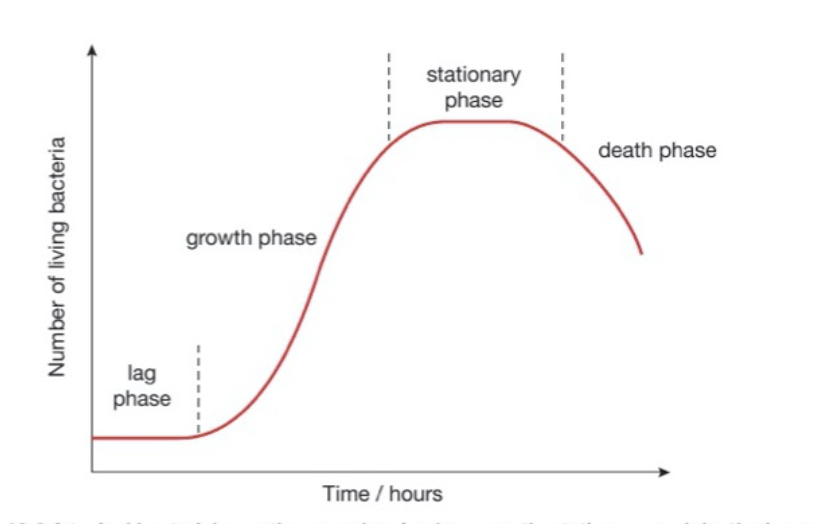
Explain the bacterial culture sigmoid curve
Lag phase → adapt to new environment
Exponential or log phase → grow exponentially
Stationary phase → number of deaths = number of births
Death phase = organisms start to die
OBJR + OBJQ
What are 7 methods of disease transmission?
Air droplet
Animal vector
Eating contaminated food
Drinking contaminated food
Direct contact
Blood-to-blood
Through sexual intercourse
OBJQ
Which cell does HIV infect, and what is the function of the infected cell?
HIV infects a type of white blood cell, a lymphocyte called a T-helper cell.
The function of the T-helper cell is to help other lymphocytes to become active and start fighting infections.
OBJQ
Explain how HIV approaches humans.
HIV is a retrovirus. The genetic material of HIV is RNA. The virus makes DNA from the RNA, and this DNA becomes incorporated into the DNA of the T-helper cell.
Retrovirus = A virus that can change its genetic material to match the host’s.
RNA of HIV uses the reverse transcriptase enzyme to make DNA
At some point in the infection, the HIV DNA is activated. It then instructs the lymphocyte to make HIV proteins and more RNA.
The HIV proteins and RNA are assembled into new virus particles.
Some of the HIV proteins end up as antigens on the surface of the cell.
These HIV proteins are recognised by the person’s immune system as being ‘foreign’ to the body.
The lymphocyte is destroyed by the immune system.
The assembled virus particles escape to infect other lymphocytes.
The cycle repeats itself for as long as the body can replace the lymphocytes that have been destroyed
Eventually the body will not be able to replace the lymphocytes as quickly as they are being destroyed.
The number of free viruses in the blood increases rapidly, and HIV may infect other areas of the body, including the brain.
The immune system is severely damaged, and other disease-causing
Microorganisms infect the body.
The death of a person is caused by “opportunistic” diseases such as TB and pneumonia or cancer such as Kaposi’s sarcoma.
OBJQ
What are 3 main ways of HIV transmission?
Sexual intercourse, vertical transmission, blood-to-blood contact
What is the medicine prescribed for HIV?
PreP (often recommended to take before intercourse)
OBJQ
What are control measures for HIV?
Prevent sharing sterile needles
Be faithful to 1 sexual partner
Use of condom/femidom
Testing blood used for transfusion
(A transfusion is a safe medical procedure where donated blood or parts of blood—such as red blood cells, platelets, or plasma—are put directly into your vein)
What are the first symptoms of Ebola?
Fever, muscle pain, headache, sore throat, followed by vomiting, diarrhoea and damage to liver and kidney functions.
What is the natural host of Ebola?
African fruit bat
OBJQ
Explain types of transmission of Ebola
Body fluids (semen, blood, saliva, faeces)
Bedding
Broken skin, mucous membranes such as the mouth and intestine
OBJQ
What are 2 types of treatment for Ebola?
Oral Rehydration Therapy
IV drips (Giving fluids intravenously)
OBJQ
State preventive measures for Ebola
-Checking their contact
-Dealing with individual patients
-Having laboratory testing facilities
-Organising safe burials
OBJQ
Explain Oral Rehydration Therapy
-ORT is a pack containing a solution of salt and glucose mixed with sterile water (Isotonic solution)
-Helps to rehydrate tissues and prevent furthur damages such as death.
Explain latency period
Period that a person is infected in the body but there are no signs or symptoms shown
Highly infectious to others
Can last up to 20→50 years or even 70 or more
OBJQ
Explain cholera in terms of cause, method of transmission, time for symptoms to show, how they infect and its preventive measures.
Cause: Vibrio cholerae
Method of transmission: contaminated food and drinks, poor hygiene
Time for symptoms to show: a few hours or days after infection
Infection: bacteria enter gut→if survive acidic condition in stomach→reach small intestine (reproduce, secrete toxin) → upset the functions of epithelial lining→toxin cause water loss or salt from intestine→severe diarrhoea→dehyrated→heart rate increase→low blood pressure→muscle cramp→death (sometimes)
Preventive measure: antibiotic and ORT
OBJQ
Explain typhoid in terms of cause, method of transmission, incubation period, symptoms, how they infect and its preventive measures.
Cause: Salmonella Typhi
Method of transmission: Drinking water that is contaminated by stool or flies transferring bacteria from stool to food
Incubation: 2 weeks
Symptoms: Flu-like symptoms: high fever, headache, cough and feeling unwell, stomach cramp, constipation, diarrhoea, vomiting, delirium (mental confusion)
Infection: Diarrhoea leads to dehydration and can be life-threatening as bacteria attack the intestinal lining and cause bleeding and even holes in the gut wall. Toxins→inflammation of heart and organ failure
Preventive measures: ORT, antibiotics, good sanitation and hygiene
OBJQ
Explain gonorrhoea in terms of cause, method of transmission, general symptoms, untreated threat and preventive measures
STD or STI
Cause: Neisseria gonorrhoeae
Method of transmission: sexual intercourse
Symptoms (women): discharge from vagina, bleeding during menstruation
Symptoms (men): discharge of pus from the penis and pain during urination.
Untreated threat: infection spreads to the uterus, oviduct, and ovaries→infertile women
Preventive measure: antibiotics, limit sexual partners
OBJQ
Explain Athlete’s foot in terms of cause and method of transmission, infection sites, effects of bad infections, treatment and hygiene measures.
Cause: Pathogenic fungi
Method of transmission: Direct contact
Infection sites: skin, nail, mucous membranes of mouth and vagina
Effects of bad infections: sore, raw patches
Treatment: 1. 30-40% is cured by humans immune system
2. Antifungal drug
Hygiene measures: 1. Avoid changing rooms
2. Wear protective food cover
3. Wear cotton socks and loose-fitting shoes
4. Toenails cut short
5. Avoid sharing or using other people's personal wears
OBJQ
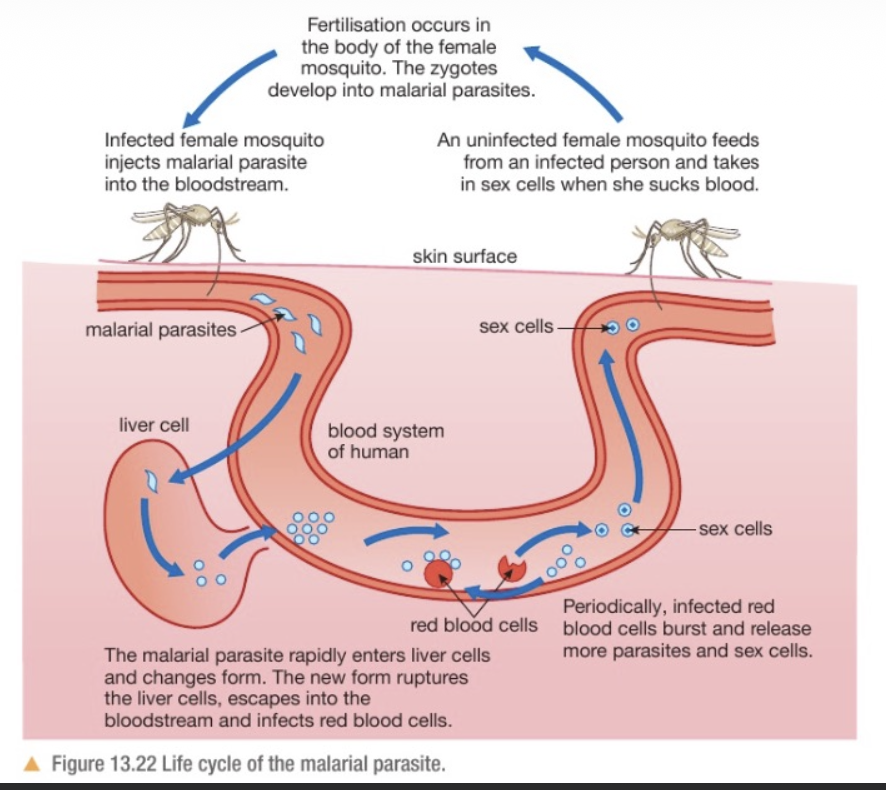
Explain malaria in terms of cause, method of transmission and symptoms, time span of malarial parasite and preventive measures.
Cause: Plasmodium Protozoa
Method of transmission: Anopheles mosquito vector
Symptoms: Alternating cold sweats and fever, vomitting, joint pain, anaemia.
Time span of malarial parasite: 2 weeks to several months.
Preventive measures: Control the number of Plasmodium parasites
Control the number of mosquitoes
-Insecticides
-Draining swamps and pools
-Use drugs to target various stages of the protozoan life cycle.
- Wear long-sleeved shirts, insect repellents
- Introduce Tilapia→feed on larvae of mosquito
- Use mosquito nets
Infection step by step
FAQ + Once exam question
Explain sickle cell anaemia in terms of cause, symptoms, and beneficial point of sickle cell anaemia.
Cause: mutation
Symptoms: Tiredness, less oxygen and energy supply, difficulty breathing
Beneficial point: Patients with sickle cell anaemia won’t suffer from malaria because malarial parasites don’t recognise RBCs as their site of reproduction of sex cell.
Explain innate and adaptive immune responses.
Innate→general immune response (phagocytes) and perform phagocytosis
Adaptive→produce antibodies (specific)
Explain phagocytosis in 3 steps.
The phagocyte changes shape by pseudopods (false feet) and surrounds pathogens.
Pseudopods envelop pathogens, and the cell membrane joins, trapping the target inside a food vacuole. The pathogen is used to help feed the phagocyte.
Digestive enzymes are poured into
the food vacuole to kill and break down the pathogen into tiny, harmless parts. The phagocyte is then ready to attack again.
OBJQ
Explain how lymphocytes, upon binding to 2 types of cells, are produced after cell division
The receptor and antigen bind to the receptor on the lymphocyte.
Upon binding, the lymphocyte becomes activated and divides by mitosis (somatic) (proliferates).
Produces 2 types of cells that can recognise the antigens. 2 types: Plasma cells (produce antibodies) and memory cells.
Kill pathogen cells and become memory cells in lymphnode/lymphoid tissue.
Secondary Immune Response of lymphocyte
Antigen binds to the receptor on the lymphocyte.
Memory cells become activated.
Proliferated
Produce many antibodies and kill pathogens.
What is another way to address “antigens”?
Marker chemicals
What are 2 general purposes of antibodies?
Neutralising the largest threat, like binding to the target to stop infection from spreading to more cells; causing a pathogen to burst open; and binding to pathogenic toxins in the blood to neutralise
Recruiting other cells and chemicals to combat the threats, like acting as markers to attract phagocytes to pathogens and cause pathogens to clump together (inactive and easily killed by phagocytes)
Explain memory cells.
Immune to disease in the future
Remain in blood for many years or, in some cases, a lifetime
If the same microorganisms re-infect, memory cells start to reproduce and make antibodies. (Except for viruses or pathogens that can change shape.)
State 3 characteristics of secondary immune response.
Quicker/faster
More antibodies
Stay longer in the blood
OBJQ
Explain briefly about 4 types of immunity
Active (making own antibodies) | Passive (acquired antibodies) | |
Natural | Recovering from infection | Breastfeeding and placenta |
Artificial | Vaccine | Injecting antibodies |
What are the advantages of active and passive immunity?
Active→long term
Passive→immediate result
OBJQ
Explain the ways of giving vaccination, its mechanisms and 5 components that might be in the vaccine (attenuated)
Orally or by injection
Lymphocytes recognise the antigens and multiply as microorganisms enter the bloodstream.
Form memory cells and make us immune to disease.
Dead microorganisms→Typhoid and whooping cough
Weakened part of actual microorganisms→TB and measles
Harmless bacteria (genetically modified to carry antigens) remove toxigenicity, keep antigenicity→hepatitis B
Modified bacterial toxins→Tetanus, diphtheria
Antigens on their own→influenza
Explain herd immunity.

What are the pros and cons of vaccination?
Pros | Cons |
Cheaper than other options | Needle phobia |
Helps control the spread of infectious diseases | May develop reactions or side effects |
Reduced number of deaths | People might take fewer precautions |
OBJQ
What is meant by antibiotics?
Chemicals that kill microorganisms or reduce their growth to treat bacterial or fungal infections. (Do not work on viruses)
OBJQ
What are natural antibiotics produced from, and its example?
Bacteria and fungi.
1st antibiotics→by fungus Penicillium→Penicillin→kill bacteria
OBJQ
What are 3 types of antibiotics and their functions?
Bactericidal→kill bacteria
Bacteriostatic→stop bacteria from reproducing
Broad-spectrum antibiotics→act against a range of bacteria
OBJQ
What are 3 effects of antibiotics?
Interfere with manufacture of cell wall→weaken cell wall→osmotic lysis (water enters by osmosis and bursts the cell)
Interfere with DNA replication→cell division is impossible, so can’t multiply.
Interfere with protein synthesis→stop the production of enzymes.
How do bacteria become antibiotic-resistant?
Random gene mutation
OBJQ
Explain Methicillin-resistant Staphylococcus aureus and how it becomes a problem.
Known as a “superbug” • resistant to many antibiotics. Major problem in hospitals.