LECTURE 8 (copy) (copy)
 Call Kai
 Learn
Learn Practice Test
 Spaced Repetition
 Match
Match Flashcards
 Knowt Play
1/57

There's no tags or description
Looks like no tags are added yet.
Name | Mastery | Learn | Test | Matching | Spaced | Call with Kai | Chat |
|---|
No analytics yet
Send a link to your students to track their progress
58 Terms
What are the key aspects of casting/pressing in manufacturing technology for dental components?
Shapes dental components through casting or pressing materials into specific molds
Common applications: dental crowns, bridges, metal frameworks for dentures
Advantages: Allows intricate and customized shapes, versatile with various materials
Front: What are the key aspects of cutting off/milling in dental manufacturing?
Shapes dental materials using cutting or milling machines by removing excess material
Common applications: crafting dental prosthetics, implant components
Advantages: High precision, accuracy, adaptable to various materials
What are the key aspects of additive manufacturing in dental technology?
Builds dental structures layer by layer using additive processes
Common applications: dental models, surgical guides, prosthetics
Advantages: Rapid prototyping, customization, suitable for complex designs
What is investing in dental manufacturing?
Definition: A manipulation where the prototype of the future structure (e.g., dental prosthesis) is surrounded by a material that retains its shape at operating temperature
Process of forming a mold is called an investment
What is the lost wax casting process?
Definition: A method using a wax model to create the mold, with the wax eliminated to form the mold cavity
What are the first six steps of the metal casting procedure?
Prepare the Tooth: Prepare the tooth receiving the cast restoration
Make an Impression: Create an impression of the prepared tooth
Pour Gypsum: Pour gypsum into the impression to make a positive cast
Make a Wax Pattern: Create a wax pattern representing the lost tooth structure
Sprue the Wax Pattern: Fix the wax pattern in space using a crucible former and sprue former
Invest the Wax Pattern: Invest the wax pattern to create a mold
What are the last six steps of the metal casting procedure?
7. Eliminate the Wax Pattern: Burn out the wax in a furnace to form the mold
8. Force Molten Metal: Force molten metal into the mold
9. Clean the Cast: Clean the cast
10. Remove the Sprue: Remove the sprue (connection point) from the casting
11. Finish and Polish: Finish and polish the casting on the die
12. Cement the Restoration: Cement the finished cast restoration onto the prepared tooth
shrinkage wax plus allow =?
investment expansion
What are the key properties of investment materials?
Should not react with wax and metal alloys
Must be easy to handle
Must not break down at high temperatures
Must not release products (gases) that contaminate the alloy surface
Must have sufficient expansion to compensate for alloy shrinkage
Must be sufficiently porous to allow air and gases passage
Should reproduce detail and smoothness of the structure
Must have a long service life and low cost
Must have high compressive strength to resist casting forces
What are the key aspects of refractory materials in investment materials?
Refractory materials can withstand temperatures of at least 1500 degrees in a normal atmosphere
Commonly used allotropic forms of silica: quartz and cristobalite
When heated, these materials change crystal structure, decreasing density and increasing volume to compensate for alloy shrinkage
What are the key binding agents in investment materials?
Bind and set individual refractory particles into a solid structure
Common binding agents: alpha form of calcium sulfate hemihydrate, phosphates, ethyl silicate
What are the key modifiers in investment materials?
Added in small quantities to alter properties of investment materials
Common modifiers: sodium chloride, boric acid, calcium sulfate, graphite, copper or magnesium oxide
What are the three types of investment materials?
Gypsum bonded investments
Phosphate bonded investments
Ethyl silicate bonded investments
What are the applications and composition of gypsum bonded investments?
used for?
made of?
binder?
can withstand?
composition?
Commonly used to cast gold alloys for single crowns and small fixed partial dentures, gypsum used in dent = almost pure calcium sulfate dihydrate
Binder: gypsum
Used for gold plays, crowns, fixed and removable partial dentures
Ideal for gold, withstands 700°C temperature
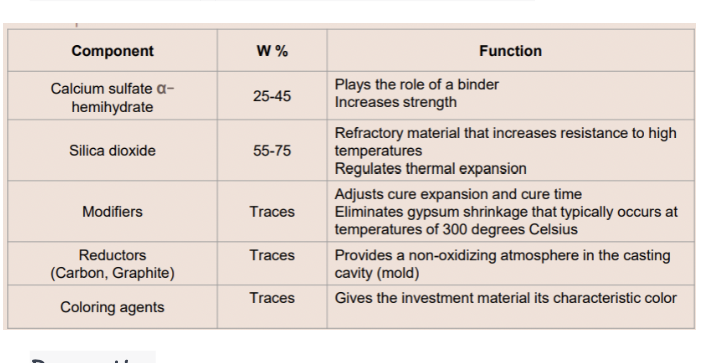
Composition: gypsum, silica, and modifiers
The components of gypsum bonded investments included are (list five)
name each of their function
by how much do the main three investment materials expand?
1.3 to 2 percent
What are the properties of gypsum bonded investment materials?
expansion types
when do they become brittle!
Expansion types:
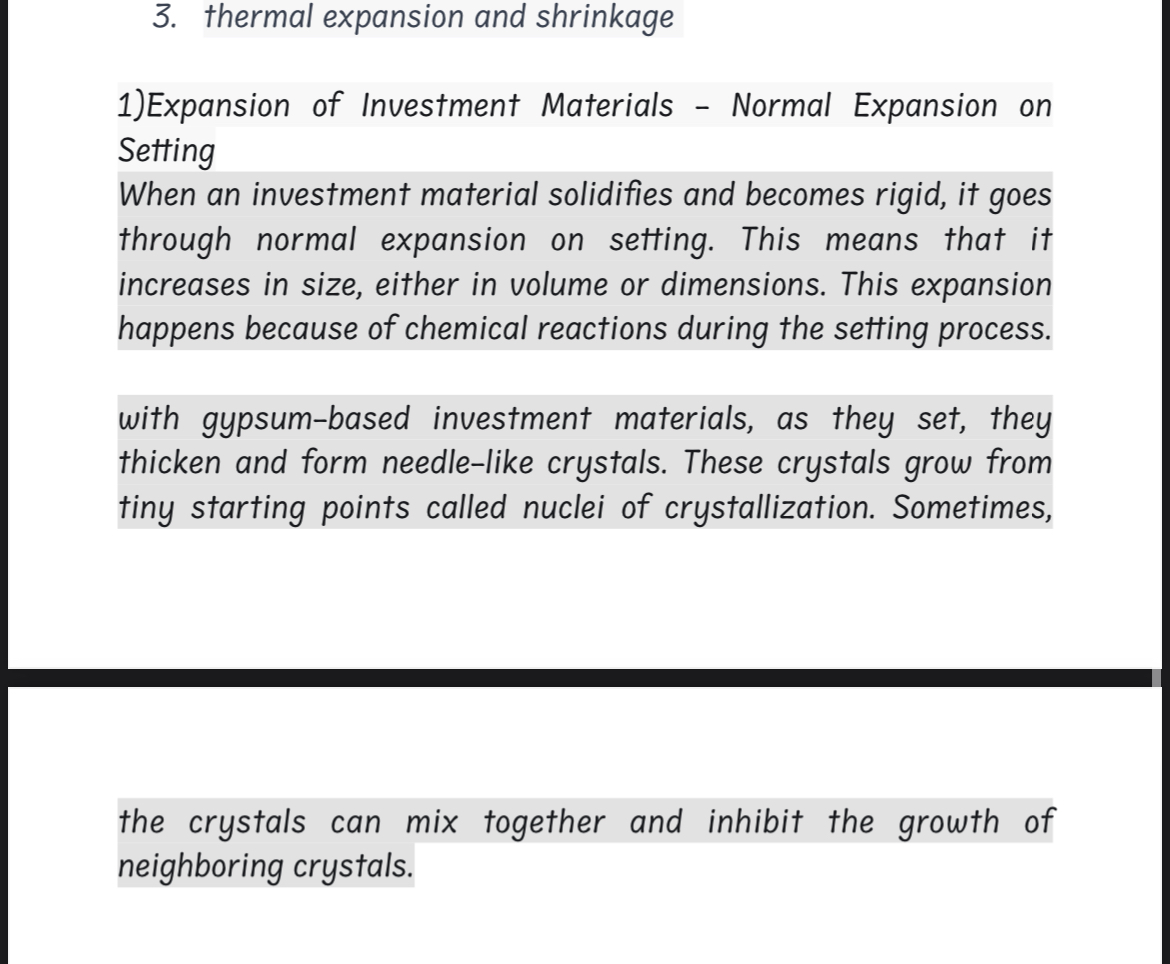
normal setting expansion -
occurs as investment hardens in air
hygroscopic setting expansion -
occurs while investment is in water
thermal expansion - occurs as investment is heated
Sulfur dioxide and sulfur trioxide release above 700°C can make cast alloy brittle
therefore Not used for high melting point alloys like Cobalt-Chrome and Palladium
What is the setting reaction and setting time for gypsum investment materials?
Setting reaction involves dissolution and precipitation process
Hemihydrate particles dissolve and recrystallize into dihydrate form
Setting time: 5 to 25 minutes from mixing start to complete set
What factors influence the setting time of gypsum investment materials?
Solubility of Alpha Hemihydrate: Accelerated by sodium sulfate, retarded by borax
Crystallisation Nuclei: Accelerates solidification, retards solidification
Degree of Crystal Growth: Increased by accelerators, decreased by retarders
Composition Variations: Increasing silica extends setting time
Powder Size: Finer alpha hemihydrate accelerates curing
Impurities: Gypsum (dihydrate) shortens curing time
Water/Powder Ratio: Increased water slows curing
Mixing Speed: Faster mixing quickens curing
Mixing Liquid Temperature: Warmer water accelerates curing; beyond 50°C, slows curing
What is the purpose of modifying agents in gypsum-bonded investments
Control setting rate (accelerators/retarders)
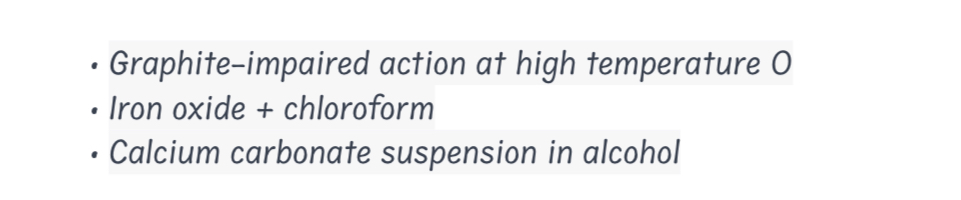
Protect embedded gold alloy components (reducing agents like powdered graphite or copper)
Increase thermal expansion (additives like boric acid, soluble halide salts)
What are the disadvantages of gypsum-bonded investments?
Unsuitable for casting high-melting gold alloys, palladium alloys, and base-metal alloys like nickel-chromium and cobalt-chromium
Tend to decompose at high temperatures
normal expansion
talk about it in gypsum investments too
Q: What is hygroscopic expansion in investment materials and what factors affect it? (continued)
Finer particle size of silica increases expansion.
Higher water/powder ratio results in less expansion.
Reduced mixing time lowers hygroscopicity.
Older material exhibits lower hygroscopic expansion.
What occurs during the thermal expansion of gypsum investment material?
The material expands when heated during casting.
The amount of expansion depends on the type and amount of silica present.
What causes shrinkage in gypsum investment material and under what conditions does it occur?
l
Shrinkage occurs when the material cools down below 700°C.
Shrinkage is caused by the gypsum.
It is unrelated to the amount and properties of silica in the material.
make on these
What are the two types of strength in gypsum bonded investment materials?
Wet or green strength: Strength when excess water is present after initial setting
Dry strength: Strength after drying, typically twice as strong as wet strength
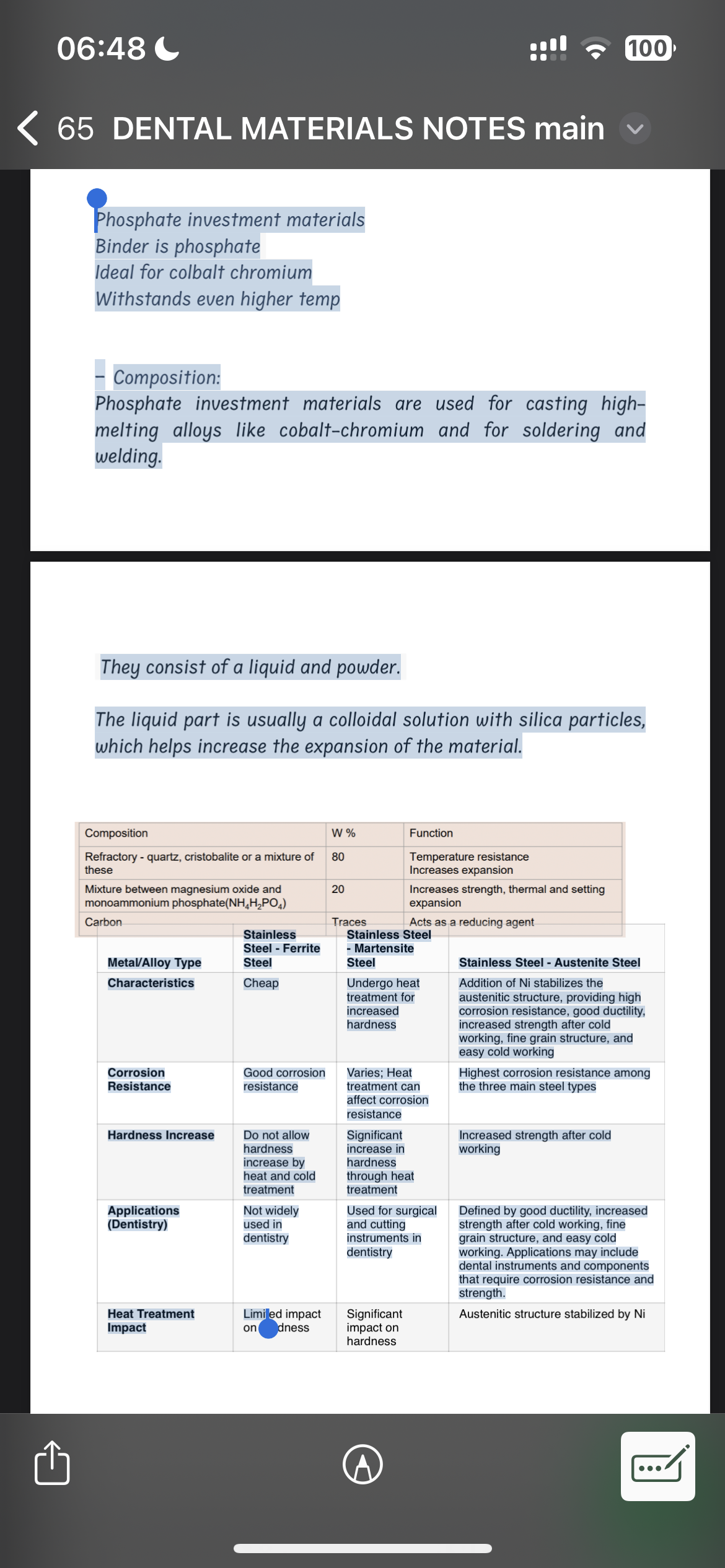
What are the characteristics of Martensite Steel?
Undergoes heat treatment for increased hardness
Corrosion resistance varies; heat treatment can affect it
Significant increase in hardness through heat treatment
Used for surgical and cutting instruments in dentistry
Significant impact on hardness through heat treatment
What are the characteristics of Austenite Steel?
Addition of Ni stabilizes the austenitic structure
Provides high corrosion resistance, good ductility
Increased strength after cold working
Fine grain structure, easy cold working
Highest corrosion resistance among the three main steel types
Applications include dental instruments and components that require corrosion resistance and strength
Austenitic structure stabilized by Ni
What are the compressive strength requirements for phosphate bonded investments?
Type I (for inlays, crowns, etc.): Minimum 2.5 MPa
Type II (for removable appliances): Minimum 3 MPa
What are the setting expansion characteristics of phosphate bonded investments?
Full-strength liquid: About 0.4%
Hygroscopic technique: Additional 0.6% to 0.8%
Within 30% of manufacturer's stated value
What are the thermal expansion characteristics of phosphate bonded investments?
50:50 mixture of liquid and water: About 0.8%
Undiluted liquid: About 1% to 1.2%
Within 15% of manufacturer's stated value
How does temperature affect the mixing and setting time of phosphate bonded investments?
Hotter mixture sets faster
Setting reaction generates heat, speeding up curing
Better mixing and efficiency lead to faster curing and higher temperature
Mechanical mixing under vacuum preferred for optimal results
advantages and disadvantage of phosphate investments
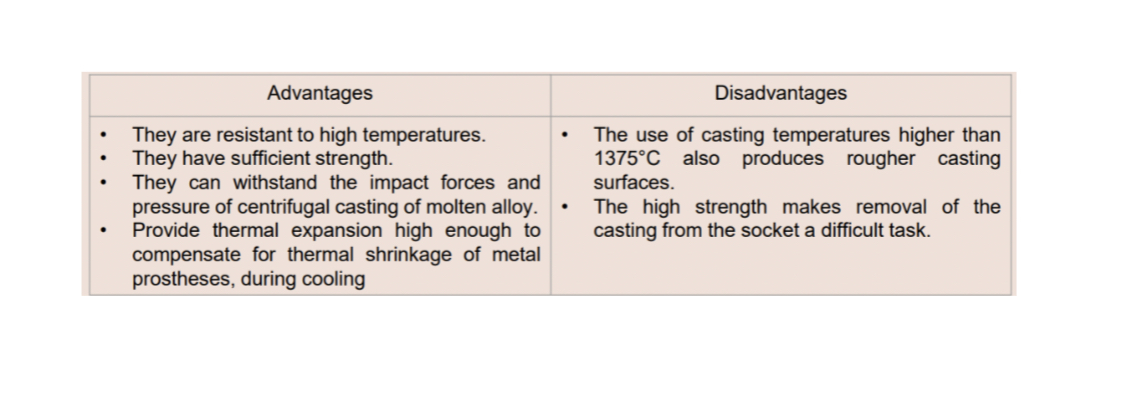
how is mixing and setting time affected by temperature?
If the mixture is hotter, it will set faster. The setting reaction itself generates heat, which speeds up the curing process. Increasing the mixing time and e%ciency also leads to faster curing and a greater rise in temperature. Generally, the better the mixing, the smoother and more accurate the casting will be.
Mechanical mixing under vacuum is often preferred for optimal results
What is the binder in ethyl silicate investment materials?
silica
For what applications are ethyl silicate investment materials ideal?
Base metal alloys partial dentures
High resistance to heat and wear
What is the primary use of ethyl silicate investment materials?
Making molds for the casting of removable partial dentures of cobalt-chromium
What are the components of the powder composition of ethyl silicate investment materials?
Refractory silica
Glass particles
Minor amounts of MgO (calcined magnesium oxide) and other oxides
advantages and disadvantages of ethyl silicate
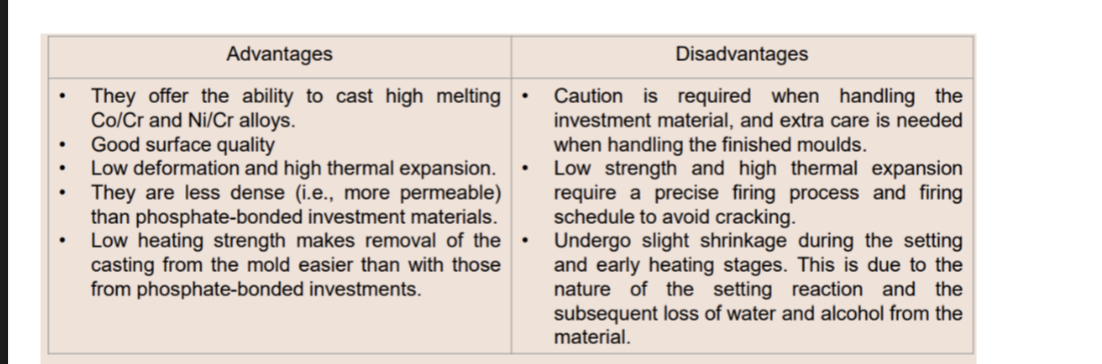
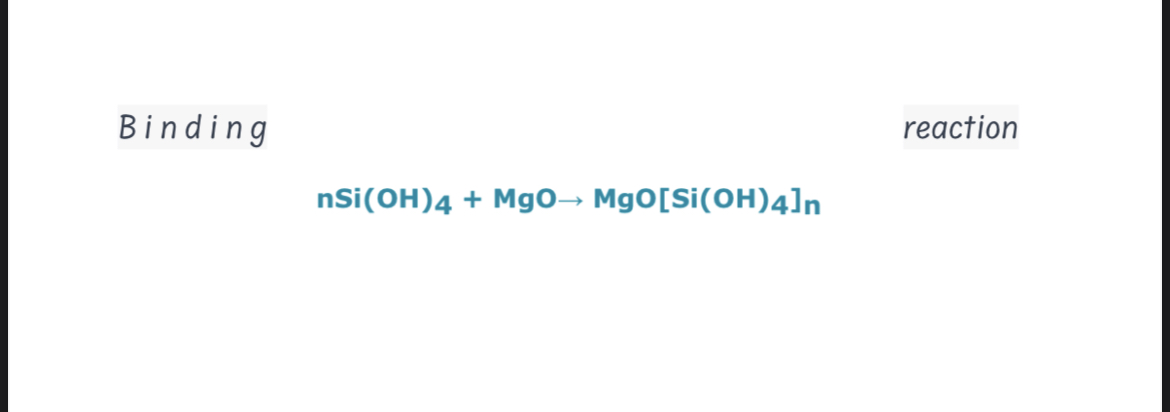
setting reaction of ethyl silicate

binding reaction of ethyl silicate
What is the main ingredient in magnesium-zirconium investment materials?
Magnesium oxide (acts as both a binder and a refractory)
What additional components are found in magnesium-zirconium investment materials?
Aluminum oxide
Zirconium oxide
Lithium aluminosilicate
Zirconium silicate
What are the three main types of welding?
Spot welding
Pressure welding
Laser welding
Q: Describe spot welding.
Clean metal surfaces placed together under pressure
Current passed through the joint to induce interfacial melting
Melting starts at the interface and propagates outwards
SPOT ON FACE: interface
Describe pressure welding.
Two metal parts placed side by side with a large force applied perpendicular to the surface
Pure gold, extremely ductile, can be pressure welded by hand
Force must cause permanent deformations to reveal metal without foil
Force applied rapidly to compress exposed surfaces before gases are adsorbed
Surface roughness problems overcome by compressive forces
Describe laser welding.
High-intensity coherent light pulse generated by the laser
Pulse duration and intensity selected to melt metals in a small area
Beam focused on the joint to melt opposing surfaces
Expansion from high temperature and change of state forms the weld upon solidification
What is soldering and how is it different from welding?
Soldering joins two metal parts using a metal/alloy with a lower melting point than the parts to be joined
The solder melts and fills the gap between the parts, solidifies to form a monolithic solid
What are the requirements for solder in soldering?
Melting temperature 60-90 degrees lower than the base alloy's solidification temperature
Similar physical and chemical properties to the base alloy
Must wet the alloy well
Must flow over the temperature range of the soldering process
Must be corrosion resistant and non-staining
Metals in the solder must not alloy with the base alloy to form undesirable properties
Q: What are the types of solder based on soldering time and melting temperature?
Soldering time: Primary (before firing and glazing porcelain) and Secondary (after firing and glazing porcelain)
Melting temperature: High melting and Low melting
What are fluxes and their functions in soldering?
Fluxes: Compounds applied to metal surfaces to dissolve/prevent oxides and other substances that reduce the quality/strength of the soldered area
Functions:
Protective fluxes: Protect surfaces from oxide formation
Reducing fluxes: Reduce surface oxide layer to pure metal
Dissolving fluxes: Dissolve formed oxides and absorb them
What are the main ingredients and suitable alloys for fluoride fluxes?
Main Ingredients: Alkali fluorides (KF), Boric Acid (H2BO2), Borax
Suitable Alloys: Chromium Alloys
what is soldering?
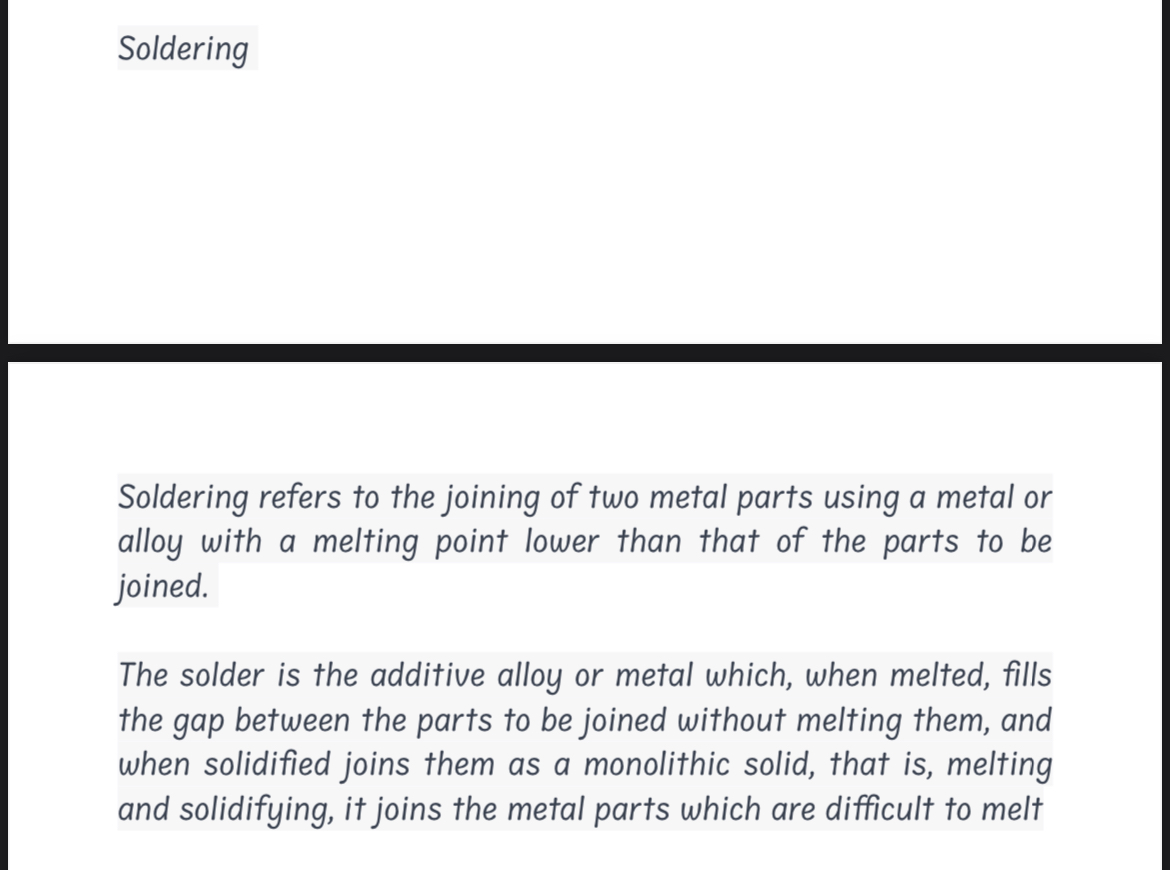
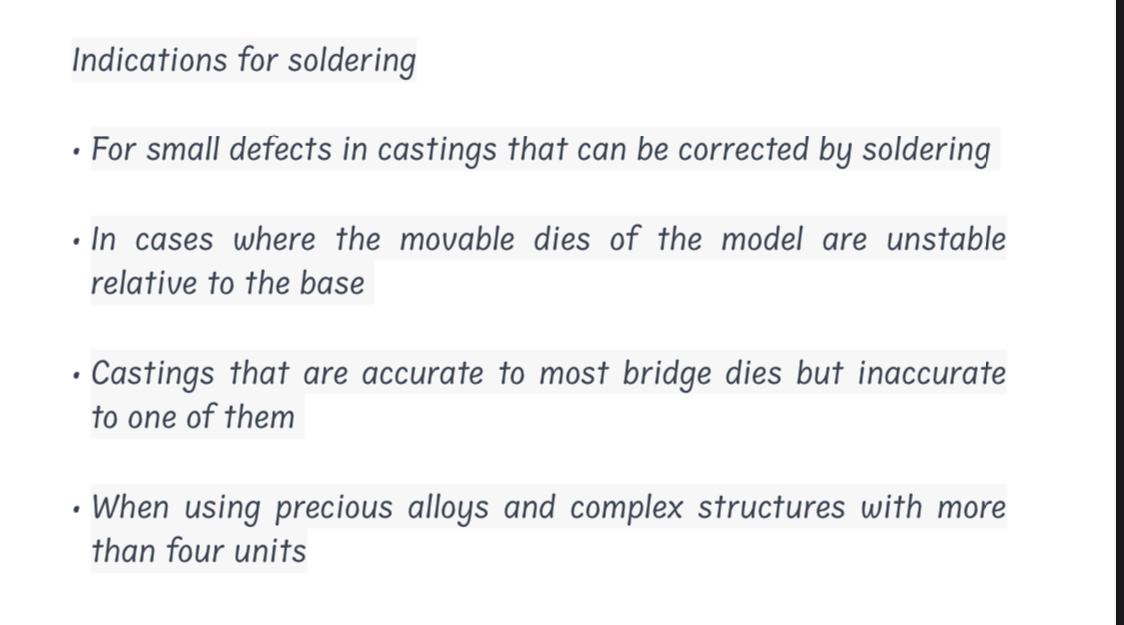
indications for soldering/ when is it used?
What is the function of anti-flux in soldering?
Anti-flux is applied to surfaces to prevent solder from flowing onto unwanted areas
Acts as a barrier to keep the solder in place and ensure it only goes where intended
types of anti fluxes